- 388 pages
- English
- ePUB (mobile friendly)
- Available on iOS & Android
eBook - ePub
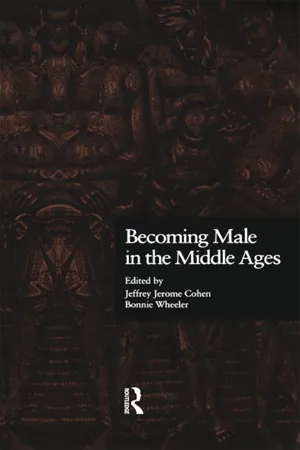
Becoming Male in the Middle Ages
About this book
First published in 1997. Most work in gender studies has focused on women. This volume brings together various forms of gender theory, especially feminist and queer theory, to explore how men made cultures and culture made men, in the Middle Ages.
Information
EUNUCHS WHO KEEP THE SABBATH: BECOMING MALE AND THE ASCETIC IDEAL IN THIRTEENTH-CENTURY JEWISHMY STICISM
This study examines the nexus of asceticism and eroticism in the zoharic kabbalah. Renunciation of sexual power facilitated the spiritual empowerment of the male mystics.
The link between asceticism and gender has been well established in scholarly literature. In the history of various classical religious traditions, particularly prominent in Christianity, ascetic behavior afforded women the opportunity to overcome not only the limitations of the natural body but also the social status determined by gender. The stereotypical construction of women (well attested in Late Antiquity and the Middle Ages) as sexual objects (expressed most dramatically as the personification of carnal desire in the form of the temptress) and domestic beings (identified principally through the roles of marriage, childbearing, and housekeeping) was disrupted by the adoption of an ascetic lifestyle. Celibacy served as the most effective way to attain the erasure of sexual difference epitomized in the baptismal formula adopted by Paul, “there is neither male nor female, for you are all one in Christ Jesus” (Gal. 3: 28).1 However, in light of the prevailing gender hierarchy, which is affirmed by Paul himself (1 Cor. 11: 2–16, 14: 34–36), the renunciation of sexual and other bodily pleasures on the part of early Christian women meant that the female became more spiritual and hence more masculine. Sexual abstention could thus be seen as part of the redemptive process by means of which the spiritual order is restored and the female element obliterated. Alternatively expressed, one can speak of asceticism as the mechanism by means of which the feminine female (seductive Eve) is transformed into the masculine female (virgin Mary or the body of the Church). Analogously, in the case of male Christian ascetics, sexual abstinence, epitomized in the statement attributed to Jesus regarding those who “have made themselves eunuchs for the sake of the kingdom of heaven” (Matt. 19:12), did not entail effeminization but a further empowering of the masculine, which was associated with the incorporeal. Spiritual progress was understood as a process of the female becoming male.2 Ascetical sublimation, therefore, did not result in the complete effacing of gender differences in either a sociological or theological sense. On the contrary, the destabilization of the sociosexual roles of women only reinforced the dominant position of the male in the social and religious order.
The focus of this study is the impact of the ascetic ideal of sexual abstinence on the construction of masculinity in the mystical fraternity surrounding the literary composition of the Zohar in late-thirteenth-century Castile. Scholars have duly noted the ascetical dimension expressed in the classical rabbinic corpus and in the medieval pietistic treatises of both Iberian and Franco-German extraction as well as in the unique trend of Jewish Sufism that evolved amongst the descendants of Maimonides in Egypt in the thirteenth and fourteenth centuries.3 By contrast, the function of asceticism in kabbalistic texts has not received the attention that it warrants. What has been written on the subject has concentrated for the most part on the ascetic dimensions of kabbalistic pietism expressed in sixteenth-century texts.4 The specific connection of gender and asceticism, to the best of my knowledge, has not been treated by scholars of Jewish mysticism.
Much emphasis has been placed on the sacrality of sexuality in the kabbalistic tradition.5 The scholarly consensus is expressed with passionate eloquence by Gershom Scholem:
Chastity is indeed one of the highest moral values of Judaism…. But at no time was sexual asceticism accorded the dignity of a religious value, and the mystics make no exception. Too deeply was the first command of the Torah, Be fruitful and multiply, impressed upon their minds. The contrast to other forms of mysticism is striking enough to be worth mentioning: non-Jewish mysticism, which glorified and propagated asceticism, ended sometimes by transplanting eroticism into the relation of man to god. Kabbalism, on the other hand, was tempted to discover the mystery of sex within God himself. For the rest it rejected asceticism and continued to regard marriage not as a concession to the frailty of the flesh but as one of the most sacred mysteries. Every true marriage is a symbolical realization of the union of God and the Shekhinah.6
From other passages in his oeuvre, it is clear that Scholem not only recognized that there has been an ascetical dimension in the history of Judaism, but he was of the opinion that the early kabbalists in twelfth-century Provence emerged from groups of ascetic pietists (referred to variously as perushim, nezirim, and hasidism).7 Indeed, the contemplative ideal proferred by the Provençal kabbalist, Isaac the Blind, and elaborated by his Geronese disciples, is predicated on an ascetic renunciation of the body and sensual desire.8 In this connection, Scholem noted the historical similarities between the ascetic phenomenon in the Jewish communities of southern France and the monastic tendencies evident in both Catholic clergy and Cathar perfecti of the time. Yet, even here Scholem sounded a note of caution, asserting that there are “clear divergences resulting from the different attitudes of Judaism and Christianity toward celibacy.”9
One cannot disagree with the claim that in the kabbalistic tradition, as in the case of rabbinic Judaism more generally, sexuality is not problematized in the way that it is in the history of Christianity.10 The practice of unconditional celibacy is not idealized in Jewish texts nor is the image of the virgin placed on a spiritual pedestal. Indeed, from the more specific vantage point of the theosophic kabbalah, articulated especially (but not exclusively) in the zoharic corpus, the Christian ideal of monasticism is demonized. The embodiment of impurity, Satan, is portrayed as the castrated male who is contrasted with the virile, circumcised male Jew.11 This symbolism underlies the zoharic portrayal of the kings of Edom (Gen. 36: 31–39), the archetypal representation of the historical force of Christianity, as emasculated males.12 From the perspective of gender, therefore, Christianity is correlated with masculine impotence, which is equivalent to the feminine character of judgment. The overcoming of the primordial state of male sterility is related in the Zohar to Hadar, the last of the Edomite kings delineated in the biblical record, for he is the only one whose wife, Mehetabel, is mentioned. Symbolically, the zoharic author associates Hadar with the divine attribute that corresponds to the phallus, Yesod, which is also called the “fruit of the tree of splendor,”peri ‘es hadar (Lev. 23: 40) and is compared to the date-palm (based on Ps. 92:13), which comprises male and female characteristics.13 Significantly, the rectification of the celibate condition of the previous seven Edomite kings, who represent the ecclesiastical hierarchy of Roman Catholicism, is connected to the androgynous phallus14 of God (embodied in the circumcised penis of the Jewish male). That heterosexual desire is a component of this rectification is obvious from the fact that Hadar and Mehetabel are both mentioned. But the theosophical importance of the heterosexual pairing, which one may presume is expressed in the erotic bonding between the sexes, is derived from the fact that the locus of the androgyny is the phallic gradation, represented symbolically by Hadar. Erotic yearning for the feminine is indicative of the beginning of the redemptive process, which overcomes duality and division, but the consummation is marked by the restoration of the feminine to the masculine, which entails the transformation of the Shekhinah from feminine other to the sign of the covenant or the corona of the phallus.15 Corresponding to this crossing of gender identities is a shift in the texture of the erotic experience from the heterosexual to the homoerotic, a point to which I shall return below.
Repeatedly, as scholars of Jewish mysticism have noted, the zoharic authorship and scores of other kabbalists emphasize that anthropological completeness is attained only in marriage. According to the graphic image of the Zohar, the single male or female is merely “half a body” (pebg gufa’), a technical term that denotes ontological (and not merely physiological or even psychological) imperfection.16 Indeed, the distinctive holiness of the Jewish people (based on the biblical mandate in Lev. 19: 2) is linked to the sanctity that is attained when husband and wife are joined together in sexual intercourse, which is a form of imitatio dei insofar as the divine anthropos is imaged as a union of masculine and feminine.17 Accordingly, in kabbalistic sources in general, and in the Zohar in particular, one finds a positive valorization of marriage as a means of religious devotion. In line with the rabbinic ethos, moreover, the kabbalists affirm the positive valence of human sexuality as the means to procreate.18 Moreover, the kabbalists, building upon allusions found in some rabbinic comments, assigned theurgic significance to human sexuality as a means to cause the indwelling of the Shekhinah or to augment the divine image,19 which is understood in the theosophic symbolism of the kabbalah as androgynous.20 The failure to produce offspring is considered by the Zohar to be a major offense, indeed the transgression for which the punishment of transmigration of the soul is specifically prescribed.21 The man who dies childless is judged as if he had castrated himself. Inasmuch as emasculation is a distinguishing feature of the demonic force, such a person cleaves to the side of the unholy and he is thus denied entrance before God.22
Although the idea that the complete human being comprises male and female is clearly rooted in earlier rabbinic exegesis of the scriptural account of creation, it is possible that the particular form of expression that this idea assumes in the Zohar serves as a polemic against the Christian affirmation of celibacy as the means to restore humanity to its pristine state. Precisely this intention is implied in one context where this doctrine is related to the zoharic claim that a priest who is not married cannot enter the Temple to offer sacrifices.23 The Shekhinah does not rest on such a person and blessings cannot be transmitted through him since he is blemished. Indeed, he is not even in the category of a human being (’adam) insofar as the latter comprises both male and female.24 In passing, I note the convergence of the theurgic-symbolic and erotic-ecstatic elements: The priest cannot draw down blessings that issue from the union of the masculine and feminine aspects of the divine unless he is erotically bound to the Shekhinah, but only one who is wed can be bound in such a way,25 for, as it is recurringly emphasized in the zoharic corpus, the Shekhinah (or the blessing that emanates therefrom) only rests upon the man who is married.26 The portrayal of the married Jewish priest functions in this context as an antidote to the Catholic priest who is required to be celibate. These passages and many others unquestionably support the contention of Scholem (and scholars who have followed his line of interpretation) that the kabbalistic tradition assigned a positive valence to sexuality as a sacrament that celebrates the union of masculine and feminine energies in the divine as well as the means by which children are engendered in this world.
From another perspective, however, Scholem’s generalization must be qualified. Not only is it the case that there have been Jewish mystics of an ascetic orientation, but the sacralization of human sexuality, which lies at the heart of kabbalistic myth and ritual, is dialectically related to the ascetic impulse.27 To express the matter in an alternative way, in the kabbalistic tradition carnal sexuality is celebrated only to the extent that it is transformed by the proper intentionality into a spiritual act. This dimension of the kabbalistic approach, as it has been pointed out recently,28 is articulated clearly in one of the more important manuals on sexual etiquette written in the later part of the thirteenth-century, the Iggeret ha-Oodesh, the “Holy Epistle.” It is worthwhile examining some of the key passages from this work since the attitude expressed therein is rather typical of the position adopted by medieval kabbalists in general.
According to the anonymous author of this text, the ontic condition o...
Table of contents
- Cover
- Half Title
- Title Page
- Copyright Page
- Table of Contents
- BECOMING AND UNBECOMING
- BODY DOUBLES: PRODUCING THE MASCULINE Corpus
- BECOMING CHRISTIAN, BECOMING MALE?
- WHERE THE BOYS ARE: CHILDREN AND SEX IN THE ANGLO-SAXON PENITENTIALS
- IRONIC INTERTEXTUALITY AND THE READER’S RESISTANCE TO HEROIC MASCULINITY IN THE Waltharius
- ABELARD AND (RE)WRITING THE MALE BODY: CASTRATION, IDENTITY, AND REMASCULINIZATION
- ORIGENARY FANTASIES: ABELARD’S CASTRATION AND CONFESSION
- ABELARD’S BLISSFUL CASTRATION
- EUNUCHS WHO KEEP THE SABBATH: BECOMING MALE AND THE ASCETIC IDEAL IN THIRTEENTH-CENTURY JEWISH MYSTICISM
- SHARING WINE, WOMEN, AND SONG: MASCULINE IDENTITY FORMATION IN THE MEDIEVAL EUROPEAN UNIVERSITIES
- WOLF MAN
- GOWTHER AMONG THE DOGS: BECOMING INHUMAN C. 1400
- EROTIC DISCIPLINE…OR “TEE HEE, I LIKE MY BOYS TO BE GIRLS”: INVENTING WITH THE BODY IN CHAUCER’S Miller’s Tale
- THE PARDONER, VEILED AND UNVEILED
- TRANSVESTITE KNIGHTS IN MEDIEVAL LIFE AND LITERATURE
- THE VICIOUS GUISE: EFFEMINACY, SODOMY, AND Mankind
- OUTLAW MASCULINITIES: DRAG, BLACKFACE, AND LATE MEDIEVAL LABORING-CLASS FESTIVITIES
- NORMATIVE HETEROSEXUALITY IN HISTORY AND THEORY: THE CASE OF SIR DAVID LINDSAY OF THE MOUNT
- ON BECOMING-MALE
- Contributors
Trusted by 375,005 students
Access to over 1.5 million titles for a fair monthly price.
Study more efficiently using our study tools.
Frequently asked questions
Yes, you can cancel anytime from the Subscription tab in your account settings on the Perlego website. Your subscription will stay active until the end of your current billing period. Learn how to cancel your subscription
No, books cannot be downloaded as external files, such as PDFs, for use outside of Perlego. However, you can download books within the Perlego app for offline reading on mobile or tablet. Learn how to download books offline
Perlego offers two plans: Essential and Complete
- Essential is ideal for learners and professionals who enjoy exploring a wide range of subjects. Access the Essential Library with 800,000+ trusted titles and best-sellers across business, personal growth, and the humanities. Includes unlimited reading time and Standard Read Aloud voice.
- Complete: Perfect for advanced learners and researchers needing full, unrestricted access. Unlock 1.5M+ books across hundreds of subjects, including academic and specialized titles. The Complete Plan also includes advanced features like Premium Read Aloud and Research Assistant.
We are an online textbook subscription service, where you can get access to an entire online library for less than the price of a single book per month. With over 1.5 million books across 990+ topics, we’ve got you covered! Learn about our mission
Look out for the read-aloud symbol on your next book to see if you can listen to it. The read-aloud tool reads text aloud for you, highlighting the text as it is being read. You can pause it, speed it up and slow it down. Learn more about Read Aloud
Yes! You can use the Perlego app on both iOS and Android devices to read anytime, anywhere — even offline. Perfect for commutes or when you’re on the go.
Please note we cannot support devices running on iOS 13 and Android 7 or earlier. Learn more about using the app
Please note we cannot support devices running on iOS 13 and Android 7 or earlier. Learn more about using the app
Yes, you can access Becoming Male in the Middle Ages by Jeffrey Jerome Cohen,Bonnie Wheeler in PDF and/or ePUB format, as well as other popular books in Literature & Literary Criticism. We have over 1.5 million books available in our catalogue for you to explore.