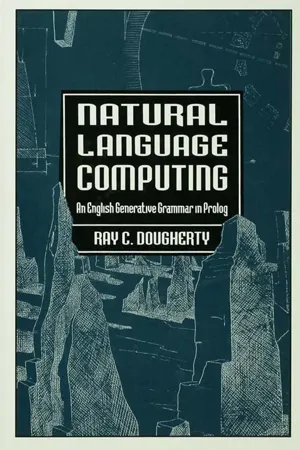
This book's main goal is to show readers how to use the linguistic theory of Noam Chomsky, called Universal Grammar, to represent English, French, and German on a computer using the Prolog computer language. In so doing, it presents a follow-the-dots approach to natural language processing, linguistic theory, artificial intelligence, and expert systems. The basic idea is to introduce meaningful answers to significant problems involved in representing human language data on a computer.
- 400 pages
- English
- ePUB (mobile friendly)
- Available on iOS & Android
eBook - ePub
About this book
Information
chapter 1
NATURAL INTELLIGENCE, LINGUISTICS, AND PROLOG
The old phrase “stop and think” is sound psychology. For thinking is stoppage of the immediate manifestation of impulse until that impulse has been brought into connection with other possible tendencies to action so that a more comprehensive plan of activity is formed.... Thinking is thus a postponement of immediate action, while it effects internal control of impulse through a union of observation and memory, this union being the heart of reflection.... What has been said explains the meaning of the well-word phrase “self-control”.... The method of intelligence manifested in the experimental method demands keeping track of ideas, activities, and observed consequences. Keeping track is a matter of reflective review and summarizing, in that there is both discrimination and record of the significant features of a developing experience. To reflect is to look back over what has been done so as to extract the net meanings that are the capital stock for intelligent dealing with further experiences. It is the heart of intellectual organization and of the disciplined mind.
John Dewey, 1938/1969
Experience and Education
Experience and Education
1.1. The Information Society
Table 1.1 presents information about the distribution of the workforce in various countries since 1900 between three segments of the economy. Sector I includes agriculture, forestry, and fishing. Sector II includes manufacturing, mining, and construction. Sector III includes service, education, and medicine.
A society that is predominantly sector I might be called pre-industrial. A society that is predominantly sector II is called an industrial society. A population mainly employed in sector III is often called a service society, in which the service industries include education, medicine, repairs, shipping, data management, insurance, computer programming, inventory control, and delivery and postal services. Insofar as much of the service consists of information-based services, the service society can be called an information society.
| Table 1.1. Change in the Distribution of Employment in Three Sectors (percentage of total workforce) | |||
| Sector I agriculture forestry mining | Sector II manufacturing mining construction | Section III service education medicine | |
| France | |||
| 1901 | 42 | 30 | 28 |
| 1959 | 23 | 38 | 38 |
| 1979 | 9 | 35 | 56 |
| United States | |||
| 1900 | 38 | 28 | 34 |
| 1960 | 9 | 34 | 57 |
| 1981 | 3 | 29 | 68 |
| Turkey | |||
| 1927 | 82 | 8 | 10 |
| 1960 | 75 | 10 | 15 |
| 1975 | 64 | 11 | 25 |
| Sweden | |||
| 1965 | 12 | 42 | 46 |
| 1969 | 9 | 40 | 51 |
| 1979 | 9 | 32 | 62 |
| India | |||
| 1901 | 72 | 12 | 16 |
| 1971 | 71 | 12 | 17 |
| Japan | |||
| 1920 | 54 | 25 | 21 |
| 1950 | 48 | 27 | 25 |
| 1980 | 10 | 35 | 55 |
The charts in Figure 1.1 indicate that the United States moved from a society mainly occupied in sectors I and II in 1900 to an information society in which 68% of the workforce was occupied in sector III by 1981. At present, less than 3% of the workforce in sector I generates all of the agricultural and forest products in the United States. The chart labeled Tomorrow is based on recent U.S. government statistics.
Baumol and Wolff (1992), in their article considering the latest data on comparative U.S. productivity and the state of manufacturing, discussed the shift of the labor force into sector III in these terms:
[Consider] the service economy “deindustrialization” argument, that claims that because the share of the U.S. labor force employed in the services is growing, we can infer that U.S. manufacturing exports are losing out to foreign competitors. [The data] indicate that the share of service jobs in the U.S. did grow about 20 percent in the 23 years between 1965 and 1988, for which figures are available. But [data] also show that this growth rate of service job share was higher than ours in all of the leading industrial economies. If we are becoming, increasingly, a service economy, other countries are moving in that direction far faster than we.
Actually, there is good reason to believe that the share of service employment in every industrial country is growing for the same reason the share of manufacturing jobs grew earlier. The previous intersectoral shift of the labor force out of agriculture and into manufacturing is attributable primarily to the sensational growth of agricultural productivity. In the 18th century it took about 90 percent of the population to produce enough farm products to feed the nation poorly; today a mere 3 percent of the labor force produces unmanageable surpluses of farm products. In its turn, rapid growth of productivity in manufacturing is reducing the share of the labor force needed to meet demands for manufactured goods, and so is driving workers to the services – and predominantly to the burgeoning information industries, not to mere hamburger flipping and dishwashing.
None of this proves that our country is immune from long run threats to retention of its economic leadership of the world, and that it faces no problems in this arena. But, evidently, it is in a far better state than is widely believed, (pp. 2-3)

The change from section I to II was based on the use of tools and machines to replace or amplify human efforts. Natural power – natural in that sense that it occurs in nature independent of human invention (human beings, horses, oxen, elephants, etc.) – was replaced by artificial power – artificial in that it is a human construct (tractors, bulldozers, factory ships, chainsaws, etc.). Natural energy sources (sun, wind, water) were replaced by artificial energy sources (electricity, coal, oil, atomic energy). Concepts such as power and energy are essential to understanding sectors I and II. The concepts information and intelligence play a crucial role in understanding sector III.
Shannon and Weaver (1949) developed information theory in which information is defined in terms of selection among a given set of alternatives. Any communication we receive that helps us make a selection by reducing the number of possible alternatives contains information. Shannon and Weaver differentiate information from data. Consider two different telephone books. The alpha-book contains an alphabetical list of all subscribers by last names. Each entry consists of the subscriber's last name, first name, address, and telephone number. The num-book contains a sequential list of all telephone numbers, smallest to largest. Each entry consists of the telephone number, the subscriber's last name, first name, and address. These books contain the same data but different information.
Information relates to how data are structured for answering questions. A datum provides the answer to a question. One book is suited to answer: What is the telephone number of Jane Doe? The other is suited to answer: What is the name of the person with the number 998-7950? Consider the alpha-book. If the datum for Bob Steigler incorrectly lists his telephone number as 998-7950 when it is actually 777-3010, and Bob Steigler is listed in the correct alphabetical order of names, then the book has the correct information structure but the wrong datum. If the datum for Bob Steigler correctly lists his phone number as 777-3010, but incorrectly has placed Steigler out of alphabetic order among the Bs, then the book has the correct datum but an incorrect information structure. This type of technical terminology is rarely discussed in this book, but we have been consistent in differentiating the data structures (record structure) from the information structure of the database (that structure relating to the questions to be answered).
When we program in Prolog, we decide the information structure of the data. To rephrase John Dewey, the method of intelligence manifested in Prolog demands keeping track of ideas, activities, and observed consequences. Programming so that Prolog can keep track of the data is a matter of reflective review and summarization, in which there is both discrimination and record of the significant information structures of the data.
Intelligence that occurs in nature is natural intelligence. Intelligence that does not occur except through human intervention and artifice is artificial intelligence. Our attempt to program human language structures onto a computing machine assumes it is possible to construct an artificial intelligence that in some significant sense duplicates a fragment of natural intelligence, particularly, some specific aspects of human intelligence.
Our usage of natural versus artificial accords with that of Darwin. Artificial selection is that practiced by animal breeders who select males and females from one generation to produce specific properties in the males and females of the next. Darwin (1962/1859), in his Origin of Species, argued that the same evolution of properties that occurs through artificial selection occurs in nature through a process of natural selection. I follow Darwin's usage because I believe that intelligence is part of the biological world and should be studied scientifically, just as one would study any other biological object. It is possible to research the structure, function, development, growth, and evolution of the heart, liver, kidneys, thumb, binocular vision, binaural hearing, hand-eye coordination, memory, pattern-recognition abilities, and problem-solving skills. In this study we follow the perspective of Noam Chomsky and focus on those species-specific aspects of human intelligence that make language possible.
For a considerable time after Darwin theorized that the principles of heredity that regulate artificial selection also regulate natural selection, people argued that he was confusing two fundamentally different processes. They maintained that the principles of heredity that work in artificial farm breeding situations do not operate in nature. A current debate concerning intelligence parallels the debates of Darwin's time, but in the other direction. Some people argue that the principles of natural intelligence that regulate natural human behavior and functions do not bear much relation to the principles of artificial intelligence that are invoked to explain the functions of a machines (for an interesting discussion, see Chomsky, 1966; Descartes 1964/1911; and Searle , 1984).
Most people associate natural intelligence with animals and not plants or inanimate objects. Also, since the work of Descartes in the 1600s, most people – insofar as they even think about such things -associate artificial intelligence with machines and not undifferentiated lumps of matter.
What have been the major factors in causing the shift from sectors I and II to III? The obvious reason for the shift is the rise in the productivity of a worker. The shift of workers out of agriculture, forestry, and mining has not resulted in a decrease in sector I products.
What has led to the increase in worker productivity? Any answer will include these three major factors:
There is a theory of problem types and job tasks for the workers in sectors I and II.
Science and technology enabled us to understand, harness, shape, and transform power and energy in order to channel it into job tasks.
There is a (relatively) well-defined idea of worker productivity for sectors I and II: bushels of wheat per worker, tons of steel per worker, worker hours per car, and so on.
Most people grasp the changes that have taken place in farming, fishing, and mining, although they might not glorify their understanding with terms such as theory of problem types. The problems confronting a farmer or forester involve moving heavy things, cutting things down, bundling things up, shipping things long distances, and avoiding rodents. Insofar as a horse had any sense, it would have seen the writing on the wall as the steam tractor chugged its way into the farmer's heart by greatly increasing his productivity while decreasing his maintenance expenditures. A theory of job tasks led to the invention of specific tools (chainsaw, reaper, hydraulic winch, etc.), each of which increased worker productivity. In sector I one can easily visualize the problem types that led to specific job tasks and the natural sources of labor (horse, ox, farmer) that were replaced by tools and machines.
In sector II, the theory of job tasks – formulated in some cases by “efficiency experts” and industrial engineers – led to assembly lines, automation, robotics, and sophist...
Table of contents
- Front Cover
- Title Page
- Copyright
- Dedication
- Contents
- Preface
- Introduction: What is Computational Linguistics?
- How to Use this Book: A Pictorial Essay,
- Chapter 1 Natural Intelligence, Linguistics, and Prolog.
- Chapter 2 How to Read and Write in Prolog.
- Chapter 3 How to Load, Run, and Edit a Prolog Program.
- Chapter 4 Tables of Data as Prolog Facts and Relations.
- Chapter 5 How Prolog Backtracks in Searches.
- Chapter 6 The Canonical Form of a Prolog Relation.
- Chapter 7 Computational Tools for Language Processing.
- Chapter 8 Computational Tools for Sentence Processing.
- APPENDICES.
- REFERENCES
- INDEX OF NAMES
- INDEX
Trusted by 375,005 students
Access to over 1.5 million titles for a fair monthly price.
Study more efficiently using our study tools.
Frequently asked questions
Yes, you can cancel anytime from the Subscription tab in your account settings on the Perlego website. Your subscription will stay active until the end of your current billing period. Learn how to cancel your subscription
No, books cannot be downloaded as external files, such as PDFs, for use outside of Perlego. However, you can download books within the Perlego app for offline reading on mobile or tablet. Learn how to download books offline
Perlego offers two plans: Essential and Complete
- Essential is ideal for learners and professionals who enjoy exploring a wide range of subjects. Access the Essential Library with 800,000+ trusted titles and best-sellers across business, personal growth, and the humanities. Includes unlimited reading time and Standard Read Aloud voice.
- Complete: Perfect for advanced learners and researchers needing full, unrestricted access. Unlock 1.5M+ books across hundreds of subjects, including academic and specialized titles. The Complete Plan also includes advanced features like Premium Read Aloud and Research Assistant.
We are an online textbook subscription service, where you can get access to an entire online library for less than the price of a single book per month. With over 1.5 million books across 990+ topics, we’ve got you covered! Learn about our mission
Look out for the read-aloud symbol on your next book to see if you can listen to it. The read-aloud tool reads text aloud for you, highlighting the text as it is being read. You can pause it, speed it up and slow it down. Learn more about Read Aloud
Yes! You can use the Perlego app on both iOS and Android devices to read anytime, anywhere — even offline. Perfect for commutes or when you’re on the go.
Please note we cannot support devices running on iOS 13 and Android 7 or earlier. Learn more about using the app
Please note we cannot support devices running on iOS 13 and Android 7 or earlier. Learn more about using the app
Yes, you can access Natural Language Computing by Ray C. Dougherty in PDF and/or ePUB format, as well as other popular books in Psychology & Cognitive Psychology & Cognition. We have over 1.5 million books available in our catalogue for you to explore.