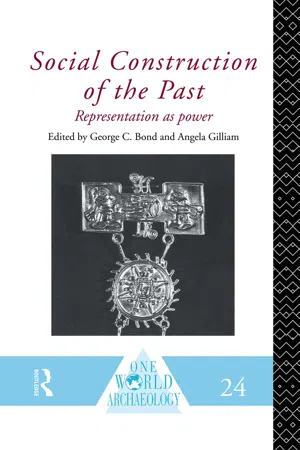
First published in 1994. Anthropological and archaeological enquiry are shaped by the historical times in which they are formulated. This collection of essays examines how mainstream scholarship constructs the past - in the case of anthropologists, usually the past of other peoples. By creating another people's cultural history, scholars appropriate it and turn it into a form of domination by one group over another. Mainstream scholarship has often failed to recognize the intellectual and scholarly contribution of subjugated peoples. This volume looks at the way 'postcolonial' scholars are redefining the nature of scholarship, and themselves, in order to develop a more egalitarian discourse. Social Constructions of the Past examines labour, race and gender and its relationship to power and class. It includes essays on a broad range of topics, from the role of intellectuals in restructuring a non-apartheid South Africa, to Haitian working-class women using sexuality to resist domination.
- 256 pages
- English
- ePUB (mobile friendly)
- Available on iOS & Android
eBook - ePub
About this book
Trusted by 375,005 students
Access to over 1.5 million titles for a fair monthly price.
Study more efficiently using our study tools.
The representation of ethnicity
1 Ethnicity and representation
LEITH MULLINGS
Representation of inequality has long been contested terrain. Though the emergence of the modern culture concept in the twentieth century permitted a comprehensive critique of race to enter the social science literature, there have always been alternative explanations for inequality. Social reformers, revolutionaries, environmental determinists and Marxist social scientists have challenged biological essentialism. People of colour, often working outside the academy, explored the political economy of race relations, and critiqued the representation of racial and national inequality (see Bond & Gilliam 1994).
Recently, the rise of poststructuralist theory has promoted the emergence of a language which, though generally inaccessible to those outside the academy, supports decentring science, knowledge and the canon, and deconstructing prevailing representations of inequality. But in repudiating the representation of race, much of this literature has retreated from analysis of the relations of race, often overlooking the work of those Third World scholars who definitively link representation to relations of domination and the necessity to challenge them. As notions of indeterminacy of truth easily shade into denial of the reality of slavery, the Holocaust and other forms of oppression, these new studies of race and representation have stepped back from confronting power.
The following chapters, on the other hand, clearly draw the relationship between systems of representation and the social relations in which they are embedded. In placing the study of ethnicity squarely within the context of power relationships, they develop important themes in new approaches to the study of ethnicity. Ethnicity is analysed as: 1) socially constructed, contextually dynamic and historically specific; 2) an arena in which hierarchical relations are presented, reproduced and contested; and 3) interactional, intersecting with other forms of oppositionality.
Contemporary approaches to ethnicity emphasize its historical contingency (Omi & Winant 1986, Balibar & Wallerstein 1991, San Juan 1992). In the formation of nation-states ethnic representation may support an authorized vision of a national past that promotes the conquering group and marginalizes others – usually autochthonous and labouring populations. For example, in Colombia and Brazil, complementary ideological themes which shift over time denigrate blacks and Indians while camouflaging the existence of domination.
In Colombia, prevailing representations of blacks reflect the changing structural tensions between segregation and discrimination, and the pressures toward ethnic mixing. On the one hand, the notion of blanqueamiento (whitening) paints Colombia’s history as one of gradual ‘whitening’: blackness is part of a primitive and backward past that is transcended as ‘whitening’ moves the nation forward into civilization and modernization. This theme clearly disparages the contribution of blacks and Indians. On the other hand, the more progressive representation of the past as a time of mixedness (lo mestizo) affirms the intermingling of population streams. But in celebrating the obliteration of difference, it submerges real differences of race, class and region and denies that racial discrimination exists. Both ideological themes at once subordinate blacks and deny that subordination (see Wade 1994).
Similarly for Indians in Brazil, racial meanings change shape and are played out at specific historical moments. ‘Edenic discourse’ (of Indianism) portrays the past as an idyllic time of innocence and freedom. As Europeans began to compete with Indians for resources a ‘civilizing discourse’ (of indigenism) -built on notions of backwardness, savagery, and paganism – emerged (see Ramos 1994). Though these forms of discourse appear conflicting, they are complementary, both constructing a national vision that denies Indians a legitimate voice in their future.
Similarly, in the United States biological explanations for the socioeconomic inequality of African Americans gave way to cultural ones. Just as ideologies of assimilation obscure discrimination against blacks in Colombia, in the United States (post?)modern liberal acceptance of the social construction of race often leads to the dismissal of its social consequences and rejection of responsibility for past and present oppression.
Racial representation is important in mediating and presenting struggles and confrontations. In the United States racial representation is crucial to constructing a history that encourages working-class whites to identify with white power holders, facilitating labour control of both blacks and whites (see Roediger 1991). Buck (1994) demonstrates that a racialized version of history -which underplays and distorts the role of African Americans, denies activism to poor black and white farmers, in which race and racism are presented as part of nature rather than a reflection of a specific historical moment – cuts people off from a history that could empower them, presenting protest as pointless.
Ethnicity is also an arena in which representation is contested. As ‘reception theory’ seeks to document, people are involved in active struggle with images and may challenge, modify or accommodate that which is presented to them (Hall 1973). In Colombia people of African descent have contested ideologies of both assimilationism and ‘whitening’ through organizations seeking to reclaim their history (see Wade 1994). Indians in Brazil have increasingly turned to mass media to assert their identity and minority rights (see Ramos 1994).
But alternative and oppositional visions are not independent of the categories of the dominant culture (Williams 1977). Charles (1994) raises important questions about how we understand accommodation, resistance and transformation and reminds us that identities are interactional, that representation of ethnicity is linked to nationality, class and gender.
The link between gender and sexuality on the one hand, and ethnicity and nationality on the other, is key to representing community and history. Particularly in situations of colonialism, slavery and other forms of oppression, constructions of gender and sexuality become important instruments for racial othering: men of colour are generally depicted as sexually aggressive while women are portrayed as sexually provocative (see Mullings 1994).
But these representations are not received as whole cloth. Charles (1994) asserts that working-class Haitian women employ sexuality as a type of capital, resisting the norms established by the prevailing sex/gender system through the contre-pouvoir (counter-power) of sexual politics. She asserts that sexual politics as practised by enslaved women and free mulatto women modified the basic structure of Caribbean society by creating a mulatto class with access to land. Sexual politics became ‘a form of survival, accommodation, resistance and empowerment’ (p. 54) which ‘mediat[ed] all relations of race, class and culture’ (p. 55).
This provocative argument deconstructs historically circumscribed notions of good woman/bad woman, and as such makes a contribution to contemporary explorations into how some women view sexual resources in a commodified society (Alexander 1987). It also provides a supporting case study for the literature rejecting essentialist notions of sexuality, asserting that sexuality is socially constructed and contested (see, for example, Vance 1984, Epstein 1987, Vance 1991).
But society shapes sexuality in intricate ways. It is important to problema-tize the link between sexuality, reproduction and social reproduction and clearly to draw the constraints within which people make choices about reproduction and sexuality.
Though boundaries between accommodation, resistance and transformation are not always clear, in this case although the norms of the gender/sex system are to some degree contested, they are not transformed. As is evident in Colombia and Brazil, the existence of a mulatto population does not necessarily challenge the denigration of blackness, nor confront the structure of inequality. In fact a mulatto population may function as a buffer, obfuscating the stark realities of a race and class hierarchy.
In examining constructions of the past, in asking how concepts of race, ethnicity and inequality are created and reproduced, these chapters lay the basis for the next phase of work: illuminating the manner in which contemporary global processes give rise to new relations and constructions of identity and ethnicity.
Our analysis of the past shapes our understanding of the present, and sets parameters for how we think about transformative actions to shape the future. These chapters demonstrate that just as mystification of oppression in the past rationalizes its continuation in the present and future (see Wade 1994, Ramos 1994), representation of protest as pointless or ineffective may retard, at least for a time, the development of future challenges (see Buck 1994). As Cabral suggested, the negation of a dominated people’s culture is characteristic of the relationship of domination; it is a negation of their history and of their struggle as well (Cabral 1973). The struggle for history is about the present and the future.
Acknowledgements
I would like to thank Juan Flores, with whom I co-taught a seminar on ethnicity, for helping me to think about new approaches to ethnicity.
References
- Alexander, P. 1987. Prostitution: a difficult issue for feminists. In Sex Work: writing in the sex industry, Delacosta, F. & P. Alexander (eds). Pittsburgh: Clies.
- Balibar, E. & I. Wallerstein 1991. Race, Nation, Class: ambiguous identities. London: Verso.
- Bond, G. C. & A. Gilliam (eds) 1994. Social Construction of the Past: representation as power. London: Routledge.
- Buck, P. Davidson 1994. Racial representations and power in the dependent development of the United States South. In Social Construction of the Past: representation as power, Bond, G. C. & A. Gilliam (eds), 29–43. London: Routledge.
- Cabral, A. 1973. Return to the Source: selected speeches of Amilcar Cabral. New York: Information Services.
- Charles, C. 1994. Sexual politics and the mediation of class, gender, and race in former slave plantation societies: the case of Haiti. In Social Construction of the Past: representation as power, Bond, G. C. & A. Gilliam (eds), 44–58. London: Routledge.
- Hall, S. 1973. Encoding and decoding in the television discourse. Center for Contemporary Cultural Studies, Stencilled Occasional Paper No. 7, Media Series.
- Mullings, L. 1994. Images, ideology and women of color. In Women of Color in US Society, Baca-Zinn, M. & B. Dill (eds). Philadelphia: Temple University Press.
- Omi, M. & H. Winant 1986. Racial Formation in the United States. London: Routledge.
- Ramos, A. 1994. From Eden to limbo: the construction of indigenism in Brazil. In Social Construction of the Past: representation as power, Bond, G. C. & A. Gilliam (eds), 74–88. London: Routledge.
- Roediger, D. 1991. The Wages of Whiteness: race and the making of the American working class. London: Verso.
- San Juan, E. 1992. Racial Formations/Critical Transformations. London: Humanities Press International.
- Vance, C. S. 1984. Pleasure and danger: towards a politics of sexuality. In Pleasure and Danger: exploring female sexuality, Vance, C. S. (ed.), 1–27. Boston: Routledge & Kegan Paul.
- Vance, C. S. 1991. Anthropology rediscovers sexuality: a theoretical comment. Social Sciences and Medicine 38, 875–84.
- Wade, P. 1994. Representation and power: blacks in Colombia. In Social Construction of the Past: representation as power, Bond, G. C. & A. Gilliam (eds), 59–73. London: Routledge.
- Williams, R. 1977. Marxism and Literature. Oxford: Oxford University Press.
2 Racial representations and power in the dependent development of the United States South
PEM DAVIDSON BUCK
Illegitimate anthropology and hegemony
The analysis of relationships between racial representations and power has been far from a purely abstract process for me. To be fair, I should say that my analysis may well be biased by both anger and fear. To be doubly fair, I might also add that influence by well-placed anger and fear does not necessarily produce an anthropology which is in some sense ‘wrong’. These two emotions became gradually stronger in response to the objective conditions I discovered in researching a past whose unfamiliar contours slowly emerged from the mists of the hegemonic history that was part of my white, middle-class heritage. Its contours bore little resemblance even to a more radical version of history that reflected my seventeen years among poor whites in central Kentucky.
There were, in fact, two interrelated sources for these reactions. One was my increased understanding of the past and probable future of...
Table of contents
- Cover
- Half Title
- Series Page
- Title Page
- Copyright Page
- Table of Contents
- List of contributors
- Foreword
- Preface
- Introduction
- The representation of ethnicity
- The social construction of antiquity
- The scholarship of inequality: the South African case
- Index
Frequently asked questions
Yes, you can cancel anytime from the Subscription tab in your account settings on the Perlego website. Your subscription will stay active until the end of your current billing period. Learn how to cancel your subscription
No, books cannot be downloaded as external files, such as PDFs, for use outside of Perlego. However, you can download books within the Perlego app for offline reading on mobile or tablet. Learn how to download books offline
Perlego offers two plans: Essential and Complete
- Essential is ideal for learners and professionals who enjoy exploring a wide range of subjects. Access the Essential Library with 800,000+ trusted titles and best-sellers across business, personal growth, and the humanities. Includes unlimited reading time and Standard Read Aloud voice.
- Complete: Perfect for advanced learners and researchers needing full, unrestricted access. Unlock 1.5M+ books across hundreds of subjects, including academic and specialized titles. The Complete Plan also includes advanced features like Premium Read Aloud and Research Assistant.
We are an online textbook subscription service, where you can get access to an entire online library for less than the price of a single book per month. With over 1.5 million books across 990+ topics, we’ve got you covered! Learn about our mission
Look out for the read-aloud symbol on your next book to see if you can listen to it. The read-aloud tool reads text aloud for you, highlighting the text as it is being read. You can pause it, speed it up and slow it down. Learn more about Read Aloud
Yes! You can use the Perlego app on both iOS and Android devices to read anytime, anywhere — even offline. Perfect for commutes or when you’re on the go.
Please note we cannot support devices running on iOS 13 and Android 7 or earlier. Learn more about using the app
Please note we cannot support devices running on iOS 13 and Android 7 or earlier. Learn more about using the app
Yes, you can access Social Construction of the Past by George C. Bond,Angela Gilliam in PDF and/or ePUB format, as well as other popular books in History & Historiography. We have over 1.5 million books available in our catalogue for you to explore.