- 250 pages
- English
- ePUB (mobile friendly)
- Available on iOS & Android
eBook - ePub
Settled Asbestos Dust Sampling and Analysis
About this book
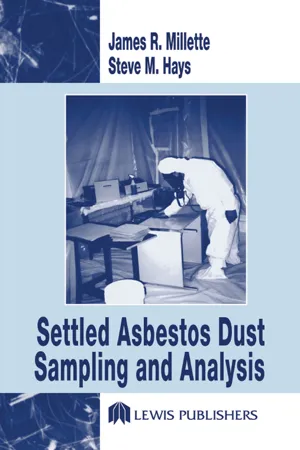
Settled Asbestos Dust Sampling and Analysis compiles the most significant data on asbestos in settled dust. This ready reference presents an analysis of settled dusts and surface particles of all sizes for asbestosthat is useful for qualitative and quantitative assessment and helps to determine the source of fibers. The main scope of this reference includes sample collection, sample analyses, and interpretation of settled dust data, as well as the use of such data for purposes including asbestos abatement projects and in-place management programs. Sections on lead and other particulates are also included.
Trusted by 375,005 students
Access to over 1 million titles for a fair monthly price.
Study more efficiently using our study tools.
Information
CHAPTER 1
Introduction
Pieces of asbestos-containing materials (ACM’s) found in buildings may be released from the in-place material by a number of mechanisms including physical disturbance, deterioration, and the natural aging of the material. Some of the released material is in the form of visible pieces of debris, some as individual fibers of asbestos which can only be seen under an electron microscope. All of the large and most of the small fiber structures and non-asbestos particles which are released eventually settle on the surfaces of ceiling tiles, light fixtures, furnishings, equipment, floors, and carpeting and become part of the normal dust. Activities which disturb the debris or dust such as maintenance or custodial tasks are likely to re-entrain the asbestos, and this re-entrainment may cause personal exposure to airborne asbestos. Analysis of settled dusts and surface particles of all sizes for asbestos is useful for qualitative and quantitative assessment and may help determine the source of the fibers. This information may be helpful in developing plans to minimize the build-up of asbestos-containing dust by controlling the source and by preventing resuspension of dust.
The study of asbestos-containing debris and settled dust is part of the general field of study of surface contamination. The term “surface contamination” is used to describe the fouling of a surface with an undesired or unexpected chemistry1 which, for instance, in the semiconductor industry may represent any particle which prevents the fabricated part from functioning properly. In the assessment of buildings, “surface contamination” refers to the part of the dust which contains materials that are considered toxic. According to the Occupational Safety and Health Administration (OSHA) Field Operations Manual, there are a variety of reasons why surface contamination, and especially removable surface contamination, may need to be assessed.2 One reason is that accumulated toxic materials (e.g., asbestos, lead, or beryllium) may become resuspended in air and may contribute to airborne exposures.
Although this book emphasizes asbestos in the settled dust, sections about lead and other particulate have been included because many of the technologies which are being studied in regard to various surface contaminant situations can be used in conjunction with asbestos fibers.
Although a number of published articles have dealt with the subject area of asbestos and other particulate in surface contamination3, this book is an attempt to compile the most significant information for ready reference.
REFERENCES
1. Fish, B.R., Ed., Surface Contamination, Pergamon Press, Oxford, England, 1967.
2. Occupational Safety and Health Administration, Sampling for surface contamination, OSHA Instruction CPL 2–2.20, Occupational Safety and Health Administration, Washington, D.C., March 30, 1984, Chapter VIII.
3. Brackett, K.A., Seitz, S.D., and Clark, P.J., EPA bibliography on surface contamination, Microscope, 40, 164, 1992.
CHAPTER 2
Definitions and General Characteristics of Dust
DEFINITIONS
The term “settled dust” as used in conjunction with asbestos in buildings was defined in a publication in 1986 as loose fibers and particles that have collected on building surfaces.1 However, the term “dust” has no single definition. It has a common usage among homemakers and building owners as the fine particle layer that accumulates on furnishings and must be “dusted” off. It is also used in a variety of scientific and technical disciplines to describe a collection of small particles, but seldom are these definitions the same. To further confuse the issue, the term is used to describe a collection of small particles which is both airborne and has settled or accumulated on surfaces. Although “dust” conveys the same general meaning to many people, it does not have one meaning which can be considered a single definition.
In physics, “dust” is a loose term applied to solid particles predominantly larger than colloidal size and capable of temporary gas suspension.2 In the general geological sense, the term “dust” refers to wind transported regolith, the debris resulting from weathering.3 In aerosol science, the term “dust” is one of several terms used to describe different types of particles comprising aerosols, microscopic sized particles dispersed in gases, often in air.4 The term “dust” is also used to describe a dispersion of solid particles usually resulting from the fracture of larger masses of material such as in blasting, drilling, crushing or grinding operations. Whereas “mists” are a dispersion of liquid particles, many of which are visible, “fog” refers to visible aerosols of a liquid formed by condensation; “fume” is an aerosol of solid particles formed by condensation of vaporized materials; and “smoke” refers to an aerosol resulting from incomplete combustion mainly of carbon and other combustible materials. These aerosol definitions sometimes overlap because they have arisen from popular usage. Settled dust, accumulations of solid particles that have fallen out of the air, is also referred to as “accumulated dust,” “surface dust,” and in some cases as “surface contamination.”
Although dust is considered to be composed of particles that are small, there is no universally accepted size below which particles are considered to be dust particles. A chart entitled “Characteristics of Particles and Particle Dispersoids” is frequently cited in air pollution texts5−6 to describe the characteristics of particles. In the Technical Definitions section of this chart, the term “dust” is shown to encompass particle diameters from 1 micrometer to as large as 10,000 micrometers (1 centimeter).7 An encyclopedia lists dust as being composed of many kinds of solid materials which have diameters less than 0.0025 millimeters (2.5 μm).8 In geology, the term refers to dry solid matter of silt and clay size which is taken to be less than 1/16 of a millimeter (62.5 μm).9 In a 1957 survey of airborne dust properties, the particle size range of airborne dust was considered to be from about 0.02 to 50 μm, although it was recognized that different size analysis methods resulted in different types of particle diameter values.10 In the standard of the American Society of Heating, Refrigerating and Air-Conditioning Engineers (ASHRAE) covering ventilation for acceptable indoor air quality, “dust” is defined as an air suspension of particles (aerosol) of any solid material, usually with particle size less than 100 micrometers (μm).11 The best definition for settled dust is found in the American Society for Testing and Materials (ASTM) test method for the collection and measurement of dust fall. Settleable particulate material is defined as any material composed of particles small enough to pass through a one (1) mm screen and large enough to settle by virtue of their weight into a container from the ambient air.12
Although the term “debris” is often associated with pieces of material generally larger than dust, it is not a term defined in terms of size. The United States Environmental Protection Agency (EPA) has defined the term “asbestos debris” as related to ACM in its Asbestos Hazard Emergency Response Act (AHERA) regulation as pieces of asbestos-containing building material (ACBM) that can be identified by color, texture, or composition.13 The EPA definition also includes dust, if the dust is determined by an accredited inspector, to be ACM.
For the purposes of this book, settled dust is defined as being particulate material less than one (1) mm in its longest dimension and which is deposited on a surface. Debris is defined here as pieces of material which can be identified as to probable source by visual assessment of their color, texture, or composition.
CHARACTERISTICS OF DUST
In order to understand asbestos in surface contamination, it is useful to have some information about the general nature of dust and debris. The composition of building and household dust is a combination of particles resulting from human (and pet) activities, general degradation of building materials, and a contribution from the outdoor dust that comes in by a variety of ways including the air system, through open windows, or carried in on shoes. The relative contribution of each source will vary according to geographic location, location within the building, and activities which occur in the building, including the type of air-conditioning and ventilation system.
There are a number of sources of dust in the outdoor setting. Cosmic dust which reaches the earth’s surface is mainly related to the disintegration of meteorites (black magnetic spherrules). Their contribution to the overall outdoor settled dust is small in comparison with other sources. Among other natural sources, volcanic dust can be a significant source of dust particles. Some dust particles originate in the process of conversion of gas to particulate which occurs with sulfur and nitrogen oxides in the air. Forest fires and other burning may contribute both organic and inorganic particles to the dust. Along the coastal areas, sea salts may be an important source of dust particles. Deflation (wind erosion) of soil is a main source of atmospheric dust particles larger than 2 μm. Airborne dust also contains pollens, spores and decaying vegetable material.14
Industrial emissions such as those from smoke stacks, stockpiles, and waste dumps may contribute to the airborne dust load. In the local area surrounding a building, the activities of demolition and construction can cause significant amounts of airborne dust. The natural degradation of exterior building materials as they are affected by the elements contribute to the components of dust. Similarly the weathering of rocks produces fine particles which in some cases may become airborne. Once put into the air, all of these particles eventually fall to the ground, but many are carried to earth in rain and snow.
Many settled dust particles are created by the deterioration of materials. Greathouse and Wessel have defined deterioration as a process of transition from a higher to a lower energy state and have also stated that physical, chemical and biological factors or agents all may play roles in promoting degradation.15 The local environment determines which agents are present in a given spot to cause the deterioration. Physical deteriorative agents include heat, sunlight, vibration, and air which includes the abrasive agents of dust and grit in the airflow. Chemical deteriorative agents include moisture, salts, acids, alkalies, and gases. Biological agents include fungi (molds), bacteria, and insects. Moisture in the form of humidity plays an especially significant role in degradation of some materials. Small amounts of atmospheric acids are created by the combination of moisture and sulfur dioxide and moisture and carbon dioxide, which yield respectively sulfurous and carbonic acids. In general, the more water, the more and faster the degradation of most materials.16
Although some characterization of the particles that make up outdoor dusts and those found in industrial settings has been done, research on examining particles found in dusts from commercial buildings and residences is limited. The 1957 survey of the American Society of Heating and Air-Conditioning Engineers (ASHAE) provided some data on the characteristics of typical airborne dust particles in residen...
Table of contents
- Cover
- Half Title
- Title Page
- Copyright Page
- Table of Contents
- Chapter 1 Introduction
- Chapter 2 Definitions and General Characteristics of Dust
- Chapter 3 Settled Dust Methods: History and Discussion
- Chapter 4 Field Guide for Asbestos Dust Sampling
- Chapter 5 Laboratory Analysis Procedures
- Chapter 6 Data: Levels of Asbestos in Dust
- Chapter 7 Information About the Source of Asbestos in Dust
- Chapter 8 Resuspension of Settled Dust
- Chapter 9 Using Settled Dust Data in Building Inspections and in Operations and Maintenance
- Chapter 10 Relevance of Settled Dust to the Design of Abatement Actions
- Glossary
- Appendix 1 Asbestos Exposure During and Following Cable Installation in the Vicinity of Fireproofing
- Appendix 2 DECON: A Case Study in Technology
- Appendix 3 Asbestos at a Fire Scene: The Case of the Dupont Plaza Hotel
- Appendix 4 Methods for the Analysis of Carpet Samples for Asbestos
- Appendix 5 Use of Observation Data and Environmental Studies in Developing Better Operations and Maintenance Plans
- Appendix 6 Air and Dust Sampling in Return Air Plenums
- Appendix 7 Observations on Studies Useful to Asbestos O&M Activities
- Appendix 8 Re-entrainment of Asbestos from Dust in a Building with Acoustical Plaster
- Appendix 9 Scanning Electron Microscopy of Post-it Notes Used for Environmental Sampling
- Appendix 10 Exposure to Airborne Asbestos Associated with Simulated Cable Installation xsAbove a Suspended Ceiling
- Index
Frequently asked questions
Yes, you can cancel anytime from the Subscription tab in your account settings on the Perlego website. Your subscription will stay active until the end of your current billing period. Learn how to cancel your subscription
No, books cannot be downloaded as external files, such as PDFs, for use outside of Perlego. However, you can download books within the Perlego app for offline reading on mobile or tablet. Learn how to download books offline
Perlego offers two plans: Essential and Complete
- Essential is ideal for learners and professionals who enjoy exploring a wide range of subjects. Access the Essential Library with 800,000+ trusted titles and best-sellers across business, personal growth, and the humanities. Includes unlimited reading time and Standard Read Aloud voice.
- Complete: Perfect for advanced learners and researchers needing full, unrestricted access. Unlock 1.4M+ books across hundreds of subjects, including academic and specialized titles. The Complete Plan also includes advanced features like Premium Read Aloud and Research Assistant.
We are an online textbook subscription service, where you can get access to an entire online library for less than the price of a single book per month. With over 1 million books across 990+ topics, we’ve got you covered! Learn about our mission
Look out for the read-aloud symbol on your next book to see if you can listen to it. The read-aloud tool reads text aloud for you, highlighting the text as it is being read. You can pause it, speed it up and slow it down. Learn more about Read Aloud
Yes! You can use the Perlego app on both iOS and Android devices to read anytime, anywhere — even offline. Perfect for commutes or when you’re on the go.
Please note we cannot support devices running on iOS 13 and Android 7 or earlier. Learn more about using the app
Please note we cannot support devices running on iOS 13 and Android 7 or earlier. Learn more about using the app
Yes, you can access Settled Asbestos Dust Sampling and Analysis by Steve M. Hays,James R. Millette in PDF and/or ePUB format, as well as other popular books in Technology & Engineering & Ecology. We have over one million books available in our catalogue for you to explore.