- 384 pages
- English
- ePUB (mobile friendly)
- Available on iOS & Android
eBook - ePub
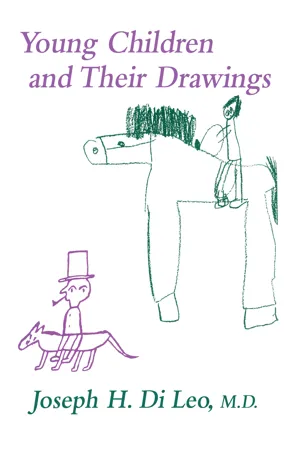
Young Children And Their Drawings
About this book
Published in 1996, Young Children and Their Drawings is a valuable contribution to the field of Psychotherapy.
Information
Part One
The Usual and Normative
1
Introduction
The drawings that enrich and enliven this volume are for the most part the work and play of children between the ages of thirteen months and six years. Drawings by older children have been included to add perspective, and to illustrate changes that occur as the child matures beyond the preschool years and is increasingly influenced by the culture.
The “artists” came from a wide range of social, racial, ethnic, and educational backgrounds.
The infants, that is, those under two, were either in adopting homes, foster homes, or in residence at New York Foundling Hospital.
The preschoolers, unless otherwise indicated, were living with their own families, and were applicants for admission to nursery schools. Others were in adopting or foster homes.
As consultant to St. Joseph’s School for the Deaf, the writer has been able to familiarize himself with the drawing behavior of hundreds of children with communication disorders.
Over a long period of time, a formidable collection of drawings has been acquired. Much of this material has been of value in the differential diagnosis of mental subnormality, emotional, organic, and perceptuo-motor disorders. In his own practice, the writer has found the drawings to be indispensable for an understanding of the child and his difficulties.
The first section of this book deals with the usual or normative. It traces the progression that can be expected as the scribbling infant becomes a preschooler, whose graphic activity has matured from movement for its own sake to movement for representation. The peculiarities in these drawings and their significance are discussed at some length, for herein lies a key to the secret of childhood. The child is ever changing and yet ever himself. As he changes, his drawings will reflect the change. Only those who know how the child expresses himself graphically can aspire to detect and interpret the deviant and the unusual. It is difficult but generously rewarding.
2
Procedure
All drawings were made by children in individual sessions, not in a group.
Present were the parent or parent surrogate, the examiner (the writer presented the situation in each instance).
A sheet of green-tinted letter-sized paper was placed on the table top directly before the child. The examiner then placed the red lumber crayon in the center of the paper, pointing away from the child.
In most cases it was not necessary to say anything but if the child hesitated, he was asked to “make something.” Scribbling was demonstrated to all infants under 18 months, when most will scribble spontaneously.
A pencil was given to those able to control it adequately, generally to children over four.
The following sequence was adhered to:
13 to 18 months:
demonstration of scribbling by examiner
18 to 24 months:
spontaneous drawing
demonstration of vertical stroke, of circle.
24 to 36 months: spontaneous drawing
demonstration of vertical
copy of circle—if unsuccessful, demonstration of circle
demonstration of horizontal
demonstration of cross
36 to 48 months:
spontaneous drawing
draw a man
copy of cross
copy of circle—if unsuccessful,
demonstration of cross and circle
48 to 60 months:
spontaneous drawing
draw a man
draw a lady
draw your family
copy of triangle,
copy of square
copy of circle—if unsuccessful,
the figures were demonstrated.
over 60 months:
same procedure as for 48 to 60 months,
with addition of copy diamond.
Note that all drawing situations in children from 18 months begin with spontaneous drawing. This is a completely unstructured situation in which the child is free from any model or suggestion. Where the child is old enough (over three) the examiner then asks that he draw a man. The less said the better. When the child responds “I can’t” the examiner encourages him, using the instructions given by F. Goodenough but adapting them to an individual child, viz., “I want to see if you can make one as well as the boy (or girl) who was here this morning”. This or similar gentle prodding is usually sufficient. Most children who say “I can’t” will prove themselves quite capable and will respond to encouragement.
The examiner refrains from any comment or suggestions even when the child draws just a big head instead of a whole man. When the child indicates that he has finished, the examiner takes the drawing and presents the child with another sheet of paper, saying “now make a whole man”. If the child again makes just a head, the examiner accepts the drawing of a person as represented by the head alone and considers the situation terminated.
It will be noted that geometric forms to be copied or imitated are not presented prior to the spontaneous drawing and draw-a-man, -lady, and -family situations. This order is aimed at avoiding any suggestion whatsoever, that might arise from the copying or imitation.
It should also be noted that the present writer is opposed to having children copy or imitate drawings and that the exception is made only for purposes of diagnosis.
3
Developmental Sequences
The term “development” will be used in its generally accepted sense, to indicate differentiation and increase in complexity of function, thereby distinguishing it from “growth”, a term used to express increase in size and weight. In reality, these two aspects of maturation are intimately related and begin inseparably, with life. At conception, when the 23 chromosomes from each parent interact with their mates, the sequence of bases in the DNA lays the ground plan for growth and development. There is a general ground plan for the species and within it variations for individual differences resulting from familial inheritance. Millions of years of evolutionary differentiation are summed up and telescoped into the brief time that covers the child’s ontogenetic development. From its very onset, development is a continuous, orderly process teleologically directed towards maturity. Structure and function become increasingly complex and differentiated, according to a biological time-table. Expressed in chronological time, variations may be noted between individuals, yet the order in which the changes occur—the sequence—is remarkably uniform until variations in the environment are great enough to deviate the organism from its predetermined course. Accordingly, uniformity is most striking during prenatal development, for it is during that time that the environment is basically the same for all uncomplicated pregnancies: “for no king had any other first beginning…” Everyman began as a zygote, passed through stages of ovum, embryo, and fetus, and appeared at birth with the same behavior repertory that had been maturing in the womb. From remote and proximate forebears he inherited his cry, rooting and sucking reflexes, hand and toe grasp, the Moro reflex and other behavior patterns, some transient, some permanent, all related either to his survival or to his future development. And like the rest of mankind, he would achieve encephalic control over his action system, in cephalo-caudad sequence. Sequences are most clearly manifest in those fields of behavior that are more closely interwoven with neuro-muscular maturation...
Table of contents
- Cover
- Half Title
- Title Page
- Plates and Acknowledgments
- Dedication
- Copyright
- Contents
- Foreword
- Preface
- Part One: The Usual and Normative
- Part Two: The Unusual and Deviant
- Appendix Norms for the Imitation and Copying of Geometric Forms
- References
- Index of Names
- Index of Subjects
Trusted by 375,005 students
Access to over 1.5 million titles for a fair monthly price.
Study more efficiently using our study tools.
Frequently asked questions
Yes, you can cancel anytime from the Subscription tab in your account settings on the Perlego website. Your subscription will stay active until the end of your current billing period. Learn how to cancel your subscription
No, books cannot be downloaded as external files, such as PDFs, for use outside of Perlego. However, you can download books within the Perlego app for offline reading on mobile or tablet. Learn how to download books offline
Perlego offers two plans: Essential and Complete
- Essential is ideal for learners and professionals who enjoy exploring a wide range of subjects. Access the Essential Library with 800,000+ trusted titles and best-sellers across business, personal growth, and the humanities. Includes unlimited reading time and Standard Read Aloud voice.
- Complete: Perfect for advanced learners and researchers needing full, unrestricted access. Unlock 1.5M+ books across hundreds of subjects, including academic and specialized titles. The Complete Plan also includes advanced features like Premium Read Aloud and Research Assistant.
We are an online textbook subscription service, where you can get access to an entire online library for less than the price of a single book per month. With over 1.5 million books across 990+ topics, we’ve got you covered! Learn about our mission
Look out for the read-aloud symbol on your next book to see if you can listen to it. The read-aloud tool reads text aloud for you, highlighting the text as it is being read. You can pause it, speed it up and slow it down. Learn more about Read Aloud
Yes! You can use the Perlego app on both iOS and Android devices to read anytime, anywhere — even offline. Perfect for commutes or when you’re on the go.
Please note we cannot support devices running on iOS 13 and Android 7 or earlier. Learn more about using the app
Please note we cannot support devices running on iOS 13 and Android 7 or earlier. Learn more about using the app
Yes, you can access Young Children And Their Drawings by Joseph di Leo in PDF and/or ePUB format, as well as other popular books in Psychology & Developmental Psychology. We have over 1.5 million books available in our catalogue for you to explore.