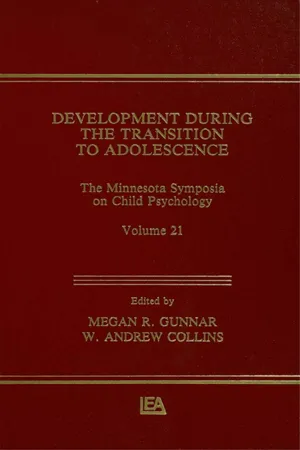
Research on the processes of change during the transition from middle childhood to adolescence has been a relatively neglected area of scholarship until recently. This volume, features prominent researchers who provide integrative accounts of their research programs, focusing on processes of physical, social, and cognitive change during this important transition period in development. Also included in this volume is an overview, discussion, and critical analysis of core conceptual issues in the study of adolescent transition.
eBook - ePub
Development During the Transition to Adolescence
The Minnesota Symposia on Child Psychology, Volume 21
- 232 pages
- English
- ePUB (mobile friendly)
- Available on iOS & Android
eBook - ePub
Development During the Transition to Adolescence
The Minnesota Symposia on Child Psychology, Volume 21
About this book
Trusted by 375,005 students
Access to over 1.5 million titles for a fair monthly price.
Study more efficiently using our study tools.
Information
Subtopic
Developmental PsychologyIndex
Psychology1
Research on the Transition to Adolescence: Continuity in the Study of Development Process
The contributors to the 21st annual Minnesota Symposium represent a growing number of developmental scholars who are turning their attention to the transition to adolescence. There have been numerous studies of children in the elementary school years (Collins, 1984) and a sizable number involving teenagers, as well (Petersen, in press); but by and large, those literatures have not focused on the processes of change that bridge the two periods. We chose the term transition to adolescence for this Symposium to underscore a focus on the processes by which individuals organize their experiences around the biological, behavioral, and social events of the second decade of life.
For most of the past two decades, considerable attention has been given to development during infancy and early childhood. The growing interest in middle childhood and adolescent development is less a reaction against the remarkably productive emphases of those years than an extension of the study of developmental processes to the later and, in some respects, more complex transitions of the school years. Although there is apparent discontinuity in the population under study, there is considerable continuity in the developmental issues that drive research on the transition to adolescence and those that were central to the study of early development.
The authors in this volume are researchers whose work represents especially compelling attempts to examine significant issues of developmental process in the phenomena of the transition to adolescence. In this introductory chapter, I note three themes that not only characterize their work, but illustrate the intellectual impetus behind a developmental perspective on the changes of middle childhood and adolescence.
Biological Maturation and Developmental Processes
The first theme is the reason that is both the most obvious and, to many scholars, the most compelling reason for studying the transition to adolescence: namely, to take advantage of the salient changes of puberty to examine the nature of biological maturation and its interactive role in individual development.
Studies of pubertal changes illustrate why developmentalists now generally acknowledge that biological differences affect development through diverse processes. For example, a predictable recurring theme in research on puberty has been to specify the organizing and activating roles of gonadal hormones on sexually dimorphic behavior. The goal has been to estimate the nature and extent of biological contributions to behavioral differences between males and females that emerge at adolescence. The yield from this correlational approach has been enlightening, but largely by suggesting that pubertal change per se does not exert a strongly deterministic influence on behavioral change at adolescence. Ford and Beach (1951) and Money (Money & Ehrhardt, 1972) long ago demonstrated that the biological substrate for sexually dimorphic reproductive behavior was laid down prenatally or immediately postnatally, leaving for puberty primarily an activating role in sexual behavior. In another domain, attempts to find an association between pubertal hormone changes and brain lateralization differences that would explain spatial skill differences have resulted in ambiguous findings (Newcombe & Dubas, 1987). Even in the area of emotional functioning, there is not yet evidence of direct links with gonadal hormone variations, despite the general increase in affective disorders during the adolescent years (Masten, 1986). In all of these instances, we may yet find further evidence of hormonal influences, but the information we now have indicates that accounts based solely on variations in pubertal indicators are inadequate.
It is not surprising, consequently, that research on pubertal change has increasingly focused on social-mediational models of the link between biological change and individual adaptation. Here the yield has been more positive. Take, for example, the extensive work on correlates of timing of maturation. During the transition to adolescence, physical maturity status is correlated with predictions and ratings of social success and of social and emotional maturity by adults and peers, with late-maturing boys and early-maturing girls being rated less favorably than early-maturing boys and on-time or late-maturing girls (e.g., Blyth et al. 1981; Faust, 1960; Jones, 1965; Jones & Bayley, 1950; Jones & Mussen, 1958; Simmons, Blyth, & McKinney, 1983). Furthermore, self-esteem and satisfaction with body tend to be lower for the former groups (Blyth, Simmons, & Zakin, 1985; Duncan, Ritter, Dornbusch, Gross, & Carlsmith, 1985; Mussen & Jones, 1957; Simmons et al., 1983). Thus, there is ample reason to seek explanations of timing effects on self-evaluation that incorporate perceptions of others’ responses to physical-maturity cues and young persons’ own self-perceptions of deviations from norms of appearance.
An even finer grained picture of the implications of the social context for individual adaptation emerges from studies of menarche. The gist of these studies is that this salient pubertal event elicits different reactions from adolescent females, depending on several contextual influences that appear to change the understanding and emotional significance of menstruation. For example, girls from families with negative, secretive attitudes toward sexuality often experienced menarche more negatively than girls from families with more positive, open attitudes. Girls who had little or no information about their bodies and the nature and significance of menarche tended to respond with more fear and distaste than those who were better prepared (Brooks-Gunn & Ruble, 1982, 1983; Greif & Ulman, 1982; Rierdan & Koff, 1985). Girls who experienced menarche very early were more likely to find it fearsome and negative than those who were on time or late, perhaps because early maturers were less likely to have been given adequate information about what to expect (Ruble & Brooks-Gunn, 1982). Thus, the emotional and perceived physical effects of menarche varied in comprehensible ways as a function of contextual variables. These findings buttress the point that the subjective experience of physical change is significant in determining individuals’ responses to pubertal transitions.
Such findings put considerable pressure on those who study the transition to adolescence to provide new models to guide research on the interaction of biological, individual, and social factors. The prevailing view is that the interplay among these factors occurs as a transaction, in which changes in the individual produce concomitant reactions from others, which in turn alter the influences on further developmental change. For example, signs of physical maturation may trigger age-graded behavioral expectations from others that later maturers of the same age do not face so intensely. These reactions and expectations create a different set of environmental opportunities and demands for early and late maturers, which, in turn, affect their subsequent development (e.g., Lerner, 1985).
This general model is not a new one in developmental psychology or in psychobiology, nor is it unique to an interest in older children and adolescents (e.g., Sameroff, 1975). In the 1957 conference on the concept of development that was a forerunner of the Minnesota Symposium series, T. C. Schneirla (1957) described a similar pattern, which he called a circular function:
An indispensable feature of development is that of circular relationships& as the processes of each given stage open the way for further stimulus-reaction relationships depending on the scope of the instrinsic and extrinsic conditions then prevalent. (p. 86)
Then, as now, the difficulties of documenting the implicit action-reaction phases implied by transactions or circular functions were obvious. Schneirla noted, in fact, that:
As an abstract operation, for heuristic purposes, (maturation and experience) may be conceptualized disjunctively in their effects upon development&. But realistically, the two concepts must be considered as standing for complex systems of intervening variables closely integrated at all stages of development. (p. 86)
The data we now have from the transition to adolescence are indeed disjunctive, to use Schneirla’s word, from the perspective of a transactional model. For example, there is evidence that adults and peers perceive individuals of different pubertal statuses differently and that self-evaluation tends to be lower for the groups that traditionally are rated as less socially successful or desirable, but relatively little is known about the processes by which self and others’ perceptions may affect psychosocial outcomes. Similarly, girls’ perceptions and reported emotional responses to menarche vary with contexts, but as yet there is no information about the part of the transactional process by which these variations would affect adaptation in the general population. At present, researchers may be said to be following an implicit strategy of examining the various segments of hypothesized transactions in a more or less piecemeal fashion in hopes of aggregating a network of evidence that will eventually bear on the more complex dynamic process; but we are far from reaching that goal.
As in other periods of life, the transactional model of development must become more integral to research designs in the study of the transition to adolescence if it is to be more than an appealing metaphor for developmental change. As we accumulate more evidence, the pressure builds for more elaborate designs to analyze the transactions that may help to account for some of the phenomena. For example, a team at the National Institutes of Health (Nottelman et al., 1987) have recently found that levels of adrenal androgens and sex steroids, relative to age, show different patterns of association to four categories of psychosocial measures: competence; self-image; behavior problems; and affective states, such as depression and anxiety. In sorting out the linkages that explain these general correlations, these researchers intend to track the associations between different hormones and changes in physical morphology and capabilities on one hand and changes in social context and interpersonal reactions. A design that addresses, over time, the possible transactions between hormonal changes in the individual and the possible pathways in the social context is the minimal requirement for an adequate analysis of correlations between hormonal concomitants of puberty and social and emotional characteristics.
At this point, the study of pubertal change virtually stands alone as a vehicle for analyzing the role of differential rates of biological maturation in human development. One reason for this is that biological change in adolescence is clearly discernible and its social significance is widely—albeit implicitly— agreed upon. Consequently, the often subtle interplay between primary biological change, social mediating factors, and behavior and adjustment can be tracked more readily during pubescence than at other times in the life cycle. The chapters in this volume take us farther in both of the classic directions of research on pubertal change: in understanding how gonadal hormones may and may not be implicated in intensified gender differences in behavior at puberty (Chapter 2), and in what we know about the processes through which pubertal status may affect psychosocial functioning and adaptation in interpersonal relationships (Chapters 3 and 5). These chapters provide some of the best current examples of the thoughtful incorporation of biological markers into the study of developmental processes.
Environmental Change and Individual Development
A second theme deals with an aspect of developmental transitions that is somewhat more gradual than the biological changes of puberty, but nonetheless distinctively marked in the experience of most children: namely, normative and historical changes in the environment. Let me hasten to add that behavioral and social scientists in general—and psychologists, in particular—still have rudimentary concepts and skills for characterizing environmental influences as richly and precisely as we might wish (e.g., Magnusson, 1981). Yet there are clear signs that environmental change is an essential element in understanding developmental transitions. In the case of the transition to adolescence, let me note briefly several emerging lines of research on the sources of environmental change and their role in development.
Changes in Age-Related Behavioral Expectations
The first is an interest in environmental changes that stem from age-graded expectations for behavioral and emotional functioning. Two examples ilustrate this point. First, data from the Human Relations Area Files show that the age of 12 or 13 is a major demarcation point for age-related expectations across cultures, signifying the time when adultlike physical capability, combined with greater cognitive and social maturity, produces a qualitative shift in typical behaviors (Rogoff, Sellers, Pirrotta, Fox, & White, 1975). This work documents a general change in expectations at the beginning of adolescence that contrasts with expectations for younger children. It may be, of course, that this apparently age-related change actually reflects a presumed association with biological change. Hence, my second example.
In research at the Institute of Child Development (Collins, Schoenleber, & Westby, 1987), we have attempted a more finely grained analysis of the expectations held by middle-class adults in the United States for children of different ages within the transition to adolescence. Using a Behavioral Expectations Inventory for assessing behaviors that are commonly thought to change between the ages of 11 and 16, we had adults—none of whom were themselves parents of adolescents—indicate whether each of the 28 items was “characteristic” or “not characteristic” of each of three age groups: 11- to 12-year-olds, 13- to 14-year-olds; and 15- to 16-year-olds. There were separate instruments for boys and for girls, and each group of adults rated only one sex. We found that the extent to which items in these categories were expected followed linear patterns, with expectations for 11- to 12-year-olds and 15- to 16-year-olds at the extremes and expectations for 13- to 14-year-olds in the middle. In some categories, of course, adults expected more abrupt changes in behavior within this span of ages. For example, behaviors having to do with communication and sensitivity, like “is moody” and “responds in a surly way to parents’ comments,” were thought to be characteristic of the older two groups, but not of the younger. A few items, mostly those concerning heterosexual activity and seriousness, were expected for 15- to 16-year-olds, but not the younger two groups. There was, then, quite extensive differentiation of expectations on the basis of age alone, divorced from any cues about individual physical or personal characteristics.
How may expected differences of this sort contribute to environmental change in the transition to adolescence? Some recent studies suggest one way: age-related changes may elicit different attributions about child behaviors than parents have made at earlier points in development. For example, Dix, Ruble, Grusec, and Nixon (1986) compared adults’ responses to hypothetical misbehaviors by children and adolescents and found that the older the child, the more likely parents were to infer that that child understood that ...
Table of contents
- Cover
- Half Title
- Title Page
- Copyright
- Contents
- Preface
- 1. Research on the Transition to Adolescence: Continuity in the Study of Developmental Processes
- 2. Hormones and Behavior at Puberty: Activation or Concatenation?
- 3. Adapting to Menarche: Familial Control and Conflict
- 4. Concepts of Self and Social Convention: Adolescents’ and Parents’ Reasoning about Hypothetical and Actual Family Conflicts
- 5. Cumulative Change at Entry to Adolescence
- 6. Adolescent Transition in Developmental Perspective: Sociological and Historical Insights
- 7. Commentary: The Role of Conflict in Adolescent-Parent Relationships
- 8. Commentary: Developmental Issues in the Transition to Early Adolescence
- Author Index
- Subject Index
Frequently asked questions
Yes, you can cancel anytime from the Subscription tab in your account settings on the Perlego website. Your subscription will stay active until the end of your current billing period. Learn how to cancel your subscription
No, books cannot be downloaded as external files, such as PDFs, for use outside of Perlego. However, you can download books within the Perlego app for offline reading on mobile or tablet. Learn how to download books offline
Perlego offers two plans: Essential and Complete
- Essential is ideal for learners and professionals who enjoy exploring a wide range of subjects. Access the Essential Library with 800,000+ trusted titles and best-sellers across business, personal growth, and the humanities. Includes unlimited reading time and Standard Read Aloud voice.
- Complete: Perfect for advanced learners and researchers needing full, unrestricted access. Unlock 1.5M+ books across hundreds of subjects, including academic and specialized titles. The Complete Plan also includes advanced features like Premium Read Aloud and Research Assistant.
We are an online textbook subscription service, where you can get access to an entire online library for less than the price of a single book per month. With over 1.5 million books across 990+ topics, we’ve got you covered! Learn about our mission
Look out for the read-aloud symbol on your next book to see if you can listen to it. The read-aloud tool reads text aloud for you, highlighting the text as it is being read. You can pause it, speed it up and slow it down. Learn more about Read Aloud
Yes! You can use the Perlego app on both iOS and Android devices to read anytime, anywhere — even offline. Perfect for commutes or when you’re on the go.
Please note we cannot support devices running on iOS 13 and Android 7 or earlier. Learn more about using the app
Please note we cannot support devices running on iOS 13 and Android 7 or earlier. Learn more about using the app
Yes, you can access Development During the Transition to Adolescence by Megan R. Gunnar,W. Andrew Collins in PDF and/or ePUB format, as well as other popular books in Psychology & Developmental Psychology. We have over 1.5 million books available in our catalogue for you to explore.