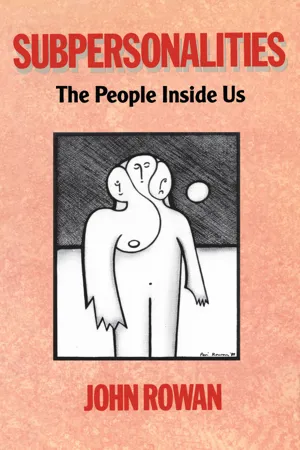
We all have had the experience of being divided, of being in two minds' about something - one part of us wants to do this, another wants to do that. Subpersonalities is the first book to do justice to the phenomenon as a normal feature of our psychological life. John Rowan argues that we all have a number of personalities that express themselves in different situations and that by recognising them we can come to understand ourselves better and improve our relationships with others. Anyone reading this book will run the risk of making quite new discoveries about themselves. In looking at where subpersonalities come from, John Rowan explores the work of psychologists and psychotherapists, from Jung and Freud onwards, and adds insights gained from his own work as a therapist and counsellor. He relates the journey of discovery that he himself undertook in search of his own subpersonalities. The result is a fascinating book that challenges our accepted view of ourselves and provides an intriguing picture of how human beings work and why communication between them so often goes wrong. Subpersonalties is a book for anyone interested in their own personality and how it helps or hinders their everyday life.
- 256 pages
- English
- ePUB (mobile friendly)
- Available on iOS & Android
eBook - ePub
About this book
Information
Part One

What are Subpersonalities?
Chapter One
Setting the Scene
In writing a book like this, it seems to be important to make it clear where I am coming from. What school do I represent? What is my philosophy? What biases do you have to allow for?
Starting Point
When I was twenty I discovered Spinoza: his philosophy seemed to take me up on to a high mountain from which I could see everything very clearly. Then when I was twenty-five I met Harold Walsby, a deeply versed Hegelian who later went on to create a dialectical algebra: he initiated me into the philosophy of Hegel, and particularly into a version which emphasized that nothing is absolute. It was a devastating intellectual experience, which seemed to strip away everything I had believed up to that point, and then to build up again from nothing. (Then I came across a text which said, ‘No one can be a Hegelian who has not first been a Spinozist.’) Through Walsby’s insistence, I learned how Hegel’s dialectical thinking came into Marxism, and acquired a thorough education in that way of thinking about the world. Also I made some study of Polish many-valued logic. I also discovered that certain psychologists were dialectical in their thinking, and particularly valued Krech and Crutchfield, whose 1948 ground-breaking book on social psychology was not long out, and Mary Parker Follett, whose book Freedom and Coordination had only recently appeared.
I was a long time finding out what I wanted to do in life, and it was not until 1959, when I was thirty-four, that I embarked on my first degree (in philosophy and psychology) under Richard Peters at Birkbeck College in the University of London. Four years later I graduated, and went on to become a social psychologist, specializing in consumer research. From there, after a personal revolution in my whole attitude to the world, I discovered humanistic psychology and found it very congenial, and also became interested in radical psychology. The whole field of group work opened up, and interested me very much, as I have explained in more detail elsewhere (Rowan, in press). Later, in 1974, I took the Diploma in Applied Behavioural Science under John Southgate at the Polytechnic of North London, became an organizational psychologist specializing in research and group work, and joined the Occupational Psychology Division of the British Psychological Society. And from there, after another traumatic turn-round, I became a counsellor and psychotherapist, joining the British Association for Counselling (and later becoming part of the committee dealing with the accreditation of individual counsellors) and the Association of Humanistic Psychology Practitioners, where I became part of the membership committee. Later I helped to found the Institute of Psychotherapy and Social Studies, where I had to work with psychoanalysts in an integrated course, and learned a great deal about Freud and the object relations school. It was out of this experience that my book The Reality Game: a Guide to Humanistic Counselling and Psychotherapy emerged in 1983.
My own experience in psychotherapy started in groups (encounter, psychodrama, Gestalt, Tavistock, T-groups, psychosynthesis, bioenergetics, movement, marathon, and so on), moved into co-counselling (where I became a teacher with the Barefoot Psychoanalyst school), and from there into psychotherapy after I had trained with Dr William Swartley in the approach known as primal integration (see Rowan 1988), which is in many ways very close to the object relations school in psychoanalysis, represented by people like Balint, Fairbairn, Guntrip, and Winnicott. At present I am seeing a Jungian analyst, and this represents the longest period of one-to-one work in my experience. I find much in the Jungian approach which helps to integrate the humanistic and the psychoanalytic.
This puts me in the position of coming from a basically humanistic orientation, but being able to see and use material from the psychoanalytic schools and also from academic philosophy and psychology. With this much as preamble, let us embark on a quest which will take us into all these areas and more.
Definitions
Most of us have had the experience of being ‘taken over’ by a part of ourselves which we didn’t know was there. We say ‘I don’t know what got into me.’ This is generally a negative experience, although it can be positive too. The way in which we usually recognize the presence of a subpersonality is that we find ourselves, in a particular situation, acting in ways which we do not like or which go against our interests, and unable to change this by an act of will or a conscious decision. This lasts as long as the situation lasts – perhaps a few minutes, perhaps an hour, perhaps a few hours – and then it changes by itself when we leave this situation and go into a different one. As long as fifteen years ago it was possible for a good and quite uncontroversial text on social psychology (Middlebrook 1974) to say things like ‘Thus the individual is not a single self, but many selves, which change somewhat as the individual shifts from situation to situation and person to person. We are, in short, what the situation demands.’
The question of whether there are parts of a person which can be talked to and worked with as if they were separate little personalities with a will of their own is one which has fascinated nearly everyone who has had to work with people in any depth. Phrases like ‘On the one hand I want to … on the other hand I don’t’, ‘I don’t know how I could have done it’, ‘It was as if a voice was telling me off’ are so common that they inevitably give a counsellor or therapist the cue that more than one system is at work. Internalized mothers and fathers are so common that it has almost become a joke. All these are examples of ways in which the idea of subpersonalities presents itself very patently and obviously.
It is an extraordinary fact that there is at present no systematic book on subpersonalities, and the word does not appear in any text on personality theory known to me. It is not in the dictionaries of psychology nor in the dictionaries of psychotherapy. Yet the thing itself is used by virtually every clinician who has ever written about working with people, and by more and more psychologists paying attention to what is there as opposed to what is supposed to be there. Whether with Freud we talk about the ego, the id and the superego; whether with Jung we talk about the complexes or the archetypes; whether with Federn or Berne or John Watkinswe talk about ego states; whether with Lewin we talk about subregions of the personality; whether with Perls we talk about the topdog and the underdog, or retroflection; whether with Klein or Fairbairn or Gun trip we talk about internal objects; whether with Balint we talk about the child in the patient; whether with Mary Watkins we talk about imaginal objects; whether with McAdams we talk about imagoes; whether with Hilgard we talk about the hidden observer; whether with Tart we talk about identity states; whether with Denzin we talk about the emotionally divided self; whether with Winnicott or Lake or Janov or Laing we talk about the false or unreal self; whether with Gurdjieff we talk about little I’s; whether with Gofftnan we talk about multiple selfing; whether with Stone and Winkelman we talk about energy patterns; whether with Mahrer we talk about deeper potentials coming to the surface; whether with Mair we talk about a community of self; whether with Ornstein we talk about small minds; whether with Gazzaniga or Minsky we talk about agents and agencies within the mind; whether with Gergen or Martindale or O’Connor or Shapiro we talk about subselves; whether with Strauss or Rossan we talk about subidentities; whether with Markus we talk about possible selves; whether with Kihlstrom and Cantor we talk about self-schemas; whether with T. B. Rogers we talk about prototypes; whether with Beahrs we talk about alter-personalities, or whether with Assagioli or Redfearn we talk about subpersonalities – all the time we are talking about the same thing: this thing which is not mentioned in the textbooks of personality.
My own working definition of a subpersonality is a semipermanent and semi-autonomous region of the personality capable of acting as a person. This goes further than the definition offered by Brown (1979), who says that subpersonalities are ‘patterns of feelings, thoughts, behaviours, perceptions, postures and ways of moving which tend to coalesce in response to various recurring situations in life’. And I think it is an improvement on the definition of an ego state (which we shall see later is another name for a subpersonality) of Watkins (1978) where he says that it is ‘a coherent system of behaviours and experiences with boundaries more or less permeable which separate it from other such systems within the overall Self’. It is very close to the definition which Tart (1986) gives of what he calls identity states: ‘a unique configuration or system of psychological structures or subsystems … to which the sense of “I!” is given’.
But perhaps it is best of all to say with Beahrs (1982) that dissociation is not an either/or phenomenon, but exists along a dissociative continum. At one end of this continuum are fluctuations in mood, interpreted as a state of mind organized around a particular emotion. Moods can be transient even when they seem quite long-lasting; basically they can come and go, leaving no trace behind. Similarly with hypnotic altered states of consciousness, or the altered states due to drugs: these too can be powerful and impressive at the time, but vanish as though they had never been: they are basically transient.
Further along the continuum, but still well within the range of normal experience, are the roles and ego states and sub-personalities within which individuals perform state-specific tasks and life activities. It is this region of the continuum with which we shall be concerned in this book – a particular set of circumstances will call forth a particular identifiable and relatively long-lasting subpersonality, which existed before that moment and will continue to exist after it.
Marie-Louise von Franz has suggested in an interview on film that subpersonalities themselves have a range of relative dissociation, such that they take us over sometimes mildly and sometimes more forcefully:
I could give you a whole list of the persons I can be. I am an old peasant woman who thinks of cooking and of the house. I am a scholar who thinks about deciphering manuscripts. I am a psychotherapist who thinks about how to interpret people’s dreams. I am a mischievous little boy who enjoys the company of a ten-year-old and playing mischievous tricks on adults, and so on. I could give you twenty more such characters. They suddenly enter you, but if you see what is happening you can keep them out of your system, play with them and put them aside again. But if you are possessed, they enter you involuntarily and you act them out involuntarily.
(Boa 1988: 241)
She goes on to say that possession by the animus is a common problem for women and the men who live with them. We shall come back to this later.
Further along again, and now I think outside the range of normality, are the states of possession detailed by Crabtree (1988), where a family member, who may be alive or dead, can somehow enter into a person and influence them, often against their will.
At the far end of this continuum are the very dissociated states, characterized by fugue and amnesia, which come under the heading of psychiatric states of dissociated personality. These have been dealt with in terms of standard psychiatric categories, because they are very serious and disabling. But we are not concerned in this book with multiple personalities as such, because they are too extreme. In this book we are dealing with people who are as normal as you and I.
The fact seems to be that there are many researchers and practitioners using conceptual systems which bring in the idea of subpersonalities in some form, all working independently of one another and using different terms and different ways of thinking about the matter.
It seems, then, that there is room for a full-scale book which will deal with the matter fully, showing how important it is for any truly adequate personality theory, and how relevant it is both in psychotherapy and in everyday life; and sorting out the varied terminology which makes the field difficult to grapple with.
One possible source of confusion needs to be dealt with at the start, though it will recur at various points within the whole treatment of the subject. This is that it is important that on the one hand we want to reify the subpersonalities – turn them into solid objects, as it were, by the process of personification – but on the other hand to remember always that we are not talking about things, but about processes which are actually very fluid and in change, and may be much bigger than we understand at first. On the one hand it will be very useful for us to think in terms of homunculi – little people within the person – but on the other hand we must beware of giving them a status which they do not deserve and which would not be proper; they are in fact moments in a process of change and development which is lifelong. We have to hang on to the dialectic of this ability to handle these apparent contradictions and paradoxes.
History
It is not easy to discover the history of the idea of subpersonalities. It is one of those concepts, so common in the field of the human sciences, which has a long past but a short history.
Most primitive cultures, both ancient and modern, have been aware of altered states of consciousness and spirit possession, both of which are forerunners of the modern idea of subpersonalities. Priests, witch doctors, and shamans have made these ideas a stock-in-trade since early in the history of the human race. There were ‘sleep temples’ in ancient Greece and in Egypt where patients were encouraged to go into altered states of consciousness, were actually hypnotized, or were talked to during their sleep and given curative suggestions. Gods and goddesses, as we shall see later, can sometimes usefully be thought of as projected subpersonalities. The Druids, the Celtic priesthood, are supposed to have been experts in the use of these methods. In primitive cultures, these changes have often been brought about through the use of trances, and trance induction has been brought about by means of rhythm, drums, dancing, chanting, and so on.
The earliest example I have come across of someone actually talking to a subpersonality, and being answered back, comes in an Egyptian document of approximately 2200 BC – a dialogue between a suicidal man and his soul. This is quoted in full and explained at length by...
Table of contents
- Cover Page
- Title Page
- Copyright Page
- Dedication
- Contents
- List of illustrations
- Acknowledgements
- Introduction
- Part One: What are Subpersonalities?
- Part Two: Functions and Uses of Subpersonalities
- Part Three: The Explanations
- Part Four: The Potential
- Bibliography
- Index
Trusted by 375,005 students
Access to over 1.5 million titles for a fair monthly price.
Study more efficiently using our study tools.
Frequently asked questions
Yes, you can cancel anytime from the Subscription tab in your account settings on the Perlego website. Your subscription will stay active until the end of your current billing period. Learn how to cancel your subscription
No, books cannot be downloaded as external files, such as PDFs, for use outside of Perlego. However, you can download books within the Perlego app for offline reading on mobile or tablet. Learn how to download books offline
We are an online textbook subscription service, where you can get access to an entire online library for less than the price of a single book per month. With over 1.5 million books across 990+ topics, we’ve got you covered! Learn about our mission
Look out for the read-aloud symbol on your next book to see if you can listen to it. The read-aloud tool reads text aloud for you, highlighting the text as it is being read. You can pause it, speed it up and slow it down. Learn more about Read Aloud
Yes! You can use the Perlego app on both iOS and Android devices to read anytime, anywhere — even offline. Perfect for commutes or when you’re on the go.
Please note we cannot support devices running on iOS 13 and Android 7 or earlier. Learn more about using the app
Please note we cannot support devices running on iOS 13 and Android 7 or earlier. Learn more about using the app
Yes, you can access Subpersonalities by John Rowan in PDF and/or ePUB format, as well as other popular books in Psychology & Mental Health in Psychology. We have over 1.5 million books available in our catalogue for you to explore.