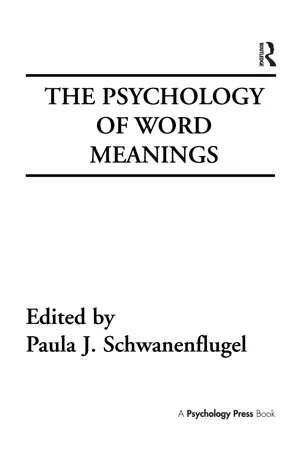
This volume contains perspectives from a collection of cognitive scientists on the psychological, philosophical, and educational issues surrounding the meanings of words and how these meanings are learned and accessed. It features chapters covering the nature and structure of word meaning, how new word meanings are acquired in childhood and later on in life, and how research in word processing may tell us something about the way in which word meanings are represented and how they relate to the language processor.
- 304 pages
- English
- ePUB (mobile friendly)
- Available on iOS & Android
eBook - ePub
The Psychology of Word Meanings
About this book
Information
| 1 | Meaning and Concepts |
When a child learns to call only cars by the name car, has he or she learned the meaning of car, the concept of cars, or both? Could the child have learned one without the other? Imagine an adult who calls some tree an oak when it is really a maple. Does this person not know the correct meaning of oak or is he or she confused about the category of oaks? Or do these questions amount to the same thing? The goal of this chapter is to analyze the psychological representation of word meaning and to determine its relation to concepts. In carrying out this goal, we will also need to consider philosophical views on what word meaning really is.
When discussing meaning and concepts, the first problem to address is which is which. In the psychological literature, some writers seem to randomly choose one term to use, without any clear motivation for the choice. Other writers use the terms interchangeably, perhaps in the hope that at least one of them will be correct. The issue here, of course, is not to choose one term as being “correct,” but to decide what these terms mean in a theory-neutral way. By meaning I mean the semantic components of words, in particular. That is, meaning is the component of linguistic elements that gives them significance. This usage does not imply a commitment to any particular theory of meaning. By concepts I mean mental representations of coherent classes of entities. Concepts are our notions of what kinds of objects and events make up the world. These representations may or may not correspond to word meanings, and this is a large part of what we’ll be worried about in this chapter.
SEMANTIC THEORIES
Let me start by very briefly considering one view of what meanings are-the view given to us by formal semantics (see Dowty, Wall, & Peters, 1981, for a good introduction). Formal semantics considers meaning to be a relation between words and the world. There are two parts to this relation. First, there is the extension, which is the set of all the objects that the word describes. So, the extension of chair would be all the chairs in the world—or, according to most theories, all the possible chairs in all the possible worlds. The second component of meaning is called the intension (not to be confused with intention). In everyday terms, the intension is the property that all chairs have in common—it’s the chairness of chairs. One way to think of the intension is as a rule or property that can pick out the extension. Once you know what the (true) property of being a chair is, you can pick out all the chairs that you might encounter. Most theories of formal semantics use both of these components, which causes a serious problem for psychologists trying to apply these theories to psychology, because it seems very clear that the extension can’t be anything that people know or manipulate. That is, people cannot know or represent all the chairs in the world, much less in all possible worlds. To this degree, then, it’s very difficult to relate such formal semantic theories to psychological accounts of meaning (Cohen & Murphy, 1984).
This chapter focuses on the more psychologically relevant aspect of meaning, the intension. It seems likely that people could learn these intensions, or something like them, when they learn word meanings. And if you know the intension of a word, you may not have to know its complete extension, because the intension can be applied to actual objects to evaluate whether they belong to the extension. So, if you know what the intension of chair is, you can use it to pick out actual chairs. If intensions are part of word meanings, then we can make at least some connection between semantic theory and human language processing through them.
Virtually every theory of the psychological representation of word meaning proposes that people learn the intensions of words, with different theories disagreeing on just how the intensions are represented. For example, theories have claimed that people represent word meaning as semantic components (Clark, 1972; Katz & Fodor, 1963; Smith, Shoben, & Rips, 1974), as prototypes (Rosch, 1973, 1975), as nodes in a network (Collins & Quillian, 1969), as mental models (Johnson-Laird, 1983), and so on.
However, the philosopher Hilary Putnam (1973, 1975, 1988) has made compelling arguments against the assumption that people know the intensions of words, which is at the core of our psychological theories of meaning. The following example illustrates Putnam’s argument. People have been buying oranges and lemons for many years, and most of them know what the difference is between them. However, it’s conceivable that a biologist could do a genetic and morphological study of lemon trees and find out that some of the varieties that we had been calling lemons are really a rather peculiar variety of orange. This may sound a little outlandish, but such re-evaluations have actually occurred. We know that whales are not fish, even though they look and act a lot like them, and people previously thought that they were fish. Biologists have made similar surprising discoveries over the years (e.g., that “glass snakes” are really a kind of lizard), so this one is not unreasonable.
In this example, it turns out that even fluent speakers of English have been misusing the language. They have been calling a large number of oranges lemons for years, as if they didn’t know the meaning of the word lemon. Although word meaning may not at first glance seem to be an empirical matter, the scientist’s discovery would change people’s word use and understanding of what lemons really are. So, many people who speak English apparently didn’t know what the word lemon means—although they had a mental description of lemons, this couldn’t have been the true intension of lemon, as it didn’t actually pick out only lemons (but also some oranges). The point is, of course, that this scenario could arise for almost any natural kind word—not just lemon. So, the same kind of example could be used to show that people don’t really know what horse, cat, fruit, water, canyon, tree, silver, or grass mean. It’s not important that scientists haven’t yet disconfirmed our notion of, say, what silver means—the very fact that scientists could disconfirm it shows that there is more to the meaning than whatever is in our mental representation of the word.
The example of the lemon is somewhat realistic, in that scientific discoveries are often changing our conceptions of things that we thought we understood. Putnam (1973, 1988) has constructed a more whimsical example that makes the point even more compellingly (my description is also based on the version of Fodor, 1987). Imagine that there is a world called Twin-Earth that is identical to the Earth in every respect but one. For example, every person on Earth has a twin there who is atom for atom identical with his or her Earth counterpart. The only respect in which Twin-Earth and Earth differ is that whereas our substance gold corresponds to an element, the thing that they call “gold” on Twin-Earth is a complicated alloy, which we can call “XYZ.” Superficially, however, gold and XYZ are very similar.
Now let’s consider the relationship between me and the person just like me on Twin-Earth (Twin-me). Presumably, we must have the same thoughts and mental life, because we are molecule-for-molecule identical. However, Putnam argues that our meanings are not identical. For example, we might both make the statement, “I have a gold watch.” However, when I say that sentence, what I mean is that I have a gold watch, but what my twin means is that he has an XYZ watch. That is, the meaning of gold on Earth is the element gold, but the meaning of the same word on Twin-Earth is XYZ. Since it is XYZ that they have always called gold, XYZ is causally connected to the word gold in just the same way that gold on Earth is connected to the word gold.
Why is this a problem? Well, since Twin-me and I have identical brains and, it seems likely, identical mental representations, it seems that we should have identical meanings. However, as just pointed out, we don’t. We differ in that my meaning of gold is not the same as my twin’s. Thus, Putnam poses the following paradox: Even though we have identical mental and brain states, our meanings are not identical. For psychologists, the point is that word meaning doesn’t seem to be a matter of psychology (i.e., our mental representations); the physics of Earth or Twin-Earth partly determines what the meaning is.
Putnam points out several important implications of these examples. One is that there is a linguistic division of labor for names describing natural kinds: We know something about the meaning of these words, but we also delegate some of the responsibility for determining their true meaning to other people—experts. To some degree, then, it’s an empirical question as to exactly what a lemon is or gold is; the science of biology will tell us (eventually) what it really is to be a lemon, and we have to allocate some of the linguistic work to biologists at the same time that we’re using these words.
The second implication is that people apparently don’t know the intensions of words. It seems that we didn’t really know the meaning of lemon, even though we had a mental description of lemons. And even though Twin-me and I had identical mental states, and, in particular, we had the same beliefs about gold, we had different meanings of the word gold. As Putnam (1973) put it in a famous” quote: “Cut the pie any way you like, ‘meanings’ just ain’t in the head!” (p. 704). Why aren’t they in the head? Because there is a “right answer” to what the meaning is, and that answer is a fact about the world—not about our mental representations. So, the meaning of lemon is whatever lemons really are, regardless of our beliefs about them. And the meaning of gold depends on what gold really is on Earth (or Twin-Earth), not just on what we believe about gold.
One may feel that the Twin-Earth example is a rather récherché philosophical puzzle that has few implications for psychology. But its importance is in suggesting that meaning is not a matter of mental representations, and therefore that the study of meaning is not really part of psychology. And cases of meaning change, such as the lemon/orange example, show that Putnam’s problem can have real consequences—namely, that people’s mental representations of a word don’t seem to determine what the word really means.
If we accept Putnam’s conclusion, the psychology of meaning looks like a doomed endeavor. If meanings ain’t in the head, there can’t be any psychology of them. How is a psychologist to deal with this problem? To begin with, by ignoring it. Rather than directly answer the question of where meanings are, if they aren’t in the head, I’m going to approach the question from the other side by asking just what is in the head. Rather than attacking Putnam’s problem itself, I will initially confine myself to the question of psychological semantics: How do people represent word meanings? I’ll discuss this by working through a series of questions that spell out the major possibilities. Following this purely theoretical discussion is a review of empirical evidence that bears on the question of meaning representation. Finally, the chapter ends with an attempted resolution to Putnam’s problem by reviewing what has been found in the head and evaluating whether it is “meaning.”
THE REPRESENTATION OF MEANING
Perhaps the first question one should ask is whether people have any knowledge at all of word meanings. Although the answer seems obviously to be “yes,” there are possible arguments against it. One could argue that English is a language with a grammar and semantics regardless of whether anyone alive speaks it (Katz, 1981, expresses this view but not the psychological implication under discussion). English could be conceived of as a linguistic system apart from its speakers, just as mathematics was a valid system even before humans discovered it. To take a realistic example, there certainly is a fact of the matter as to whether a phonetic sequence is a sentence of ancient Hittite, even if there is no one alive who knows this language. The rules of the language do not have to be actually known by anyone in order to be the correct rules. Therefore, one could argue, there’s no need to talk about meanings of English words being in the head, because the semantics of English exist (in some sense) independently of people.
This view of language has a certain degree of validity (though see Chomsky, 1986), but it doesn’t seem to bear on the question of what speakers of a language actually know. The fact that one could imagine the semantics of English existing apart from any speakers does not entail that speakers don’t know the rules of English. In contrast, people’s everyday language use provides strong prima facie evidence that they know something about their language, or else their behavior would be inexplicable. Although Putnam’s examples still must be accounted for, it is clear that there is something in the head that accounts both for performance in experiments (see Smith, 1978) and for normal language use.
Let us tentatively conclude then, that people have some kind of mental representation that controls their word use. What is the nature of these mental objects? One possibility is that meanings are a purely linguistic construction, just as relative clauses and phonemes are purely linguistic elements—someone who doesn’t know any languages doesn’t know about phonemes or relative clauses. On this view, meanings are strictly internal to the linguistic system; they aren’t part of the general “language of thought” that we use to think about the world.
If we had such a theory, we could still explain the semantic relations among words. For example, we could take the Katz and Fodor (1963) framework of semantic markers as being such a theory. They suggested that word meanings can be represented as collections of semantic markers, such as [unmarried, adult, male] for the meaning of bachelor. If we interpret the semantic markers as arbitrary linguistic symbols, then we might have a theory of meaning that was strictly internal to the linguistic system. That is, the features could be rewritten as any arbitrary strings with no effect on the theory’s explanatory power. The feature [male] could just as well have been [xyzzy] or [%3#A20!]. (By the same token, if syntacticians were to call noun phrases “LGs” instead of “NPs,” this would have no effect on the explanatory power of their theories.) We could still explain semantic relations such as entailment, synonymy, and antonymy through the relations of these symbols. For example, synonymous words would have exactly the same (arbitrary) semantic markers. Opposites would be words that differ in the value of exactly one marker.
Such a theory could explain many linguistic phenomena, but it has serious problems as a psychological model. In order for people to understand how words are related to real objects in the world, they must interpret each of these components in terms of some concept that they already know. Although one could have a set of semantic markers that are purely internal to the linguistic system, these meanings couldn’t refer to real objects by themselves, because they aren’t connected to those objects in any way. That is, in order to identify birds with the word bird, the word must be connected to actual properties of birds. And in order to use the word bird in conversation, it must be connected to knowledge of a...
Table of contents
- Cover
- Halftitle
- Title
- Copyright
- Contents
- Contributors
- Preface
- An Introduction to the Psychology of Word Meaning
- 1. Meaning and Concepts
- 2. Word Meaning and Word Use
- 3. Cross-Cultural Aspects of Word Meanings
- 4. The Combination of Prototype Concepts
- 5. Predicating and Nonpredicating Combinations
- 6. Learning Word Meanings from Definitions: Problems and Potential
- 7. Beyond the Instrumentalist Hypothesis: Some Relationships Between Word Meanings and Comprehension
- 8. On the Early Influence of Meaning in Word Recognition: A Review of the Literature
- 9. Why are Abstract Concepts Hard to Understand?
- 10. Interpretation of Word Meanings by the Cerebral Hemispheres: One is Not Enough
- Author Index
- Subject Index
Trusted by 375,005 students
Access to over 1.5 million titles for a fair monthly price.
Study more efficiently using our study tools.
Frequently asked questions
Yes, you can cancel anytime from the Subscription tab in your account settings on the Perlego website. Your subscription will stay active until the end of your current billing period. Learn how to cancel your subscription
No, books cannot be downloaded as external files, such as PDFs, for use outside of Perlego. However, you can download books within the Perlego app for offline reading on mobile or tablet. Learn how to download books offline
Perlego offers two plans: Essential and Complete
- Essential is ideal for learners and professionals who enjoy exploring a wide range of subjects. Access the Essential Library with 800,000+ trusted titles and best-sellers across business, personal growth, and the humanities. Includes unlimited reading time and Standard Read Aloud voice.
- Complete: Perfect for advanced learners and researchers needing full, unrestricted access. Unlock 1.5M+ books across hundreds of subjects, including academic and specialized titles. The Complete Plan also includes advanced features like Premium Read Aloud and Research Assistant.
We are an online textbook subscription service, where you can get access to an entire online library for less than the price of a single book per month. With over 1.5 million books across 990+ topics, we’ve got you covered! Learn about our mission
Look out for the read-aloud symbol on your next book to see if you can listen to it. The read-aloud tool reads text aloud for you, highlighting the text as it is being read. You can pause it, speed it up and slow it down. Learn more about Read Aloud
Yes! You can use the Perlego app on both iOS and Android devices to read anytime, anywhere — even offline. Perfect for commutes or when you’re on the go.
Please note we cannot support devices running on iOS 13 and Android 7 or earlier. Learn more about using the app
Please note we cannot support devices running on iOS 13 and Android 7 or earlier. Learn more about using the app
Yes, you can access The Psychology of Word Meanings by Paula J. Schwanenflugel in PDF and/or ePUB format, as well as other popular books in Personal Development & History & Theory in Psychology. We have over 1.5 million books available in our catalogue for you to explore.