- 280 pages
- English
- ePUB (mobile friendly)
- Available on iOS & Android
eBook - ePub
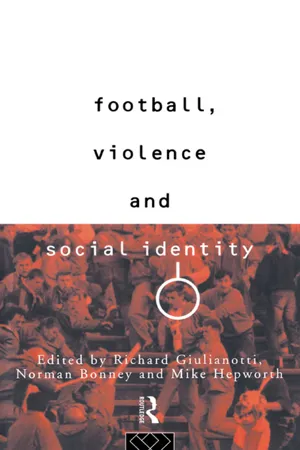
Football, Violence and Social Identity
About this book
Drawing on research from Britain, Europe, Argentina and the USA this volume examines the culture and loyalties of soccer players and crowds and their relationships to social order, disorder and violence. This informative and accessible book will be of interest to students of Sport Science and to all of those who love the game of soccer.
Trusted by 375,005 students
Access to over 1.5 million titles for a fair monthly price.
Study more efficiently using our study tools.
Information
Chapter 1
Introduction
This edited collection is about football fan association and behaviour; more specifically, it is about football fan violence. It explores the interrelations of participatory and aggressive behaviour, social identity, and the politics of public order and control, within a football context. In contradistinction to Steve Redhead's (1986) stretched claim, it is not the ‘final football book’ on fan violence or supporter culture generally. Rather, as its various contributors demonstrate, it is part of a series of academic texts exploring football fan culture and experience. In keeping with the overriding theme of these inquiries, our principal concern is with football-related violence. However, its cross-cultural and interdisciplinary themes provide the collection with an appreciably fresh approach to this subject.
This collection is the first major English language text to draw together a spectrum of international and methodological perspectives on football fan violence. In doing so, it is situated at the interface of transformations and continuities in football's contemporary status. Changes relate most notably to its globalization, as the world's premier spectator sport and cultural form—witnessed not only in the financial promise of the United States hosting the 1994 World Cup Finals, but also at the affective, everyday level, through football followers’ heightened curiosity with, and media consumption of, the game's interpretation and performance in other nations and continents. A counterpoint to these dynamics is the most palpable, culturally shared experience of football, its public, media and governmental association with varying degrees of partisanship, rivalry and aggression among its spectators.
There has been a marked consistency in the academic questions asked of British football hooliganism, pertaining to definition, social ascription and action. Why is it that particular social practices are designated ‘football hooliganism’? Which social groups are identified as ‘football hooligans’, and by whom? Where are the clear demarcations or grey areas between particular modes of fan behaviour, in terms of fanaticism, ‘hooliganism’ or generally expressive support? In addition to readdressing these questions, in the light of current political and academic debates on contemporary fan violence, this collection's distinctively cultural theme introduces a range of underlying, comparative inquiries. What commonalities or differences exist between expressive young supporters in different cultural contexts? Are the bases for these overlaps or distinctions found in actual behaviour or secondary interpretation? What historical, political and social forces have shaped particular cultures of club or national fan identity? How extensive is the influence of British youth styles and subcultures on their contemporaries abroad? Is this exchange one-way or reciprocal? And, perhaps most importantly of all, what effect might the State have in recognizing, repelling or rehabilitating ‘football hooligan’ supporters?
The pluralist theme of this collection relates not only to the subject matter, but also to the contributors’ nationalities, academic disciplines and methodologies. The authors are from Argentina, Norway, Italy, the Netherlands, the United States, Scotland and England. Between them, their papers broach a range of perspectives—anthropological, psychological and sociological. Methods deployed include qualitative studies of primary and secondary data, through fieldwork and case histories; statistical data compilation and analysis; the application of interpretive and figurational sociologies, and contemporary social theory.
The introductory chapter is by Richard Giulianotti. It provides the reader with a natural history of what we continue to know as ‘football hooliganism’, as it has been read in British parliamentary and sociological terms. Giulianotti seeks to demonstrate that some models advanced to explain the general evolution of political issues do not neatly fit British ‘football hooliganism’, Identifying the issue's politico-sociological genus in the mid-1960s, he charts its course through Westminster and academe in distinctive periods, until the present. In this way, he outlines the production of knowledge on fan violence, and how academic contributions have related historically to particular political and social questions surrounding the phenomenon. Broad cultural issues have further shaped the social meaning of fan disorder, and the subsequent approach of politicians and academics. These have included the consensual, corporatist system of policy-making, predominant in the 1960s and 1970s, which sought to involve all relevant parties in decision-making; and the socially divisive New Right administration of the 1980s, invoking harsh and quick ‘solutions’ to fan violence and crime in general. There has also been an increasingly nationalist intervention in the political culture of football, bringing with it sniping comments across the Scottish border over the respective merits (and violent propensities) of neighbouring English and Scottish fans. Giulianotti's paper suggests that the English political endeavour of the 1990s to tone down (‘deamplify’) prior concern with fan violence, by referring to the effectiveness of recent legislation, duplicates the Scottish experience of the 1980s. Bearing in mind the appallingly stereotyped persona of the English fan abroad, it would appear unlikely that a culture of State-induced fan fraternity will be allowed to match that cultivated amongst Scottish international fans (cf. Giulianotti, 1993a).
The study of political and sociological inquiries into fan disorder is illuminated further by two Argentinian academics, the anthropologist Eduardo Archetti and the ethnographer Amilcar Romero. They kick off with a provocative critique of English sociological explanations of football-related violence. Arguing that a lack of field research appears generic to these studies, the authors promote a flexible, anthropological approach sympathetic to that pioneered by Armstrong and Harris (1991). Detailing four case studies, dating from 1958 (‘the first death’) to 1983–4 (‘organized fan violence’), Archetti and Romero chart the main points on the trajectory of Argentinian football-related violence, against a terrain of military dictatorship and societal ‘paramilitarization’. The essay serves to underscore the centrality of special politico-cultural and historical processes in the generation of football-related violence and hooligan identities. It also establishes the collection's theme that football culture is indicative of a given society's cognition of existential, moral and political fundamentals.
Italian sociologists Alessandro Dal Lago and Rocco De Biasi continue the critical study of English explanations of football hooliganism. They present statistical and ethnographic evidence that the class-orientated explanations of English football hooliganism, whether in terms of employment status or cultural lifeworld (cf. Dunning, this volume; I. Taylor, 1987), are incongruent to Italian football fan identity and culture. Drawing on research with AC Milan, Internazionale and Genoa supporters, they argue that the Italian tifo (football fanaticism) harbours strong, often conflicting intra-city and regional animosities. The most fundamental, macrocultural conflicts involve major sides divided by the mezzogiorno (see Dunning, this volume); but this ought not to overshadow localized rivalries such as Atalanta (of Bergamo) and Brescia, or Fiorentina (Florence) and Bologna (cf. Roversi, 1992:56–8). Moreover, the distinctive identity of Italian football fans is further illustrated by two modes of football fan association, within each club's support. Official fan clubs are far more populous and centralized than their UK equivalents. Conversely, the tensions underlying the ambivalent relationship between the ‘militant’ fans, the ultras, and their elected club, are mirrored on a broader stage by commentators and other fans from outwith Italy confusing these supporters with ‘organized hooligans’.
And if ‘militant’ fans mirror a ‘fanatical’ relationship to the club, surely they manage to strike at something more fundamental, perhaps the deeply embedded values about the game itself. In 1985, Redhead and McLaughlin briefly identified the distinctive ‘casual’ style and its regional rivalries; it required a further eight years for its symbolic and cultural components to be given systematic examination in print, through Richard Giulianotti's (1993b) research in Aberdeen. Gerry Finn's paper explores the value network of Glasgow Rangers casuals, by unpacking the cultures of aggression and violence rooted in Scottish and other soccer, using a societal psychological approach. Socialization processes of playing, administering and supporting the game display ambiguous and highly contextual validations of aggression and evaluations of violence. One of Finn's principal exponents of ‘dirty play’, the English midfielder Vinny Jones, illustrates his onfield instrumentality through an aptly hooligan metaphor:
I think that in any walks of life, if the top man gets sorted out early doors…I mean if I was on me own and there's a gang of lads and they're gonna start on me, I would go in and whack the biggest and the toughest straight away. And that's what happened in the Cup Final.
(Vinny Jones, Wimbledon FC, Soccer's Hard Men)
In the pursuit of their football-related goals, players and spectators enjoy related senses of liminality: the hedonic charge readily afforded by football culture, the ‘flow’ sensations of immersion in the action. Finn confronts the significance of the anti-hooligan, ‘carnival’ identity of Scottish international fans, and the continuing presence of club-level soccer hooligan subcultures. Each, he maintains, is enwrapped by the sense of jouissance, of being ‘at one with the action’, that characterizes the game's culture-though with diametrically opposing consequences.
From Scotland we cross the border to England. The leading British sociologist of football hooliganism is in no doubt that any deep-seated metamorphosis in English fan culture has been overstated. And, in a robust defence of figurational sociology, he is equally consistent in advancing the value of the Eliasian case in explaining the phenomenon. Eric Dunning compiles and evaluates the latest batch of critiques on the ‘Leicester School’, which seek to identify empirical and epistemological weaknesses in its numerous researches. Some fieldwork and presentational shortcomings are acknowledged, particularly regarding the location of football within a community configuration, and the repositioning of subsequent findings on an English rather than British or pan-European stage. However, the process-sociological perspective of Norbert Elias is retained wholeheartedly, to the extent that its applicability to football-related disorder overseas is also adduced. Regional and ethnic rivalries vicariously enacted by football fans in Italy accord with the ‘established-outsider’ thesis advanced by Elias (Elias and Scotson, 1965). Equally, Eliasians would further contend that the historical interplay of political and football violence may be explained by the weak co-development of self-control and State formation (Elias, 1982).
The major theme of the paper by American sociologists Jerry M. Lewis and AnneMarie Scarisbrick-Hauser is the difficulty which official reports into British stadium disasters have in addressing football hooligan behaviour. By way of illustration they explore the inquiries concerned with disasters at Birmingham, Bradford and Hillsborough (Popplewell, 1985; P. Taylor, 1990). The analysts posit that the reports neglect to delineate precisely the types of behaviour in which football fans engage on an everyday basis. More particularly, recent inquiries have failed to establish adequate distinctions between ‘hooliganism’ and culturally accepted modes of behaviour among fans. Such lacunae can have grave implications for supporters regularly experiencing the policy outcomes of ill-informed findings. In response, Lewis and Scarisbrick-Hauser introduce the McPhail categories for describing crowd behaviour recorded in the two most recent reports. The paper is therefore one of the first to seek a systematic and positivist understanding of soccer fan behaviour.
A similarly positivist, policy-orientated approach is promoted by the Dutch sociologist H.H. van der Brug. Outlining the historicocultural genesis of Dutch fan subcultures, or ‘Sides’, van der Brug firstly recognizes a general trend towards attacks on opposing fans and players rather than referees and officials. He goes on to explore the educational level of Dutch hooligans, contrasting the findings with British research, as well as the differing anticipation of hooligan incidents by Dutch international supporters on their travels. The association of football hooliganism and its media reportage is also documented. The scale of club-level violence in the Netherlands since the late 1980s had led most of the British press to predict intense levels of violence, a ‘superhooligan showdown’, when England were due to play Holland, firstly at a Wembley friendly in March 1988, and then at the 1988 European Championship Finals in June, and the 1990 World Cup Finals in Cagliari. That nothing of this proportion materialized elicited few meaningful enquiries from its publicists, although a key reason lay in the understated, consensual strategy adopted by Dutch policing in anticipation of these fixtures (van der Brug and Meijs, 1988). The author cautiously advocates restitutive public policies such as club/hooligan social programmes for reducing the incidence of match-related disorder. The proactive method of policing ‘away’ fans en route to fixtures is similarly endorsed.
In Britain, a more theatrical and coercive police measure is the ‘dawn raid’. Acting on the basis of ‘intelligence’ about individuals, acquired in the course of earlier police work, a unit of officers descends on one address or a number of domiciles, as part of a co-ordinated ‘operation’. The facilitating ‘search warrant’ is granted by magistrates on the police expectation of discovering material evidence regarding the planning or execution of football-related violence. The controversial paper by anthropologist Gary Armstrong and criminologist Dick Hobbs exposes a darker underside to the philosophy behind the ‘dawn raid’. Spotlighting the genesis of recent, technology-led strategies in the policing of English football fans, the authors identify two principal methods which are increasingly prevalent and ‘media-friendly’—panoptical surveillance of fans through closed circuit television and databases, and covert policing of ‘hooligan’ subcultures. The authors argue that these methods represent a significant departure from established policing practices, a transition sustained by the liberal left's disinclination to defend the civil rights of the hooligan ‘folk devil’. The weak justification for subsequent ‘dawn raids’ on the homes of individuals is registered by the authors, who also note their failure to effect criminal convictions. Armstrong and Hobbs attack the underlying rationale for these tactics, the belief that by imprisoning the sinister ‘generals’, the hooligan residue will be left rudderless and thereby discontinue its football violence.
Continuing the critical, socio-legal analysis of football hooliganism, the final chapter is an extended case study of a Scottish football-related trial. Two of three men accused of attempted murder and mobbing and rioting were convicted and jailed, following disorder at a disco in Dunfermline. The convictions pivoted on the general belief that the football hooligan gang, the Hibs casuals from Edinburgh, had perpetrated the mêlée. Drawing on Scots Law jurisprudence and post-modern social theory, Richard Giulianotti outlines the genus of the Scottish ‘soccer casual’ subcultural style, and its particularly problematic relationships to the Scottish juridico-administrative system, which pro-motes the domestic game as ‘hooligan free’. The media's portrayal of Hibs casuals, prior to the court case, as a surreptitious, quasi-Mafia outfit is explored, as well as the events leading up to the disorder. Assessing the circumstances in which the trial took place, the gathering and presentation of evidence, and the lack of corroboration provided by the prosecution, the paper argues that the convictions were of highly dubious probity. The verdicts reflect more a diffuse state of mind on Scottish hooliganism than a ‘reasonable’ evaluation of the evidence brought before the court.
REFERENCES
Armstrong, G. and R. Harris (1991) ‘Football Hooligans: theory and evidence’, Sociological Review, 39, 3:427–58.
Brug, H.H. van der and J. Meijs (1988) ‘Dutch Supporters at the European Championships in Germany’, Council of Europe.
Elias, N. (1982) State Formation and Civilization: the civilizing process, Oxford: Blackwell.
Elias, N. and J.L. Scotson (1965) The Established and the Outsiders, London: Frank Cass.
Giulianotti, R. (1993a) ‘A Model of the Carnivalesque? Scottish football fans at the 1992 European Championship finals in Sweden and beyond’, Working Papers in Popular Cultural Studies No.6, Manchester Institute for Popular Culture.
——(1993b) ‘Soccer Casuals as Cultural Intermediaries: the politics of Scottish style’, in S. Redhead (ed.) The Passion and the Fashion, Aldershot: Avebury.
Popplewell, O., Lord Justice (Chairman) (1985) Inquiry into the Crowd Safety and Control at Sports Grounds: interim report, London: HMSO.
Redhead, S. (1986) Sing When You're Winning, London: Pluto.
Redhead, S. and E. McLaughlin (1985) ‘Soccer's Style Wars’, New Society 16 August
Roversi, A. (1992) Calcio, Tifo e Violenza, Bologna: II Mulino.
Taylor, I. (1987) ‘Putting the Boot into a Working Class Sport: British soccer after Bradford and Brussels´, Sociology of Sport Journal, 4.
Taylor, P., Lord Justice (Chairman) (1990) Inquiry into the Hillsborough Stadium Disaster: final report, London: HMSO.
Chapter 2
Social Identity and public order Political and academic discourses on football violence
INTRODUCTION
Although the world's leading team sport, it was not until the 1960s that the social significance of football received substantive and separate attention from social scientists and historians (Harrington, 1968; Lever, 1969; I. Taylor, 1969). For over a decade, the major contributions focused on English fans, particularly on the subject of hooliganism, as Marxists (Ian Taylor, John Clarke, John Hargreaves, Alan Ingham), anthropologists (Peter Marsh and associates, Desmond Morris) and process-sociologists (Eric Dunning and the Leicester researchers) clashed over the nature of the football-watching experience, and more specifically the causes of these supporters’ disorderly behaviour.1 sub Subsequently, the most notable contributors to the English hooliganism debate have included environmental psychologists (David Canter and associates), cultural anthropologists (Gary Armstrong and Rosemary Harris), those working within the cultural studies (Richard Giulianotti and Steve Redhead) and collective behaviour fields (Jerry Lewis and AnneMarie Scarisbrick-Hauser), or upholding the tradition of urban ethnography (Dick Hob...
Table of contents
- Front Cover
- Football, Violence and Social Identity
- Title Page
- Copyright
- Contents
- List of tables
- List of contributors
- Acknowledgements
- 1 Introduction
- 2 Social identity and public order: political and academic discourses on football violence
- 3 Death and violence in Argentinian football
- 4 Italian football fans: culture and organization
- 5 Football violence: a societal psychological perspective
- 6 The social roots of football hooliganism: a reply to the critics of the ’Leicester School
- 7 An analysis of football crowd safety reports using the McPhail categories
- 8 Football hooliganism in the Netherlands
- 9 Tackled from behind
- 10 Taking liberties: Hibs casuals and Scottish law
- Index
Frequently asked questions
Yes, you can cancel anytime from the Subscription tab in your account settings on the Perlego website. Your subscription will stay active until the end of your current billing period. Learn how to cancel your subscription
No, books cannot be downloaded as external files, such as PDFs, for use outside of Perlego. However, you can download books within the Perlego app for offline reading on mobile or tablet. Learn how to download books offline
Perlego offers two plans: Essential and Complete
- Essential is ideal for learners and professionals who enjoy exploring a wide range of subjects. Access the Essential Library with 800,000+ trusted titles and best-sellers across business, personal growth, and the humanities. Includes unlimited reading time and Standard Read Aloud voice.
- Complete: Perfect for advanced learners and researchers needing full, unrestricted access. Unlock 1.5M+ books across hundreds of subjects, including academic and specialized titles. The Complete Plan also includes advanced features like Premium Read Aloud and Research Assistant.
We are an online textbook subscription service, where you can get access to an entire online library for less than the price of a single book per month. With over 1.5 million books across 990+ topics, we’ve got you covered! Learn about our mission
Look out for the read-aloud symbol on your next book to see if you can listen to it. The read-aloud tool reads text aloud for you, highlighting the text as it is being read. You can pause it, speed it up and slow it down. Learn more about Read Aloud
Yes! You can use the Perlego app on both iOS and Android devices to read anytime, anywhere — even offline. Perfect for commutes or when you’re on the go.
Please note we cannot support devices running on iOS 13 and Android 7 or earlier. Learn more about using the app
Please note we cannot support devices running on iOS 13 and Android 7 or earlier. Learn more about using the app
Yes, you can access Football, Violence and Social Identity by Richard Guilianotti in PDF and/or ePUB format, as well as other popular books in Social Sciences & Sociology. We have over 1.5 million books available in our catalogue for you to explore.