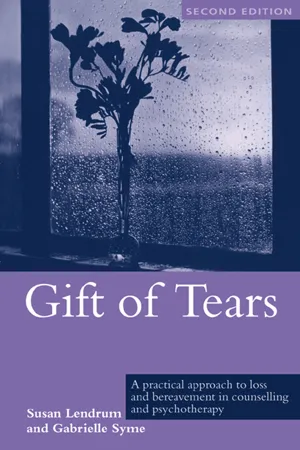
This thoroughly revised and updated edition of Gift of Tears includes new research and examples of recent events to help illustrate the effects of loss. Containing a strong practical element, the book guides the reader through the process of contemplating and eventually confronting their own relationship to loss.
Written by experienced counsellors and psychotherapists, the book contains candid and readable discussions of central issues, including:
* how to understand and work with anger and guilt
* attachment patterns and loss
* historical changes in attitudes to death and bereavement
* death as a particular form of loss.
Gift of Tears is intended for anyone who finds they have to cope, in the course of their daily lives, with the grief of others. It will prove invaluable to counsellors, therapists, mental health professionals and all those helping the bereaved.
www.bereavementarena.com
eBook - ePub
Gift of Tears
A Practical Approach to Loss and Bereavement in Counselling and Psychotherapy
- 272 pages
- English
- ePUB (mobile friendly)
- Available on iOS & Android
eBook - ePub
Gift of Tears
A Practical Approach to Loss and Bereavement in Counselling and Psychotherapy
About this book
Trusted by 375,005 students
Access to over 1.5 million titles for a fair monthly price.
Study more efficiently using our study tools.
Information
Subtopic
Mental Health in PsychologyIndex
PsychologyPart I
Loss and nurture
Chapter 1
Early attachments and loss
Natural or necessary losses
To be born, a baby must leave the womb; to grow up and leave its mother, a baby needs to be weaned. The child entering school and learning about the world needs to leave its parents, and adolescents have the task of leaving their own family in order to set up their own separate lives. These ‘leavings’ constitute much of the loss that human beings in our culture experience as part of the natural process of growing up and eventually of death.
In thinking of these stages only as development or ‘growing up’, it is easy to forget the place of loss in growth and change. These losses, which happen to the majority of us, usually evoke strong feelings. As babies, such feelings find powerful and direct expression. Think of the baby sleeping who awakens and lies quietly for a bit, but suddenly starts to cry lustily, as if it cannot bear to be alone any more. The cry is usually very compelling to the mother and appears to demand a response and a re-establishment of human connection. The younger the baby is, the shorter the time it can bear on its own. Weaning a baby is not just a nutritional process but also an emotional process in which the infant gradually manages longer periods on its own; with maturity comes the capacity to be alone. People who study babies propose that this is because babies gradually develop the knowledge that their parent will return and that the loss or absence is survivable meanwhile. In other words, as we mature we discover inner resources and knowledge. Without increasing periods alone and the consequent experience of loss, we would not mature. These losses are termed ‘necessary losses’ (Viorst, 1989). Each one of these necessary losses resulting from separation needs to be recognised and comforted. Given enough comfort, each loss successfully managed is a step towards independence and growing self-awareness. We do not necessarily remember these losses but we are shaped by them, for they are internalised and form part of our unconscious memory. In other words, they are not forgotten but become part of our inner emotional world. The unconscious memory of them begins to build a sense of inner strength. We have learnt that loss is survivable, and as we begin to face loss more consciously we can discover inner resources. Mothers ‘know’ about and draw on these internalised resources in their handling of their babies and children, responding intuitively with the comfort they need.
To focus on your own ‘intuitive’ knowledge of loss, consider the example in Exercise 1.1 of a child lost and separated from his mother in a crowded shopping centre.
Exercise 1.1 Lost child
It is 4 p.m. on a wintry afternoon. Tom (2) and his mother, Mary, are in the shopping centre. Mary is tired and keen to get home. She thinks Tom is still in tow. Tom, however, has been distracted by some moving toy he’s just spotted. After a minute or two he turns to tell her and realises she’s not there. As that moment, he emits a piercing and penetrating scream which seems to blot out all other sounds.
You can use your imagination to continue the story, knowing how Tom would feel.
If you were able to get inside Tom’s skin you will have noticed some strong feelings. These probably included shock, disbelief, terror, fear and anger. Your ability to recall these feelings draws on your memory and your understanding that others feel similar things in similar situations, i.e. your empathic capacity.
You also know that Tom’s mother’s experience of the same event will be different. This is told in Exercise 1.2 (p. 5).
In thinking about Mary’s feelings you will have recognised fear, anger, frustration and relief. You can respond to the story because you know intuitively how people are likely to feel in a frightening situation of loss or separation. Tom’s frightened, angry cry was his way of trying to get his mother back. Mary’s anger fuelled her drive to get through the crowd. Anger is one of the very strong feelings that arises when we fear a separation, and is a regulator to try to ensure that the attachment bond remains intact. Even when she found Tom, it took time for her fear and anger to subside.
Exercise 1.2 Mother’s response
As Mary suddenly realises that Tom’s not there, her heart misses a beat. She hears the piercing scream and tries to rush towards him, but the centre is crowded and her way is barred. Despite her tiredness she finds sudden energy to get through the crowd and reaches Tom within a few seconds. She shouts and rages at him for a minute. As she gradually calms down, she realises he is frightened too. Fighting back her tears, she puts her arms round him, cuddles him, calms him down and sets off home. When they get home they tell the family through their tears about their frightening afternoon.
Use your imagination to list the various feelings Mary experienced.
Fortunately the loss was brief and her fear manageable, so she was able quickly to comfort him in the way he needed. The relief of getting home and telling the rest of the family allowed the tears to flow. The ‘gift’ of their tears gave the family a sense of their interconnectedness and a recognition of the importance of Tom.
The powerful feelings of shock, fear, terror, anger and frustration evoked in Tom and Mary through even this very brief separation are not surprising. Research into the power of human attachment, and especially the bonding of young children to their attachment figures or carers, most frequently their mothers, confirms that such unforeseen separations are very frightening for good reasons.
Some studies of attachment behaviour
Sigmund Freud, who recognised the enormous influence of childhood experiences on adult emotional life, wrote about the strength of early attachments. He recognised this most basic of all human drives towards forming and sustaining attachments to others, yet seemed to understand it, initially at least, as simply a feeding relationship; primarily as cupboard love. Of course for the newborn baby the balance between life and death hangs upon the success of this relationship and the attendant ability to deal with hunger, pain and illness. But is this all there is to the mother and baby relationship?
John Bowlby, a psychoanalyst interested in childhood development, thought not. He was interested in more recent studies by biologists such as Konrad Lorenz and Nicolaas Tinbergen, who observed patterns of behaviour in birds and other animals. They noticed that many species of bird forged strong and specific attachment bonds. Lorenz’s goslings ‘locked’ on to the first moving object in sight (usually the mother goose, but occasionally Lorenz himself!); many of Tinbergen’s birds, having ‘locked’ on to a bird of the opposite sex, had remained mates throughout life (Bowlby, 1969).
The newborn baby does not, of course, ‘lock’ on to the first moving object and will be relatively undiscriminating about the person who attends to its needs in the early months. At this stage the baby is thought to be unaware of itself as a separate person. By about six months, however, a very marked preference for one person develops. It is as though the baby, having recognised its separateness and aloneness, ‘decides’ to counter this terrible aloneness by falling in love with the very person recognised as ‘other’ and yet who is also familiar. Anyone judged ‘unfamiliar’ is likely to be firmly rejected at this stage. As women suckle babies and, in our culture, generally also tend to their physical needs and interact with them in the process, mothers are usually, but not necessarily, the chosen attachment figures. It appears that the need for human connection is fundamental. ‘The love of others comes into being simultaneously with the recognition of their existence’, wrote Ian Suttie in 1935. As soon as we can distinguish ‘you’ and ‘me’ we seem almost to fall in love, perhaps to try to assuage the terror and isolation of that very separateness.
Experiments by Harry Harlow (1961), using a range of wire model ‘monkey-mothers’, showed that baby rhesus monkeys would thrive best and form attachments only to wire substitutes that were covered in cloth and gave ‘contact comfort’ – in other words, that were ‘cuddly’. In other experiments where the infant monkeys were alarmed or in a strange setting, only those with cloth models were comforted sufficiently to start to explore. It looks, therefore, as though monkeys are ‘programmed’ to stay close to a cuddly mother, thus finding protection from predators that might harm them. Only with this security are they able to explore, play and mature. This attachment behaviour is found in the young of most species of mammals and birds. Its likely function is self-preservation, in that an immature animal seeks close proximity to an adult, which in turn will protect it from danger.
Baby humans seem also to be ‘programmed’ to stay close to their mothers to find protection from danger. Babies who did not have a mother or mother-figure to stay close to and who were hospitalised from birth were studied by Rene Spitz in America in the early 1940s. He found that babies whose hunger, pain and illness needs had been methodically attended to, but who had ‘only 1/8th of a nurse’, were severely retarded developmentally, both mentally and physically (Spitz, 1945). It would seem that a reliable early attachment is of vital importance to healthy development, and the cost of breaking that bond, as in institutional care with a low carer to baby ratio, or with ‘wire mothers’, may be very high.
Quality of attachment
In the 1970s, attachment behaviour was observed in more detail by a team led by Mary Ainsworth, one of Bowlby’s co-workers (Ainsworth et al., 1978). For a year she observed infant-mother dyads in their home, seeing them for four hours every three weeks. At the end of this year’s observation she conducted a standardised ‘strange situation’ procedure. In this the reactions of these infants now aged between 12 and 18 months, when left alone for three minutes in a standardised strange situation and then reunited with their mothers, were observed. She found three distinct patterns of response. The majority of babies were upset during the separation episode and explored little. On their mother’s return they would respond strongly, seeking close bodily contact, and insist on interacting with her. A second group of babies showed no distress during separation and on reunion avoided contact and interaction with their mother. The smallest group of all were anxious, even before separation, and were enormously upset during the separation, but on reunion, although they wanted close contact, they resisted interaction. Ainsworth described the first group of children as ‘securely attached’ (B attachment category) and observed that the mothers of these children were sensitive and positively responsive to them. The other two groups were said to be ‘anxiously attached’ and either ‘avoidant’ (A attachment category) or ‘ambivalent’ (C attachment category). The avoidant children had mothers who were interfering as well as rejecting and with an aversion to physical contact. These mothers were frequently angry but showed little facial expression. The ambivalent children’s mothers were not rejecting, seemed to enjoy physical contact but were singularly insensitive. Ainsworth and her team concluded that attachment behaviour and response to separation are markedly affected by the mother’s personality.
When Ainsworth’s work was followed up by Mary Main and her colleagues (1986, cited in Main, 1994), it was found that a small group of babies did not fit the three categories identified by her, but showed a mixture of A and C. They were insecure but showed disorganised attachment behaviour and were disoriented in the presence of their parents during the strange situation procedure. At about the same time it was found that some maltreated infants also showed this disorganisation. These maltreated infants had either psychiatrically disturbed or cruel and frightening parents. This gave a fourth attachment category known as disorganised/disoriented (D). When observed with their parents in the strange situation procedure they often freeze all movement and have a trance-like expression. Another example of disoriented behaviour is clinging while crying hard but at the same time leaning away with their gaze averted.
It is important to stress that these categories are not diagnostic. An insecure attachment is not pathological but indicates that there is a developmental risk of maladaptive and problem behaviour. The patterns are of interest because they help us to understand the response of people to subsequent losses. What is observable is that those with more secure attachments have a noticeable vitality in their relationships. More recent research observing infants with their mothers has given us greater understanding of these patterns.
Attunement and psychoneurobiology
Daniel Stern (1985) picked up Bowlby’s notion of the working model of the mother in the infant’s mind and contributed further to our understanding of the interpersonal world of the infant. His studies observing mother-infant behavioural interaction and the intense sharing of an inner feeling state led him to recognise a phenomenon he called ‘affect attunement’. He is referring to the way in which one person, by synchronising their interactions to another, recognises, validates and shares feelings and communicates without necessarily using words. The ‘affect attunement’ of the ordinarily intuitive mother means that she tunes into, and resonates with, the baby’s feeli...
Table of contents
- Cover Page
- Half Title Page
- Title Page
- Copyright Page
- Dedication
- Contents
- List of exercies
- List of tables
- Introduction to first edition
- Introduction to second edition
- Acknowledgements
- Part I Loss and nurture
- Part II Death as a particular form of loss
- Part III Working with the grieving
- Part IV Anger and guilt
- Part V Professional implications
- Appendix A Useful Resources
- Appendix B Useful websites
- Appendix C Furthur Reading
- Appendix D Multimedia
- Appendix E Useful BACP publications
- References
- Author Index
- Subject index
Frequently asked questions
Yes, you can cancel anytime from the Subscription tab in your account settings on the Perlego website. Your subscription will stay active until the end of your current billing period. Learn how to cancel your subscription
No, books cannot be downloaded as external files, such as PDFs, for use outside of Perlego. However, you can download books within the Perlego app for offline reading on mobile or tablet. Learn how to download books offline
Perlego offers two plans: Essential and Complete
- Essential is ideal for learners and professionals who enjoy exploring a wide range of subjects. Access the Essential Library with 800,000+ trusted titles and best-sellers across business, personal growth, and the humanities. Includes unlimited reading time and Standard Read Aloud voice.
- Complete: Perfect for advanced learners and researchers needing full, unrestricted access. Unlock 1.5M+ books across hundreds of subjects, including academic and specialized titles. The Complete Plan also includes advanced features like Premium Read Aloud and Research Assistant.
We are an online textbook subscription service, where you can get access to an entire online library for less than the price of a single book per month. With over 1.5 million books across 990+ topics, we’ve got you covered! Learn about our mission
Look out for the read-aloud symbol on your next book to see if you can listen to it. The read-aloud tool reads text aloud for you, highlighting the text as it is being read. You can pause it, speed it up and slow it down. Learn more about Read Aloud
Yes! You can use the Perlego app on both iOS and Android devices to read anytime, anywhere — even offline. Perfect for commutes or when you’re on the go.
Please note we cannot support devices running on iOS 13 and Android 7 or earlier. Learn more about using the app
Please note we cannot support devices running on iOS 13 and Android 7 or earlier. Learn more about using the app
Yes, you can access Gift of Tears by Susan Lendrum,Gabrielle Syme in PDF and/or ePUB format, as well as other popular books in Psychology & Mental Health in Psychology. We have over 1.5 million books available in our catalogue for you to explore.