eBook - ePub
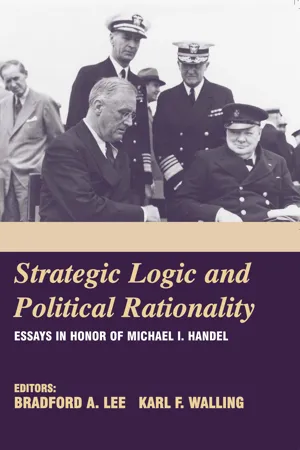
Strategic Logic and Political Rationality
Essays in Honor of Michael I. Handel
- 320 pages
- English
- ePUB (mobile friendly)
- Available on iOS & Android
eBook - ePub
Strategic Logic and Political Rationality
Essays in Honor of Michael I. Handel
About this book
One of three volumes in honour of the teaching and scholarship of the late Michael I. Handel, this book details the universal logic of strategy and the ability of liberal-democratic governments to address this logic rationally.
Treating war as an extension of politics, the diverse contributors (drawn from the United States, the United Kingdom, Australia and Israel) explore the difficulties in matching strategy to policy, especially in free societies.
Information
PART I:
STRATEGIC LOGIC
1
Strategy in War and Sports: A Comparison
Sports and war have many obvious similarities, not least because many cultures—from medieval Europe to the tribes of the North American plains—have blurred the distinctions between them. Both involve winning and losing, both settle disputes, and both arouse the same emotions of fear, excitement, euphoria, and shame. In both realms, men (and, increasingly, women) wear uniforms and compete on behalf of larger populations, and both feature endless ex post facto analysis, or ‘Monday morning quarterbacking’. Discussions of war rely heavily upon metaphors from sport, and vice versa.
Differences are, however, equally critical. Sports are a closely regulated competition that take place according to complex rules kept by neutral officials. Such rules are designed to level the playing field—a complete contrast to war, where both sides seek superiority of all kinds. Athletic contests take place within specified limits of time and space, while wars do not. Elements of physical danger, while certainly present in sport, are generally kept within bounds. Most important of all, sports take place largely for their own sake, while war, as Clausewitz tells us, aims at a broader political objective. In war, victory on the battlefield is only a means; in sports, victory is the end, whether defined with regard to one game, or a long series of games that make up a season. Even at the highest levels of analysis, however, similarities between war and sport abound.
Proceeding from the highest levels to the lowest, I shall explore some of the more telling analogies between these two realms. First, at the policy level, we shall look at the tension in both sport and war between long-term and short-term goals, an issue that raises problems of innovation, cost, and even when to fight. Moving downward to the strategic level, we shall see how some of war’s best-known strategic maxims have won various types of games, as well as wars. And, lastly, we shall look at the similar demands that sports and war make upon individuals, and how, in both cases, competitors can cope with these demands and even turn them to their advantage.
Battles and Broader Objectives
Wars, of course, may have many different goals. Victory is the primary goal of sport, but it is not the only one. Modern professional sports seek profit as well as victory, and we shall find that the two goals can often conflict. In addition, sports, like war, often force commanders to assign greater or lesser importance to individual campaigns, or even wars, and to distribute their effort accordingly. Lastly, neither sports nor war ever stand still, and teams, like nations and military services, must innovate to remain victorious. They experience some of the same difficulties in doing so.
Money, in modern team sports, is both one of the objects of the ownership and the tool that enables teams to win. Professional American baseball now faces, and not for the first time, a situation in which about half of its teams do not have the resources to buy a winning set of ball players in an increasingly free market. (Although the press frequently portrays this situation as a consequence of free agency, richer teams have always enjoyed an advantage, and from 1920 to the late 1940s the Philadelphia Phillies, Boston Braves, and St Louis Browns had even less chance of winning a pennant than teams like the Montreal Expos or Pittsburgh Pirates do today.) During the past ten years, several teams, including the San Diego Padres, the Florida Marlins, and the Chicago White Sox, have chosen to forego victory in the short and medium term in exchange for higher profits and unloaded some of the more expensive players on their roster. This step was especially striking in the case of the Marlins, who sold off their team after winning the 1997 World Series. In an earlier era, Connie Mack, who owned and managed the Philadelphia Athletics for almost half a century, confessed late in his career that he preferred a team that contended, but did not win, since it would draw fans to the ball park without requiring him to raise his players’ salaries in exchange for a pennant. While international politics and war may not offer exact analogies to this phenomenon, teams that forego attempts at total victory are similar, in some respects, to nations that insist upon proclaiming goals that they lack either the will or the resources to achieve, or to smaller nations who give up some of their independence in exchange for security provided by a powerful ally.
The difficult relationship of battles to campaigns and wars plays an enormous part in sport, as well as war. Such problems pose special challenges for leading European soccer teams, which often have to fight on two or even three fronts at once: their domestic league competition, a domestic cup competition, and a European cup (or now, ‘Champions’ League’) competition. At some point in every season, some teams must decide to make one or the other of these goals their ‘center of gravity’, as it were, and rest players and schedule practice accordingly. In almost every American sport, the use of ever-increasing rounds of playoffs to determine the national champion at the end of the season has inevitably diminished the intensity of competition during the regular season—a campaign that it is no longer necessary to win. The best tennis players and golfers save their best efforts for the Grand Slam events. Games, like battles, have different levels of significance, and both generals and coaches understand this and act accordingly.
Sometimes even an entire season has to be sacrificed for the sake of the future. Bill Russell joined the Boston Celtics in late 1956, and that team won its first NBA (National Basketball Association) championship a few months later. They were on their way to a second one in 1958 when Russell sprained his ankle during the final playoff series against the St Louis Hawks. Russell returned to action for a few minutes in the next game, but his coach Red Auerbach—one of the most successful strategists in the history of sport—pulled the limping center out of the game. ‘There’ll be other seasons, Russ’, Auerbach said—and the Celtics and Russell won the next eight NBA championships in a row.
The need to innovate—to abandon proven tactics, weapons, and strategies that have become obsolete—is one of the most difficult problems armies and nations face. The same problem plays at least as big a role in professional sports, where players are the team’s ‘weapons’, and where all of them are subject to obsolescence simply because of the deterioration of the human body. In the same way that the battleship became the symbol of great navies in the early twentieth century, established star players become, and remain, the symbols of successful teams—often well after their peak effectiveness has passed. In baseball, Branch Rickey, who created and maintained great teams with the St Louis Cardinals in the 1920s and 1930s and the Brooklyn Dodgers in the 1940s, was one of the first to realize this. ‘You think you’re all right at first base’, he explained patiently to his Brooklyn manager Leo Durocher in 1943,
Because you have a big-name player there who has done better in his day. You keep hoping he’ll do better again. At any rate, you think he’ll do well enough… The bad ball players don’t hurt you so much because you know they’re bad, and you take steps to replace them. But the…‘good enough’ boys kill you.1
Rickey, of course, could just as easily have been describing the Prussian Army in 1806 or the Royal Navy in 1940. The American football general manager who trades established stars for draft choices, or the soccer manager, like Sir Alex Ferguson of Manchester United, who lets stars transfer with several years of effectiveness left and breaks in younger players in their place, understands this principle. The championship team that automatically begins the next season with the same cast of characters—like the cavalry general on the eve of World War I—does not.
Indeed, Bill James, the American baseball theorist (or ‘sabermetrician’), reduced this concept to what he called The Law of Competitive Balance’ in 1982. ‘There develop over time’, he wrote, ‘separate and unequal strategies adopted by winners and losers; the balance of those strategies favors the losers, and thus serves constantly to narrow the difference between the two.’2 Teams that improved in one year, James had discovered, tend to decline in the next (in part because their improvement owed something to luck), and vice-versa. This law, he acknowledged, had application far beyond sports. In the 1920s and 1930s, the British and French counted on defensive warfare and economic strength to win a new conflict with Germany, while the defeated Germans planned new tactics based upon new weapons to reverse the outcome of World War I. Defeat—in sport as in war—frees the defeated from the dogmas of the past and helps them discover new energy to improve. Victory is a soporific, and, human nature being what it is, these patterns repeat themselves again and again. In sport as in war one must not only distinguish between long- and short-term goals, one must also recognize the need for changing the weapons and tactics to achieve them.
Fundamentals of Strategy
Several basic strategic arguments have dominated the analysis of war since the beginning of recorded history. The same arguments, and the same contrasting strategies, continually emerge and re-emerge in the world of sport.
‘Know the enemy, know yourself’, says Sun Tzu,3 and you will not lose once in a hundred battles. This remains perhaps the most questionable of all the Chinese master’s maxims, since it ignores the critical role of chance in war, as in sport, but, nonetheless, winning through information dominance and surprise—as MacArthur did in Inchon and Brasidas did in Thrace—has been the goal of many great teams and players. In the 1980s, Bill Walsh of the San Francisco 49ers tried to secure information dominance by scripting the first 21 plays his offense would run, making it impossible for the defense to infer the next play from the results of the previous few, or even from the down-and-yardage situation. He also included new, trick plays early in the game to create confusion.4 In his 1974 fight to regain the heavyweight title from George Foreman, Muhammad Ali stunned the champion in the first round with an unexpected tactic—a series of effective right leads to the jaw.
Tennis players and fans alike know the importance of getting the first serve in the court, but few realize that this tactic also relies mainly on information dominance. A first serve is usually faster than a second one, but, more importantly, it is far less predictable, and the receiver cannot set himself up to hit a particular shot before he sees it. In baseball the never-ending duel between pitchers and catchers on one side and hitters on the other turns on the batter’s ability to anticipate the next pitch. Confidence plays an enormous role in both sport and war, and nothing increases confidence like the knowledge that the enemy has been caught unawares.
Clausewitz, a somewhat more methodical strategist than Sun Tzu, argues for strength everywhere, but especially at the decisive point. For the Green Bay Packers of the 1960s or the Dallas Cowboys of the 1990s, this point was the offensive line that ensured their control of the ball and their dominance. In baseball, a belief in the decisive nature of the last inning or two has led teams since the 1990s to reserve an outstanding pitcher as a ‘closer’, whose role is to protect such a lead. The great baseball theorist Bill James has himself made a military analogy, arguing that Napoleon was the inventor of relief pitching, since he held troops in reserve for the crucial moment, but in his latest book he has also shown through simulations that today’s teams are making a mistake by reserving their closer for situations in which they are leading, since a more decisive point arises when the teams are tied in the late innings.5 This conclusion illustrates another common aspect of war and sport: how certain strategies become dominant within a particular army, or even within all contemporary armies, even though other strategies would work better. In the widely different sports of base-ball and soccer, many teams have won by being ‘strong down the middle’—a term which refers to the catcher, second baseman, shortstop and centerfielder in baseball, and the goalkeeper, central defender, central midfielder and center forward in soccer. In tennis, the ‘decisive point’ refers literally to break point, and players frequently reserve particular serves or tactics to deal with the points that can easily cost them sets and matches.
Sun Tzu advises warriors to fight on their own terms, not the enemy’s, and few military maxims have found better application in sport. From 1923 through 1973, Yankee Stadium, the home of the Yankees, measured well over 400 feet to center and left-center field, but only ...
Table of contents
- Cover
- Halftitle
- Title
- Copyright
- Dedication
- Contents
- Acknowledgements
- Notes on Contributors
- Introduction
- Part I: Strategic Logic
- Part II: Political Rationality
- Index
Trusted by 375,005 students
Access to over 1.5 million titles for a fair monthly price.
Study more efficiently using our study tools.
Frequently asked questions
Yes, you can cancel anytime from the Subscription tab in your account settings on the Perlego website. Your subscription will stay active until the end of your current billing period. Learn how to cancel your subscription
No, books cannot be downloaded as external files, such as PDFs, for use outside of Perlego. However, you can download books within the Perlego app for offline reading on mobile or tablet. Learn how to download books offline
Perlego offers two plans: Essential and Complete
- Essential is ideal for learners and professionals who enjoy exploring a wide range of subjects. Access the Essential Library with 800,000+ trusted titles and best-sellers across business, personal growth, and the humanities. Includes unlimited reading time and Standard Read Aloud voice.
- Complete: Perfect for advanced learners and researchers needing full, unrestricted access. Unlock 1.5M+ books across hundreds of subjects, including academic and specialized titles. The Complete Plan also includes advanced features like Premium Read Aloud and Research Assistant.
We are an online textbook subscription service, where you can get access to an entire online library for less than the price of a single book per month. With over 1.5 million books across 990+ topics, we’ve got you covered! Learn about our mission
Look out for the read-aloud symbol on your next book to see if you can listen to it. The read-aloud tool reads text aloud for you, highlighting the text as it is being read. You can pause it, speed it up and slow it down. Learn more about Read Aloud
Yes! You can use the Perlego app on both iOS and Android devices to read anytime, anywhere — even offline. Perfect for commutes or when you’re on the go.
Please note we cannot support devices running on iOS 13 and Android 7 or earlier. Learn more about using the app
Please note we cannot support devices running on iOS 13 and Android 7 or earlier. Learn more about using the app
Yes, you can access Strategic Logic and Political Rationality by Bradford A. Lee,Karl F. Walling in PDF and/or ePUB format, as well as other popular books in Politics & International Relations & International Relations. We have over 1.5 million books available in our catalogue for you to explore.