- 336 pages
- English
- ePUB (mobile friendly)
- Available on iOS & Android
eBook - ePub
About this book
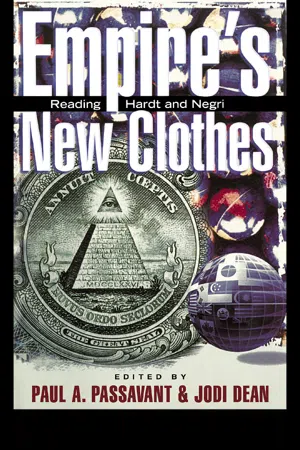
The publication of Empire last year created a sensation that spread from academia to the media to cocktail-party buzz. A book that causes such a scholarly commotion comes along only once every decade or so wrote the New York Times , as the book's radical vision of imperial power in the new millennium sparked both histrionic condemnation and serious academic engagement. After September 11 this discussion of Empire's political and legal theories was closely linked with the struggle to redefine America's place in a changed world. The book was read as a diagnosis of our era and a call for liberatory action, while Michael Hardt was acclaimed as the next Jacques Derrida. Framing the debate about this landmark work, The Empire's New Clothes brings together leading scholars to make sense of Empire's new vocabulary and tackle its claims head on. Does the authors' vision accurately describe the power structure of today's world? Do the processes of globalization today represent a fundamental break from the past? Is the book really a communist manifesto for the new age? Empire's New Clothes investigates these and other key issues, giving academics, students, and lay readers a handle on a work that touches the most vital themes of current political, social, and economic life.
Trusted by 375,005 students
Access to over 1.5 million titles for a fair monthly price.
Study more efficiently using our study tools.
Information
Immanence
1
Can Immanence Explain Social Struggles?
In a recent interview,1 Jacques Rancière opposes his notion of “people” (peuple)2 to the category of “multitude” as presented by the authors of Empire. As is well known, Rancière differentiates between police and politics, the first being the logic of counting and assigning the population to differential places, and the second, the subversion of that differentiating logic through the constitution of an egalitarian discourse which puts into question established identities. The “people” is the specific subject of politics and presupposes a sharp division in the social body that cannot be led back to any kind of immanent unity. Empire, on the contrary, makes immanence its central category and the ultimate ground of the multitude’s unity.
It is worthwhile describing the main lines of Rancière’s critique because they provide a good starting point for what we have to say about the book on which we are commenting. The immanentism of Hardt and Negri would be linked, according to Rancière, to their Nietzschean/Deleuzian ethics of affirmation, which does away with any reactive or negative dimension. Empire would belong, in that respect, to the whole tradition of modern political philosophy, which is profoundly metapolitical: “the kernel of metapolitics is to lead back the precarious artifices of the political scene to the truth of an immanent power which organizes beings in a community and identifies the true community with the grasped and sensible operation of this truth.”3 From Hardt’s and Negri’s rejection of any inherent negativity in political subjects it follows that the power inherent in the multitude has to be a disruptive power, “lodged in all state of domination as its ultimate content, a content destined to destroy all barriers. ‘Multitudes’ have to be a content whose continent is Empire.”4 Disruptive forces operating through a purely immanent movement are what Marxist theory called ‘productive forces’ and there would be, according to Rancière, a strict homology between the place of productive forces and that in which multitudes, as described in Empire, act. Rancière points out that productive forces should not necessarily be understood in any narrow productivist sense: there has been a constant widening of the concept from the strict economism of classical Marxism to the recent attempts to introduce in it the ensemble of scientific and intellectual abilities, passing through the Leninist attempt to supplement via political intervention a role that productive forces refused to fulfill.
I think that Rancière has rightly stressed what I see as the main source of several weaknesses of Empire, including a central one: that within its theoretical framework, politics becomes unthinkable. So I will start from a discussion of its notion of immanence and move later to various other theoretical and political aspects of the book.
Let us start with the authors’ discussion of the origins of European modernity. While the usual insistence is on the secularization process, that process would be: “in our view…only a symptom of the primary event of modernity: the affirmation of the powers of this world, the discovery of the plane of immanence. ‘Omne eus habet aliquod esse proprium’—every entity has a singular essence. Duns Scotus’ affirmation subverts the medieval conception of being as an object of analogical and thus dualistic predication—a being with one foot in this world and one in a transcendental realm.”5 Duns Scotus’s insistence on the singularity of being would have started an assertion of immanence that the authors describe as a process whose representative names would have been Nicholas of Cusa, Pico della Mirandola, and Bovillus—other names quoted are Bacon and Occam—and whose point of arrival is Spinoza: “By the time we arrive at Spinoza, in fact, the horizon of immanence and the horizon of the democratic political order coincide completely. The plane of immanence is the one on which the powers of singularity are realized and the one on which the truth of the new humanity is determined historically, technically and politically. For this very fact, because there cannot be any external mediation, the singular is presented as the multitude.”6 The revolution, however, ran into trouble. It had its Thermidor. The Thirty Years War was the outcome, and the need for peace led to the defeat of the forces of progress and the instauration of absolutism.
The first striking thing that one finds in this analysis is that it gives us a truncated narrative. For the assertion of a radical immanentism does not start, as Hardt and Negri seem to believe, at the time of Duns Scotus but much earlier, during the Carolingian Renaissance—more precisely, in Scotus Erigena’s De Divisione Naturae. And in its initial formulations it had nothing to do with sec ularism, for it was an answer to strictly theological difficulties. The attempt to go back to those origins does not obey a purely erudite scruple; on the contrary, to clarify the context of theological alternatives of which immanentism was only one has direct relevance to the political issues that we are discussing today. The original theological question—which occupied the mind, among others, of no less a thinker than Saint Augustine—was how to make compatible the worldly existence of evil with divine omnipotence. If God is responsible for evil, he cannot be absolute Goodness; if he is not responsible for evil, he is not Almighty. Immanentism in its first formulations is an answer to this question. According to Erigena, evil does not really exist, for things we call evil are necessary stages that God has to pass through in order to reach his divine perfection. But this is obviously impossible without God being, somehow, internal to the world.
From that point onward, immanentism had a long career in Western thought. It is very much present in Northern mysticism and in some of the authors discussed in Empire, such as Nicholas of Cusa and Spinoza, and it is going to find its highest point in Hegel and Marx. Hegel’s cunning of reason closely follows the argument that Erigena formulated one thousand years before. As the Philosophy of History asserts, universal history is not the terrain of happiness. And the Marxian version is scarcely different: society had to supersede primitive communism and pass through the whole hell of class division to develop the productive forces of humanity, and it is only at the end of the process, in a fully developed communism, that the rationality of all this suffering become visible.7
What are, however, really important in reference to these theological debates are the other existing alternatives in case the immanentist route is not followed. For in that case evil is not the appearance of a rationality underlying and explaining it, but a brute and irreducible fact. As the chasm separating good and evil is strictly constitutive and there is no ground reducing to its immanent development the totality of what exists, there is an element of negativity that cannot be eliminated either through dialectical mediation or through Nietzschean assertiveness. We are not very far here from the alternatives referred to by Rancière in his interview. (Let us observe that, strictly speaking, the category of excess is not incompatible with the notion of a nondialectical negativity that we are proposing. It is only if we try to combine excess with immanence that the nonpolitical turn that we will presently discuss is unavoidable.)
In the same way that, with modernity, immanence ceased to be a theological concept and become fully secularized, the religious notion of evil becomes, with the modern turn, the kernel of what we can call “social antagonism.” What the latter retains from the former is the notion of a radical disjuncture—radical in the sense that it cannot be reabsorbed by any deeper objectivity that would reduce the terms of the antagonism to moments of its own internal movement, for example, the development of productive forces or any other form of immanence. Now, I would contend that it is only by accepting such a notion of antagonism— and its corollary, which is radical social division—that we are confronted with forms of social action that can truly be called political Why so? To show this I will consider an early text by Marx that I have discussed fully elsewhere.8 In it, Marx opposes a purely human revolution to a merely political one. The differential feature is that in the former a universal subject emerges in and for itself. In the words of Marx: “By proclaiming the dissolution of the hitherto world order the proletariat merely states the secret of its own existence, for it is in fact the dissolution of that world order.” To put it in terms close to Hardt and Negri: the universality of the proletariat fully depends on its immanence within an objective social order that is entirely the product of capitalism—which is, in turn, a moment in the universal development of the productive forces. But precisely because of that reason, the universality of the revolutionary subject entails the end of politics—that is, the beginning of the withering away of the State and the transition (according to the Saint-Simonian motto adopted by Marxism) from the government of men to the administration of things.
As for the second revolution—the political one—its distinctive feature is, for Marx, an essential asymmetry: that between the universality of the task and the particularism of the agent carrying it out. Marx describes this asymmetry in nonequivocal terms: a certain regime is felt as universal oppression, and that allows the particular social force able to lead the struggle against it to present itself as universal liberator—universalizing, thus, its particular objectives. Here we find the real theoretical watershed in contemporary discussions: either we assert the possibility of a universality that is not politically constructed and mediated or we assert that all universality is precarious and depends on a historical construction out of heterogeneous elements. Hardt and Negri accept the first alternative without hesitation. If, conversely, we accept the second, we are on the threshold of the Gramscian conception of hegemony. (Gramsci is another for whom—understandably given their premises—Hardt and Negri show little sympathy.)
It is interesting to see the consequences that Empire draws from its approach to immanence. There is an actual historical subject of what they conceive as the realization of a full immanence: it is what they call the “multitude.” The full realization of the multitude’s immanence would be the elimination of all transcendence. This can be accepted only, of course, if the postulate of the homogeneity and unity of the multitude as an historical agent is not put into question—a matter to which we will return shortly. But some of the results of this strict opposition between immanence and transcendence can be quickly detected. Let us take their way of dealing with the question of sovereignty. For them, modern political sovereignty—well anchored in the counterrevolution ary trend of the second modernity—is reduced to the attempt at constructing a transcendent political apparatus:
Sovereignty is thus defined both by transcendence and by representation, two concepts that the humanist has posed as contradictory. On the one hand, the transcendence of the sovereign is founded not on an external theological support but only on the immanent logic of human relations. On the other hand, the representation that functions to legitimate this sovereign power also alienates it completely from the multitude of subjects…. Here [in Bodin and Hobbes] the concept of modern sovereignty is born in its state of transcendental purity. The contract of association is intrinsic to and inseparable from the contract of subjugation.9
So sovereignty was an essentially repressive device trying to prevent the democratic upsurge of an unspecified multitude. What a beautiful fabula! For as anybody acquainted with the modern theory of sovereignty knows, its practical implementation entailed a far more complicated process than the story proposed by Hardt and Negri. In the first place, the multitude they are speaking about is a purely fanciful construction. What we had in early modernity was an estamental society, profoundly fragmented, which did not move at all in the direction of constructing a unified political subject capable of establishing an alternative social order. Royal sovereignty was established fighting on a double front: against the universalistic powers—the Church and the Empire—and against local feudal powers. And many newly emerging social sectors—bourgeois, especially —were the social base that made possible the emergence of royal sovereignty. That the transference of control of many social spheres to the new social states is at the root of the new forms of biopower is incontestable, but the alternative to that process was not autonomous power of any hypothetical multitude but the continuation of feudal fragmentation. It is more: it was only when this process of centralization had advanced beyond a certain point that something resembling a unitary multitude could emerge through the transference of sovereignty from the king to the people.
This leads us to the second aspect of Hardt’s and Negri’s dichotomy: the question of representation. What are the conditions for the elimination of any form of representation? Obviously, the elimination of any kind of asymmetry between actual political subjects and the community as a whole. If the volonté générale is the will of a subject whose limits coincide with those of the community, there is no need for any relation of representation but neither for the continuation of politics as a relevant activity. That is why, as we mentioned earlier, the emergence of a universal class heralded, for Marxism, the withering away of the State. But if we have an internally divided society, the will of the community as a whole has to be politically constructed out of a primary— constitutive—diver sity. In that case, the volonté générale requires representation as its primary terrain of emergence. This means that any “multitude” is constructed through political action—which presupposes antagonism and hegemony.
The reason why Hardt and Negri do not even pose themselves this question is that for them the unity of the multitude results from the spontaneous aggregation of a plurality of actions that do not need to be articulated between themselves. In their words: “If these points were to constitute something like a new cycle of struggles, it would be a cycle defined not by the communicative extension of the struggles but rather by their singular emergence, by the intensity that characterizes them one by one. In short, this new phase is defined by the fact that these struggles do not link horizontally, but each one leaps vertically, directly to the virtual center of Empire”(58).
One cannot avoid finding it a little difficult to understand how an entity that has no boundaries—“The concept of Empire is characterized fundamentally by a lack of boundaries: Empire’s rule has no limits” (xix)—can still have a virtual center, but let it pass. What we are told, anyway, is: 1) that a set of unconnected struggles tend, by some kind of coincidentia oppositorum, to converge in their assault on a supposed center; 2) that in spite of their diversity, without any kind of political intervention, they will tend to aggregate with each other; and 3) that they could never have aims that are incompatible with each other. It does not take long to realize that these are highly unrealistic assumptions, to put it mildly. They clash with the most elementary evidence of the international scene, which shows us a proliferation of social actors fighting each other for a variety of religious, ethnic, or racial reasons. And the assumption that imperialism is over (“The United States does not and indeed no nation-state can today, form the center of an imperialist project. No nation will be world leader in the way modern European nations were”) does not fare any better, as anybody looking at what is going on in the world after September 11 can easily realize (xiv; emphasis in original). What is totally lacking in Empire is a th...
Table of contents
- Cover Page
- Title Page
- Copyright Page
- Acknowledgments
- Introduction Postmodern Republicanism
- Immanence 1: Can Immanence Explain Social Struggles?
- Transcendence 2: The Immanence of Empire
- Market 3: On Divine Markets and the Problem of Justice: Empire As Theodicy
- Law 4: Legal Imperialism: Empire’s Invisible Hand?
- Representation 5: From Empire’s Law to the Multitude’s Rights: Law, Representation, Revolution
- Sovereignty 6: Representing the International: Sovereignty After Modernity?
- Global 7: Africa’s Ambiguous Relation to Empire and Empire
- Intermezzo: The Theory & Event Interview
- Space 8: The Repositioning of Citizenship: Emergent Subjects and Spaces for Politics
- Place 9: The Irrepressible Lightness and Joy of Being Green: Empire and Environmentalism
- Migration 10: Smooth Politics
- Generation 11: Taking the Millennialist Pulse of Empire’s Multitude: A Genealogical Feminist Diagnosis
- Capitalism 12: The Ideology of the Empire and Its Traps
- Communication 13: The Networked Empire: Communicative Capitalism and the Hope for Politics
- Revolution 14: The Myth of the Multitude
- Event 15: Representation and the Event
- Contributors
Frequently asked questions
Yes, you can cancel anytime from the Subscription tab in your account settings on the Perlego website. Your subscription will stay active until the end of your current billing period. Learn how to cancel your subscription
No, books cannot be downloaded as external files, such as PDFs, for use outside of Perlego. However, you can download books within the Perlego app for offline reading on mobile or tablet. Learn how to download books offline
Perlego offers two plans: Essential and Complete
- Essential is ideal for learners and professionals who enjoy exploring a wide range of subjects. Access the Essential Library with 800,000+ trusted titles and best-sellers across business, personal growth, and the humanities. Includes unlimited reading time and Standard Read Aloud voice.
- Complete: Perfect for advanced learners and researchers needing full, unrestricted access. Unlock 1.5M+ books across hundreds of subjects, including academic and specialized titles. The Complete Plan also includes advanced features like Premium Read Aloud and Research Assistant.
We are an online textbook subscription service, where you can get access to an entire online library for less than the price of a single book per month. With over 1.5 million books across 990+ topics, we’ve got you covered! Learn about our mission
Look out for the read-aloud symbol on your next book to see if you can listen to it. The read-aloud tool reads text aloud for you, highlighting the text as it is being read. You can pause it, speed it up and slow it down. Learn more about Read Aloud
Yes! You can use the Perlego app on both iOS and Android devices to read anytime, anywhere — even offline. Perfect for commutes or when you’re on the go.
Please note we cannot support devices running on iOS 13 and Android 7 or earlier. Learn more about using the app
Please note we cannot support devices running on iOS 13 and Android 7 or earlier. Learn more about using the app
Yes, you can access Empire's New Clothes by Paul Passavant,Jodi Dean in PDF and/or ePUB format, as well as other popular books in Politics & International Relations & Globalisation. We have over 1.5 million books available in our catalogue for you to explore.