eBook - ePub
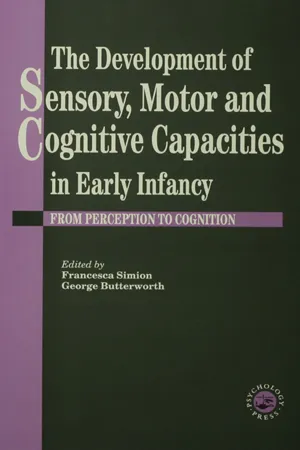
The Development Of Sensory, Motor And Cognitive Capacities In Early Infancy
From Sensation To Cognition
- 352 pages
- English
- ePUB (mobile friendly)
- Available on iOS & Android
eBook - ePub
The Development Of Sensory, Motor And Cognitive Capacities In Early Infancy
From Sensation To Cognition
About this book
Research on the development of human infants has revealed remarkable capacities in recent years. Instead of stressing the limitations of the newborn, the modern approach is now more optimistically based on an assessment of the adaptive capabilities of the infant. Innate endowment, coupled with interaction with the physical and social environment, enables a developmental transition from processes deeply rooted in early perception and action to the cognitive and language abilities typical of the toddler.; This book reviews a number of issues in early human development. It includes a reconceptualization of the role of perception at the origins of development, a reconciliation of psychophysical and ecological approaches to early face perception, and building bridges between biological and psychological aspects of development in terms of brain structure and function. Topics covered include basic exploratory processes of early visual systems in early perception and action; face perception in newborns, species typical aspects of human communication, imitation, perception of the phonetic structure of speech, origins of the pointing gesture, handedness origins and development, theoretical contributions on perception and cognition, implicit and explicit knowledge in babies; sensory-motor coordination and cognition, information processing and cognition, perception, habituation and the development of intelligence from infancy.
Trusted by 375,005 students
Access to over 1.5 million titles for a fair monthly price.
Study more efficiently using our study tools.
Information
PART I
The Visual System in Early Development
CHAPTER ONE
The ‘Where and What’ or ‘Who and How’ of Visual Development
Janette Atkinson
University College, London, UK
A number of neurobiological models of visual development have been put forward over the past twenty years. One popular idea is that of two visual systems: a primitive, evolutionarily older subcortical system controls orienting responses which define crudely ‘where’ an object is located and triggers foveation, while newer cortical mechanisms define ‘what’ is actually in the foveated area. Using this idea, Bronson (1974) suggested that newborn vision is totally subcortically controlled with the cortex starting to mature at around 2 months postnatally. Atkinson (1984) put forward a modified model in which the newborn visual system is largely subcortically controlled, with executive control of vision being taken over by a number of cortical modules postnatally. These cortical modules can be thought of as a number of cortical streams, each specifically processing particular types of visual information and each becoming operational at different ages.
These hypotheses have been updated in the light of both recent infant data and ideas arising out of models of adult vision. The first model of the adult visual system is based largely on primate studies, which have dissociated a ‘where’ and a ‘what’ system within the cortical pathways. Zeki and his co-workers first defined an area selective for motion information (V5 or MT) and a colour specific area, V4 (Zeki 1974, 1978, 1983). Ungerleider and Mishkin (1982) suggested that the two streams are associated with different visual capacities – a largely parietal module is involved in localizing objects within a spatial array and is intimately linked to eye movement mechanisms of selective attention, while the temporal lobe contains mechanisms tuned to ‘what’ aspects such as form, colour and face recognition. Clinical observations of patients with specific focal lesions have shown a dissociation between loss of position or movement perception and deficits of object recognition (e.g. Damasio & Benton, 1979; Milner & Goodale, 1995; Zihl et al., 1983).
The second model of the adult system is based on the idea of parvocellular and magnocellular streams. The two streams are distinct at ganglion cell and LGN levels, project to different parts of primary visual cortex, V1, and continue within independent cortical streams to V4 and V5 (Livingstone & Hubel, 1988; Maunsell & Newsome, 1987; Van Essen & Maunsell, 1983). The parvocellular-based system is proposed to subserve detailed form vision and colour, while the magnocellular system subserves movement perception and some aspects of stereoscopic vision. Comparisons have been made between psychophysical data on adults and the functioning of the parvo-based and magno-based pathways. Similar comparisons are made from looking at the time course of development of specific cortical modules in infant development. It appears that there is some evidence to suggest that parvocellular-based systems may become operational slightly earlier than magnocellular-based systems (Atkinson, 1992).
Goodale and Milner (1992) suggest that the distinction between the ‘where’ and ‘what’ cortical streams is not one for separating different properties, such as colour and movement, but rather two broad categories of visual coding. One stream is useful for perception and one for action. As the ventral pathways contain specialized areas for face perception and the dorsal stream contains systems for controlling eye movements, reaching and grasping, we can rename these systems the ‘who?’ and the ‘how?’ mechanisms. Rather than two distinct streams, Goodale and Milner suggest multiple streams, loosely connected into two broad modules, with each operating in an internal coordinated fashion. The relatively fast ‘action’ module has a very short memory and is for automatic ‘unconscious’ immediate responses whereas the ventral stream controls ‘conscious’ awareness and interactions with more long-lasting elaborate memory stores. When this model is applied to human development we can see that it is not only possible to have differential timing of functional development between the two major streams, but it is also possible to have differential development, internally, within each stream. A very obvious example is the differential development in babies of ‘action’ modules for reaching and grasping as opposed to walking. Both these action programmes must involve some spatial analysis of the visual layout, but there may be quite different scales used, one involving nearby space relative to the infant’s body and one involving peripheral vision and spatial layout some distance from the child. So although some initial perceptual analysis will be common to both reaching and walking, the integration of this information from the ventral stream with the appropriate motor programmes and spatial maps in the dorsal stream may be different and have different functional onsets.
This means that our theory of visual development involves a first stage with development of functioning in specific cortical channels, followed by a second stage where information is integrated across channels within a single stream so that complete objects and people can have an internal representation, and this is followed by a third stage for directing actions to this object or person. We can think of the first and second stages taking part largely in the ventral stream, with dynamic online information added to this from the dorsal stream at stage three. Of course integration between information regarding colour, shape and texture and information about movement, must take place at a relatively early stage to enable separation of one object from another and each object to be separated from its background (figure–ground separation). These two processes of integration and segregation take place continuously and simultaneously, to provide smooth uninterrupted perception of a dynamically changing visual world. We do not as yet have a complete neurobiological model of these processes in adult or infant perception, but recent results on ‘structure from depth’ and ‘structure from motion’ do start to address these issues (e.g. Braddick, 1993).
In this chapter I will attempt to briefly summarize some of our current understanding of visual development from the neurobiological modelling perspective. For the sake of clarity I will divide visual development into three processes, although in the developing brain these processes are unlikely to be completely distinct. Our model will be considered to consist of three overlapping stages or processes:
1. Development of specific cortical modules. Here selectively tuned pools of cortical neurones become operational for processing distinct visual attributes such as relative size, shape, colour and movement.
2. Development of integration (‘binding’) and segmentation processes within and between ventral and dorsal streams. Here integration and segregation between and within subcortical and cortical modules become operational. These processes allow infants to recognise objects as a whole and to understand the dynamic spatial layout of the visual world. In any adult visuomotor act information must also be smoothly integrated from the ventral (perceptual) system and the dorsal (action) system. In this chapter I will discuss two new paradigms we have been using which show that even beyond infancy in early childhood this integration does not always happen. The child does not always seem to be able to integrate.
3. Development of selective attentional modules. Here attentional modules become operational, allowing the infant to shift visual attention from one object to another and shift between different levels of processing within a single object, e.g. local versus global processing in attending to a particular feature rather than the whole object.
As many of these areas have been discussed at length elsewhere, only a brief summary will be given in this chapter. Throughout this discussion I will use the term ‘module’ to describe a collection of brain areas thought to be interconnected regarding their functional significance in behaviour. The use of the term ‘stream’ implies some serial order between modules or within a module.
DEVELOPMENT OF SPECIFIC CORTICAL MODULES
Rationale (‘designer stimuli’): From primate electrophysiology we know that the adult visual cortex contains populations of neurons specifically sensitive (‘tuned’) to specific visual attributes. For example, a population of cortical neurons will give their maximum response to lines which are vertically oriented. We also know that neurons within the subcortical system are indifferent to many visual attributes. For example, neurons in subcortical visual areas are indifferent to the orientation or slant of a grating pattern. A general strategy to separate cortical functioning from subcortical functioning is to use ‘designer stimuli’, chosen to be appropriate stimuli for particular types of cortical neurons, which are within particular cortical streams.
Below, I describe briefly how we have used this approach to gauge the development of the infant’s sensitivity to a number of visual attributes. The examples considered are of course by no means exhaustive. In each case, we have designed our test so that, if the infant shows a discriminative response between two stimuli, which differ in only one dimension of one visual attribute, we can argue that the infant must have working neurons operating to enable discriminative responses. For example, if the infant shows a discriminative response between two grating patterns which differ only in the slant of the lines in the pattern, then we argue that the infant must have working cortical modules which are sensitive to differences along this particular dimension. The examples are given for changes of orientation, direction of motion and disparity.
Example 1: Development of the orientation module
Infants of a few days of age have been shown to discriminate between differently oriented static grating patterns (Atkinson et al., 1988; Slater et al., 1988). However, if dynamic stimuli are used, as is necessary in recording visual evoked potentials (VEPs), the age at which the first reliable VEP is recorded varies with the temporal parameters of the stimulus. In general if the stimulus changes in slant or orientation at relatively low rates (three times per second), a significant VEP is seen at a median age of three weeks postnatally. The discriminative response is found at an older age (around two to three months) if the stimulus changes orientation more rapidly (Braddick et al. 1989; Braddick et al., 1986a; Wattam-Bell, 1985). If the infant is shown a phase-reversing (PR) grating, where the grating is in a constant orientation, but the black and white stripes are periodically interchanged at 3rps or 8rps, a significant PR-VEP can be recorded for infants from birth. These results support the idea of very rapid development (or sensitivity at birth) of cortical modules for processing changes of orientation. But the response depends on the temporal properties of the stimulus as well as the spatial, and it seems that both spatial and temporal sensitivity improve with age. Different ranges of temporal and spatial sensitivity have been found in the cell properties of the magnocellular and parvocellular pathways (Derrington & Lennie, 1984). One plausible interpretation is that the magnocellular pathways are involved in fast temporal analysis, while the parvocellular pathways carry only slow temporal information. By analogy, we can argue from our results with infants that the orientation discrimination we see in the first few weeks of life is more likely to be related to parvocellular-based activity than to magnocellular-based modules.
Example 2: Development of the motion module
The results from infant studies on sensitivity to motion are quite puzzling. Motion provides a very direct source of information concerning the contents and layout of the environment and it would seem reasonable to imagine that modules for sensitivity to motion might be the first to become functional in development. It is of course true that young infants prefer moving to static visual stimuli. However the ability to distinguish between moving and stationary stimuli may reflect sensitivity to temporal modulation rather than motion as such and it is well known that infants show a preference for full field flicker (Regal et al., 1983), i.e. temporal modulation which lacks coherent motion. In general, true motion detectors are in evidence if a differential response to different directions of motion can be demonstrated
Indeed the newborn does have a crude directional system already operating as is evidenced by the optokinetic system, a stabilizing mechanism which is present in some form in the visual system of virtually every species. If newborn infants view with both eyes open a large or full field of random dots, moving horizontally at a relatively low velocity, optokinetic eye movements (OKN), with the smooth component of the eye movement following the direction of movement, can be elicited to both the left and right. In newborn infants viewing with one eye alone, monocular optokinetic nystagmus (mOKN) can only be driven by a stimulus pattern moving nasalward (i.e. towards the nose): mOKN is not elicited by movement in the opposite direction (Atkinson, 1979; Atkinson & Braddick, 1981). Neurophysiological studies suggest that OKN is mediated by a subcortical nucleus, the nucleus of the optic tract (NOT). At birth each NOT is driven only by direct crossed input from the contralateral eye, and responses of neurons in each NOT show the same asymmetry of OKN as newborn infants. This means that the newborn binocular response can be generated by stimulation of one NOT from the right eye for rightward movement and stimulation of the other NOT and eye for leftward movement. It is proposed that at a later age an indirect pathway from visual cortex to NOT becomes functional, allowing symmetrical OKN responses with monocular viewing.
To measure cortical directional mechanisms in infants, we have used designer stimuli consisting of two-dimensional random dot displays, which can have a particular direction of motion without the confounding presence of any dominant orientation component. In a similar way to the OR-VEP technique, we can generate a VEP to a change in the direction of motion of a set of random dots (Wattam-Bell, 1988, 1991). The first significant motion VEP for a velocity of 5 deg/sec appears at around 6-8 weeks of age, with onset for higher velocities occurring later (Wattam-Bell, 1991). Parallel behavioural studies show once again that the velocity is a critical determinant in obtaining discrimination of relative motion at different ages (Wattam-Bell, 1990) but true cortical directional detectors have not as yet been demonstrated prior to 6–8 weeks of age with...
Table of contents
- Cover Page
- Half Title page
- Title Page
- Copyright Page
- Contents
- List of Contributors
- Preface
- Part I The Visual System in Early Development
- Part II Face Perception: Psychological and Neurological Models
- Part III Perception, Action and Communication
- Part IV Perception and Cognition
- Author Index
- Author Index
- Subject Index
- Subject Index
Frequently asked questions
Yes, you can cancel anytime from the Subscription tab in your account settings on the Perlego website. Your subscription will stay active until the end of your current billing period. Learn how to cancel your subscription
No, books cannot be downloaded as external files, such as PDFs, for use outside of Perlego. However, you can download books within the Perlego app for offline reading on mobile or tablet. Learn how to download books offline
Perlego offers two plans: Essential and Complete
- Essential is ideal for learners and professionals who enjoy exploring a wide range of subjects. Access the Essential Library with 800,000+ trusted titles and best-sellers across business, personal growth, and the humanities. Includes unlimited reading time and Standard Read Aloud voice.
- Complete: Perfect for advanced learners and researchers needing full, unrestricted access. Unlock 1.5M+ books across hundreds of subjects, including academic and specialized titles. The Complete Plan also includes advanced features like Premium Read Aloud and Research Assistant.
We are an online textbook subscription service, where you can get access to an entire online library for less than the price of a single book per month. With over 1.5 million books across 990+ topics, we’ve got you covered! Learn about our mission
Look out for the read-aloud symbol on your next book to see if you can listen to it. The read-aloud tool reads text aloud for you, highlighting the text as it is being read. You can pause it, speed it up and slow it down. Learn more about Read Aloud
Yes! You can use the Perlego app on both iOS and Android devices to read anytime, anywhere — even offline. Perfect for commutes or when you’re on the go.
Please note we cannot support devices running on iOS 13 and Android 7 or earlier. Learn more about using the app
Please note we cannot support devices running on iOS 13 and Android 7 or earlier. Learn more about using the app
Yes, you can access The Development Of Sensory, Motor And Cognitive Capacities In Early Infancy by Butterworth University of Sussex., George Butterworth,Francesca Simion, George Butterworth, Francesca Simion in PDF and/or ePUB format, as well as other popular books in Psychology & Developmental Psychology. We have over 1.5 million books available in our catalogue for you to explore.