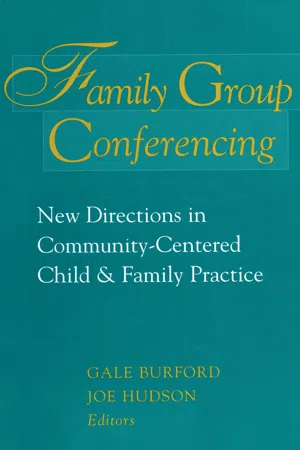
eBook - ePub
Family Group Conferencing
New Directions in Community-Centered Child and Family Practice
- 338 pages
- English
- ePUB (mobile friendly)
- Available on iOS & Android
eBook - ePub
Family Group Conferencing
New Directions in Community-Centered Child and Family Practice
About this book
Family Group Conferencing indicates a large-scale shift in assumptions about the way child welfare services are planned and delivered - away from models that emphasize pathology, and toward those seeking an ecological understanding of the families and social networks involved. The contributors also present a wealth of information on related approaches, such as community conferences, circles, and wraparound services. The British Journal of Social Work noted that 'there are issues relating to both process and outcome. This book offers some answers that are intelligent and passionate.'
Trusted by 375,005 students
Access to over 1.5 million titles for a fair monthly price.
Study more efficiently using our study tools.
Information
11 Establishing Shared Responsibility for Child Welfare through Peacemaking Circles
KAY PRANIS and BARRY STUART
In the past twenty years, much blame has been heaped on families for their own problems and the problems of their children, including delinquency and school failure. Communities have failed families more than families have failed their children. A nuclear family cannot by itself socialize children to community norms and responsibilities. To understand their obligation to community, children must experience community. Families need the support and assistance of the whole community in caring for and setting limits for their children. At the same time, families must acknowledge that their actions have an impact on the community; consequently, what happens in the family that affects the community is the community’s business.
Working out the relationship of family accountability to the community for what happens in the family, and community accountability to the family for how the community assists the family, is an ongoing process requiring respectful, reflective dialogue about family and community values and expectations. Families do their work embedded in the context of community. Families and communities have reciprocal obligations and responsibilities. Peacemaking circles provide a very effective forum for working out those reciprocal obligations. Deficiencies within communities call for courts to intervene, and once courts do, community dependence upon state service systems increase. Capacities within communities enable circles to intervene, and when they do, community self-reliance increases. One feeds on deficiencies and builds more dependence; the other feeds on capacity and builds more capacity.
Before sharing some thoughts on the use of peacemaking circles for child protection, we present a story about a child protection case that was processed through a peacemaking circle by a community just learning to use circles.
A FAMILY CRISIS: NINE-YEAR-OLD OUT OF CONTROL
Mark, nine years old, came to the attention of social services because he stole $140 from his grandmother, a cab driver, who had tip money around the house. In the two-month period after that referral Mark had thirteen new charges. His behavior had gone completely out of control. Mark’s father has never been involved in his life. For the first three years of Mark’s life, he lived with his mother, Colleen. During this time, Mark was physically and sexually abused by his mother’s boyfriend. When child services moved toward putting him in placement, his maternal grandmother came from another state and took Mark, then age three, home to live with her and his sister, Mary, six years older. When Mark was seven, Colleen came to live with them. Colleen had very little patience and no parenting skills. Mark was looking for a mom, but she pushed him away. Grandmother remained in charge of the parenting process, but she also lacked parenting skills. Though Grandmother had lived in the neighborhood for many years, she and Colleen were quite isolated. They had no close contacts and rarely interacted socially with anyone in the community.
When asked whom he would want at the circle, Mark initially said he did not want his mom there: “She was mean.” Before the first circle, he changed his mind and wanted her to be there. She agreed to attend. An initial circle of understanding was convened to support the family and seek understanding of the problems. Mark, Colleen, Grandmother, Mary, a family friend, a neighbor, mothers of two of Mark’s friends, a community volunteer from a foster grandparent program, a county commissioner concerned about juvenile crime, a mental health therapist, YMCA youth staff, a community volunteer from the community safety net, and a community volunteer keeper attended. The mothers of Mark’s friends were angry because they felt Mark was dragging their children into trouble. The neighbor was initially angry and afraid. She had turned Mark in for some of his behavior. In the circle the neighbor tearfully revealed that her own sons had been in trouble. Her husband had told her not to get involved, but she replied, “I can’t stand by and watch this kid become like our boys.”
In the circle, participants expressed their frustration with Mark, their fears about his future, their sense of helplessness, their concern about the family, and their desire to have Mark, the family, and the neighborhood safe. Mark was very responsive to the men in the circle. He sat slumped in his chair, avoiding eye contact, and constantly fidgeting. His actions depicted anger, frustration, and impatience. When the men in the circle spoke, he sat up, attentive, and made eye contact. After a few rounds of the feather, underlying problems and concerns were identified and proposals began to emerge. Colleen and Grandmother agreed to attend parenting classes. All family members agreed to participate in individual and family counseling. The county commissioner agreed to try to get Mark back in school. The foster grandfather agreed to spend time with Mark on leisure activities and help with homework. The YMCA staff agreed to find support for a family membership at the Y. The mother of one of his friends agreed to take Mark and her son rollerskating twice in the next month.
The circle ended with a number of commitments to begin addressing the issues identified. At the next circle a few weeks later, the circle discovered that Mary, fifteen, had a boyfriend living in the house with the approval of Colleen and Grandmother. He was thirty-two years old. He had bruised Mark on several occasions by pinching him at sensitive pressure points to make him behave. Mary had a strong sense of responsibility for her brother, as if she were his mother. She struggled, but recognized that Mark’s needs required the boyfriend to move out. The foster grandfather included Mary in some activities with Mark in which she could relate playfully to him as a brother. Mark loved dogs. The circle made arrangements for Mark to walk the dogs of several neighbors regularly. Mark’s behavior improved and the family was cooperative with counseling and parenting classes, but Children and Family Services wanted to remove Mark from the home. They had concluded that despite some progress, the mother and grandmother did not have adequate skills to parent. A staffing meeting was held to discuss placement. The ten agencies involved with Mark were represented and three community people from the circle attended. The agency representatives consulted the files and began discussing the case. Circle members quickly realized that the professionals knew very little about Mark and his family and were proposing action that they believed would not help Mark. Circle members were torn about the issue. They recognized that Mark needed more than his family could provide, but they also knew that everyone in the family was working at better relationships and skills and they all were committed to each other. The circle asked the staffing group to allow them to develop a different approach.
Circle participants found a neighborhood foster home with a pair of very skilled foster parents. They convened the circle again, included the foster parents, and developed a plan that enabled Mark to live with his family, but go to the foster home twice a week to give his family respite and allow Mark to regularly experience a strong, nurturing environment. Grandmother and Colleen agreed to spend some time in the foster home with Mark to observe the foster parent interactions with Mark. Children and Family Services accepted the circle proposal and expressed amazement at the level of community support for this child. The agency representatives began to ask the circle, “What do you guys think we should do?” Over a period of many months the circle constructed a net of supportive relationships combined with skill-building activities for family members, community members, and social service agencies, resulting in a dramatically different environment for Mark and his family and a sense of hope in the neighborhood. Members of the circle committed to work with Mark and his family as long as needed.
What might have been the conclusion of the state agencies acting alone? Despite best efforts of state agencies and foster homes, many young children taken into state care end up before the courts or face years of difficulties as they work through the trauma of separation from their families. Many family circumstances are so dysfunctional that removing children is the only choice. Yet some dysfunctional families, with the help of resources from extended families, the community, and the state can offer a better environment than state care. How can all of these resources be marshaled to create options that the state alone cannot muster? Not in all, but in many cases, peacemaking circles can create the environment necessary to develop the understanding and commitment necessary to make the impossible seem possible.
WHERE AND HOW CIRCLES ARE BEING USED
The first use of peacemaking circles for child welfare cases in the Yukon and in Minnesota emerged in the organic fashion that is a natural part of the circle process. They grew out of communities engaged in circle sentencing. In Minnesota, Brother Shane Price, a tireless community activist, attended a peacemaking circle training for a neighborhood project piloting circles with delinquent African-American juveniles with the hope that it would help heal his community. Believing that it takes a village to raise a child, Brother Shane had been puzzling over how to “call the village.” After training in circles he was convinced that peacemaking circles are how we “call the village.” Though the training focused on using circles for problems of crime, Shane, an employee of Children and Family Services, began to envision the process applied to families he worked with who were caught up in the child protection system. Inspired by a vision of a community-based response that wraps families in loving care, Shane enlisted the help of key resource people for planning, developed a proposal, and secured funding from a state fund designed to encourage innovative responses to child protection cases. At the first training for the child protection circle project, one of the community volunteers, Jessica Hughes, a lawyer who worked for the Office of Equal Opportunity at the University of Minnesota, immediately recognized the potential of the process. She began to use peacemaking circles to resolve complaints of discrimination in the workplace. Circles seed themselves in new places.
The contemporary use of peacemaking circles in public processes began in the Yukon with circles used in the criminal justice system to support victims, work with offenders, and determine sentences for offenders. The effectiveness of peacemaking circles in resolving conflict, revealing underlying causes, creating innovative solutions, and releasing emotions safely and constructively soon attracted the attention of people struggling with problems in other fields. Peacemaking circles have been used for problem solving, brainstorming, group decision-making, support, conflict resolution, mutual education, and sharing. They have been applied in criminal justice, social services, education, industry, churches, neighborhoods, and families. Educators began to use peacemaking circles to handle behavior problems in schools rather than simply suspending students. Educators also recognized that peacemaking circles could be used as a preventive measure by providing a place for students to identify emerging fears, tensions, or conflict before they escalate to destructive confrontation.
A transitional housing program for women uses peacemaking circles to explore the personal stories and pain of the women. A peacemaking circle in the Hmong community in St. Paul, Minnesota, provides a safe place for women to express their frustration at the role of women in traditional Hmong culture, while at the same time providing a place for traditional leaders to express their fear at the loss of their culture. In countless ways people are finding the peacemaking circles helpful in their daily lives.
CIRCLE PROCESS
Peacemaking circles provide a process for bringing people together as equals to talk about very difficult issues and painful experiences in an atmosphere of respect and concern for everyone. Peacemaking circles create a space in which all people, regardless of their role, can reach out to one another as equals and recognize their mutual interdependence in the struggle to live in a good way and to help one another through the difficult spots in life. Peacemaking circles are built on the tradition of talking circles, common among indigenous people of North America, in which a talking piece, passed from person to person consecutively around the circle, regulates the dialogue. The person holding the talking piece has the undivided attention of everyone else in the circle and can speak without interruption. The use of the talking piece allows for full expression of emotions, deeper listening, thoughtful reflection, and an unrushed pace. Additionally, the talking piece creates space for people who find it difficult to speak in a group. Drawing on both traditional wisdom and contemporary knowledge, the circle process also incorporates elements of modern peacemaking and consensus building processes.
Participants are seated in a circle of chairs with no tables. Sometimes objects with meaning to the group are placed in the center as a focal point to remind participants of shared values and common ground. The physical format of the circle symbolizes shared leadership, equality, connection, and inclusion. It also promotes focus, accountability, and participation from all. The circle process typically involves four stages:
- Acceptance: The community and the immediately affected parties determine whether the circle process is appropriate for the situation.
- Preparation: Separate circles for various interests (family, social workers) are held to explore issues and concerns and prepare all parties to participate effectively. Thorough preparation is critical to the overall effectiveness of the circle process. Preparation includes identifying possible supporters in the natural network of the family to participate in the process.
- Gathering: All parties are brought together to express feelings and concerns and to develop mutually acceptable solutions to issues identified.
- Follow-up: Regular communication and check-ins are used to assess progress and adjust agreements as conditions change.
At any stage multiple circles may be held to complete the tasks of that stage.
Circles are facilitated by keepers who are responsible for setting a tone of respect and hope that supports and honors every participant. All circles are guided by the following commitments participants make to one another:
- What comes out in circle, stays in circle: Personal information shared in circle is kept confidential except when safety would be compromised.
- Speak with respect: Speak only when you have the talking piece; speak in a good way about good and difficult feelings; leave time for others to speak.
- Listen with respect: Actively listen with your heart and body.
- Stay in circle: Respect for circle calls upon people to stay in the circle while the circle works to find resolution to issues raised.
Additional guidelines may be created by circle participants to meet the needs of that situation. Guidelines institute a covenant defining how people will interact and share space and time as a group.
Circles consciously engage all aspects of human experience—spiritual, emotional, physical, and mental. Ceremony and ritual are used in the opening and closing of a circle to mark the space of circle as a sacred space in which participants will be present with one another in a different way than in an ordinary meeting. While the design, procedures, and participants vary greatly from one circle to another, there are some fundamental principles common to all circles:
Participants:
- Act on personal values
- Direct participation
- Voluntary involvement
- Respect for all and all things
- Self-design
- Equal opportunity to participate
- Shared vision
Process:
- Inclusive of all interests
- Easily accessible to all
- Flexible to accomodate each case
- Holistic approach
- Spiritual experiences respected
- Consensus outcomes
- Accountability to others and to process
In the circle process, social institutions play important roles, but the process is centered on the community conte...
Table of contents
- Cover Page
- Half Title
- Title Page
- Copyright Page
- Dedication
- Contents
- Foreword
- Acknowledgments
- Contributors
- General Introduction: Family Group Conference Programming
- Section I Introduction: Origins and Philosophical Framework
- Section II Introduction: Practice Frameworks
- 10 Bringing the Community Back In: Patch and Family Group Decision-Making
- 11 Establishing Shared Responsibility for Child Welfare through Peacemaking Circles
- Section III Introduction: Comparative Practices
- 21 Diversions and Departures in the Implementation of Family Group Conferencing in the United States
- 25 Family Decision Process: Healing the Fractured Relationship
- Section IV Introduction: Evaluating Family Group Conferences
- Index
Frequently asked questions
Yes, you can cancel anytime from the Subscription tab in your account settings on the Perlego website. Your subscription will stay active until the end of your current billing period. Learn how to cancel your subscription
No, books cannot be downloaded as external files, such as PDFs, for use outside of Perlego. However, you can download books within the Perlego app for offline reading on mobile or tablet. Learn how to download books offline
Perlego offers two plans: Essential and Complete
- Essential is ideal for learners and professionals who enjoy exploring a wide range of subjects. Access the Essential Library with 800,000+ trusted titles and best-sellers across business, personal growth, and the humanities. Includes unlimited reading time and Standard Read Aloud voice.
- Complete: Perfect for advanced learners and researchers needing full, unrestricted access. Unlock 1.5M+ books across hundreds of subjects, including academic and specialized titles. The Complete Plan also includes advanced features like Premium Read Aloud and Research Assistant.
We are an online textbook subscription service, where you can get access to an entire online library for less than the price of a single book per month. With over 1.5 million books across 990+ topics, we’ve got you covered! Learn about our mission
Look out for the read-aloud symbol on your next book to see if you can listen to it. The read-aloud tool reads text aloud for you, highlighting the text as it is being read. You can pause it, speed it up and slow it down. Learn more about Read Aloud
Yes! You can use the Perlego app on both iOS and Android devices to read anytime, anywhere — even offline. Perfect for commutes or when you’re on the go.
Please note we cannot support devices running on iOS 13 and Android 7 or earlier. Learn more about using the app
Please note we cannot support devices running on iOS 13 and Android 7 or earlier. Learn more about using the app
Yes, you can access Family Group Conferencing by Gale Burford, Joe Hudson,Gale Burford in PDF and/or ePUB format, as well as other popular books in Politics & International Relations & Sociology. We have over 1.5 million books available in our catalogue for you to explore.