In this innovative contribution to the field of environmental history, Stephen Mosley explores the devastating human and environmental costs of smoke pollution in the world's first industrial city.
eBook - ePub
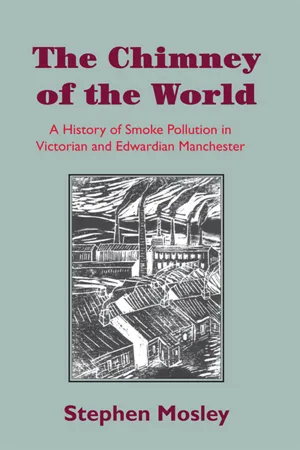
The Chimney of the World
A History of Smoke Pollution in Victorian and Edwardian Manchester
- 276 pages
- English
- ePUB (mobile friendly)
- Available on iOS & Android
eBook - ePub
The Chimney of the World
A History of Smoke Pollution in Victorian and Edwardian Manchester
About this book
Trusted by 375,005 students
Access to over 1.5 million titles for a fair monthly price.
Study more efficiently using our study tools.
Information
Subtopic
19th Century HistoryIndex
History
Map 1. The Cotton Towns of North-West England.
Adapted from Fowler, A. and T. Wyke, The Barefoot Aristocrats, 1987.

Map 2. Manchester in 1838.
Adapted from Redford, A., and Russell, I.S., The History of Local Government in Manchester. Vol.II: Borough and City, 1940.
Introduction
Manchester, Air Pollution, and Urban Environmental History

In 1994, when I began researching this study, a national survey of air quality revealed that Manchester had the dirtiest air in Britain, with the possible exception of Belfast. Readings taken on the Manchester Town Hall roof on 22 December 1994, as 65,000 cars entered the city centre between the hours of 7am and 10am, showed high concentrations of both nitrogen dioxide and carbon monoxide.1 Pollutants from vehicle exhaust fumes have been linked to an alarming rise in respiratory diseases and an increase in the incidence of a variety of cancers in urban areas.2 Manchester’s ascent to the top of the national air pollution league table sparked protests from environmental campaigners in the city, who swiftly formed an alliance called Fresh Air Now. Radical direct action groups, such as Reclaim the Streets, have sprung up all over the country in an attempt to halt new road-building schemes and bring cleaner air to Britain’s cities.3 The current level of public interest and involvement in actions to reduce urban air pollution is impressive but not wholly without precedent. Concerns about the air above cities have a long history, and are not, as some modern Green activists tend to think, simply a new product of late twentieth-century anxieties about global environmental degradation.4 Moreover, just as today, nineteenth-century Manchester, the ‘shock city’ of the Industrial Revolution, also found itself in the spotlight regarding dirty air.
In February 1884 John Ruskin, considered by some modern commentators to be ‘the first Green man in England’, symbolically represented Manchester as the spiritual home of air pollution.5 In his lectures on ‘The Storm-Cloud of the Nineteenth Century’ Ruskin described to his audience a ‘terrific and horrible’ thunderstorm observed from his home at Coniston Water in the Lake District, during the course of which the air became ‘one loathsome mass of sultry and foul fog, like smoke’ before finally blowing itself out, only to leave behind the sullen climatic conditions that he provocatively named ‘Manchester devil’s darkness’.6 By the early 1880s, after a century of rapid urban and industrial growth, the name of Manchester had become synonymous with leaden skies, dirt and smoke. Ruskin was deeply worried about the effects that air pollution drifting in from the numerous towns and cities of south-east Lancashire might have upon the Lakes. And in choosing to highlight the smoky image of Manchester – the world’s first real industrial city – as the concrete embodiment of his concerns, he had picked a fitting target.7 Manchester, once feted as ‘the symbol of a new age’, had come to epitomise the grimy, polluted industrial city: it was, in the words of one contemporary, ‘the chimney of the world’.8
Today the shimmering haze of photochemical smogs has replaced the stifling gloom of sulphurous coal smoke as a major problem of urban life. Many scientists believe that rates of pollution emissions from an exponentially expanding human economy are a serious threat to the ability of the earth’s natural cycles to regulate established climatic patterns and purify the air. Donella Meadows, Dennis Meadows and Jørgen Randers, for example, in their influential study Beyond the Limits declared, ‘Human society is now using resources and producing wastes at rates that are not sustainable’.9 More and more people, like Ruskin before them, are making the connection between local urban emissions and wider ranging pollution problems. Invisible, global phenomena such as the ‘holes’ in the ozone layer and the ‘greenhouse effect’ are now universally recognised as serious – and real – environmental threats. Against this backdrop it is not surprising to find that interest in the roots of air pollution problems is now increasing amongst historians. As concern for the environment has grown, so has the discipline of Environmental History, bringing a much-needed historical perspective to discussions about the ways in which humans interact with nature. This new field has started to dislodge the stubbornly recurring notion of a past ‘Golden Age’ of environmental harmony, when humans were more attuned to the earth and nature was pristine and untainted. It also provides a useful contextual framework for informed and critical debate about the implications of persistent pollution for future generations. Air pollution on a grand scale began with the Industrial Revolution, and, therefore, a study of the ‘smoke nuisance’ in Manchester, the spiritual home of both, may provide valuable insights for those concerned with finding solutions to today’s urban environmental problems.
Manchester: setting the scene
By the 1850s Britain had become the ‘workshop of the world’: a sobriquet largely earned by the energy and enterprise of the Manchester region’s industrial entrepreneurs and factory hands in supplying the world with cotton textiles. Some 90 per cent of Britain’s cotton industry was concentrated in the smoky Manchester region (south-east Lancashire, north-west Derbyshire and northeast Cheshire) by 1835.10 The employment of steam-powered technologies in both its spinning and weaving mills had made cotton Lancashire a centre of booming production and sustained economic growth ‘the like of which the world had never seen before’, as Tables 1 and 2 demonstrate.11
Date | Retained imports (million lbs) |
1770–79 | 48 |
1780–89 | 155 |
1790–99 | 286 |
1800–09 | 594 |
1810–19 | 934 |
1820–29 | 1664 |
1830–39 | 3208 |
1840–49 | 4072 |
Table 1. Raw Cotton Consumption in Britain, 1770–1849.
Sources: Mitchell, B.R., British Historical Statistics, Cambridge University Press, Cambridge, 1988, pp.330–3; and Rose, M.B., (ed.), The Lancashire Cotton Industry, Lancashire County Books, Preston, 1996, p.7.
Date | £ (thousands) | % of total British exports |
1784–86 | 766 | 6.0 |
1794–96 | 3,392 | 15.6 |
1804–06 | 15,871 | 42.3 |
1814–16 | 18,742 | 42.1 |
1824–26 | 16,879 | 47.8 |
1834–36 | 22,398 | 48.5 |
1844–46 | 25,835 | 44.2 |
1854–56 | 34,908 | 34.1 |
Table 2. Exports of British Cotton Goods 1784–1856.
Sources: Davis, R., The Industrial Revolution and Overseas Trade, Leicester University Press, Leicester, 1979, p.15; and Rose, M.B., (ed.), The Lancashire Cotton Industry, Lancashire County Books, Preston, 1996, p.9.
Burgeoning overseas demand for Lancashire’s cotton goods in America, Europe, Africa and Asia had stimulated the industry’s phenomenal growth, and the value of British exports in this commodity rose from ‘practically nothing’ (£46,000) in 1751 to almost £35 million a century later.12 By the early decades of the nineteenth century the Manchester region’s cotton products constituted well over 40 per cent of the value of all the nation’s exports. The cotton textile trade remained an important national industry throughout the Victorian and Edwardian periods. Although its share of the value of British exports had fallen to 25 per cent by 1913 it was still the nation’s largest export industry.13 However, the Cotton Famine of the early 1860s, a major slump in trade exacerbated by the American Civil War, exposed the myth that the industry was essential for Britain’s economic well being.14 Even so, the Cotton Famine brought mass unemployment and severe distress to Lancashire’s factory towns, as did other cyclical trade depressions, emphasising the crucial importance of the industry at a regional level.

Illustration 1. ‘Manchester, Getting Up the Steam’.
Source: Builder 1853.
The primary source of energy for Manchester’s numerous steam-powered mills – and the main source of heat in the homes of its many citizens –was the abundant and inexpensive fossil fuel of the Lancashire coalfield. As coal consumption increased, dense emissions of black, sulphurous smoke in Manchester gradually became a serious problem, blocking out the sun, destroying vegetation, corroding buildings and damaging the health of city dwellers. In 1872 the term ‘acid rain’ was neologised by the Victorian scientist Robert Angus Smith to describe some of the deleterious environmental consequences of air pollution in and around Manchester.15 Most contemporaries, however, commonly referred to the ‘smoke nuisance’ when discussing the myriad and far-reaching effects of the city’s air pollution problem. By the early 1840s, as vegetation was all but banished from the city centre, and mortality statistics began to reveal the extent of health problems caused by polluted air, an anti-smoke movement sprang into existence at Manchester. But while Manchester and other major British cities were fairly quick to tackle the pressing problem of a clean water supply, and the removal of other ‘nuisances’ such as refuse and human wastes, campaigners were still lobbying for the abatement of coal smoke well over a century later.16
Historians have often suggested that indifference on the part of the general public was the critical weakness that hindered the smoke abatement movement. Carlos Flick neatly sums up this widely held notion: ‘the movement for smoke abatement, like the steam engines themselves, could not work without sufficient pressure behind it’.17 ‘In the absence of popular alarm and indignation’, Flick continues...
Table of contents
- Cover Page
- Half Title page
- Title Page
- Copyright Page
- Contents
- List of abbreviation
- List of illustrations, figures, and tables
- Acknowledgements
- Map 1. The Cotton Towns of North-West England
- Map 2. Manchester in 1838
- Introduction: Manchester, Air Pollution, and Urban Environmental History
- Part One: The Nature of Smoke
- Part Two: Stories about Smoke
- Part Three: The Search for Solutions
- Epilogue: Too Little, Too Late?
- Notes
- Bibliography
- Index
Frequently asked questions
Yes, you can cancel anytime from the Subscription tab in your account settings on the Perlego website. Your subscription will stay active until the end of your current billing period. Learn how to cancel your subscription
No, books cannot be downloaded as external files, such as PDFs, for use outside of Perlego. However, you can download books within the Perlego app for offline reading on mobile or tablet. Learn how to download books offline
Perlego offers two plans: Essential and Complete
- Essential is ideal for learners and professionals who enjoy exploring a wide range of subjects. Access the Essential Library with 800,000+ trusted titles and best-sellers across business, personal growth, and the humanities. Includes unlimited reading time and Standard Read Aloud voice.
- Complete: Perfect for advanced learners and researchers needing full, unrestricted access. Unlock 1.5M+ books across hundreds of subjects, including academic and specialized titles. The Complete Plan also includes advanced features like Premium Read Aloud and Research Assistant.
We are an online textbook subscription service, where you can get access to an entire online library for less than the price of a single book per month. With over 1.5 million books across 990+ topics, we’ve got you covered! Learn about our mission
Look out for the read-aloud symbol on your next book to see if you can listen to it. The read-aloud tool reads text aloud for you, highlighting the text as it is being read. You can pause it, speed it up and slow it down. Learn more about Read Aloud
Yes! You can use the Perlego app on both iOS and Android devices to read anytime, anywhere — even offline. Perfect for commutes or when you’re on the go.
Please note we cannot support devices running on iOS 13 and Android 7 or earlier. Learn more about using the app
Please note we cannot support devices running on iOS 13 and Android 7 or earlier. Learn more about using the app
Yes, you can access The Chimney of the World by Stephen Mosley in PDF and/or ePUB format, as well as other popular books in History & 19th Century History. We have over 1.5 million books available in our catalogue for you to explore.