- 352 pages
- English
- ePUB (mobile friendly)
- Available on iOS & Android
eBook - ePub
About this book
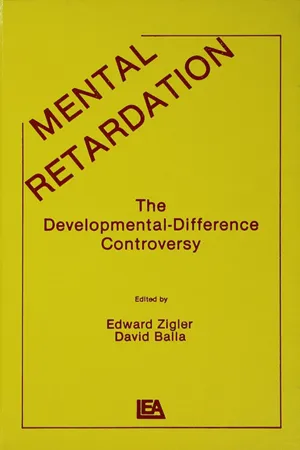
Published in 1983, Mental Retardation is a valuable contribution to the field of Education.
Trusted by 375,005 students
Access to over 1.5 million titles for a fair monthly price.
Study more efficiently using our study tools.
Information
Topic
EducationSubtopic
Education GeneralI THE DEVELOPMENTAL APPROACH
1 Introduction: The Developmental Approach to Mental Retardation
Edward Zigler
David Balla
Yale University
David Balla
Yale University
There is a central issue and unifying theme of this book: the developmental-difference controversy in the area of mental retardation. Stated most simply, this controversy centers around the question of whether the behavior of those retarded persons with no evidence of central nervous system dysfunction is best understood by those principles in developmental psychology that have been found to be generally applicable in explaining the behavior and development of non-retarded persons, or whether it is necessary to invoke specific differences over and above a generally lower rate and asymptote of cognitive development. This controversy is of importance because at least 75% of all those identified as retarded have no evidence of organic brain dysfunction.
Retarded persons with no evidence of organic brain dysfunction are referred to by the American Association on Mental Deficiency as suffering from “retardation due to psychosocial disadvantage.” The older and more widely used term is “cultural-familial retardation.” We use this latter term throughout the book. We prefer this term in that this form of retardation is best understood as involving a combination of environmental (cultural) and genetic (familial) causes. Thus, the term cultural-familial seems to us to be a more precise diagnosis than “retardation due to psychosocial disadvantage.” According to the developmental theorist, the familially retarded person is viewed as a normal individual in the sense that he falls within the normal distribution of intelligence dictated by the gene pool. He or she is normal in exactly the same sense that a person who is in the lower third percentile of height is considered to be normal. This person will be called “short” but will not be seen as being abnormal. As a consequence of the developmental theorists' view of a familially retarded person as a normal individual, these theorists predict that the performance of this retarded person and a nonretarded person of equivalent developmental level (most typically defined by mental age [MA] on an IQ test) on a cognitive task should be exactly the same. The difference theorist would maintain that retarded and nonretarded persons even of equivalent developmental levels should differ in cognitive performance because of intrinsic differences over and above intellectual slowness.
This book is divided into three major sections. Firstly, the developmental position is presented. Then, several of the major difference positions are discussed. Finally, a series of chapters on the developmental-difference controversy are presented.
THE DEVELOPMENTAL POSITION
In order to understand the developmental position, it is necessary to discuss several issues in the area of mental retardation: the developmentalist's view of “intelligent” behavior, motivational determinants of retarded behavior, the effects of institutions on retarded persons, and the effects of etiology of retardation on performance. We present a brief overview of each of the issues.
Many would agree with the proposition that ultimately the crucial defining feature of mental retardation is low intelligence in comparison with some general reference group. Although such a statement may seem self-evident, difficulties arise when we attempt to define intelligence and to measure it. Of course, intelligence is most often measured with an IQ test and the resulting score is used as an index of intellectual level. The IQ score is not a pure measure of formal cognition. By “intelligence” or formal cognition, we mean such processes as ability in short-term memory, abstracting ability, reasoning, speed of visual information processing, as well as other variables that have been of interest to cognitive psychologists. Many of these cognitive variables have been investigated at great length by the difference theorists represented in this book.
Formal cognition, although of great importance, is only one of the factors that influence performance on an intelligence test or, for that matter, almost any behavior. Performance is also affected by achievement factors. Two individuals with identical cognitive capacities may have had very different experiences in the learning of such items as “What is a slipper?” or “Who wrote Faust?”. We must draw a clear distinction between formal cognition and achievement. If we ask a person “Who wrote Faust” and he/she replies that he/she does not know, we might assume that there is something inadequate about his/her memory or retrieval system, which are aspects of the formal cognitive system. On the other hand, if in the person's experience he/she has never encountered the work Faust, he/she will fail the item even though his/her memory and retrieval systems are perfectly adequate. This cognition-achievement distinction is quite similar to the familiar process-content distinction in developmental psychology.
Finally, intelligence test performance is influenced by a variety of motivational and personality variables that have little to do with either formal cognition or achievement. A person can achieve a low score on an IQ or achievement test even when formal cognitive factors and general achievement are adequate. Such a person's motivational stance may preclude optimal or adequate behavior in a test-like situation. One example of such a motivational variable is fear or wariness in a test situation. These motivational personality variables have a major role in the developmental approach to mental retardation. Whenever differences in performance are found between retarded and non-retarded groups of individuals matched on MA, the developmental theorist typically looks for differences in motivation between the two groups.
Much of the work of the developmental thinkers in the area of mental retardation has focused on motivational differences between retarded and nonretarded persons. Retarded persons have been found to be more responsive to social reinforcement from a supportive adult than nonretarded persons of equivalent developmental level. This heightened responsiveness to social reinforcement stems from a history of social deprivation. Often, retarded persons are more interested in interacting with a kindly adult in a testing situation than they are in solving the problem at hand. Paradoxically, retarded persons have also been found to be more wary of strange adults than nonretarded persons. We refer to the heightened responsiveness to social reinforcement and increased wariness as positive and negative reaction tendencies, respectively. The retarded are also less likely to trust their own cognitive resources in problem-solving attempts and rather to rely on possible solutions provided by others. This increased imitative-ness is often detrimental to problem solution. We refer to the imitative problem-solving style as outerdirectedness. Frequent failure is also observed in many retarded persons. Because of this high preponderance of failure experiences, the retarded often have a low expectancy of success in problem solving. In addition, their behavior can often be seen as aimed at avoiding failure rather than achieving success. The expectancy of success variable is extensively discussed in a chapter to follow. Different classes of reinforcers have been found to be differentially effective with retarded and nonretarded persons. The retarded are typically more responsive to concrete reinforcement than to intangible reinforcement. “Learned helplessness” has also been seen to characterize the performance of retarded individuals, a phenomenon that is discussed in Chapter 3.
In any consideration of the developmental position it is necessary to discuss the effects of institutional experience on the behavior of retarded persons. In many studies where nonretarded and retarded groups have been compared, the comparison has involved institutionalized retarded individuals with nonretarded individuals living at home. Thus, it is impossible to determine whether any results obtained reflect cognitive differences between retarded and nonretarded groups or the effects of institutionalization. Paradoxically, though researchers have all too often ignored the institutionalization variable, it is generally assumed that institutions have uniformly catastrophic effects on development. We have found that the effects of institutionalization are by no means uniformly negative. Any comprehensive understanding of the effects of institutionalization requires a consideration of the characteristics of the retarded person, his/her preinstitutional life experience, the nature of the institution, and the assessment of a variety of outcome variables on the part of the resident.
As noted previously, the developmental position is limited to those individuals with no evidence of organic brain damage. Seventy-five percent of all retarded individuals have no evidence of central nervous system dysfunction. Those persons with known central nervous system dysfunction, either due to genetic or environmental causes, indeed, can be seen as possessing a “defect.” However, all too often in research in mental retardation, the question of etiology has been ignored, and groups of retarded individuals comprised of persons with both cultural-familial and organic diagnoses have been compared with groups of nonretarded individuals. In such studies involving retarded groups with heterogeneous diagnoses, it is difficult to determine if any results obtained reflect intellectual slowness per se or the effects of organic brain damage that might be found at any level of intelligence. Any true experimental confrontation between developmental and difference positions must be limited to the cultural-familial retarded. As is discussed in Chapter 14, the difference position has often been supported if etiology is not taken into consideration in the research, whereas the developmental position has most often been supported if etiology is considered.
THE DIFFERENCE POSITIONS
The second major section of this book is devoted to a presentation of some of the major difference positions in mental retardation. These difference positions have their roots in the area of cognitive psychology, and consequently relatively little attention has been given to the motivational variables that have been of great concern to developmental theorists. Another characteristic of most difference theories is their focus on relatively small subsets of the possible number of cognitive processes; for example, short-term memory.
Historically, the oldest and most influential of the difference positions is the work of Lewin and Kounin on rigidity in the retarded. While this position is far too complex to summarize here, the general view that the retarded are inherently more rigid in their behavior than are nonretarded persons of the same MA has been extremely influential in the area of education and training of retarded persons. Although this position has been regarded by some as little more than an historical relic, variations of the rigidity theme continue to be propounded to the present day.
The retarded have also been characterized as suffering from a deficit in verbal mediation ability. This position is most closely identified with the work of the late Russian psychologist, Alexander Luria. Luria maintained that retarded individuals do not use verbal mediators to guide their behavior as effectively as do nonretarded persons. This verbal mediation deficiency has been said to involve an underdevelopment or general inertness of the verbal system and a dissociation of this system from the motor or action system. A review of this position is presented in Chapter 7.
Another deficit said to characterize the retarded involves relative inadequacy in short-term memory. The work in this area is most closely associated with Norman Ellis. Again, the original work in this area relied heavily on what at that time appeared to be a quasiphysiological construct, stimulus trace. More recently, the work has moved more toward the mainstream of cognitive psychology, with emphasis on flow charts; constructs such as primary, secondary, and tertiary memory, and the study of encoding, rehearsal, and retrieval strategies. However, stimulus-trace theory has by no means been abandoned, and recent evidence in support of this is discussed in Chapter 8.
THE DEVELOPMENTAL-DIFFERENCE CONTROVERSY
The third major section in this book is devoted to the controversy that has arisen around developmental and difference approaches in the area of mental retardation. The major criticisms of the developmental position are presented in chapters by Norman Milgram and Morton Weir. Milgram has characterized the developmental approach as constituting a motivational theory of mental retardation and as giving insufficient attention to cognitive approaches to the problem. He also maintained that the developmentalist's insistence on comparing nonretarded and retarded groups of equivalent mental age in experimental tests of the developmental-difference controversy was “untenable,” in that identical MA scores may be arrived at in numerous ways, reflecting myriad patterns of strengths and weaknesses. Weir asserted that if IQ is a measure of the rate of cognitive development, a low IQ score should index a slower rate of learning on any task, including the measures typically used in laboratory research. Thus, according to Weir, retarded individuals should do more poorly than nonretarded individuals of the same mental age on any cognitive task. In Chapter 13, Weir's criticism is responded to from the developmental perspective.
The Piagetian approach to mental retardation is also discussed in this section. This approach, adopted by the Geneva group, especially Inhelder, has been interpreted as consistent with both the developmental and difference positions. In a comprehensive review of empirical research inspired by the Geneva group, written by John Weisz and presented in Chapter 14, it is concluded that the developmental position was strongly supported.
In summary, a comprehensive discussion of a major controversy in the area of mental retardation, that between developmental and difference theorists, is presented in this book. The developmental and major difference positions are presented. In the course of these presentations, several key issues in the area of mental retardation and general developmental psychology are discussed: the most appropriate research methodology for the study of the phenomenon of retardation, the relative importance of cognitive, achievement, and motivational factors in human development, and the relative importance of various cognitive subsystems (ie., short-term memory, attention) in the understanding of retarded behavior.
2 Motivational and Personality Factors in the Performance of the Retarded*
Edward Zigler
David Balla
Yale University
David Balla
Yale University
In much of the thinking concerning mentally retarded persons, it appears to be assumed that retarded behavior is simply a consequence of low intelligence or inadequate cognitive functioning. This assumption is made despite the commonplace view in psychology that any behavior cannot simply be a function of formal cognitive functioning. In addition to cognitive determinants of behavior, achievements and motivational factors also play a crucial role (Seitz, Abelson, Levine, & Zigler, 1975; Zigler & Butterfield, 1968). These authors have argued that performance on an IQ test or any “cognitive task” reflects a combination of three factors: (1) formal cognitive processes such as memory, reasoning, and abstracting ability; (2) achievement factors involving specific knowledge of the problem to be solved; and (3) a wide range of personality and motivational...
Table of contents
- Cover
- Half Title
- Full Title
- Copyright
- Contents
- PART I: THE DEVELOPMENTAL APPROACH
- PART II: THE DIFFERENCE POSITIONS
- PART III: DEVELOPMENTAL-DIFFERENCE CONTROVERSY
- Author Index
- Subject Index
Frequently asked questions
Yes, you can cancel anytime from the Subscription tab in your account settings on the Perlego website. Your subscription will stay active until the end of your current billing period. Learn how to cancel your subscription
No, books cannot be downloaded as external files, such as PDFs, for use outside of Perlego. However, you can download books within the Perlego app for offline reading on mobile or tablet. Learn how to download books offline
Perlego offers two plans: Essential and Complete
- Essential is ideal for learners and professionals who enjoy exploring a wide range of subjects. Access the Essential Library with 800,000+ trusted titles and best-sellers across business, personal growth, and the humanities. Includes unlimited reading time and Standard Read Aloud voice.
- Complete: Perfect for advanced learners and researchers needing full, unrestricted access. Unlock 1.5M+ books across hundreds of subjects, including academic and specialized titles. The Complete Plan also includes advanced features like Premium Read Aloud and Research Assistant.
We are an online textbook subscription service, where you can get access to an entire online library for less than the price of a single book per month. With over 1.5 million books across 990+ topics, we’ve got you covered! Learn about our mission
Look out for the read-aloud symbol on your next book to see if you can listen to it. The read-aloud tool reads text aloud for you, highlighting the text as it is being read. You can pause it, speed it up and slow it down. Learn more about Read Aloud
Yes! You can use the Perlego app on both iOS and Android devices to read anytime, anywhere — even offline. Perfect for commutes or when you’re on the go.
Please note we cannot support devices running on iOS 13 and Android 7 or earlier. Learn more about using the app
Please note we cannot support devices running on iOS 13 and Android 7 or earlier. Learn more about using the app
Yes, you can access Mental Retardation by E. Zigler,D. Balla in PDF and/or ePUB format, as well as other popular books in Education & Education General. We have over 1.5 million books available in our catalogue for you to explore.