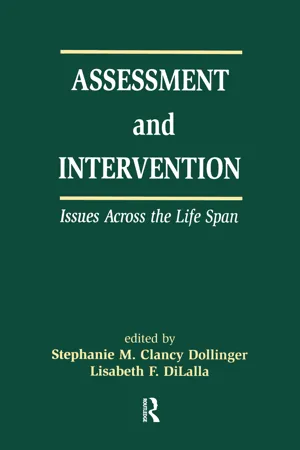
This volume evolved from the second life span development conference held at Southern Illinois University entitled "Assessment and Intervention Across the Lifespan." Providing an overview and consideration of important directions for research in areas of assessment and intervention across the lifespan, the presentations covered a variety of topic areas including social ecology, cultural diversity, attitudes about aging, as well as attention, visual, and linguistic skills.
This volume consists of chapters based on the conference presentations as well as additional chapters by experts in related specialty areas discussing attachment theory, learning disabilities, and phonological processing. The second conference and volume continue the work of the first conference and its associated earlier volume.
The chapters cover important interactions between assessment and intervention for each major developmental period; several emphasize the importance of early assessment and intervention. A common theme found throughout is the critical connection between basic research and practice. The editors hope this book will prove useful not only to researchers, but also to practitioners in related disciplines working with individuals of all ages.
eBook - ePub
Assessment and Intervention Issues Across the Life Span
- 320 pages
- English
- ePUB (mobile friendly)
- Available on iOS & Android
eBook - ePub
Assessment and Intervention Issues Across the Life Span
About this book
Trusted by 375,005 students
Access to over 1.5 million titles for a fair monthly price.
Study more efficiently using our study tools.
Information
1
When Worlds Collide:
Assessment Meets Intervention
When originally conceived, this chapter was to be a recapitulation of the Second Life Span Developmental Psychology Conference. This was to be the chapter that summarized and put into perspective the sparkling new papers presented on the conference topic, “Assessment and Intervention: Issues Across the Life Span.” However, due to unavoidable circumstances, the summary was actually presented as the first paper of the conference and the reordering in presentation serendipitously became an advantage. In the lead chapter, it is possible to present a retrospective of the status of assessment across the life span, followed by a discussion of how assessment could and should interface with intervention. The retrospective was shaped, in part, by the nine papers that were presented at the First Life-Span Developmental Psychology Conference, titled “Assessment of Biological Mechanisms Across the Life Span.” The papers presented at the conference described a variety of different assessments useful for infants, children, and adults that were developed over many decades of work. Yet, as was clear from those papers, much remains to be learned about how the results obtained from the application of assessment techniques can be linked to appropriate intervention strategies. As the papers presented in the second conference revealed, many intervention strategies with demonstrated effectiveness for remediating a variety of developmental, social, and cognitive disabilities and different medical and physiological problems are not directly and individually linked to specific assessments. How to link the most effective assessments with the most effective interventions still remains to be determined.
In the book published from the first conference, entitled Assessment of Biological Mechanisms Across The Life Span (DiLalla & Dollinger, 1993), eight chapters detail a variety of assessment techniques useful for a diverse age range. To recapitulate, these chapters describe several visual, biomedical, behavior genetic, and brain processing mechanisms that were found to influence specific cognitive and social abilities. In the visual domain, novel techniques for assessing deficits in the visual pathway that influence contrast sensitivity and detection of spatial frequency were implicated in the deficits noted in children with reading disabilities and in vision problems in the elderly (Lehmkuhle, 1993). A second paper provided a description of various techniques developed for assessing vision in infancy (Shea, 1993). The usefulness of assessments of perinatal risks in the detection of the developmental delay in later infancy and childhood is described in the third paper (V. Molfese, 1993). Examples were given in this paper of several ways in which perinatal risk conditions are used to predict performance on cognitive tests during the preschool years. Information on how behavior across the life span is affected by genetic influences was described in two papers along with details on how the often interactive effects of heredity and environment can be separated through twin studies (DiLalla & Falligant, 1993; McGue & Carmichael, 1993). The final three papers discussed biological approaches to assessment involving brain functioning (Clancy Dollinger, 1993; Molfese, Gill, Simos, & Tan, 1995; Ober & Shenaut, 1993). Assessments of memory functioning in patients with Alzheimer’s disease using semantic priming, changes in cerebral asymmetry in adult subjects using visual half field methodology, and neuroelectrical responses in infants as predictors of cognitive abilities in childhood were discussed. In each case, clear evidence was presented showing that many different aspects of mental functioning can be detected using measures of biological mechanisms.
Together, the information presented in these papers from the first conference provided rich information on successful biological approaches to assessment that are useful with infant, child, and adult populations. It is clear from these papers that assessment is and has been a major focus of the research community. The result of all this research attention is the clear demonstration that many effective assessment techniques were developed.
With all the progress that was made, where does the assessment community need to direct its attention? If only the assessment side of the equation is known, what is lacking in our knowledge? The promising results obtained from the extensive assessment work has set the stage for making the transition to intervention, which is, after all, the intended link with assessment. Intervention typically receives little consideration in the various literatures that publish assessment research. This relative lack of attention is consistent with the observation that rarely in the development and implementation of new assessment techniques is there an explicit consideration of what specific intervention techniques are indicated in light of the assessment results. More typical are statements such as “if X can be assessed in the first few months of life, the targeted infants can be directed to appropriate interventions.” The specifics as to what are the “appropriate interventions” are not often addressed.
Kaye (1986) argued that assessment and intervention must be considered together because both involve intersecting issues. Kaye points to several issues as showing this intersection. First, assessment and intervention both involve questions of costs and benefits. For assessment, the questions are, assessment of what conditions, and for what ends? In attempting to answer, we must identify assessments that can identify conditions leading to a poor prognosis if not treated (cost). The assessments must also be able to identify conditions for which an intervention exists that actually improves the prognosis (benefit). It makes little sense to assess individuals for risk conditions that are likely to lead to negative outcomes if treatability is unknown or if options for treatment are undeveloped or unavailable.
For intervention, the cost-benefit issue focuses on questions such as: intervention for what conditions? How successful is the intervention likely to be? If a variety of possible intervention techniques exist, the choice of which intervention strategy to apply would involve consideration of what the costs of the intervention will be in a particular case—in terms of applying the intervention and not applying it. In deciding between these choices, there must be a consideration of how much will be gained from applying the intervention and what will be lost from not applying the intervention. These decisions must include consideration of questions such as: what are the expectations that the intervention will actually succeed? and for what proportion of individuals to whom the intervention is applied will there be success? These questions address issues pertaining to estimates of the benefit side of the cost-benefit equation.
In considering the cost-benefit aspect of assessment and intervention, it is also important to determine whether or not intervention techniques exist that are appropriate for the age range in which the assessments are developed. For example, assessment techniques for children that identify conditions for which no interventions have yet been developed are not sufficient. Major efforts were made to develop assessment techniques for infants and preschool children under the belief that the earlier an intervention can be applied, the better the outcome. However, intervention techniques for infants and preschool children are not prevalent and are certainly less sophisticated than are the intervention techniques developed for school-age children. Clearly, the interface of assessment with intervention must be directed toward conditions for which complementary intervention techniques exist or can be developed, and for a condition that makes cost-benefit sense to treat with the age range within which the condition is prevalent.
Second, Kaye argued that the costs of the assessment and intervention techniques are often far too great to permit their use with large populations. Thus, decisions must be made as to who will be assessed and who will receive the intervention. These decisions are not easily done and are rarely addressed in these terms. Most frequently, assessment techniques are evaluated in terms of sensitivity and specificity, where sensitivity is the proportion of true positives (i.e., the identification of individuals who actually have the condition being screened for) and specificity is the proportion of true negatives (i.e., the identification of individuals who really do not have the condition). Ideally, the most efficient use of assessment techniques is to adjust their scoring criteria to maximize sensitivity so that the greatest possible benefits will be obtained for those individuals with the condition that the assessment technique was designed to identify. Attaining this goal of high sensitivity is difficult to achieve and usually involves the manipulation of assessment scores. Manipulation of scores tends to result in the overidentification of false positives (i.e., individuals identified as having the condition but who do not actually have it) and false negatives (i.e., individuals who are not identified as not having the condition but who actually have it). The usual assumption underlying the setting of assessment scores so that maximum identification of true positives is achieved is that missing true positive cases is far worse than identifying a few cases who do not actually have the condition being screened for. It is further assumed that in all cases the result of being “positively” identified and participating in a treatment program will do no harm to the individuals even if they do not actually have the condition being treated. Although arguments challenging these types of assumptions will continue, including concern about incorrectly labeling individuals and the costs of applying treatment where it is not needed, the seriousness of conditions being screened for often played a role in how issues of sensitivity and specificity are defined.
For intervention, cost is evaluated based on the attainment of specified outcome criteria by the individuals receiving the treatment. The effectiveness of the intervention technique is gauged by the outcomes achieved. Frequently, however, beneficial effects are only found for subgroups of individuals, and not for all the members of the group. Identifying which specific individuals or subgroups of individuals are most likely to benefit from the intervention has been as problematic to those developing effective intervention techniques as have the identification problems encountered by those developing assessment techniques. However, such identification issues are critical to overcome as important issues concerning the cost of treatment, and who will pay those costs is nationally debated.
Third, Kaye argued that decisions on administering assessments or providing interventions frequently involve the issue of what types of cases should have highest priority. Kaye argued that it makes little sense to develop and administer assessment and intervention techniques without knowing what their payoffs will be. Frequently, the payoff is not known with certainty. These payoffs can only be properly evaluated through the consideration of a variety of different issues. For example, school-age children are often targeted for interventions because their problems are readily apparent, especially in the school setting where assessments are applied on a weekly basis through classroom tests and at year intervals through the use of various mandated state and school district achievement tests. The presumption is that the payoff with school-age children will be great. However, complicating the payoff with regard to intervention effectiveness are the cognitive, social–environmental, personality, physiological, and other changes that come with developmental progressions in childhood. The intrinsic and extrinsic factors characterizing children’s development can complicate the success of even the best intervention techniques. Yet, despite these complications, some people would wholeheartedly endorse the time and effort needed to develop, refine, and apply interventions for children. Considerably greater efforts might be made with children who have their whole lives ahead of them than efforts expended in developing intervention techniques for elderly populations in which the payoff might be seen as too short term. However, as the baby boomers age, the interest in assessments for screening and interventions for remediating conditions in order to assure healthy, cognitively intact adulthood years is growing rapidly! From an admittedly superficial observation, it appears that young infants and toddlers are about as unpopular as the elderly as targets for intervention strategies based on the availability of relatively few types of intervention techniques for both groups—possibly because neither group has enough of an advocacy force as yet.
A further difficulty in evaluating the payoff of interventions and, by implication, assessment is the ability to clearly specify what the outcomes of a particular case would be without intervention. The difficulty here, of course, is that naturally occurring cases are rarely available and those that are discovered are so unusual as to make generalizations difficult or impossible. For example, a California girl named Genie was discovered who was severely sensory deprived and without language after many years of abuse. Genie, who was in the middle childhood years when she was discovered, presented an opportunity for developmentalists to see how language might be acquired years after it would have naturally developed and after years of deprivation. Yet the extensive retardation across a variety of cognitive domains and Genie’s uncertain prior developmental history made it clear that the intervention processes accompanying the complexities of language learning would be nearly impossible to study with Genie (Curtiss, 1977). There are also reports of situations in which an intervention technique was developed that was so successful that the researchers and practitioners were reluctant to establish a control group to use for comparison purposes because such a group would have been deprived of the benefits of the intervention (Gilkerson, 1995). In both of these examples, the effectiveness of intervention can only be inferred.
A closer linkage is needed between assessment and intervention techniques so that assessment results can be used in a prescriptive sense for identifying specific intervention programs. Kaye (1986) described this notion as using assessment techniques as placement tests for intervention programs. Then close study needs to be made of the relationship between the initial assessment performance and the influence of the intervention on subsequent assessment performance. Ideally, long term studies would be initiated in which assessment and intervention phases would be followed by phases of repeated assessment and intervention as long as these phases are needed to obtain the desired outcomes. We are using evoked brain potentials as a technique to identify children predicted to have problems in areas of language and cognitive development. We have now begun recording evoked potential and behavioral responses while the children are engaged in tasks involving phonological discrimination, phonological awareness, and orthographic skills—skills that are related to children’s reading abilities. Intervention strategies are being developed to enable children with specific reading skill problems to incrementally master their problem areas. For example, children will be taught to use phonics in phonological awareness tasks and their performance will be compared over time to determine if resultant changes in reading skills can be shown. Following the application of the intervention strategies, reassessments using evoked brain potential and behavioral techniques will be applied to see if there are changes in brain and behavioral responses that reflect the benefits gained from the intervention. If there are changes, then intervention might proceed, but if there are no changes, then the type of intervention will be changed in an effort to effect a different result.
Another example of the successful demonstration of this assessment-intervention-assessment approach is a project by D. Molfese (1993) in which changes in brain responses to world geography knowledge was shown using a pretest-training-posttest approach. During the pretest, adolescents were asked to identify match-mismatch between names and shapes of fictional countries. Following a training session in which names and shapes of countries were learned, a posttest was given. Discrete regions of the evoked potential waveform obtained during the posttest were distinctly different from those obtained during the pretest. These differences were attributed to the effects of the training session. This approach offers a means for linking behavioral changes with neurological responses to obtain additional evidence of the effects of training beyond that which can be obtained from behavioral assessment alone.
The Next Steps
This book contains 10 chapters reporting on innovative and effective approaches to intervention across the life span. Each chapter focuses on what can be gained from assessment information that is helpful for considering intervention options. Two chapters describe environmental and social competence approaches to assessment and intervention with children who have disabilities (Glen Aylward; Sharon Vaughn & Jane Sinagub). Two chapters focus on the importance of biological and cognitive mechanisms in influencing both assessment and intervention in studies of cognitive and language development (Dennis Molfese & colleagues, Martha Vandervelden & Linda Siegel). One chapter describes successful approaches to treating children with reading and writing disabilities (Virginia Berninger et al.). The role of social factors, such as attachment, social ecology, and culture, in interventions with specific populations is addressed in three chapters (Patricia Crittenden, Alan Vaux, and Christina Mitchell). Two chapters consider the needs of middle-aged and elderly people as factors in determining whether or not intervention is needed and how to intervene (Linda Gannon, and Karlene Ball). In each case, a multidimensional, multifactorial, or multisystem approach is taken in considering the types of intervention or approaches that are needed to address specific types of disabilities and dysfunctions. Such multiplicative approaches are consistent with findings from assessment research that most disabilities and dysfunctions are complex and multisystemic in nature. As more information is shared between assessment and intervention researchers and practitioners, and as more efforts are made to consider assessment and intervention from a life-span perspective, more areas affording opportunities for interface will be discovered, for the betterment of both fields.
REFERENCES
Clancy Dollinger, S. M. (1993). Assessment of cerebral asymmetry in aging: A review of the visual modality. In L. F. DiLalla & S. M. Clancy Dollinger (Eds.), Assessment of biological mechanisms across the life span (pp. 151–172). Hillsdale, NJ: Lawrence Erlbaum Associates.
Curtiss, S. (1977). Genie: A psycholinguistic study of a modern-day “wild child.” New York: Academic Press.
DiLalla, L., & Clancy Dollinger, S. (1993). Assessment of biological mechanisms across the life span. Hillsdale, NJ: Lawrence Erlbaum Associates.
DiLalla, L., & Falligant, E. (1993). An environmental and behavioral genetic perspective on behavioral inhibition in toddlers. In L.F. DiLalla & S.M. Clancy Dollinger (Eds.), Assessment of biological mechanisms across the life span (pp.91...
Table of contents
- Cover
- Halftitle
- Title
- Copyright
- Contents
- Preface
- 1 When Worlds Collide: Assessment Meets Intervention
- 2 Environmental Influences: Considerations for Early Assessment and Intervention
- 3 Truth, Error, Omission, Distortion, and Deception: The Application of Attachment Theory to the Assessment and Treatment of Psychological Disorder
- 4 The Assessment of Phonological Processing in Early Literacy: A Developmental Approach
- 5 Prediction and Intervention of School Age Language Problems Using Electrophysiological Measures Obtained at Birth
- 6 Directed Reading and Writing Activities: Aiming Instruction to Working Brain Systems
- 7 Social Assessment of At-Risk Populations: Implications for Students with Learning Disabilities
- 8 Tending the Social Ecology: Alternative Intervention Strategies for Violent Behavior
- 9 Culturally Relevant Intervention with Minority Adolescents: Before the Beginning
- 10 Perspectives on Biological, Social, and Psychological Phenomena in Middle- and Old-Age Women: Interference or Intervention?
- 11 Enhancing Mobility in the Elderly: Attentional Interventions for Driving
- Author Index
- Subject Index
Frequently asked questions
Yes, you can cancel anytime from the Subscription tab in your account settings on the Perlego website. Your subscription will stay active until the end of your current billing period. Learn how to cancel your subscription
No, books cannot be downloaded as external files, such as PDFs, for use outside of Perlego. However, you can download books within the Perlego app for offline reading on mobile or tablet. Learn how to download books offline
Perlego offers two plans: Essential and Complete
- Essential is ideal for learners and professionals who enjoy exploring a wide range of subjects. Access the Essential Library with 800,000+ trusted titles and best-sellers across business, personal growth, and the humanities. Includes unlimited reading time and Standard Read Aloud voice.
- Complete: Perfect for advanced learners and researchers needing full, unrestricted access. Unlock 1.5M+ books across hundreds of subjects, including academic and specialized titles. The Complete Plan also includes advanced features like Premium Read Aloud and Research Assistant.
We are an online textbook subscription service, where you can get access to an entire online library for less than the price of a single book per month. With over 1.5 million books across 990+ topics, we’ve got you covered! Learn about our mission
Look out for the read-aloud symbol on your next book to see if you can listen to it. The read-aloud tool reads text aloud for you, highlighting the text as it is being read. You can pause it, speed it up and slow it down. Learn more about Read Aloud
Yes! You can use the Perlego app on both iOS and Android devices to read anytime, anywhere — even offline. Perfect for commutes or when you’re on the go.
Please note we cannot support devices running on iOS 13 and Android 7 or earlier. Learn more about using the app
Please note we cannot support devices running on iOS 13 and Android 7 or earlier. Learn more about using the app
Yes, you can access Assessment and Intervention Issues Across the Life Span by Stephanie M.C. Dollinger,Lisabeth F. DiLalla,Stephanie MC Dollinger in PDF and/or ePUB format, as well as other popular books in Psychology & Developmental Psychology. We have over 1.5 million books available in our catalogue for you to explore.