eBook - ePub
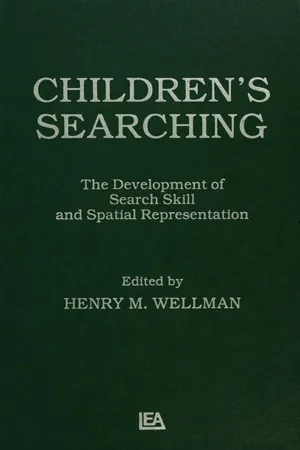
Children's Searching
The Development of Search Skill and Spatial Representation
- 344 pages
- English
- ePUB (mobile friendly)
- Available on iOS & Android
eBook - ePub
About this book
Published in 1985, Childrens Searching is a valubale contribution to the field of Developmental Psychology.
Trusted by 375,005 students
Access to over 1.5 million titles for a fair monthly price.
Study more efficiently using our study tools.
Information
1
Beyond Egocentrism: A New Look at the Beginnings of Spatial Representation
Arizona State University
This chapter examines evidence concerning the development of spatial representation in and beyond infancy. The early development of spatial representation is connected with search in two ways. First, the notion of search itself seems naturally to entail a search space (cf. Wellman & Somerville, 1982), for which the searcher may or may not use some form of internal or external representation. Second, historically search tasks have provided the typical means of investigating spatial representation in infants.
Our main purpose is to review the notion of egocentric spatial representation in infancy. The prevalent cognitive-developmental view of early spatial representation argues that the infant begins with a representational system which locates objects and events in relation to the body, with no objective awareness of body position (or changes in body position) in a surrounding space. This egocentric coding system is supplanted, toward the end of infancy, by an objective (or allocentric, or geocentric) representational system, which is based on the relations of objects, people, and events to other objects occupying relatively stable positions in space. We examine a growing body of empirical evidence relevant to this view, together with conceptual issues surrounding the meaning of the terms representation and egocentric. Our conclusion is that the current evidence supports an alternative view, which is also consistent with spatial developments beyond infancy. This alternative view emphasizes changes in the nature of children’s developing uses of spatial information, rather than changes in the form of stored representations. The solution of search problems is a major source of information about these developments, especially in infancy.
The term spatial representation has several meanings in the psychological literature (e.g., Deregowski, 1977; Liben, 1981; Mandler, 1983). If we consider only internal representations, there are two senses of spatial representation that may be distinguished.1 First, there is spatial information that is stored and available to the person (infant or adult). This sense of spatial representation (or knowledge) is the one on which our discussion of infant spatial development focuses. Second, there is Piaget’s (Piaget, 1954; Piaget & Inhelder, 1967) use of the term representational space to refer to a form of thought that is attained only when the child acts conceptually in space (e.g., infers a view not perceptually given; reads a map). Clearly, these two senses of the term representation do not have equal developmental status: spatial storage is developmentally prior to spatial thought. While preverbal, presymbolic infants do not engage in conceptual thinking about space or create symbolic artifacts based on their spatial knowledge, there is evidence that they do represent spatial information (Mandler, 1983; Yonas & Pick, 1975).
Spatial storage is the most basic form of representational behavior, since spatial thought presumes and requires stored spatial information. That is, spatial thought is one way in which spatial information may be used (see Mandler, 1983). In discussions of spatial representation as storage, it is critical to maintain a distinction between the information that is stored and how that information may be used. The importance of this distinction stems from the fact that one cannot directly examine the stored spatial representation. Empirical evidence always concerns representations as used to perform a particular function. There is no way to examine directly just the representation itself (Newcombe, 1981; Palmer, 1978). This does not mean that inferences can never be drawn about the stored representation, but that to do so it is necessary also to consider the rules or operations that govern its use. Thus, Palmer (1978) has emphasized the need to focus less on the representation per se and to “consider its functional information content as defined by the processes that use it” (p. 300).
To clarify this distinction between the stored representation of information and its uses, and to introduce the principal ways in which represented spatial information might be used, let us consider a mobile animal traversing some terrain (of a relatively large or small scale). As the animal moves, its relation to objects in the environment changes. To be well adapted, mobile organisms must keep track of where they are (e.g., Krebs, 1978; Menzel, 1973). Doing so, while efficiently maintaining position constancy, requires the representation of information about space since objects go in and out of view. Later, when the animal returns to that space, it will show a benefit from prior encounters. In this case, the gain constitutes evidence of some representation of the spatial information. The nature of this representation may be inferred from the nature of the practical gain in the later encounter.2 There are two things to note. First, the inference about the representation does not reflect only the representation, per se. Rather, it reflects the represented information as utilized by the organism. Second, in most animals and human infants the utilization of spatial information is limited to practical orientation and action.
If the animal crossing the terrain is an adult human, there is a second sense in which we might say he or she uses represented spatial information. The adult may, for example, draw a map that represents the space externally. The creation of such an external representation provides much stronger evidence that some form of stored spatial information exists. At the same time, it requires the capacity to use graphic, verbal, or other symbols, (cf. Piaget & Inhelder, 1967; Siegel & White, 1975; Werner & Kaplan, 1963/1984). The manipulation of such symbols constitutes spatial thought, which under this definition infants do not display. However, although representation in this latter sense of spatial thought develops after infancy, we argue that it draws on the same basic stored spatial representation. Thus to account for developmental changes in infancy and beyond, it is not necessary to postulate changes in the basic form of stored information available to the child. Development may consist primarily of changes in the ways in which stored spatial information can be used.
For the preverbal infant, the evidence of (stored) representation comes from direct action and orientation in space. One important category of actions is the retrieval of hidden or displaced objects, which is required in simple search tasks. There are certain risks involved in making inferences about spatial representation from indirect behavioral evidence (see also Liben, 1982; Yonas & Pick, 1975). Nevertheless, cognitive developmental researchers have considered it likely that the infant does code spatial information in some form (Mandler, 1983). The coding of spatial information is assumed to consist of relations, and the major issue is whether the relations that the system can store are relative to the infant’s own body exclusively (i.e., egocentric) or relative to other objects or landmarks (i.e., objective). In the current literature it is suggested that early development can be accounted for in terms of a major change, toward the end of infancy, in the type of relation that is coded. This change is from an “egocentric” code (body-centered relations) to an “objective” code (relations to other objects) as the basis for spatial representation.
It is this question of the infant’s early egocentric coding of spatial information that we consider in greater depth. Although we recognize that the infant’s behavior shows dramatic changes, we argue that these observed changes may occur primarily in the way that the same form of stored information is used. Our discussion consists of three major sections. The first deals with the conceptual history of the term egocentric as applied to spatial representation. In this section we draw attention to some inconsistencies between various uses of the terms egocentric and representation in developmental contexts. In the second major section we review empirical studies of infant spatial development that are relevant to the notion of egocentric representation. As we shall see, in these studies the inferences drawn about spatial representation are based on the infant’s ability to search for hidden objects. When we refer to spatial representation we mean the stored spatial information that is available to the infant. Finally, we propose a modified account of infant spatial development that does not require a notion of early egocentric coding.
Infant Egocentrism: The Conceptual Problems
The terms egocentrism and egocentric are difficult to define precisely and differ in meaning across research areas (Ford, 1979; Glucksberg, Krauss, & Higgins, 1975; Howard & Templeton, 1966; Piaget, 1954, 1959; Piaget & Inhelder, 1967; Presson, 1980). Piaget (1954, 1959) was the first to give the terms real currency in the developmental literature. He used them initially to describe aspects of the 4- to 7-year-old child’s behavior, and subsequently, almost by analogy, to describe the infant’s interactions with objects in space (Piaget, 1968, pp. 78–79).
In the 4- to 7-year-old, it is clear that Piaget’s term egocentric was intended to describe characteristics of spatial thought rather than of stored spatial information. As applied to infants, the term referred to the logic inherent in the coordination of overt actions. Thus the infant achieved only an understanding of how to act in a “practical space,” whereas the older child was capable of performing mental operations in a “conceptual space” as well (Piaget & Inhelder, 1967). Within conceptual space, Piaget described both an early “egocentric” stage and a later stage in which egocentrism was overcome by the coordination of viewpoints and frameworks. Within practical space, no such change from an egocentric to a non-egocentric stage was postulated. In fact, the sensorimotor practical space of the infant was seen by Piaget as “inherently egocentric” (but not in the same sense as the egocentrism of later spatial thought).
There is a sense in which, to act appropriately in space, even an adult must adopt an “egocentric” viewpoint (cf. Howard & Templeton, 1966; Pick, Yonas, & Rieser, 1979). That is, in order to move, reach, or even look in the direction of some object a person requires knowledge of its position in relation to him or herself. Similarly, in using “egocentrism” to discuss infant spatial development, Piaget (1954) referred principally to his claim that, for the young infant, objects were “located” at the disposal of actions rather than being located in space, in their own right. Thus the very young infant “learns how to grasp, hence to localize, objects in relation to himself” (Piaget, 1954, p. 165). Piaget described the early coordinations of actions with respect to objects as “subjective groups,” meaning that the localization of an object depended solely on the memory of particular movements made to reach it. Gradually, the infant was said to progress toward the use of more specifically spatial notions in guiding his actions, e.g., “moving away from” or “moving near to” (Piaget, 1954, p. 197), but Piaget stressed that such notions rely on “the relations of objects with the behavior of the subject and still do not apply to the interrelations of objects independently of the action” (Piaget, 1954, p. 198). Thus, according to Piaget, throughout the first year of life the infant lacks any means of coding the relative positions of objects in space, including relations involving the position of his or her own body.3
Next, as a result of the mobility attained by infants early in the second year, Piaget considered that the infant succeeded in achieving an objective coordination of the perceived movements of other objects and of his or her own body parts. However, he still maintained that such “objective groups” did not entail the representation of spatial relations by the infant, since “the child does not yet know either how to take account of displacements produced outside the perceptual field (although he does perceive their result) or to locate himself in relation to objects (this operation presupposes that one pictures oneself as a moving object and is not merely aware of one’s own movements)” (Piaget, 1954, p. 224).
Thus even the attainment of “objective” groups with respect to immediate, overt actions in space did not signal the end of “egocentrism” in Piaget’s account of infant spatial development. Practical space remained “egocentric,” in Piaget’s sense, throughout. In Piaget’s (1954) view it was the attainment of symbolic representational skills, at the end of infancy, which brought about a significant change; “through spatial representation and the capacity to elaborate representative groups, space is constituted for the first time as a motionless environment in which the subject himself is located” (Piaget, 1954, p. 235); “spatial egocentrism … tends to disappear from the moment (the infant) locates himself in space as such, instead of perceiving space as a function of himself” (Piaget, 1954, p. 230). For Piaget, then, the “practical space” of the infant was an attempt to characterize the progressive adaptation of the infant’s actions to a spatial world. The term egocentrism was not intended to refer to a stored representation or encoding of space in infancy, but rather to a lack of symbolic skill. In Piaget’s view it was the attainment of symbolic skills, toward the end of infancy, which enabled the representation of objects (including the self) in space and which freed the infant from his or her sensorimotor egocentrism (see also Butterworth, 1978; Laurendeau & Pinard, 1970).
In recent studies of infants (e.g., Acredolo, 1978; Butterworth, 1977; Rieser, 1979), the term egocentric has been used in a variety of senses, ranging from the more descriptive to the more explanatory. On the simplest level, “egocentric” has been used to describe a response that maintains a fixed relation to the infant’s body, such as reaching to the right of the body (e.g., Bremner & Bryant, 1977; Cornell & Heth, 1979). Whereas there can be no question about this descriptive use of the term, questions do arise as soon as there is a shift from describing a single response, or a pattern of responses, to describing a general quality of the infant’s knowledge. This shift has occurred quite frequently in the literature and has created the impression that the concept of egocentricity has considerable explanatory power for infant spatial development (see e.g., Harris, 1975; Pick & Lockman, 1981).
In infant spatial development, in particular, it has proved difficult to avoid explanations in terms of “egocentric coding” or “egocentric representation,” meaning that the locations of objects are coded in some system that has the infant’s body at its center (Acredolo, 1978, 1979; Bremner, 1978a, 1978b; Butterworth, 1977; Rieser, 1979). Butterworth (1975, 1977) was one of the first to introduce spatial notions into the interpretation of performance on object permanence tasks. He suggested that the 9- to 11-month-old infant “locates the object in a duality of relations between a self-referent body-centered space (i.e., an egocentric spatial code) and the visual field (i.e., an allocentric spatial code …)” (p. 399). For Butterworth, the infant’s problem was essentially one of making the two codes congruent. Other investigators have viewed the infant as “choosing” between the two codes, with various situational and developmental factors determining whether the chosen code is “egocentric” or “allocentric” (Acredolo, 1978; Bremner, 1978a). Even in the most recent studies, where the evidence for “egocentrism” has become less firm, the notion of two opposing codes has been retained (Acredolo, 1979; Bremner, 1978b; Rieser, 1979). Rieser (1979), for example, examined the visual search behavior of 6-month-old infants. In his discussion the terms egocentric and geocentric were used in two different senses, the first of which was simply to label two of the infant’s response possibilities. However, the results were also interpreted in terms of the relative influence of three factors on visual search, two of the three being “the learned egocentric code and the learned geocentric code” (p. 1088). Rieser’s conclusion was that “the egocentric code exerts a stronger influence over the 6-month-olds’ visual search than either of the two other factors” (1979, p. 1088).
Harris (1977) proposed that spatial development could be viewed as “a gradual coordination of … two types of position specification—the self-related specification on the one hand, the landmark specification on the other” (p. 84). He reviewed evidence indicating that human infants can locate objects in relation to their bodies at an early age. He envisaged a gradual increase in the infant’s use of landmarks (the infant’s body not included) to specify the positions of objects. Harris thus explained certain search behaviors (the classic Stage IV AB error, described in more detail later) by suggesting that the infant (a) has a tendency to “neglect the more accurate but less stable self-related position code,” and also (b) “treats the landmark code as an overly stable system, and fails to update it even when the object has moved to a new position” (p. 86).
A more continuous view of the development of spatial representation was proposed by Pick and Lockman (1981). They outlined a developmental progression in spatial knowledge from matters concerned with body-body relations (e.g., thumbsucking) through body-object ...
Table of contents
- Cover
- Half Title
- Title Page
- Copyright
- Contents
- Contributors
- Preface
- Introduction
- 1. Beyond Egocentrism: A New Look at the Beginnings of Spatial Representation
- 2. Spatial Knowledge and Its Manifestations
- 3. Active Movement and Development of Spatial Abilities in Infancy
- 4. The Logical Search Skills of Infants and Young Children
- 5. The Origins of Search and Number Skills
- 6. The Early Development of Planning
- 7. Memory-Based Searching by Very Young Children
- 8. A Developmental Model of Search: Stochastic Estimation of Children’s Rule Use
- 9. A Comparative Description of Representation and Processing During Search
- 10. Mathematical Models of Search
- 11. Controlling Sources of Variation in Search Tasks: A Skill Theory Approach
- Author Index
- Subject Index
Frequently asked questions
Yes, you can cancel anytime from the Subscription tab in your account settings on the Perlego website. Your subscription will stay active until the end of your current billing period. Learn how to cancel your subscription
No, books cannot be downloaded as external files, such as PDFs, for use outside of Perlego. However, you can download books within the Perlego app for offline reading on mobile or tablet. Learn how to download books offline
Perlego offers two plans: Essential and Complete
- Essential is ideal for learners and professionals who enjoy exploring a wide range of subjects. Access the Essential Library with 800,000+ trusted titles and best-sellers across business, personal growth, and the humanities. Includes unlimited reading time and Standard Read Aloud voice.
- Complete: Perfect for advanced learners and researchers needing full, unrestricted access. Unlock 1.5M+ books across hundreds of subjects, including academic and specialized titles. The Complete Plan also includes advanced features like Premium Read Aloud and Research Assistant.
We are an online textbook subscription service, where you can get access to an entire online library for less than the price of a single book per month. With over 1.5 million books across 990+ topics, we’ve got you covered! Learn about our mission
Look out for the read-aloud symbol on your next book to see if you can listen to it. The read-aloud tool reads text aloud for you, highlighting the text as it is being read. You can pause it, speed it up and slow it down. Learn more about Read Aloud
Yes! You can use the Perlego app on both iOS and Android devices to read anytime, anywhere — even offline. Perfect for commutes or when you’re on the go.
Please note we cannot support devices running on iOS 13 and Android 7 or earlier. Learn more about using the app
Please note we cannot support devices running on iOS 13 and Android 7 or earlier. Learn more about using the app
Yes, you can access Children's Searching by H. M. Wellman in PDF and/or ePUB format, as well as other popular books in Psychology & Developmental Psychology. We have over 1.5 million books available in our catalogue for you to explore.