Adolescent Violence in the Home examines a form of violence that has a profound impact on families but is often overlooked and frequently misunderstood: teen aggression and violence toward members of their family—especially parents. Violence in adolescents is often seen as the result of a mental-health diagnosis, delinquency, or as a response to dysfunctional parenting, and though understanding a youth's mental-health status or a parenting style can be helpful, complete focus on either is misplaced. Adolescent Violence in the Home uses a restorative framework, developed by the authors and in use in court systems and organizations around the world, to situate violent behaviors in the context of power and the intergenerational cycle of violence. Readers will come away from this book with a profound understanding of the social and individual factors that lead youth to use violence and how adolescent violence affects parents, and they'll also learn about a variety of interventions that specifically address teen violence against parents.
eBook - ePub
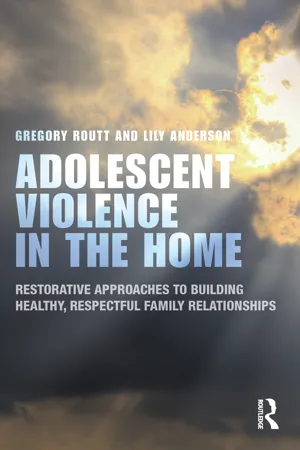
Adolescent Violence in the Home
Restorative Approaches to Building Healthy, Respectful Family Relationships
- 190 pages
- English
- ePUB (mobile friendly)
- Available on iOS & Android
eBook - ePub
Adolescent Violence in the Home
Restorative Approaches to Building Healthy, Respectful Family Relationships
About this book
Trusted by 375,005 students
Access to over 1.5 million titles for a fair monthly price.
Study more efficiently using our study tools.
Information
one
Adolescent Violence in the Home
An Uncharted Territory
The names he calls me … Oh, they just make me feel disgusted … I can’t repeat them to you. Then an hour later he acts like nothing happened.
I have a bruise on my arm from where she pushed me into the table. I’ve been wearing long sleeves to hide it for 3 weeks. What would people think?
He really scares me sometimes just with the look on his face. I have to be careful what I say to him. We all walk on eggshells when he is home. You never know what will set him off.
These are the words of parents who are talking about their teenage children. The words of these parents show the anxiety, guilt, and helplessness abused parents experience almost every day. While all parents have these feelings at times, abused parents are living in a different world where they routinely face verbal attacks and physical violence. They are sometimes afraid for themselves and often fear for the safety of their other children, but they are also afraid for their teen. “What will happen to my son if he keeps acting this way?” “Should I have seen something when he was younger that led to this?” “What can I do to stop him from acting this way?” “I don’t want his younger brothers and sisters to start doing the same things he’s doing.”
Yet, when parents do seek professional help, they find that the problem is often not addressed. Parents will say, “We have been in family counseling for over a year and we never really talk about my son’s abusive behavior.” It is common even for experts who specialize in family violence to disregard the reports from abused parents. Such responses silence parents and keep them from seeking the help they and their child desperately need.
Three Parents, Three Stories
As we noted in the preface, we have been listening to parents like these and trying to help them make sense of what is happening in their homes for 15 years, and we have learned that every story is both different and the same. Here is Marla’s account of what happened with her son Daniel:
I never know what Daniel will be like when he comes home from school. He went straight to his room and sat down at the computer. I said hello, but he didn’t say anything. I used to try to read his father’s moods like I’m doing with Daniel now. I could never really figure out his father, Richard, though, and it feels the same with Daniel.
It’s been four years since I first called the police on Daniel’s dad. He had been kicking Daniel in the stomach with his heavy boots. Daniel’s face was getting pale and blank. I had gone to the hospital a couple of times after Richard punched me in the face and slammed my head into the wall. The second time Richard attacked me, Daniel led his brother and sister out the back window to the neighbor’s house. I was so proud of him.
Even though we were free of Richard, Daniel’s father, I couldn’t help thinking that at any minute Richard would march in to tell the kids to stop laughing so loud or not to get the popcorn on the floor. Unfortunately, even within the first week, Daniel began to order his brother and sister around and I felt a knot in my stomach.
I went into Daniel’s room to remind him about the counseling appointment. I told him we needed to leave in 10 minutes. After a few minutes, I returned to Daniel’s room to tell him to turn off the computer. He just ignored me and continued to play his game so I pressed the off button. Daniel turned toward me and called me a “fucking whore.” I reacted quickly and I slapped his face. It was the same thing Richard used to call me and now I was hearing it again from my son. Daniel told me to get out of his room. I said “we need to go.”
Daniel picked up a hockey stick that was leaning against his computer table and held it above his head, like he was going to hit me. I ran from the room and he went outside and smashed the back window of the car with the hockey stick. Daniel had come full circle. Just a few months ago he swore he would never be like his dad. Now he was acting just like him. I decided to call the police. I couldn’t believe I was doing this.
This story is typical of many we have heard from parents. Marla was dealing with a volatile teen whose violence was escalating, but was frustrated at every turn when she tried to do something about it. The mental health agencies she called suggested more of the same individual counseling he had been doing that had not helped because he didn’t disclose what was really going on at home. Plus he often refused to go and she couldn’t make him. The domestic violence agencies she was going to for support had been a great help to her but couldn’t provide help to her son. She even tried calling Child Protective Services, and she was told they could only serve children who were abused, not parents. When she called the police, they made her feel like she should be a stronger parent, telling her she should “put her foot down, and discipline him more strictly,” even suggesting corporal punishment. Marla felt that no one really asked her about how the violence was affecting her and her other children, and when people did ask, her response was not taken seriously. No one really understood what she was going through.
Unlike Daniel, Tanisha didn’t grow up in a violent home, and yet, her mother Michelle reported to us that Tanisha was becoming increasingly belligerent and moving towards violence:
Tanisha is 14 years old and we have always been very close until about a year ago when she started spending more time with her friends. Her father and I separated when she was 7 and she sees her father once a month. During this last school year, Tanisha’s grades started dropping and she had an in-school suspension for skipping classes. What bothers me the most, though, is Tanisha and a couple of her friends have been hanging out with a group of older boys who are 18 or 19 years old. Right away I told her they were too old for her and she couldn’t see them. Tanisha lied to me about being with them after I said that. I am really worried about what they do and where they’re going. I grounded her when I found out she was lying to me about seeing them. Now, I realize I can’t really stop her. We argue about it all the time.
My parents disciplined me by spanking and slapping me when I was a child. I decided I would never do that to my kids. During the last year as I began to confront Tanisha more about her contact with these older boys, she started swearing at me, calling me foul names, and making really disgusting comments to me. When I grounded Tanisha for the bad language she used, she became more threatening. You know, like getting close to me, getting in my face, pushing past me, throwing things, kicking doors and walls. Finally, one night when I stood in the doorway to stop Tanisha from leaving the house at 11:30 at night, she pushed me out of the way so hard I fell into a table and then she ran out the front door.
Michelle is facing very different issues from Marla. Daniel seems to be taking the role of his abusive father in Marla’s household, while Tanisha is just trying to be with her friends. Daniel may have been influenced by his father’s behavior in ways he is not fully aware of, while Tanisha is just acting like some of the tough girls she sees at school. However, given what Daniel and Tanisha are doing at home to their mothers, how different are they really? Their behavior may have come from a different source but it’s playing out in a similar way.
Let’s look at one more family:
Maureen and I adopted Gabe when he was about a year old and today he is 13. I work as an accountant for a construction business and Maureen is a nurse. Gabe is currently in a special education program for students with behavioral problems in the local middle school. Since he has been in middle school, he has been unable to attend mainstream classes due to his behavior. He was disruptive in class, disturbed other students, and challenged the teacher’s authority.
Gabe does not have many friends. He is socially isolated and unpopular. He reacted aggressively to his classmates’ teasing and was suspended from school twice for fighting. When Gabe was in grade school, he worked with a therapist and his behavior seemed to improve at home and at school. Gabe had been prescribed medication to stabilize his mood and took it regularly. Gabe still had outbursts: he would yell, swear, and kick or punch walls. By age 11, he would sometimes have two-hour periods when he would yell, argue, and sometimes cry when he was told to turn off the TV or the computer or when we would simply say “no” to something. Overall though, he seemed to be getting better. We don’t always agree on how to handle Gabe. I feel he needs very strict rules and consistent consequences, especially when he’s violent. I think Maureen is too easy on him. She wants to reason with him about his behavior and get him to agree to make changes.
We were confident Gabe would continue to improve and grow out of his difficult behavior. When he got to middle school, he refused to attend counseling and stopped taking his medication. Then he started directing more of his aggressiveness at us, especially Maureen. He would hit her and threaten her when he didn’t get his way. He doesn’t do these things to me as much, but when I would step in when he was starting to attack his mother, he would physically challenge me and he has hit me a number of times. Finally, we decided to call the police. We didn’t know what else to do.
John and Maureen have a very different child than either Marla or Michelle. Unlike Daniel, he hasn’t grown up in a violent home, and unlike either of the others, he’s been violent from an early age. In fact, the three children don’t seem to have much in common with each other. Their personalities, interests, and backgrounds are very different. However, all the parents are struggling with abuse that is directed towards them and looking for relief from the chaos at home.
What the Numbers Tell Us
The problem of violence and abuse by children towards parents is widespread, and the numbers are much larger than most people imagine. Research on parent abuse shows significant numbers of families each year are affected by teen violence at home. One of the few research reports from the mid-1970s estimated millions of parents were abused each year by their teenagers (Cornell & Gelles, 1982). These numbers only include reports of specific kinds of physical violence, like hitting, and not the wide range of other kinds of physical violence. Unfortunately, the lack of research on parent abuse prevents the public from recognizing it as an important social issue.
Furthermore, these numbers don’t reflect the widespread emotional abuse towards parents that is endemic to anyone facing physical abuse. The name calling, threats, humiliation, and extensive property destruction are all part of an abusive relationship (Ganley, 1989). The pattern of emotional abuse reinforces and supports the physical abuse, but also carries its own destructive psychological punch apart from the physical violence. Among women who are survivors of abuse from a partner, about half report that emotional abuse causes the greatest harm (Follingstad et al., 1990). When we talk to parents, they agree that emotional abuse often feels as destructive as physical abuse.
A Blind Spot for Professionals
When we give workshops about adolescent to parent violence, some professionals think we are ignoring an obvious fact: teens that we are describing as violent are simply protecting themselves from an abusive and violent parent. It’s true that some adolescents are victims of violence and abuse by parents (Haber & Toro, 2009), and by appealing for recognition of parent abuse, we in no way mean to diminish the pain and suffering of teens who are abused by parents. Public recognition of parent violence towards adolescents is lacking in much the same way adolescent to parent violence lacks recognition. Child abuse laws were passed to protect young children, and while these laws are meant to protect adolescents, in reality adolescents who experience violence at home often have little protection and face long-term developmental problems. But although we recognize violence can be enacted both ways in parent-teen relationships, our focus is teens who are not currently being abused and who initiate violence against parents and family members.
Adolescent violence towards parents can also be confusing for professionals because teens are not consistently argumentative, belligerent, and confrontational. Parents report their teens able, kind, and considerate some of the time, yet become violent at other times. Teachers report they are respectful and helpful in their classrooms. Parents of their teen’s friends see them as model children when they are in their homes. These youth are seldom the schoolyard bullies most people think they might be and are not consistently aggressive towards peers. Outside of their families, these youth are often not necessarily conspicuous for their hostility or malevolence towards others.
Patterns of Abuse
Youth who are violent in the home can develop different patterns of abuse. Some youth have never used physical violence against a parent, but they use an array of verbal attacks and demeaning comments to assert power. Other youth have assaulted their parent one time and felt they crossed a line they shouldn’t have, and return exclusively to emotional attacks. Still others have physically assaulted a parent many times. Youth who develop a pattern of abuse have adopted a belief that, at least in some circumstances, “might makes right” and that verbal and physical attacks are legitimate.
In spite of the differences among youth who are violent at home, we can say they share some qualities: they are less able to manage difficult emotions like irritability, anger, and frustration, and their decision-making process restricts them to more aggressive solutions when they have conflicts with family members. No easy answers exist to help us understand these youth, but we do know many of them have influences in their lives that make it more likely they will choose abuse and violence. The most apparent factor, to be discussed later, is exposure to violence at home. Growing up with violence can have a powerful, lasting effect on the way we respond emotionally and cognitively to difficult situations. Other factors that can influence a youth towards using aggressive behavior include being victimized physically and emotionally, being affected by drugs or alcohol, and having a mental health diagnosis.
Parents talk about “walking on eggshells” when their teen gets upset. They don’t want to say or do something that will “set them off.” Their adolescent children are described as having “Jekyll and Hyde” personalities because they can be pleasant one minute and unbearable the next (Edenborough et al., 2008). Parents are left feeling confused and hurt and don’t know what to do about the problem.
Parent Abuse Is Unique
The description above should sound familiar to those of us who have some understanding of domestic violence, but we believe that abused parents are different from other survivors of...
Table of contents
- Cover
- Title
- Copyright
- Contents
- Preface
- Acknowledgments
- CHAPTER 1—Adolescent Violence in the Home: An Uncharted Territory
- CHAPTER 2—Physical Abuse
- CHAPTER 3—Emotional Abuse
- CHAPTER 4—Understanding Parents and Families
- CHAPTER 5—Understanding Teens
- CHAPTER 6—An Intervention Model for Youth Violence in the Home
- CHAPTER 7—Foundation for Change: A Safe Environment
- CHAPTER 8—A Restorative Practice Approach
- CHAPTER 9—A Pathway to Nonviolence: Helping Youth Develop Skills for Success
- CHAPTER 10—Helping Parents Restore Leadership in the Family
- Index
Frequently asked questions
Yes, you can cancel anytime from the Subscription tab in your account settings on the Perlego website. Your subscription will stay active until the end of your current billing period. Learn how to cancel your subscription
No, books cannot be downloaded as external files, such as PDFs, for use outside of Perlego. However, you can download books within the Perlego app for offline reading on mobile or tablet. Learn how to download books offline
Perlego offers two plans: Essential and Complete
- Essential is ideal for learners and professionals who enjoy exploring a wide range of subjects. Access the Essential Library with 800,000+ trusted titles and best-sellers across business, personal growth, and the humanities. Includes unlimited reading time and Standard Read Aloud voice.
- Complete: Perfect for advanced learners and researchers needing full, unrestricted access. Unlock 1.5M+ books across hundreds of subjects, including academic and specialized titles. The Complete Plan also includes advanced features like Premium Read Aloud and Research Assistant.
We are an online textbook subscription service, where you can get access to an entire online library for less than the price of a single book per month. With over 1.5 million books across 990+ topics, we’ve got you covered! Learn about our mission
Look out for the read-aloud symbol on your next book to see if you can listen to it. The read-aloud tool reads text aloud for you, highlighting the text as it is being read. You can pause it, speed it up and slow it down. Learn more about Read Aloud
Yes! You can use the Perlego app on both iOS and Android devices to read anytime, anywhere — even offline. Perfect for commutes or when you’re on the go.
Please note we cannot support devices running on iOS 13 and Android 7 or earlier. Learn more about using the app
Please note we cannot support devices running on iOS 13 and Android 7 or earlier. Learn more about using the app
Yes, you can access Adolescent Violence in the Home by Gregory Routt,Lily Anderson in PDF and/or ePUB format, as well as other popular books in Psychology & Developmental Psychology. We have over 1.5 million books available in our catalogue for you to explore.