- 394 pages
- English
- ePUB (mobile friendly)
- Available on iOS & Android
eBook - ePub
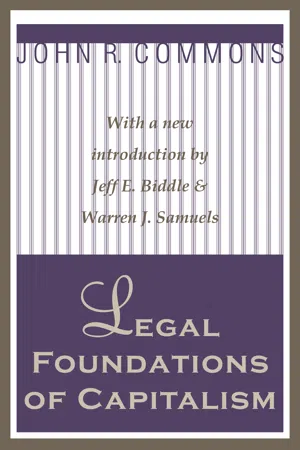
Legal Foundations of Capitalism
About this book
In what has universally been recognized as a classic of institutional economics, John R. Commons combined the skills of a professional economist, the sensibilities of an American historian, and the passion of an active participant in the conflicts of individuals, self-interest of groups, and function of voluntary associations.The aim of this volume is to work out an evolutionary and behavioral theory of value. In order to do so thoroughly, Commons examines the decisions of the courts. Doing so compelled an examination of what the courts mean by reasonable value. Commons found that the answer was tied up with a notion of reasonable conduct. It was Commons who carried the study of the habits and customs of social life to the next stage: the decisions of the courts that are based on custom and that profoundly impact the nature and function of the economic system as such.Reviewing Legal Foundations of Capitalism, Wesley Mitchell declared that Commons carried this "analysis further along his chosen line than any of his predecessors. Into our knowledge of capitalism he has incorporated a great body of new materials which no one else has used adequately." And writing in the same American Economic Review twenty-one years later, Selig Perlman noted that "To Commons the workingmen were not abstract building blocks out of which a favored deity called History was to shape the architecture of the new society, but concrete beings with legitimate ambitions for a higher standard of living and for more dignity in their lives." This edition is graced with a special introduction that places Commons in proper academic as well as intellectual context.
IV Transactions
I The Parties
When economists and courts speak of an “exchange” they usually think of two persons exchanging products or services, but when they speak of a “market” they think of two or more sellers and two or more buyers of similar commodities at a common place and time. Thus the distinction may be made between actual transactions and potential, possible and impossible transactions. The actual transactions occur, of course, between those who actually exchange products. The potential transactions are those which may or may not occur, since the parties are on the market and ready to exchange but do not. The possible transactions are those which might occur if conditions were different, such that parties not now upon the market should decide to come upon the market. To which may be added the impossible transactions which, owing to remoteness in time or place and the consequent inaccessibility of the parties to the market, cannot, under any circumstances, take place.1
These four degrees of probability are taken into account, more or less consciously, by every person who comes upon, or contemplates coming upon, the given market. But the actual choice made by any person who actually exchanges upon the market is a choice, not between the actual exchange and the possible or impossible exchanges, nor even all of the potential exchanges, but is a choice between only the actual and the next best of the potential exchanges which he has an option of making at the moment of exchange. He gains a surplus by choosing, but the actual surplus obtainable is measured by the choice between the two best accessible options. Failure to observe this limitation on the act of choice has led to palpable fallacies of both optimistic and pessimistic schools of economists, which may be designated in general as the fallacy of inaccessible or non-concomitant options, inaccessible in space, or non-concomitant in time.2
At the same time, each person coming upon the market has in mind, or is faced by, these several degrees of probability. Choice of opportunities is always choice between the two best accessible options at the moment of choice, and if there is no possible alternative, then the exchange may be of that “hold-up” character which we have noted,1 in which there is no real freedom of choice; or the next best alternative may be possible but not potential, and even if potential may not be the next best potential. Thus there is a gradation of alternatives taken into account by each party to a transaction, and consequently, from the standpoint of the motives affecting the parties, the minimum number of persons necessary to constitute a transaction is four parties, two buyers and two sellers, namely, the actual buyer and seller, and the next best alternative for each. Other potential, possible or impossible exchanges are in the background. This may be illustrated as follows:
A Transaction | |||
Actual | Potential | Possible | Impossible |
$100 B | B’ $ 90 | $ 80 | 0 |
$110 S | S’ $120 | $130 | 0 |
The actual buyer, B, of, say, a horse or cow, comes upon the market hoping to buy at, say, $100, the actual seller, S, hoping to sell at $110. The potential buyer hopes to buy at $90, the potential seller hopes to sell at $120. The other potential, or possible buyers and sellers will not ordinarily become actual buyers and sellers until those who are nearest together have first gotten off the market. They are possible exchangers. Hence the two best opportunities for the actual seller, S, are the offers of $100 and $90. Evidently the actual seller cannot be forced to sell for less than $90. On the other hand, the best two opportunities for the actual buyer are the offers to sell at $110 and $120. Evidently the actual buyer cannot be forced to pay more than $120. Consequently the actual price agreed upon by B and S will lie somewhere between $90 and $120. Between these two points may be said to be the field of persuasion and coercion, and at these points are the limits of coercion, because at these points the opposite party has a costless alternative. Beyond these two points only persuasion can induce the exchange to be made.
It will be seen that the transaction, involving four persons, indicates the two dimensions of opportunity and power present in every transaction. For the seller, S, the opportunities offered are the $100 offered by B and the $90 offered by B’. For the buyer, B, the opportunities are the $110 asked by S and the $120 asked by S’, and the actual power in exchange lies somewhere between $90 and $120.
This typical transaction describes the minimum of all economic and social relations whatever, whether it be that of the family, of business or politics. Each person is considering the alternatives open to himself, the existence of actual, potential, possible or impossible rivals, and the degree of power which he can exert within the limits of these alternatives. One is his choice of opportunities, the other is his exercise of power, but they are inseparable, and choice of opportunities is choice between two degrees of power. Out of this ultimate and universal nature of a transaction, from the standpoint of the motives affecting the will, economics derives its concepts of cost and value, of “opportunity-cost” and “dis-opportunity value,” that is, its concepts of exercise of power and choice of opportunities.1
But there are an indefinite number of possible disputes between the parties to the transaction that may arise before or after the completion of the transaction. These disputes do arise and always have arisen in the history of the race from the most primitive times, simply because man has always been subject to the principle of scarcity which limits his choice of opportunities and exercise of power. Consequently, if transactions are to go on peaceably without resort to violence between the parties there must always have been a fifth party to the transaction, namely, a judge, priest, chieftain, paterfamilias, arbitrator, foreman, superintendent, general manager, who would be able to decide and settle the dispute, with the aid of the combined power of the group to which the five parties belonged. This fifth party might, indeed, be a lawless and arbitrary ruler, in which case each of the four parties would be victims of conquest or slavery and not recognized members of the group to which the ruler belonged. But if he and they are members of the same family, tribe, nation, business concern, club or what not—in short, members of the same going concern—then his arbitrary and lawless power has always been found to be itself limited by common rules, or working rules, the “laws” of the concern.
These working rules of going concerns, have, in point of their historical origin, been ascribed to many different sources, such as gods, ancestors, conquerors, “nature,” “will of the people,” etc., the general idea being to clothe them with a certain sanctity or authority above that of the particular priest, chieftain, judge, et al., who may, for the time being, be in position of power to give effect to his interpretation of them. At any rate, they appear, in the history of the race, as the essential and ultimate means by which the members of a going concern are able to work together for a common purpose and to exert their united power against other concerns.
The way in which these working rules operate is by placing certain limits or by opening up certain enlargements for the choices and powers of the individuals, who are parties to the transactions, and these limits and enlargements of the individual wills may be condensed into the four volitional verbs, (i) may, (2) must, (3) can and (4) cannot. These verbs express the limits of behavior for any individual who is subject to any common rule or working rule of any concern. The rule merely tells him what he may, must, can or cannot do.
But when these permissions, compulsions, capacities, and incapacities suggested by these four verbs have been organized into a system of thought by later generations of theologians, philosophers or jurists, they take certain ethical or juristic names which may be distinguished, in the order in which we have named them, as (1) liberty or immunity (2) duty or liability, (3) right or power, (4) disability or exposure. These we shall consider later.1 It is needful here only to note that in consequence of the need of common rules applying to the wills of the individual members of families tribes, nations or the modern business concerns, there is a fifth party to every transaction, namely, the governor, or rather, the judge who lays down the working rules of the concern under the name of rights, duties, liberties, etc., involving the further social relation of command by a superior representing the power of the group, and obedience by inferiors, who are members of the group.
A transaction, then, involving a minimum of five persons, and not an isolated individual, nor even only two individuals, is the ultimate unit of economics, ethics and law. It is the ultimate but complex relationship, the social electrolysis, that makes possible the choice of opportunities, the exercise of power and the association of men into families, clans, nations, business, unions and other going concerns. The social unit is not an individual seeking his own pleasure: it is five individuals doing something to each other within the limits of working rules laid down by those who determine how disputes shall be decided.
II Performance, Avoidance, Forbearance
There hangs over from early theories a notion of the individual will which may be described as the will-in-vacuo, instead of the will-in-action. According to John Locke, who formulated this concept, the will is conceived, not as the will-in-action overcoming resistance and choosing between different degrees of resistance, in actual space and time, but the will is a “power,” in the sense of a faculty, a capacity, an ability, to act or not-act.1 It conforms to that notion of “power” characteristic of all branches of knowledge at the mythological stage prior to their passing over into the quantitative or scientific stage, where “power” was a kind of potency, a potentiality, a hidden essence of things, a “ding an sich,” a kind of spirit, entity or inner substance, dwelling in things, like the phlogiston of chemistry, or the vortexes of astronomy. These notions of power have disappeared more or less from the other sciences, and power has become power-in-action, known only by its behavior, not power in its essence or substance, known by magic, intuition, or introspection.
The notion of the will as a potency still remains, however, in legal and ethical doctrine, as John Locke formulated it, just as it is, in fact, the most intimate and personal of all the notions which one can have of himself. We naturally consider our will as something different from ourselves in action. We will to do one thing and actually do something else.
Yet is our actual will anything but what we actually do? The concept of the will-in-vacuo arises from a process of introspection. But introspection can give us only that small part of our will which rises above the threshhold of the unconscious or physiological. John Locke’s concept of power was the equivalent of this unconscious or physiological part of the will, undiscoverable in the attempt to explain the will in terms of introspection. The great unconscious part, with its potential feelings, emotions and ideas, coming from heredity, habit, custom and past willings, rises up and takes its part in shaping the act at the moment of action. We do not even know ourselves fully until we act. For our act is our adaptation of our faculties to and our control over our opportunities, and our real will is our will adapting itself to and controlling the environment.
Hence we have two concepts of the will and its faculties, one of which is that of the potential, possible, idealistic, or imaginary, springing from the puzzle of the unconscious, and the other is that of the actual behavior. The actual is always acting. The imaginary is what it might have done, or ought to have done, or what we hope it would be able to do, or consciously would like to do, if it did not have to choose between actual alternatives.
It is this introspective potency, this will separated from its behavior, that dominates the concept of choices formulated by John Locke and repeated in the law-books. This appears in the definition of an “act” and an “omission.” An “act” is a “voluntary movement of the muscles,” an “omission” is a not-act. Back of the act is the will; the will is volition, that is, choice; the will chooses between an “act” and an “omission”—between an acting and a not-acting. As far as quantitative dimensions are concerned there is none. An omission to act is a zero act. Not-acting is nothing. The will chooses between something and nothing.
Neither is there any dimension to the something. As far as the definition goes, the act may be an infinite act—an act of God. If the will merely chooses between acting and not-acting, its choice may just as well be between infinity and zero, which, for finite beings, is the same as between nothing and nothing.
The reason why this empty concept of the will has been a workable concept in ethics and law proceeds from the two-fold fact that the/ moralist or the trial court already has a particular act in mind,1 and he is concerned with the quality of that act, whether it be virtuous or vicious, right or wrong, or with the responsibility of the actor for doing or not doing it. The act is already there, in its quantitative dimensions as shown in the testimony, and the question remaining is, Did he do it intentionally or unintentionally? Was he compelled to do it? Was he prevented from doing it? Was it voluntary or involuntary? Was the act virtuous or vicious, right or wrong? These are questions relating to the kind of an act and the kind of will that acted. Was that will just or unjust when it performed that act or omitted to perform it? An act is properly defined as “a voluntary movement of the muscles.” But the attention of the court is directed, not to the muscles, but to the intentions that moved the muscles.
With this limited purpose in view, and the quantitative dimensions of the act and its consequences already in evidence, the legal classification of acts as merely “acts and omissions” is perhaps adequate in a trial court. The fallacy emerges when, from such a limited purpose, the larger purpose is not distinguished. The larger purpose is the definition of the will itself. If that definition is restricted to the idea of a choice between acting and not-acting, then the will is merely a separate faculty or power, a potency to act or not-act, a will in a vacuum. Freedom of the will becomes freedom to act or not-act. Liberty becomes simply the absence of restraint or compulsion and therefore becomes liberty to act or not-act.
This larger purpose of defining the will in all its diminsions does not come before a trial court which takes the law as it finds it, but it sometimes does come before a Supreme Court which decides upon the validity of the law itself under the due-process clause of the Constitution. Here the court is dealing with the will as an economic quantity and is passing upon the economic or quantitative question of public policy. This becomes a practical question when the court is considering that quantitative problem which turns on the meaning of “equality” and “inequality” as used or implied in the Constitution of the United States. Is the will of an individual equal to the collective will of a corporation? A majority of the Supreme Court of the United States holds that it is, and overruled the Legislature and the Supreme Court of Kansas which held that it was not.1 The Kansas Legislature attempted to protect the will of the individual against the will of the corporation. The higher federal court said that the attempt was not due process of law because the rights of the two were exactly equal. The workingman had the right to choose between working for the corporation and not working for it. The corporation had the equal right to choose between employing the man and not employing him. The two rights on the two sides of the transaction were exactly equal. There was “equality of right,” because each had the equal right to choose between acting and not-acting, between an “act” and an “omission.”
This abstract conclusion flows from the c...
Table of contents
- Cover Page
- Half Title
- Title Page
- Copyright
- Dedication
- Contents
- Preface
- Legal Foundations of Capitalism
- I Mechanism, Scarcity, Working Rules
- II Property, Liberty and Value
- III Physical, Economic, And Moral Power
- IV Transactions
- V Going Concerns
- VI The Rent Bargain—Feudalism And Use-Value
- VII The Price Bargain—Capitalism And Exchange-Value
- VIII The Wage Bargain—Industrialism
- IX Public Purpose
- Index
Trusted by 375,005 students
Access to over 1.5 million titles for a fair monthly price.
Study more efficiently using our study tools.
Frequently asked questions
Yes, you can cancel anytime from the Subscription tab in your account settings on the Perlego website. Your subscription will stay active until the end of your current billing period. Learn how to cancel your subscription
No, books cannot be downloaded as external files, such as PDFs, for use outside of Perlego. However, you can download books within the Perlego app for offline reading on mobile or tablet. Learn how to download books offline
Perlego offers two plans: Essential and Complete
- Essential is ideal for learners and professionals who enjoy exploring a wide range of subjects. Access the Essential Library with 800,000+ trusted titles and best-sellers across business, personal growth, and the humanities. Includes unlimited reading time and Standard Read Aloud voice.
- Complete: Perfect for advanced learners and researchers needing full, unrestricted access. Unlock 1.5M+ books across hundreds of subjects, including academic and specialized titles. The Complete Plan also includes advanced features like Premium Read Aloud and Research Assistant.
We are an online textbook subscription service, where you can get access to an entire online library for less than the price of a single book per month. With over 1.5 million books across 990+ topics, we’ve got you covered! Learn about our mission
Look out for the read-aloud symbol on your next book to see if you can listen to it. The read-aloud tool reads text aloud for you, highlighting the text as it is being read. You can pause it, speed it up and slow it down. Learn more about Read Aloud
Yes! You can use the Perlego app on both iOS and Android devices to read anytime, anywhere — even offline. Perfect for commutes or when you’re on the go.
Please note we cannot support devices running on iOS 13 and Android 7 or earlier. Learn more about using the app
Please note we cannot support devices running on iOS 13 and Android 7 or earlier. Learn more about using the app
Yes, you can access Legal Foundations of Capitalism by John R. Commons in PDF and/or ePUB format, as well as other popular books in Economics & Business General. We have over 1.5 million books available in our catalogue for you to explore.