eBook - ePub
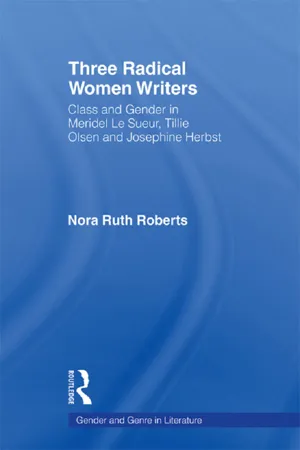
Three Radical Women Writers
Class and Gender in Meridel Le Sueur, Tillie Olsen, and Josephine Herbst
- 224 pages
- English
- ePUB (mobile friendly)
- Available on iOS & Android
eBook - ePub
Three Radical Women Writers
Class and Gender in Meridel Le Sueur, Tillie Olsen, and Josephine Herbst
About this book
Combining biography, history, and literary theory, this work looks at three of the most significant women writers to emerge from American radicalism of the 1930s. Le Sueur, Olsen, and Herbst were influenced by the Communist movement of the time, but each also forged an independent vision of feminist socialist literary milieu. Drawing on Marxist and post-Marxist theory, and addressing the challenge of such new feminist theorists as Jean Bethke Elshtain, Roberts takes a theoretical approach that encompasses the social vision and feminist practice of the writers and places them in their historical, cultural, and social contexts. The study covers their lives from the turn of the century to the 1970s, with an emphasis on the 1930s; examines their views of the Cold War; links the three to the Progressive tradition; and analyzes their key literary works. Resources for analysis include historical and contemporary theory; excerpts from the radical press of the 1920s and 1930s; and primary materials from the writers themselves, including journals, notes, and unpublished archival materials.
Information
Chapter One
Marxism and the Feminine Utopia
In the February 1911, issue of The Masses, the tongue-in-cheek commentator Eugene Wood wrote an essay entitled “A Highbrow Essay on Woman,” in which he took issue with a scholar who identified woman's economic role as one of consumption merely. Seeming to uphold the importance of woman's place in the economic system, Wood maintained that her function as reproducer of the labor force is her ultimate raison d'etre:
No, folks and friends, not Consumption of Commodities, not Production of Commodities, but Reproduction of Labor-Power is the main-top, all else being but side-shows of the snidest sort. This, which truly is the whole shooting-match, is The Economic Function of Woman. (11)
This argument seems remarkable primarily for its date. Although the position anticipates a whole wide-ranging discussion in modern times of an economic interpretation of housework given Marxist definitions of expropriation of labor and the function of labor power and commodities under capitalism, it triggered no such discussion in its own time. When Mary Inman was to raise similar questions in the Communist movement of the thirties, she met with a cold response. The very lightness of Wood's tone seems to signal a gentlemanly bantering that in some ways denigrates the seriousness of the question even while it poses questions of woman's role and capabilities in terms more sophisticated even than those of the typical suffragist exponent. “No,” Wood repeats, “there is no Economic Function peculiar to Woman but the one. Whatever the Man is able for, she also is able for, and then some.” (11). To make the point, the editors of The Masses have accompanied the piece with a cartoon drawing of a moustachioed man holding an infant and cooking a meal over a wood stove. The implication is clearly that reproduction of the labor force as woman's function is not to be understood in its merely gynecological terms but includes the full range of housewifely duties. That man should undertake such duties is laughable. The cartoon is self-consciously captioned, “In such a case what is the economic function of man?” The implication is clearly that the division of labor that militates that woman is in charge of the reproduction of labor-power derives from biological necessity.
The issue of woman's relationship to the economic system of commodity production and consumption, or as the question is known, the relationship of reproduction to production, does not figure significantly in my consideration of the work of Le Sueur, Olsen, and Herbst; however, the question of woman's relation to history and social structure does.
For my primary theoretical orientation on this question, I draw, not without reservation, on the work of Jean Bethke Elshtain as presented in her major book Public Man, Private Woman: Women in Social and Political Thought The metaphysics of the binary opposition Elshtain uniquely proposes suggests that although politics and mainstream economic functioning have been the domains of men, and the home and the “private sphere” has been that of women, the drive should not be to liberate women from the private sphere nor to collapse the private sphere into the “public” but to reconstruct the private sphere-including child-rearing, nurturing, feeding and education--as the shared domain of families which would be given a special consideration of importance in a humane society.
Elshtain distinguishes herself from contemporary feminists--from liberals to Marxists--by championing precisely the aspects of domestic life that have been rejected by feminist theorists. Wary of the conflation of the public and private realms, she implicitly overthrows the notion of the superiority of the public, or male-dominated political and economic purview. As she says:
To attain and affirm an ideal of family life as the locus of humanization is, contrary to certain unreflective radical orthodoxies, to put pressure upon social structures and arrangements, not to affirm them. For to the extent that the public world, with all its political, economic, bureaucratic force, invades and erodes the private sphere, it, not the private world, should be the target of the social rebel and feminist critic. To promote a politics of displacement that further erodes the terms of the private sphere and all that stands between us and a coarse power of market-ridden definition of all of life, is to repress discourse on public, political issues even as one simultaneously takes the symptoms of its destructive effects as the “good news” that radical change is just around the corner. (333)
Elshtain's thesis is important to my consideration of Le Sueur, Olsen, and Herbst because I find an identification of the private sphere as the primary locus of social action and a further linking of that sphere with the dominant voice of women to be the unifying factor in the works of all three writers. Other women writers wrote in the thirties, and others wrote of social issues and of the importance of women's roles in the working out of those themes, but what seems to be unique to the works of Le Sueur, Olsen, and Herbst, what makes them continue to resonate for a new generation, is that their sense of the primacy of the private realm within a social context speaks of a vision that is simultaneously linked to a particular time and suprahistorical.
To be sure, there are flaws in Elshtain's argument, flaws that bear upon its applicability to the three writers I am examining and their times. The aspect of her discussion I want to pay some special attention to is that which deals with Marxism and Marxist-feminism.
To begin with, although Elshtain does not devote much space to a consideration of the nature of housework in terms of the matrix of the commodity-production system--the paradigm into which we can fit the argument of Eugene Wood which begins this chapter-it is clear that Elshtain regards that primary economic system as the domain of the “public” or masculine, a sterile domain against which she promotes the family or “reproductive” domain of the feminine. By Elshtain's logic, equating the feminine role with that of a cog in the commodity-production machine is reductive and even destructive of the private or feminine sphere.
I hasten to indicate that this is not a reactionary “woman's place is in the home” argument. The confusion may arise from Elshtain's title which identifies the public with man and the private with woman. Elshtain goes on to assure her readers that both sexes can and perhaps should have both aspects to their lives and that the system of economic dependency as a means of holding women within the family is debilitating and crippling-even destructive of the integrity of private or family life, although this does not lead her to take on Angela Davis's militant pseudo-Marxist rejection of separate public-supported paychecks for housewives.1 Since that question does not arise explicitly in the work of the three women I am considering, I, too, will, temporarily at least, jettison it.
My quarrel with Elshtain lies in her interpretation of Marx's Utopian prognosis, which leads her to dismiss Marxism as a tool useful for feminist analysis entirely. I find myself sympathetic to her primary attack on Marxism, that it does not take into consideration the individual variations and mutual discords of collectives of various human selves. Some of this criticism can, to a degree, be leveled against the work under consideration here, especially that of Meridel Le Sueur. At the same time that Elshtain, rightly, I think, questions the “withering away of the state” fantasy in the light of the inherent individuality of members of the human community, she interprets Marx's conflation of private and public under communism with the subsuming of the private into the public that occurred under Stalinism. To be sure, in its most sophisticated application, as a device of literary critique, this charge can accurately be leveled against many of the literary products of the dominant proletarian or socialist realism prescriptions of the period, including some by women. This would be indicated by a subordination of private and personal causal factors and relationships to considerations of the workings of external social forces. In its largest sense, this construct is surely the dominant mode of the socially committed literature of the thirties and, as I will indicate, played an important part in shaping the social awareness of the characters created by Le Sueur, Olsen, and Herbst as well.
What saves the exceptional writers of the socially conscious period from being merely creators of knee-jerk automata is precisely the consideration of the private realm that Elshtain champions as the domain of women. In the case of the three women writers I am considering, it undoubtedly is the domain of women, although it can be well argued that no good work of fiction can hope to present any domain, masculine or feminine, without some development of the interaction between the public and private realms.
Elshtain is just as critical of the slogan “the personal is political,” that rallying cry of women's consciousness-raising groups across the left spectrum as the result of the disillusionment of young women with the male-dominated political movements of the sixties. She sees in this feminist gesture, as with the Marxist move in Utopian sloganeering, a conflation of the personal and the political that will jeopardize ultimately the personal rather than the superstructure by re-signifying the personal in terms of the political. Having had the experience myself, I find I am somewhat convinced by Elshtain's argument. Thus I tend not to interpret the work of Le Sueur, Olsen, and Herbst in terms of modern consciousness-raising movements, as do such modern discussants as Constance Coiner2.
At the same time that I accept Elshtain's quarrel with Marx over the conflation of the private into the public on the question of individuation and the need for political organization no matter the economic circumstances, I take a different stance in relation to the ultimate conflation of public and private human beings. The missing term in the Marxist equation as Elshtain presents it is the question of the ultimate withering away of the production of exchange-value and surplus-value according to the delineations in the major body of Marx's texts. The commodity, in Marx's vision, would disappear under communism, to be replaced by an item that was no longer bifurcated and entered into existence solely as use-value. That is to say, in the Marxist paradigm, the commodity itself replicates the social split between public and private. The public domain, far from being the Aristotelian or Platonic expression of citizenship that so many liberal theorists from Betty Friedan to Gloria Steinem seek to crash, turns out to be in the Marxist lexicon, under capitalism, a nursery for the tending and developing of exchange-value and the reconnoitering of surplus-value. In this sense I agree with Elshtain's privileging of the private domain, which she identifies with the domain of women. My only addendum would be to note that in Marx's structure this domain is that of the use-value aspect of production, and as such stands as the gateway in and of itself to the development of communism, itself a society based on the production and consumption of use-values rather than market-oriented commodities.
In the sense that Marx foresees communism as the society which will be organized around the production of use-values rather than exchange values, a society which will allow for the first time the full development of consciousness in all spheres, emanating from the rational organization of the production and consumption of the socially determined necessities of life for all, he postulates the end of the dichotomy between the social and the individual, the personal and the political, the private and the public. Not foreseeing the tyranny of the subordination of the private to the public in the name of communism under Stalinism, he did not attend in his own work to the task of delineating the difference between integrating the social and the individual and subsuming the individual within the structure of the social. As the difference between integration and subordination can be seen in the difference between dialectical development and social imposition, it seems possible to include it within the realm of Marxist discourse.
The production of use-values as the sole rationale of the social order suggests the triumph of reason through a new definition of the Marxist concept of “socially necessary” determinations of utility. This suggests that men and women can together determine rationally what they need to reproduce a humane existence both personal and political and how much time and intelligence they want to devote to developing such ends. This may be a Utopian suggestion, but it seems to be what Marx intended in his stress upon the rationality of the new order and an end of the subordination of the human species to its animal needs and to its commodity form. In this way, more importantly than what is to my mind a rather hopeless and useless fantasy about the end of conflict and alienation, Marx suggests the integration of the personal with the political through the reorganization of society from the production of commodities to the production of use-values. Much work has been done, notably by Althusser and Habermas on the project of rethinking the fantasy of the stateless order. As this does not seem essential to my project, I will not take it up here.
What is in order, with regard to Le Sueur, Olsen, and Herbst is the project of integrating the personal with the political in Elshtain's terms in a way that does not depart from Marxist thinking. If we accept Elshtain's understanding of the private sphere as being female-dominated we can lay the basis for understanding the importance of the work of these three writers. As I will show, a tracing of history and social force through the private, feminine-dominated field is perhaps the primary contribution of these three writers. By locating their work in the private domain within the context of significant forces of social change they place a unique focus on the interaction of the private and the public, of women and men.
Further, all three, as I will show, place a special emphasis on the primacy of the use-value over the exchange-value, even in consideration of the usual Marxist or quasi-Marxist interpretation of the problem of the reproduction of the labor force. The use-value becomes, in the work of these three writers, more or less what Marx intended it to be, a harbinger of the Utopian future when all work will be the production of use-values. Specifically, I draw the conclusion from this work that in modern terms, women's work is itself the harbinger of such a Utopian future. Not only Elshtain but Nancy Chodorow3 suggest that the caring and nurturing of a family and the passing down of family values to succeeding generations must be interpreted not only from the point of view of capital, which can only consider such activity in the frame of the production and consumption of commodities and the need of capital for the commodity labor. We must also see, Elshtain and Chodorow suggest, that such activity is the key to the development of a humane, rational society. In that way, woman's work, despite its unnecessarily burdensome nature, shares a component with art and literature and crafts production in that it creates use-values only secondarily for exchange and calls on especially human qualities of nurturance and artisanship.
If such a thesis were to be presented without a social context, it might be construed as a reactionary admonition to all women to “go thou and get thee with child.” The advantage of considering such a proposition in the context of Le Sueur, Olsen, and Herbst is that we can place the use-value aspect of women's work in the context of a larger political and social canvas. It turns out that what this suggests is that when the continuity of women's existence informs a social and historical imperative the resultant is a vector directing to a utopianism more viable than any Marx envisioned. The important term is the Utopian projects of both Ernst Bloch and Herbert Marcuse. Both Frankfurt Marxists suggest that an element of utopianism is necessary to set goals and projects that reach beyond the reductionist materialism of capitalism. Or, in the words of Delmore Schwartz: “In dreams begin responsibilities.” By contemplating the society of women in its use-value aspect, the three writers I am examining implicitly pose the Utopian question-is it not possible for all of humankind to engage in use-value production and eliminate the repressive structure imposed by the transformation of humanity into commodities and of human society into a matter of circulation of commodities for the dubious benefit of the few at the expense of the many? In short, the question implicit in these works is: is capitalism a fit activity for the human species?
I note that the Elshtain position is not a popular one. Elshtain has been linked with Betty Friedan's book of rethinking and with Germaine Greer under the label of “backlash feminism.”4 The charge is now prevalent and has been fundamental to the women's movement since its inception. It is based on the difference in the assumptions of whether women will take positions of “equality” with men or will find an “essentialist” domain that will continue the peculiar contributions of women in what Elshtain refers to as the “private sphere.”
Part of the controversy arises, in my opinion, from a misreading of the Marxist position. Such modern Marxist-feminist theoreticians as Margaret Benston, Heidi Hartmann and Annette Kuhn have been reading Marx's interpretation of the value of the reproduction of labor power in capitalist rather than socialist terms. Marx himself engaged in considerable debate with the “bourgeois” economists, especially Adam Smith and Ricardo, devoting three volumes in what is known as volume four of Capital under the heading Theories of Surplus Value to this debate. It is easy to surmise from Marx's own emphasis on an understanding of how value in its commodity form circulates and is reproduced that Marx himself viewed the worker and the worker's family only in the context of their place in the system of commodity exchange. This has been the dominant assumption of the Marxist-feminist theoreticians, but is, in my reading, a most un-Marxist assumption. Although Marx devoted considerable attention to the place of the human entity within the capitalist system, it was not he but the bourgeois economists with whom he argued who reduced human values to mere market values. It was Adam Smith and Ricardo who raised the question of “non-productive” labor and its role in a market economy. Marx may have been wrong to answer these theoreticians of capitalism in their own terms and thereby mislead his followers into the path of justifying all economic activity in terms of its position in the capitalist mode of production. Nevertheless, it is clear from Marx's early writings that he did not view men and women as mere cogs in a machine, nor did he reckon their value or the value of their activity in terms of their usefulness in the capitalist mode of production...
Table of contents
- Front Cover
- Half Title
- Gender and Genre in Literature
- Title Page
- Copyright
- Dedication
- Contents
- Preface and Acknowledgments
- Introduction: Three Radical Women
- Chapter One: Marxism and the Feminine Utopia
- Chapter Two: Delineating a Marxist Critique
- Chapter Three: The Political Writings of Meridel Le Sueur
- Chapter Four: Meridel Le Sueur's Feminist Sentence
- Chapter Five: Tillie Olsen's Yonnondio: From the Thirties
- Chapter Six: Tillie Olsen's Riddle
- Chapter Seven: Josephine Herbst: The Major Novels
- Chapter Eight: Josephine Herbst: Memory Speaks
- Chapter Nine: The Return to Nature: A Cross-Reading
- Works Cited
- Index
Trusted by 375,005 students
Access to over 1.5 million titles for a fair monthly price.
Study more efficiently using our study tools.
Frequently asked questions
Yes, you can cancel anytime from the Subscription tab in your account settings on the Perlego website. Your subscription will stay active until the end of your current billing period. Learn how to cancel your subscription
No, books cannot be downloaded as external files, such as PDFs, for use outside of Perlego. However, you can download books within the Perlego app for offline reading on mobile or tablet. Learn how to download books offline
Perlego offers two plans: Essential and Complete
- Essential is ideal for learners and professionals who enjoy exploring a wide range of subjects. Access the Essential Library with 800,000+ trusted titles and best-sellers across business, personal growth, and the humanities. Includes unlimited reading time and Standard Read Aloud voice.
- Complete: Perfect for advanced learners and researchers needing full, unrestricted access. Unlock 1.5M+ books across hundreds of subjects, including academic and specialized titles. The Complete Plan also includes advanced features like Premium Read Aloud and Research Assistant.
We are an online textbook subscription service, where you can get access to an entire online library for less than the price of a single book per month. With over 1.5 million books across 990+ topics, we’ve got you covered! Learn about our mission
Look out for the read-aloud symbol on your next book to see if you can listen to it. The read-aloud tool reads text aloud for you, highlighting the text as it is being read. You can pause it, speed it up and slow it down. Learn more about Read Aloud
Yes! You can use the Perlego app on both iOS and Android devices to read anytime, anywhere — even offline. Perfect for commutes or when you’re on the go.
Please note we cannot support devices running on iOS 13 and Android 7 or earlier. Learn more about using the app
Please note we cannot support devices running on iOS 13 and Android 7 or earlier. Learn more about using the app
Yes, you can access Three Radical Women Writers by Nora Ruth Roberts in PDF and/or ePUB format, as well as other popular books in Literature & Literary Biographies. We have over 1.5 million books available in our catalogue for you to explore.