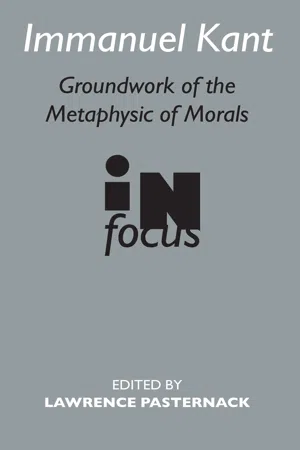
The Groundwork of the Metaphysics of Morals^ is one of the most important works of moral philosophy ever written, and Kant's most widely read work. It attempts to demonstrate that morality has its foundation in reason and that our wills are free from both natural necessity and the power of desire. It is here that Kant sets out his famous and controversial 'categorical imperative', which forms the basis of his moral theory.
This book is an essential guide to the groundwork and the many important and profound claims that Kant raises. The book combines an invaluable introduction to the work offering an exploration of these arguments and setting them in the context of Kant's thinking, along with the complete H.J Paton translation of the work, and a selection of six of the best contemporary commentaries. It is the ideal companion for all students of Kantian ethics and anyone interested in moral philosophy. _ _ _
- 296 pages
- English
- ePUB (mobile friendly)
- Available on iOS & Android
eBook - ePub
About this book
Trusted by 375,005 students
Access to over 1.5 million titles for a fair monthly price.
Study more efficiently using our study tools.
Information
GROUNDWORK OF THE METAPHYSIC OF MORALS
by
Immanuel Kant
Immanuel Kant
PREFACE
[The different branches of philosophy]
Ancient Greek philosophy was divided into three sciences: physics, ethics, and logic. This division fits the nature of the subject perfectly, and there is no need to improve on it – except perhaps by adding the principle on which it is based. By so doing we may be able on the one hand to guarantee its completeness and on the other to determine correctly its necessary subdivisions.
All rational knowledge is either material and concerned with some object, or formal and concerned solely with the form of understanding and reason themselves – with the universal rules of thinking as such without regard to differences in its objects. Formal philosophy is called logic; while material philosophy, which has to do with determinate objects and with the laws to which they are subject, is in turn divided into two, since the laws in question are laws either of nature or of freedom. The science of the first is called physics, that of the second ethics. The former is also called natural philosophy, the latter moral philosophy.
Logic can have no empirical, part1 – that is, no part in which the universal and necessary laws of thinking are based on grounds taken from experience. Otherwise it would not be logic – that is, it would not be a canon for understanding and reason, valid for all thinking and capable of demonstration. As against this, both natural and moral philosophy can each have an empirical part, since the former has to formulate its laws for nature as an object of experience, and the latter for the will of man so far as affected by nature – the first set of laws being those in accordance with which everything happens, the second being those in accordance with which everything ought to happen, although they also take into account the conditions under which what ought to happen very often does not happen.
All philosophy so far as it rests on the basis of experience can be called empirical philosophy. If it sets forth its doctrines as depending entirely on a priori principles, it can be called pure philosophy. The latter when wholly formal is called logic; but if it is confined to determinate objects of the understanding, it is then called metaphysics.
In this way there arises the Idea of a two-fold metaphysic – a meta-physic of nature and a metaphysic of morals. Thus physics will have its empirical part, but it will also have a rational one; and likewise ethics – although here the empirical part might be called specifically practical anthropology, while the rational part might properly be called morals.
[The need for pure ethics]
All industries, arts, and crafts have gained by the division of labour -that is to say, one man no longer does everything, but each confines himself to a particular task, differing markedly from others in its technique, so that he may be able to perform it with the highest perfection and with greater ease. Where tasks are not so distinguished and divided, where every man is a jack of all trades, there industry is still sunk in utter barbarism. In itself it might well be a subject not unworthy of examination, if we asked whether pure philosophy in all its parts does not demand its own special craftsman. Would it not be better for the whole of this learned industry if those accustomed to purvey, in accordance with the public taste, a mixture of the empirical and the rational in various proportions unknown even to themselves – the self-styled ‘creative thinkers’ as opposed to the ‘hair-splitters’ who attend to the purely rational part – were to be warned against carrying on at once two jobs very different in their technique, each perhaps requiring a special talent and the combination of both in one person producing mere bunglers? Here, however, I confine myself to asking whether the nature of science does not always require that the empirical part should be scrupulously separated from the rational one, and that (empirical) physics proper should be prefaced by a metaphysic of nature, while practical anthropology should be prefaced by a metaphysic of morals – each metaphysic having to be scrupulously cleansed of everything empirical if we are to know how much pure reason can accomplish in both cases and from what sources it can by itself draw its own a priori teaching. I leave it an open question whether the latter business1 is to be conducted by all moralists (whose name is legion) or only by those who feel a vocation for the subject.
Since my aim here is directed strictly to moral philosophy, I limit my proposed question to this point only – Do we not think it a matter of the utmost necessity to work out for once a pure moral philosophy completely cleansed of everything that can only be empirical and appropriate to anthropology?1 That there must be such a philosophy is already obvious from the common Idea2 of duty and from the laws of morality. Every one must admit that a law has to carry with it absolute necessity if it is to be valid morally – valid, that is, as a ground of obligation; that the command ‘Thou shalt not lie’ could not hold merely for men, other rational beings having no obligation to abide by it – and similarly with all other genuine moral laws; that here consequently the ground of obligation must be looked for, not in the nature of man nor in the circumstances of the world in which he is placed, but solely a priori in the concepts of pure reason; and that every other precept based on principles of mere experience – and even a precept that may in a certain sense be considered universal, so far as it rests in its slightest part, perhaps only in its motive, on empirical grounds3 – can indeed be called a practical rule, but never a moral law.
Thus in practical knowledge as a whole, not only are moral laws, together with their principles, essentially different from all the rest in which there is some empirical element, but the whole of moral philosophy is based on the part of it that is pure. When applied to man it does not borrow in the slightest from acquaintance with him (in anthropology), but gives him laws a priori as a rational being.1 These laws admittedly require in addition a power of judgement sharpened by experience, partly in order to distinguish the cases to which they apply, partly to procure for them admittance to the will of man and influence over practice; for man, affected as he is by so many inclinations,2 is capable of the Idea of a pure practical reason, but he has not so easily the power to realise the Idea in concreto in his conduct of life.
A metaphysic of morals is thus indispensably necessary, not merely in order to investigate, from motives of speculation, the source of practical principles which are present a priori in our reason, but because morals themselves remain exposed to corruption of all sorts as long as this guiding thread is lacking, this ultimate norm for correct moral judgement. For if any action is to be morally good, it is not enough that it should conform to the moral law – it must also be done for the sake of the moral law: where this is not so, the conformity is only too contingent and precarious, since the non-moral ground at work will now and then produce actions which accord with the law, but very often actions which transgress it. Now the moral law in its purity and genuineness (and in the field of action it is precisely this that matters most) is to be looked for nowhere else than in a pure philosophy. Hence pure philosophy (that is, metaphysics1) must come first, and without it there can be no moral philosophy at all. Indeed a philosophy which mixes up these pure principles with empirical ones does not deserve the name of philosophy (since philosophy is distinguished from ordinary rational knowledge precisely because it sets forth in a separate science what the latter apprehends only as confused with other things). Still less does it deserve the name of moral philosophy, since by this very confusion it undermines even the purity of morals themselves and acts against its own proper purpose.
[The philosophy of willing as such]
It must not be imagined that in the propaedeutics prefixed to his moral philosophy by the celebrated Wolff – that is, in the ‘Universal Practical Philosophy’,1 as he called it – we already have what is here demanded and consequently do not need to break entirely new ground. Precisely because it was supposed to be a universal practical philosophy, it has taken into consideration, not a special kind of will – not such a will as is completely determined by a priori principles apart from any empirical motives and so can be called a pure will – but willing as such, together with all activities and conditions belonging to it in this general sense. Because of this it differs from a metaphysic of morals in the same way as general logic differs from transcendental philosophy, the first of which sets forth the activities and rules of thinking as such, while the second expounds the special activities and rules of pure thinking -that is, of the thinking whereby objects are known completely a priori;1 for a metaphysic of morals has to investigate the Idea and principles of a possible pure will, and not the activities and conditions of human willing as such, which are drawn for the most part from psychology. The fact that in this ‘universal practical philosophy’ there is also talk (though quite unjustifiably) about moral laws and duty is no objection to what I say. For the authors of this science remain true to their Idea of it on this point as well: they do not distinguish motives which, as such, are conceived completely a priori by reason alone and are genuinely moral, from empirical motives which understanding raises to general concepts by the mere comparison of experiences. On the contrary, without taking into account differences in their origin they consider motives only as re...
Table of contents
- Cover
- Half Title
- Series Page
- Title Page
- Copyright Page
- Table of Contents
- Acknowledgements
- List of Contributors
- Introduction
- Groundwork of the Metaphysic of Morals
- Kant’s theory of practical reason
- Kant’s analysis of obligation: the argument of
- Consistency in action
- Morality and freedom: Kant’s Reciprocity Thesis
- Kant’s theory of moral sensibility: Respect for the
- Kant’s Third Antinomy and anomalous monism
- Select bibliography
- Index
Frequently asked questions
Yes, you can cancel anytime from the Subscription tab in your account settings on the Perlego website. Your subscription will stay active until the end of your current billing period. Learn how to cancel your subscription
No, books cannot be downloaded as external files, such as PDFs, for use outside of Perlego. However, you can download books within the Perlego app for offline reading on mobile or tablet. Learn how to download books offline
Perlego offers two plans: Essential and Complete
- Essential is ideal for learners and professionals who enjoy exploring a wide range of subjects. Access the Essential Library with 800,000+ trusted titles and best-sellers across business, personal growth, and the humanities. Includes unlimited reading time and Standard Read Aloud voice.
- Complete: Perfect for advanced learners and researchers needing full, unrestricted access. Unlock 1.5M+ books across hundreds of subjects, including academic and specialized titles. The Complete Plan also includes advanced features like Premium Read Aloud and Research Assistant.
We are an online textbook subscription service, where you can get access to an entire online library for less than the price of a single book per month. With over 1.5 million books across 990+ topics, we’ve got you covered! Learn about our mission
Look out for the read-aloud symbol on your next book to see if you can listen to it. The read-aloud tool reads text aloud for you, highlighting the text as it is being read. You can pause it, speed it up and slow it down. Learn more about Read Aloud
Yes! You can use the Perlego app on both iOS and Android devices to read anytime, anywhere — even offline. Perfect for commutes or when you’re on the go.
Please note we cannot support devices running on iOS 13 and Android 7 or earlier. Learn more about using the app
Please note we cannot support devices running on iOS 13 and Android 7 or earlier. Learn more about using the app
Yes, you can access Immanuel Kant by Lawrence Pasternack in PDF and/or ePUB format, as well as other popular books in Philosophy & Teaching Arts & Humanities. We have over 1.5 million books available in our catalogue for you to explore.