- 200 pages
- English
- ePUB (mobile friendly)
- Available on iOS & Android
eBook - ePub
About this book
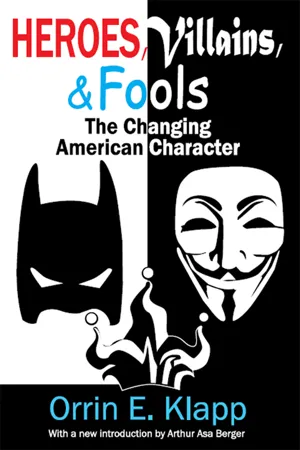
This volume presents three major social types in American society-heroes, villains, and fools-as models for American behaviour. Approaching these models primarily through language, Orrin E. Klapp explores what they may suggest about Americans as a people. Rather than study people, the author describes abstract types named and embedded in popular language. These social types are important symbols; and a way to attack a symbol is by identifying its meaning in various contexts. He further argues that the language surrounding heroes, villains, and fools reveals a social structure. We may not escape being ascribed a type, but we do have a choice of type. Known more commonly as "finding oneself," we can manipulate cues-with dress, facial expressions, style of life, or conspicuous public roles-to build an identity. This classic study has serious contemporary implications. For a public figure, an inevitable result of the typing process is the development of at least two selves, the public and the private. When the book originally appeared in 1962, the struggle to balance two images generally only plagued celebrities and politicians. Today, social media offers everyone the opportunity to develop an online persona. This volume will be of interest to sociologists as well as anyone who has a Facebook account.
Trusted by 375,005 students
Access to over 1.5 million titles for a fair monthly price.
Study more efficiently using our study tools.
Information
PART I
POPULAR AMERICAN SOCIAL TYPES
CHAPTER 1
HEROES
Heroes state major themes of an ethos, the kinds of things people approve. The heroes here presented are types judged “heroic or admirable” by most raters, though some are markedly ambivalent.1
Each represents certain themes of value and achievement.
Category | Theme |
1) Winners | Getting what you want, beating everybody, being a champ. |
2) Splendid performers | Shining before an audience, making a “hit.” |
3) Heroes of social acceptability | Being liked, attractive, good, or otherwise personally acceptable to groups and epitomizing the pleasures of belonging. |
4) Independent spirits | Standing alone, making one’s way by oneself. |
5) Group servants | Helping people, cooperation, and self-sacrifice—group service and solidarity. |
Each of these five categories seems to correspond to a different Weltanschauung. Looking at winners, one gets the impression that they live in a world in which life is a battle of champs, even dog-eat-dog competition, in which the strong man is king. Splendid performers, on the other hand, seem to live in a world of showmanship, where everything is for the grand impression and little matters except whether or not you make a hit in front of an audience. The show-off rather than the able man (unless also a show-off) is king. The third category, heroes of social acceptability, suggests a world of conformity where everyone is concerned to be liked and accepted—whether or not he shines, whether or not he is strong and able. Independent spirits have yet a different emphasis: the important thing is to stand alone, as on a frontier or where there is a loose social structure in which people are more interested in being themselves and freely moving than belonging—or, on the other hand, a confining structure from which they wish to escape. The last class, group servants, epitomize team spirit and solidarity—a world in which everyone is loyal to the cause and working with and for his neighbor. These worlds, of course, do not fit into a closely coherent, let alone a simple, picture. Modern society is a complex pluralism, and its system—or lack of system— contains contradictory hero-types. (Can one be both a do-gooder and a smart operator, for example?) I shall describe the types against their respective backgrounds.
Winners
The first category includes heroes who beat everybody, get what they want, and come out on top. Speaking generally, they are competitive, self-assertive, invidious, and oligarchic, favoring the king-of-the-hill principle in some form. Winners include strong men, top dogs, underdogs, brains, smart operators, even great lovers.
The strong man of modern times is plainly related to the conquering hero of primitive legend (Achilles, Sigurd, Beowulf, Rama) who is in vincible and can’t be stopped or even hurt because of his extraordinary, even magical power.2 American slang shows admiration for indomitable persons:
champ, ace, winner, superman, iron man, Tarzan, Samson, big operator, big leaguer, big timer, big spender, titan strong-and-silent man, man’s man, lumberjack, bronc-buster, buckaroo (also some ambivalent figures like two-gun-man, Billy the Kid, and tough guy, who are predominantly villains though they have appreciable heroic ratings).
Asked to name a strong man, Americans are likely to mention Atlas, Hercules, Samson and Tarzan; after that a range such as Jack Dempsey, Napoleon, Popeye, Superman, Paul Bunyan, Joe Louis, Teddy Roosevelt, General MacArthur, Floyd Patterson, Johnny Weismuller, John L. Lewis; also some negatively valued characters, such as Hitler, Stalin, Khrushchev, Perόn, Batista, Franco, Goliath, James Hoffa, Premier Tito, and Fidel Castro. These indicate that the strong man, while predominantly a hero, is also a villain when he abuses power in certain ways (to be discussed later). Americans are not, however, squeamish about accepting some pretty rough customers as heroes, whether Western two-gun men,3 ruthless empire-builders of politics or finance,4 even the Big Bankroll of a crime syndicate.5
A seeming reaction against the tough guy has been noted in favor of a gentlemanly kind of hero, exemplified by Gregory Peck, Henry Fonda, and James Stewart, aware that the problems of life can “not all be solved by a breezy manner, a gun, or a punch in the nose.”6 Some cowboys of film and TV, too, are ceasing to be strong-and-silent men. Yet there is little reason to believe that the strong man is ceasing to be a popular type. The mass media are full of the crudest exemplars. Politics is also a scene of swashbuckling.
Very like the strong man is the top dog (indeed, it may seem that stress is simply on point of arrival rather than what brought him there). Americans may call such a person a wheel, big shot, boss, head guy, kingpin, Mr. Big, V.I.P., tycoon; or, somewhat derisively, brass hat. Often mentioned as top dogs are: Eisenhower, Churchill, Franklin Delano Roosevelt, Nasser, Castro, Khrushchev, Hoffa, Rockefeller, Dave Beck, Du Pont, Carnegie, Walter Reuther, Governor Faubus (nominations are, of course, affected by current news). A dictator or oppressor may seem a top dog in villainous aspect; but this is by no means the predominant way in which the big shot is viewed in America; as many have observed, our business structure is markedly authoritarian under its surface of good Joeism.
Every top dog, of course, must have an underdog, whether as loyal subordinate, victim of bullying or domination—or, as it may be, rival destined to upset him. I refer here only to the kind of underdog who could properly be called heroic because he commands admiration and is expected to win, by pluck or luck, over the big guy. He might be thought of as a plucky little guy, a dark horse, a little David or a poor boy (who is going to become a self-made man). Well known stories, such as Cinderella and The Ugly Duckling, depict this theme in literature.1 Unexpectedness is an essential part of his victory against overwhelming odds—epitomized by the famous flight of Lindbergh. Americans mention Harry Truman, Fidel Castro,8 and Richard Nixon as underdogs who overcame odds.
The strong man is in a curious position of conflict with the underdog. If he fights him, he may seem a persecutor; if he doesn’t, he may look like a coward. His safest course, other than avoiding the little guy altogether, is to defend him from another big guy. An example of the embarrassment a strong man can get into by fighting an underdog was the historic boxing match of Jack Dempsey with Georges Carpentier, the overmatched but sentimentally regarded champion of France. It was one of Dempsey’s most unpopular fights. But in describing this tactical advantage of the underdog I do not wish to give the impression that his path is easy; even in America, negative types such as upstart, whippersnapper, fall guy, Sad Sack, butt, and low man, may be assigned to him.
Pausing to comment on these winner types, we may say that the strong man, top dog, and underdog reflect a world rather like a tournament in structure: sharply hierarchical, competitive, consisting of a series of encounters in which rivals are matched—the results are invidious, if not ruinous, for many. He who holds his position as king of the hill becomes top dog. The fall of a top dog—especially a disliked one—to an underdog is a source of delight to audiences that like a good fight and are preoccupied with winning or watching others win. In such a world, where the facts of life are distinctly not equalitarian (whatever the ethical ideals), the supreme goal is winning one’s way (fairly) to the highest place.
Oddly, for all the stress on top dogs, climber is not a term by which Americans designate successful ones. The one who climbs is not called a climber if he is admired. This type has a derisive flavor, with some resentment too. It may denote a striver who cannot make the grade, or has been clumsy in his maneuvers; or be used by those on higher levels to disparage crashers, upstarts and pretenders; or by rivals to express envy and the hope that another will not succeed. Why do Americans resent the climber but admire the top dog? I would say that they like achievement but despise anyone who concentrates on small tactics— finagling, climbing itself—as a substitute for the abilities a hero should have.
Another type seems opposite to the strong man if we accept the familiar antithesis of brains versus brawn: that giant of intellect, the brain. Americans also call him genius, mastermind, Einstein, pundit (sometimes professor, brain-truster, intellectual, intelligentsia, expert, specialist). Even such lesser lights as quiz kid, panel-game expert, and commentator come in for their share of glory. Asked to name a brain, Americans overwhelmingly choose Einstein, though Werner Von Braun, Robert Oppenheimer, Leonardo da Vinci, Socrates, Webster, or Aristotle are often mentioned. My data show that intellect is highly esteemed by Americans. This is borne out by polls of the National Opinion Research Center at the University of Chicago, which show that college professors rank high in prestige among other professions, at least on a par with bankers and Congressmen, though below physicians. Anyone who watches television can see that there is considerable respect for pundits, mathematical wizards, mind-readers, and people who can answer the sixty-four-thousand-dollar question.
This may seem hard to square with distrust of pure scholarship and the reputed anti-intellectualism of Americans. Seymour M. Lipset says American intellectuals don’t really have low status but just feel that way, possibly from comparing their status with that of European professors or from taking salary as the sole index of status. The key to the question, I think, is the kind of intellect that Americans admire. Contempt for dreamers, eggheads, and crackpots is well known. Philosophy is neglected in colleges. But let the idea-man produce cures, bombs, and gadgets—or enter the stock-market to become a successful analyst, a debate to win by smashing argument, or television contests to give the precise date that Shakespeare wrote his twelfth sonnet—and suddenly he is respected. What is common to these? It seems to me they are all tangible, public demonstrations of power. Not so much ideas per se but their results are appreciated. If so, the brain is consensually closer to the strong man than at first supposed—he might even be called a conquering hero of intellect. According to this, Einstein did not become the popular symbol of genius because the people appreciated his ideas but because they could feel and understand the impact of his ideas; he became a kind of demiurge generating a force that changed the world.
Also like the strong man, the brain supports hierarchy. He separates the thinker from the non-thinker; we see the master-mind directing what others do but cannot understand, as the top dog of a planning elite. If active thinking were the prerogative and pleasure of everyone, we would expect champions of intellect; but they would probably not be superstitiously revered as brains and wizards, nor, would they be despised if the results of their ideas were not immediately practical.
A third winner type is the smart operator. He is neither a brain nor a strong man, but he is similar in one essential: even though he does not claim knowledge or overcome everyone by smashing arguments or fists, somehow, when the game is over, the smart operator has the chips.
He may be called a smoothie, promoter, fast worker, diplomat—or when disapproved (with undertones of admiration): fast talker, sharpie, fox, con-man. Asked to name a smart operator, Americans may mention: Louis Wolfson, Phil Silvers (Sergeant Bilko), Maverick (TV), Richard III, Richard Nixon, Perry Mason, Frank Costello, Lucky Luciano, Dave Beck, Mike Todd, Walter Reuther, Joe McCarthy, Mayor Curley, Khrushchev, Ford, Hamilton, Lyndon Johnson, to name but a few. A fairly flattering picture of the smart operator is found in Cameron Hawley’s Cash McCall, the hero is a bafflingly shrewd gentleman who buys up weak companies and turns them over for a profit; no one knows how many deals he is involved in or where he will turn up next; he is the mystery man behind the front man. As depicted in the novel, he is ethical in the old-fashioned “rugged” sense: he does not swindle innocents but outsmarts not quite so smart operators. (Other literary pictures include Becky Sharp, Julien Sorel, Cassius, and—as an outright villain—Uriah Heep.) Asked what a smart operator does, Americans say he puts things over on people, gets what he wants by slick deals, comes out on top, can talk you out of your eye-teeth, knows how to make a fast buck without being a crook, a smooth apple, you never catch him with his guard down.
It is easier to understand the popularity of the smart operator if we recognize him as a modern version of the clever hero of folklore, extolled in most cultures.9 His basic role is to overcome more powerful opponents (some of whom happen to be exponents of law and order) by a trick. Anyone can understand such a universal figure; yet doubtless special things in America, such as laissez-faire business competition, favor such types. Also the good Joe and good-Christian ideals encourage sharpies to be smoothies and smile more without showing their teeth.
The victims (rivals) of a smart operator are seen as chumps, fall guys, or pompous clowns who have a fall coming. If his victims were viewed sympathetically, the smart operator would simply be a crook. What saves him, often, is that they are equally crooked and more powerful, so that bringing them down seems like a kind of justice.
Yet, the smart operator reflects a Machiavellian world of exploitation or dog-eat-dog competition in which those who don’t have force use trickery. You can get to the top by being a fox. It may look as if a conventional surface masks a great deal of nastiness, but the smart operator is really playing by the rules of a game that necessitate, if they do not justify, his acting the way he does. One of the conditions of this game is that moral definitions are unclear, and, without a universally recognized umpire, it is impossible to be entirely right or wrong. In such a world it is to be expected that he who manages to avoid being exploited or, better yet, exploits the exploiter, will have some of the qualities of a hero. On the other side, there is less sympathy for victims because it is assumed that people should be on their guard and have only themselves to blame if they are taken. In short, the smart operator as hero “makes sense” where exploitation and unclear moral definitions are the rule. In such a world, one may find oneself despising the honest fellow as an “idiot”10 and punishing the con-man for not being smart enough.
Last in our parade of winners is the great lover, who bears little resemblance, at first glance, to the smart operator or the strong man, but has f...
Table of contents
- Cover
- Half Title
- Title Page
- Copyright Page
- Dedication
- Table of Contents
- Introduction to the Transaction Edition Preface
- Preface
- Introduction Importance of Social Typing
- PART ONE Popular American Social Types
- PART TWO The Changing American Character
- EPILOGUE
Frequently asked questions
Yes, you can cancel anytime from the Subscription tab in your account settings on the Perlego website. Your subscription will stay active until the end of your current billing period. Learn how to cancel your subscription
No, books cannot be downloaded as external files, such as PDFs, for use outside of Perlego. However, you can download books within the Perlego app for offline reading on mobile or tablet. Learn how to download books offline
Perlego offers two plans: Essential and Complete
- Essential is ideal for learners and professionals who enjoy exploring a wide range of subjects. Access the Essential Library with 800,000+ trusted titles and best-sellers across business, personal growth, and the humanities. Includes unlimited reading time and Standard Read Aloud voice.
- Complete: Perfect for advanced learners and researchers needing full, unrestricted access. Unlock 1.5M+ books across hundreds of subjects, including academic and specialized titles. The Complete Plan also includes advanced features like Premium Read Aloud and Research Assistant.
We are an online textbook subscription service, where you can get access to an entire online library for less than the price of a single book per month. With over 1.5 million books across 990+ topics, we’ve got you covered! Learn about our mission
Look out for the read-aloud symbol on your next book to see if you can listen to it. The read-aloud tool reads text aloud for you, highlighting the text as it is being read. You can pause it, speed it up and slow it down. Learn more about Read Aloud
Yes! You can use the Perlego app on both iOS and Android devices to read anytime, anywhere — even offline. Perfect for commutes or when you’re on the go.
Please note we cannot support devices running on iOS 13 and Android 7 or earlier. Learn more about using the app
Please note we cannot support devices running on iOS 13 and Android 7 or earlier. Learn more about using the app
Yes, you can access Heroes, Villains, and Fools by Orrin E. Klapp in PDF and/or ePUB format, as well as other popular books in Social Sciences & North American History. We have over 1.5 million books available in our catalogue for you to explore.