- 165 pages
- English
- ePUB (mobile friendly)
- Available on iOS & Android
eBook - ePub
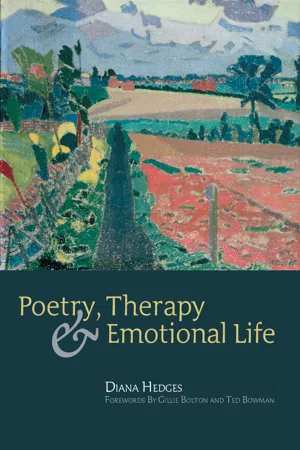
Poetry, Therapy and Emotional Life
About this book
Poetry, Therapy and Emotional Life explores the thoughts of poets, therapists and counsellors in relation to the human condition with a practical component on how poetry can be used in therapeutic work. Concentrating on the theories of Freud, Jung, Rogers, Berne, Perls and Ellis, the book examines topics such as human motivation, experience and neurosis. It encourages readers to take a fresh and enthusiastic approach to their work as counsellors, therapists or writers, and appeals to anyone with a love of poetry or writing as a means of self expression. The text contains a wealth of poetic examples both traditional and modern, along with samples from clients in creative writing groups, schools and healthcare settings. Psychological therapists and counsellors, health and social care workers, and writers alike will find this very accessible book invaluable.
Trusted by 375,005 students
Access to over 1.5 million titles for a fair monthly price.
Study more efficiently using our study tools.
Information
PART 1
CHAPTER 1
Poetry and therapy: a common pathway
When, during the célébration of his 70th birthday, one of his disciples hailed Freud as ‘the discoverer of the unconscious,’ he answered, ‘Thepoets andphilosophers before me discovered the unconscious. WhatIdiscovered was the scientific method by which the unconscious can be studied'1 (Al Alvarez)
What is it about poetry that is therapeutic: that by reading or hearing a poem we can feel more alive, calmer, understood, energised, amused or wiser? How is it that poetry can validate our experience as well as enabling us to look at something in a fresh or different way? This first chapter explores these issues and also looks at some of the similarities between reading and writing poetry and the process of psychotherapy.
Effective poetry usually works on two levels: there is the content or idea of the poem and then how it is expressed - the language, imagery, rhyme and rhythm. The same is often true of therapy and other contacts between a client or patient and a professional. There is the 'issue', the content of the problem, but there are subtle ways in which communication is formed and maintained and experienced between the person offering help and the one seeking it.
Communicating strong feelings
It would be hard to imagine a single feeling that has not been expressed in a poem. Love, loss, anguish, joy, betrayal, excitement, disappointment, scorn, fear and anxiety are the stuff of poetry. This can connect us with our own strong emotions, but can also help to break down feelings of alienation and isolation. Others have experienced the same feelings. Elizabeth Drew (1959) describes it in this way:
We read poetry because the poets, like ourselves, have been haunted by the inescapable tyranny of time and death; have suffered the pain of loss, and the more wearing, continuous pain of frustration and failure; and have had moods of unlooked for release and peace. They have known and watched in themselves and others.2
Poetry, then, can give us a sense of identity with the mood or thoughts or feelings of the poet. In addition, it broadens out our experience and helps us understand that some experiences, such as loss or making difficult moral choices, are not unique to us but are part of the human condition.
It can feel helpful to have a sad, distressed or troubled mood validated, but poetry also expresses affirmation and inspiration and offers hope. Lines such as:
I will arise and go now, and go to Innisfree
(William Butler Yeats, The Lake Isle of Innisfree, 1893)
Do not go gentle into that good night
(Dylan Thomas, Do Not Go Gentle into that Good Night, 1952)
Glory be to God for dappled things
(Gerard Manley Hopkins, Pied Beauty, 1877)
convey a feeling of energy and of action that is important for a sense of well-being.
Psychological insight
Poetry is not just an outpouring of emotion. Many poems explore complex patterns of thoughts or show how the poet moved from one thought through to another and either arrived at some conclusion or realised that he could not resolve a dilemma. The working through of a simple or complex problem can help us see something afresh and give us insights into our own or other people's difficulties. William Blake's poem A Poison Tree is a good example.
A Poison Tree
I was angry with my friend:
I told my wrath, my wrath did end.
I was angry with my foe:
I told it not, my wrath did grow.
And I water'd it in fears,
Night & morning with my tears;
And I sunned it with smiles,
And with soft deceitful wiles.
And it grew both day and night,
Till it bore an apple bright;
And my foe beheld it shine,
And he knew that it was mine,
And into my garden stole When the night had veil'd the pole:
In the morning glad I see
My foe outstretch'd beneath the tree.
(William Blake)
The poem illustrates beautifully the consequences of unexpressed hostility - the growing anger, the deceitfulness and the fearfulness. What is fascinating about the poem is that it predates Freud by about a hundred years in articulating the harmful effects of repression. The most important part of Freud's work was his assertion that unacknowledged, censored feelings and fantasies continue to exercise a huge influence on our behaviour and are the major cause of neuroses.
Language of poetry
Poetry, more than any other literary form, is about sounds, images and rhythm. People would not read it if it only conveyed a thought or a feeling. Through the rhythm, sounds and imagery our imaginations are set alive and stretched. Dylan Thomas (1951), when responding to a query about what had influenced him to become a poet, wrote:
I wanted to write poetry in the beginning because I had fallen in love with words. The words, 'Ride a cock-horse to Banbury Cross' were as haunting to me, who did not know what a cock-horse was, nor cared a damn where Banbury Cross might be, as, much later, were such lines as John Donne's 'Go and catch a falling star, Get with child a mandrake root' which also I could not understand when I first read them.3
Thomas captures something here about the essence of poetry: how much of it taps into our pre-conscious. It can connect with us in fragments, it can draw us in at the level of rhythm, or by a striking image. Nor is it frivolous to wonder why Thomas mentions that particular nursery rhyme; it has much that a fine poem should have:
Ride a cock horse to Banbury Cross
To see a fine lady ride on a white horse
With rings on her fingers and bells on her toes
She shall have music wherever she goes.
The rhythm enacts the soothing motion of a horse or a rocking horse, 'With rings on her fingers and bells on her toes' evokes sounds and sights, and 'She shall have music wherever she goes' gives a wonderful idea of infinite possibilities!
Rhythm can make our pulses go faster or slower, and we now know much more about the way physical processes can affect mental processes. A lot of modern poetry, in particular, uses rhythm to convey not just smoothness or rocking, but a sense of fragmentation, or a sense of dislocation or strangeness. In this way it resonates with the poet's thoughts and conveys the mood of the poem.
Writing poetry
The first section of this book is about links between therapeutic ideas and established poets, that is, those who have been published. However, one of the therapeutic aspects of reading and hearing poetry is how often it leads to people wanting to express themselves through writing poetry, especially when they are experiencing emotional distress. This does not seem to be the case for other literary forms. Reading novels does not usually lead to an outpouring of would-be novelists, or theatre-going to people wanting to become playwrights. Undoubtedly this has something to do with the fact that poetry is immediately accessible: a poem can express powerful feelings and thoughts in a direct, short format. It then seems to encourage something in other people to feel that they, too, could find a cathartic release in expressing themselves through poetry. Many people going through bereavement or faced with cancer or in mental health settings have been enormously helped by this means and the second section of the book explores this.
Poetry and therapy: similarities
To the extent that all art seeks to communicate, it would be true to say that therapy has something in common with all literary forms. The novel, with its development of character and plot and its narrative form, resembles the part of therapy that 'tells the story' and begs the question of 'what will happen next'. Some people's lives seem to resemble a novel, with eccentric or warring parents, jealous siblings, figures who rescue or abandon, and incredible coincidences. Drama is a wonderful medium for exploring communication between individuals. It shows intimate communication, miscommunication, dysfunctional communication and the ebb and flow of tension between characters. But, for me, poetry is the literary form that is most like therapy.
A poem can start with an image like a rock, a tulip, a railway station or a shoe box, and from that image layers of meaning emerge. Similarly, a client may start, 'I don't know why I feel so down today. I just dropped my son off at school: nothing was different, just he didn't turn back and wave as he usually does'. From that tiny detail may come a sensation of not being needed as a parent in the same way, linked to a powerful memory of not being wanted, to an overwhelming feeling of isolation. The therapeutic relationship gives space and the right climate for deeper levels of meaning to be explored. In the example I have given it starts to make sense to the client why such a seemingly trivial event can lead to a deep sense of isolation.
Revealing deeper layers of feeling can lead to a cathartic experience where the person can feel and then express a deep sense of anger, loss or shame; feelings that they usually defend themselves from experiencing, let alone expressing. Cathartic means cleansing, and the individual in therapy may feel that by expressing these feelings in a safe setting they have 'cleansed' or 'cleared out' these powerful feelings. They no longer have the power to go on affecting their lives in the same way. Poets often write for the same reason: in expressing powerful feelings, they can then let go of them. Graham Greene described writing as a form of therapy, saying, 'I wonder how all those who do not write, compose or paint can manage to escape the madness, melancholia, the panic fear which is inherent in the human situation'.
Not only do literature and therapy seek to communicate, they both explicitly see words as a means of transformation. In Macbeth Malcolm urges Macduff to express his grief:
Give sorrow words: the grief that does no...
Table of contents
- Cover Page
- Title Page
- Copyright Page
- Dedication Page
- Contents
- Forewords
- Preface
- About the author
- About the contributors
- Acknowledgements
- Permissions
- Part 1
- Part 2 Introduction
- To conclude
- Further reading
- Index
Frequently asked questions
Yes, you can cancel anytime from the Subscription tab in your account settings on the Perlego website. Your subscription will stay active until the end of your current billing period. Learn how to cancel your subscription
No, books cannot be downloaded as external files, such as PDFs, for use outside of Perlego. However, you can download books within the Perlego app for offline reading on mobile or tablet. Learn how to download books offline
Perlego offers two plans: Essential and Complete
- Essential is ideal for learners and professionals who enjoy exploring a wide range of subjects. Access the Essential Library with 800,000+ trusted titles and best-sellers across business, personal growth, and the humanities. Includes unlimited reading time and Standard Read Aloud voice.
- Complete: Perfect for advanced learners and researchers needing full, unrestricted access. Unlock 1.5M+ books across hundreds of subjects, including academic and specialized titles. The Complete Plan also includes advanced features like Premium Read Aloud and Research Assistant.
We are an online textbook subscription service, where you can get access to an entire online library for less than the price of a single book per month. With over 1.5 million books across 990+ topics, we’ve got you covered! Learn about our mission
Look out for the read-aloud symbol on your next book to see if you can listen to it. The read-aloud tool reads text aloud for you, highlighting the text as it is being read. You can pause it, speed it up and slow it down. Learn more about Read Aloud
Yes! You can use the Perlego app on both iOS and Android devices to read anytime, anywhere — even offline. Perfect for commutes or when you’re on the go.
Please note we cannot support devices running on iOS 13 and Android 7 or earlier. Learn more about using the app
Please note we cannot support devices running on iOS 13 and Android 7 or earlier. Learn more about using the app
Yes, you can access Poetry, Therapy and Emotional Life by Diana Hedges in PDF and/or ePUB format, as well as other popular books in Psychology & Mental Health in Psychology. We have over 1.5 million books available in our catalogue for you to explore.