- 160 pages
- English
- ePUB (mobile friendly)
- Available on iOS & Android
eBook - ePub
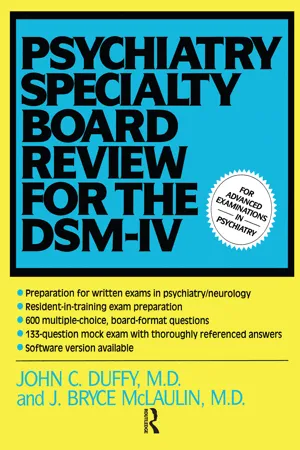
Psychiatry Specialty Board Review For The DSM-IV
About this book
This volume has been updated and revised to reflect all applicable diagnostic categories of the DSM-IV, as well as recent advances in psychopharmacology. Over 600 challenging questions covering material most likely to be found on the board examination are included, reflecting current theory and practice in child and adolescent psychiatry, psychopathology, psychopharmacology, and other selected topics. Software includes randomized question sequence, immediate viewing of score results, instant searches on specific topics, and more.
Trusted by 375,005 students
Access to over 1.5 million titles for a fair monthly price.
Study more efficiently using our study tools.
Information
1
CHILD AND ADOLESCENT
PSYCHIATRY
QUESTIONS
DIRECTIONS: For questions 1 through 78, select the single best answer.
1. Adoptive children:
a. Are not remarkable in terms of incidence of emotional problems
b. Tend to have lower IQ’s than do nonadoptive children
c. Have a high incidence of Attention-Deficit Hyperactivity Disorder
d. In general have healthy life adjustments
e. None of the above
2. According to recent theories, the way in which stimulant drugs may operate in Attention-Deficit Hyperactivity Disorder is:
a. Paradoxical
b. Sedative
c. Nonspecific stimulation of the synaptic cleft
d. Enhanced parasympathetic mechanism
e. Central adrenergic mechanisms
3. Which is not a profile for an adolescent at risk for committing an agressive act?
a. Is an older male adolescent
b. Is of low socioeconomic status
c. Has history of neurological impairment or learning disability
d. Has history of drug or alcohol abuse
e. Is oldest sibling in the family
4. Hospitalization in Anorexia Nervosa is:
a. Psychiatric emergency
b. Not recommended
c. Requires long-term treatment
d. None of the above
5. Anorexia Nervosa, Restricting Type, is characterized by:
a. Severe reduction in caloric intake
b. Refusal to maintain body weight
c. Loss of more than 25% of original body weight
d. Disturbances of body image
e. All of the above
6. Which of the following is characteristic of Bulemic Anorexia Nervosa?
a. No restriction of caloric intake
b. Episodes of binge eating during Anorexia Nervosa
c. Self-induced vomiting or use of laxitives or diuretics
d. Affects multiple organ systems
e. All of the above
7. A major effect of prolonged phenothiazine intake on psychotic and other hospitalized children is:
a. Weight changes
b. Tardive dyskensia
c. Impaired learning
d. Ocular changes
e. All of the above
8. The prevalence of Infantile Autistic Disorder is:
a. Two in 10,000
b. Three in 10,000
c. Four in 10,000
d. Five in 10,000
e. None of the above
9. Michael Rutter suggested that Autistic Disorder:
a. Is psychodynamically conditioned
b. Is strongly genetically influenced
c. Has a high treatment success rate
d. None of the above
10. Michael Rutter has defined the primary handicap in Autistic Disorder as:
a. Defective superego
b. Basic cognitive defect
c. Maturational regression
d. “System person”
e. Pathological parents
11. Children who present with psychotic symptoms due to a General Medical Condition have:
a. Long-term prodromal symptoms
b. History of a precipitating emotional stress
c. Family history of mental illness
d. Visual hallucinations
e. None of the above
12. Characteristics of sexual abuse in children include:
a. Child is used for sexual gratification of an adult
b. Child can also be abused by another child
c. Is often progressive
d. Usually involves secrecy
e. All of the above
13. Common factors found in incestuous families include:
a. Rape
b. Ritualistic abuse
c. False allegations
d. Complex relationships with the offender that encompass more than just the abuse
e. All of the above
14. A major problem in the diagnosis of sexual abuse in children is:
a. Low consciousness of its prevalence
b. Absence of physical signs, for example, genital or anal tears, bruises, or irritation
c. Symptoms are nonspecific
d. No history of overt violence
e. None of the above
15–19. Match Erik Erikson’s developmental stage with the proper achievement.
a. Oral
b. Anal
c. Oedipal
d. Latency
e. Adolescent
15. Identity
16. Initiative
17. Trust
18. Autonomy
19. Industry
20. Bender Gestalt test result(s) suggestive of brain damage include:
a. Directional confusion
b. Inability to reproduce the gestalts
c. Poor organization
d. Perseveration
e. All of the above
21. Which of the following is a major source of referral to child psychiatry?
a. Physicians
b. Schools
c. Social agencies
d. Courts
e. Parents
22. An uncommon metabolic disorder that can present dual p...
Table of contents
- Front Cover
- Half Title
- BRUNNER/MAZEL CONTINUING EDUCATION IN PSYCHIATRY AND PSYCHOLOGY SERIES
- Title Page
- Copyright
- CONTENTS
- Series Editor’s Note
- Preface
- References
- 1. CHILD AND ADOLESCENT PSYCHIATRY
- 2. PSYCHOPATHOLOGY
- 3. PSYCHOPHARMACOLOGY
- 4. SELECTED TOPICS
- 5. CASE HISTORIES
- 6. PRACTICE EXAMINATION
Frequently asked questions
Yes, you can cancel anytime from the Subscription tab in your account settings on the Perlego website. Your subscription will stay active until the end of your current billing period. Learn how to cancel your subscription
No, books cannot be downloaded as external files, such as PDFs, for use outside of Perlego. However, you can download books within the Perlego app for offline reading on mobile or tablet. Learn how to download books offline
We are an online textbook subscription service, where you can get access to an entire online library for less than the price of a single book per month. With over 1.5 million books across 990+ topics, we’ve got you covered! Learn about our mission
Look out for the read-aloud symbol on your next book to see if you can listen to it. The read-aloud tool reads text aloud for you, highlighting the text as it is being read. You can pause it, speed it up and slow it down. Learn more about Read Aloud
Yes! You can use the Perlego app on both iOS and Android devices to read anytime, anywhere — even offline. Perfect for commutes or when you’re on the go.
Please note we cannot support devices running on iOS 13 and Android 7 or earlier. Learn more about using the app
Please note we cannot support devices running on iOS 13 and Android 7 or earlier. Learn more about using the app
Yes, you can access Psychiatry Specialty Board Review For The DSM-IV by John Duffy,J. Bryce McLaulin in PDF and/or ePUB format, as well as other popular books in Medicina & Psichiatria e salute mentale. We have over 1.5 million books available in our catalogue for you to explore.