![]()
Part I
Organization Theory, Learning, and Effectiveness
![]()
Theory1, Theory2, . . . TheoryN: Hacking Through an All But Impenetrable Management Theory Jungle
Robert T. Golembiewski
“Jungle” has been a common metaphor for the state of organization studies— for a long time (e.g., Koontz, 1961, 1980), and for good reasons (e.g., Carson, Lanier, Carson, & Guidry, 2001). Stunning progress and glaring stuckness tend to characterize the issue arena, sometimes in sequence, sometimes simultaneously. And commonly, what seems to be the latter soon emerges as the former. A boom-and-bust cycle seems dominant.
A strong tide of opinion counsels against such a condition, but as yet without conclusive effect. How to avoid or moderate the “jungle” outcomes, in short, is clear enough in principle, and the several properties below usefully highlight these elementals. In introductory sum, attention goes to three points to be improved upon: incomplete conceptual and operational development; undifferentiated types of theories and confusions about them; and impossibly narrow views about “change” for research and management.
What motivates this chapter? Some might propose that the total case is reasonable enough but contains nothing new. Even in such a case, however, some orientations are so relevant that they bear periodic restatement. Moreover, the premise above is certainly wrong, if only in the sense that all of the present components have not been articulated in the present combined ways. Far more relevant, even otherwise credible sources reflect major confusions and obfuscations with regard to the integrative case to be developed here as well as with respect to one or more components of this chapter. See also the discussion below.
Paired Conceptual ↔ Operational Effort
Even the most elementary textbooks on methodology carry a major part of the basic required message: progress in empirical science comes on the backs, as it were, of two kinds of conceptual effort. Thus, nominal definitions of “cohesiveness” moved toward a kind of social gravity that attracted group members to one another, and resultant operational concepts came to dominate. That is, cohesiveness came to be seen after much undercutting effort as the result of all those forces attracting members to a group, minus those forces encouraging withdrawal. Consequently, also, operational definitions moved toward a holistic measure while earlier they had emphasized individual facets—attractiveness of members or prestige of task being prominent among them.
Development of conceptual operational definitions tended to lag, however; and associated research thus tended toward mixed results. That is, two groups might be “equally cohesive,” but that fact might be obscured because different operational definitions were used that targeted different individual aspects. For an overview, see Libo (1953) and Golembiewski (1962b). Increasingly precise conceptual definitions isolated holistic domains that characterize some empirical turf; and operational definitions then provided progressively more reliable and valid measures of those conceptual domains. For example, cohesiveness operations originally emphasized single but different facets—e.g., liking of other group members—and the academic turf was soon littered with the products of such fragmented industry. Movement toward holistic operations fortunately occurred before the early mixed results were incautiously interpreted by many observers as the unlawful if not chaotic nature of reality. Some went that far, and further (e.g., Kaufman, 1991).
By way of useful introductory orientation, please note that the overall prescriptions for research progress is clear enough, even if that implied advice is often disregarded. Success requires very high priority to the disciplined attention, over long periods of time, to replicative studies comparing operational definitions. Oppositely, however, the premium in academic research tends to go to the “f-words”—fads and fashions (Bumber, 1999). And these f-words provide neither sufficient time nor scope for the isolation of a selective and useful inventory of operational definitions (e.g., Carson et al., 2001).
In sum, the basic story is elemental. The basic script below provides both nuance as well as powerful generalizations that will at once help us understand why the management “jungle” exists as well as what we can do to blaze some useful even if limited pathways through luxuriant if suffocating growths inspired by the primacy in management research of the f-words.
Let us not beat this drum too loudly, but some notice is usefully brought to the issue of conceptual/operational development, and especially to the “comparative operational analysis” required by the massive tendency to proliferate alternate measures. This problem has long existed (e.g., March & Simon, 1958), but the failure to take into explicit account major differences in operational definitions often characterizes even the more careful summaries of thematically targeted research. Hence, the rarity of efforts in the spirit of our own (Golembiewski, Boudreau, Munzenrider, & Luo, 1996), which deliberately maintained a single operational definition to sharpen the test for the generalizability of the covariants of an apparent “centroid” in nature—the phase model of burnout.
Types of Theories and Management
Both beyond and exacerbating issues with conceptual and operational definition, the jungle in management thought also derives from several shortfalls related to the characters and roles of “theories.” In short, management thought has been incomplete as well as inadequate in distinguishing types of theories, on balance, and these shortfalls provide important reasons why the jungle metaphor came to apply, and still remains applicable.
Three kinds of distinctions between theories get emphasis here. Each of the three types of theories rests essentially on a correct appreciation of conceptual/operational definitions, with the distinctions being widely known but almost as widely neglected. The topic often gets early attention in introductory courses in scope or method, or the sociology of knowledge, but the convenience and standards of academic science discourage due respect of useful guides in designing studies and especially in interpreting the results of collections of studies. As is typical, even experienced observers insufficiently recognize that failure to be self-conscious about differences in operational definitions can lead to basic confusion and stuckness in the development of different kinds of theories (March & Simon, 1958), especially empirical, and goal-based empirical.
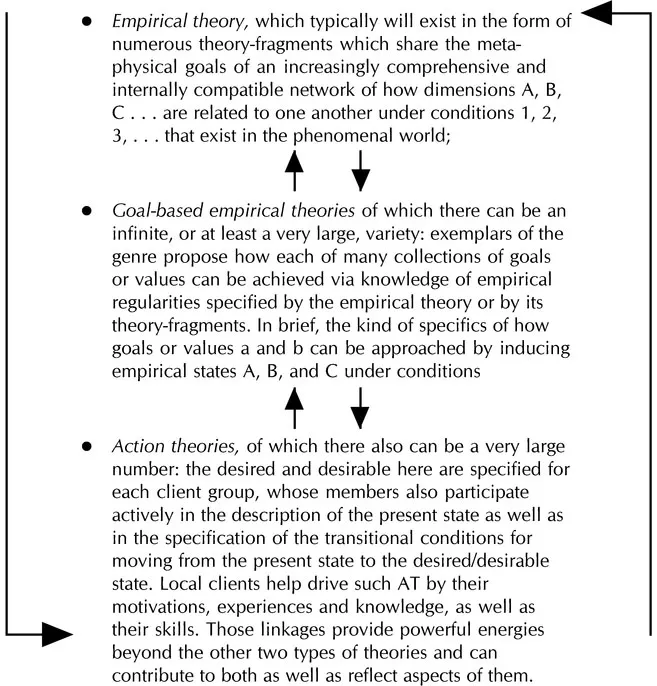
The notion of plural theories constitutes a major building block of this chapter. In sum, theory-building is not an equi-final enterprise. Rather, how and where you begin intimately determines differences in what you will get and how you can use it. This chapter distinguishes three types of theories, adding “action theories” to empirical theory and goal-based empirical theories. Figure 1 provides general guidance.
1. Empirical Theory. The objective of scientific effort in organization studies, as well as elsewhere, is the development of an increasingly comprehensive network of empirical theory—of how a and b are related to c, under conditions d, e, and f.
If clearly envisioned for a long time, empirical theory has been embraced only like a nettle. Thus, students often fail to give sufficient regard to the fact that early empirical theory often appears as patches or fragments, from which too much should not be expected. At its best, this dominant condition is characterized by faint flashes of promise that often proved to be short-lived. Robert Merton thus warned against just such an unfavorable balance, when he drew attention to the unavoidable management of “theories of the middle range.” Merton urged that great caution is appropriate in dealing with them (see Boudin, 1991).
Figure 1 Elemental Flowcharts of Three Kinds of Theories
Expectations were seldom moderate, however, and the required learning was both slow and incomplete. Thus, the problems with operational definitions all but guaranteed that apparent early flash usually would come to be seen as fizzle. In addition, many commentators confused theory with philosophizing or speculating. Perhaps the most brazen illustration of this subjugation of grasp to reach was the germanism that prescribed this reaction to any conflict of facts with a theory—“desto slecher fr de tatsache,” or “too bad for the facts.” Finally, for present purposes, most ambitions skidded well beyond “theories of the middle range” and sought general or universal theories. This meant that methodological niceties got neglected, if not ravaged, as individual flash-and-fancy had to provide the coverage that available research did not. Thus, “empirical theory” often was subordinated to the development of general systems of ideation, like Marxism, that were typically contradicted by facts rather than built upon them. As Marxist dogma prescribes, to illustrate, the Hungarian revolution in the 1950s should have been led by the proletariat but, in stark opposition, survey data showed that far-greater support existed among skilled workers. The doctrinaire approach in such cases was to eliminate survey research, if not survey researchers (e.g., Medvedev, 1969), rather than to modify the basic theory. Academic standards were more inhibited in dealing with differences, of course, but were generically similar.
If the details of such self-sealing efforts often differed greatly, the net result for empirical theory often came to the same simple and sovereign end. The pressure to develop universal systems of thought simply overwhelmed disciplined building-upon. Rather, the focus definitely was on general systems that were fated to replace one another, at best. More likely, their conceptual detritus remained to burden the isolation of patches of empirical theories of middle range; and to carefully test and then extend/replace them.
Perhaps basically, to give brief treatment to a major issue, the development of empirical theory of whatever scope was limited, and especially in its earlier development, by the canons of “straight science” such as random assignments of subjects and treatments (e.g., Susman & Evered, 1978). Typical shortfalls in such particulars permitted easy criticism, and often resulted in a methodological stuckness if not despond even among proponents of empirical research. Since work in practice often involved intact teams, for example, “random assignment” often was difficult or impossible even to contemplate.
2. Goal-Based Empirical Theories. As Figure 1 also shows, empirical theory and especially of the middle range, as well as goal-based empirical theories, can contribute to and build upon one another in direct ways. Why this is the case can be suggested quite directly by four selective points. First, there can be many goal-based empirical theories, and this multiplies their possible contributions to a comprehensive empirical theory, while it also implies both fanaticism and tentativeness—the former in connection with testing all theories of the middle range as well as tentativeness about the status of any such fragment even after determined rounds of testing.
Second, goal-based empirical theories pose less challenge to formulation and testing, and this combines convenience as well as possible tests of empirical theory fragments. Usefully, numerous clients can support the development and application of the many value sets that can underlay individual goal-based empirical theories.
Third, put another way, goal-based empirical theories can be tailored to individual clients interested in even wildly different value-sets. This could stimulate broad-ranging efforts, clearly, while motivating tests of what we believe we know from stereophonic points of view.
Fourth, any developments in empirical theory can be leveraged across many goal-based empirical theories. This not only will stimulate applications, but also often can serve as a test of fragments of empirical theory. In the same basic way, to illustrate, some basic empirical work with participation, involvement, and empowerment surfaced in a host of focused goal-based empirical applications. To illustrate, Coch and French’s (1948) original research can be viewed as an empirical fragment that stimulated the development of one basic family of related goal-based empirical variants—which family can be usefully labeled “participative management.”
More elementally, individual goal-bases simplify the reach and grasp of both research and applications. This narrowing selectivity, as it were, reduces the need for control or comparison groups, and reduces the range of intervening or moderator variables that require subtle accounting in more comprehensive empirical theory. In general, the searches for “humanist theories of work” or for “participative management” typify goal-based empirical theories, if seldom self-consciously. The standard of proof also was de-escalated and reformatted in this useful form: Can ways-and-means alternative to bureaucratic ones have similar or superior effects? (e.g., Golembiewski, 1965, 1993)
These advantages and others of a determined focus on goal-based empirical theories seldom carry the day, however, as three points can illustrate. First, and especially in early developments, the most compelling economies involve a testing-for-transfer from several goal-based empirical theories to the emerging empirical theory. Typically, however, the premium went to general system development, and stayed there. The other pathways of transfer were seldom taken, and could be disparaged in the zesty but counterproductive warfare over “pure” versus “applied” science that absorbed great energy not so long ago. Indeed, the focus on general theory often had the effect of marginalizing goal-based empirical theories as limited if not irrelevant. Goal-based empirical theories seldom were seen as having substantial value, even when they were clearly distinguished, which was seldom.
Second, the literature often confuses the two kinds of theories, which is a major conceptual cul de sac. Thus, a comprehensive empirical theory remains a long-run objective, unless nature is chaotic; but there always can be many goal-based empirical theories, limited only by human wit and will. Awkwardly, commentators often referred to a theory of organization, or even the theory. Since there always can be many goal-based empirical theories, this basic confusion inhibited the useful cross-fertilization that might have occurred under the aegis of a fuller conceptualization.
Third, as might be expected, problems of operational definition undercut the development of goal-based empirical theories, even when appropri...