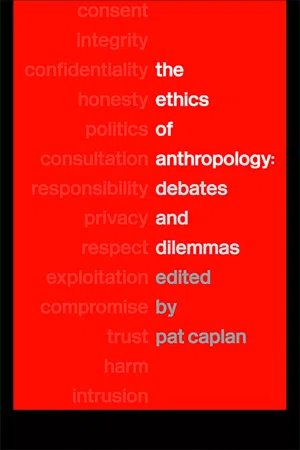
Since the inception of their discipline, anthropologists have studied virtually every conceivable aspect of other peoples' morality - religion, social control, sin, virtue, evil, duty, purity and pollution. But what of the examination of anthropology itself, and of its agendas, epistemes, theories and praxes? In 1991, Raymond Firth spoke of social anthropology as an essentially moral discipline. Is such a view outmoded in a postmodern era? Do anthropological ethics have to be re-thought each generation as the conditions of the discipline change, and as choices collide with moral alternatives? The Ethics of Anthropology looks at some of these crucial issues as they reflect on researcher relations, privacy, authority, secrecy and ownership of knowledge. The book combines theoretical papers and case studies from eminent scholars including Lisette Josephides, Steven Nugent, Marilyn Silverman, Andrew Spiegel and Veronica Strang. Showing how the topic of ethics goes to the heart of anthropology, it raises the controversial question of why - and for whom - the anthropological discipline functions.
- 256 pages
- English
- ePUB (mobile friendly)
- Available on iOS & Android
eBook - ePub
About this book
Trusted by 375,005 students
Access to over 1.5 million titles for a fair monthly price.
Study more efficiently using our study tools.
Information
1
INTRODUCTION
Anthropology and ethics
Pat Caplan
Whenever one descends from the relatively secure realm of concepts to the description of any concrete object the concepts are supposed to stand for – one finds merely a fluid collection of men and women acting at cross purposes, fraught with inner controversy and conspicuously short of the means to arbitrate between conflicting ethical positions. The moral community proves to be not so much imagined as postulated, and postulated contentiously.
(Bauman 2001: 141)
It is one of the paradoxes of the social sciences that their moral stance has not been higher than [that of] the surrounding topography.
(Appell 1978: xi)
Introduction
In the West in recent years, there has been a discursive explosion around ethics. On the political front, the newly elected Labour government in Britain in 1997 stated that it would pursue an ‘ethical’ foreign policy, a claim which rapidly became the butt of jokes by political commentators as being more honoured in the breach than the observance. It was reported that the ‘ethical’ policies of the Foreign and Commonwealth Office were regularly undermined by the Department of Trade and Industry, whose own priorities were to support British exports, while the Ministry of Defence ‘promoted arms sales without adequate safeguards’ (Guardian Weekly, 4 October 1998). Economic interests appeared largely to prevail over ethical and even, in some cases, longer-term political interests.
Ethics-talk has entered the economic arena too. A number of companies today offer their customers the option of investing their money in ‘ethical’ accounts. Indeed, the number of such schemes has multiplied in the last few years and they are currently growing faster than conventional investment ‘products’.1 The financial pages of the broadsheets regularly report on their progress with headlines like ‘Boardrooms discover corporate ethics’ (Cowe 1999), while big foundations such as Ford endorse ethical investment: ‘Corporate ethics meets the bottom line: ethical behaviour is good for business – and can lead to new markets’ (Lang 1999: 16). There are now ‘ethical consumers’, ‘corporate ethics’, and ‘socially responsible businesses’.
The university world has not escaped these discussions. In Britain, a vociferous campaign called ‘Ethics for USS’ (Universities’ Superannuation Scheme) called for ethical investment of the universities’ pension fund.2 After two years of hard lobbying, USS agreed that it would move to a ‘socially responsible investment policy’, resulting in such headlines as ‘Professors’ pensions are cleaned up’ and ‘USS strengthens its commitment to SRI (socially responsible investment)’ (Ethics for USS newsletter, December 2001).
Academics have also been part of debates around the ethics of current academic practices, as universities have been urged by governments and forced by lack of state funding to look for income from a variety of sources. Indeed, ‘Support from business and industry is regarded … as not only necessary in the current funding climate, but as a positive good, obliging academics to engage with the real world’ (Guardian Weekly, 24 May 1998, p. 13). Some universities have accepted money from such sources as Wellcome, Shell and British American Tobacco (BAT), leading to discussions about the need for ‘guidelines’. For example, the Committee of Vice-Chancellors and Principals (CVCP) and the Cancer Research Campaign joined together in 1999 to issue protocols on universities’ acceptance of funding from tobacco companies (CVCP News, Spring 1999: 5).3 Yet it is the case, of course, that, as an editorial in the Times Higher Education Supplement put it, ‘For centuries, universities have provided a socially useful way of laundering grubby money. Suppression of the monasteries, piracy, slavery, American robber barons’ ruthless exploitation; all generated profits that have supported scholars and enriched academic foundations. Guilty money was washed clean’ (THES, 23 October 1999: 14). The difference now is that such matters are perhaps more hotly debated than previously.
At the same time, universities in Britain, like their North American counterparts at an earlier date, have increasingly set up ethics committees to scrutinise the research of their academics, and even, as mentioned above, that of their students. Academics are required to make statements about the ethical implications of their work, to complete forms with checklists, and to give undertakings that all their research will be based upon principles of informed consent. While such developments are rationalised in terms of the upholding of an ethical ‘gold standard’ by the participants in the research, there is little doubt that universities are also increasingly concerned about the possibility of litigation, and see ethics statements and consent forms as ways of avoiding this. Clearly then, there is a politics and economics of ethics.
Anthropologists, like other social scientists (and scientists), now have not only to behave in an ethical way but also to be seen to be so doing by all parties involved: research subjects, colleagues, students, funders, ethics committees, and the public at large. For many, these aims can be achieved by adherence to a professional Code of Ethics. However, as will be seen, achieving agreement has never been easy, since such codes are often highly contested in their formulation, and agreement about interpretation is also problematic (see Mills, next chapter).
Yet the ethics of anthropology is clearly not just about obeying a set of guidelines; it actually goes to the heart of the discipline: the premises on which its practitioners operate, its epistemology, theory and praxis. In other words, what is anthropology for? Who is it for? Do its ethics need to be rethought each generation, as the discipline’s conditions of existence change? Are there different ethics for different contexts?
In an interview in 1991, Raymond Firth spoke of his view of social anthropology as essentially a moral discipline (Quigley 1991). Is such a view outmoded in a postmodern era? Anthropologists have, of course, studied other people’s morals under various rubrics: religion, values, social control, sin, virtue, evil, reason, duties, purity and pollution; even, following Durkheim, society itself which devises moral rules for its self-perpetuation. This remains a worthwhile exercise, but so too does the examination of our own ethics and morals, as members of the tribe of anthropologists. Here is another, more reflexive sense in which morality and ethics may be studied: that of choice and conflict between choices, and the existence of moral alternatives.
Ethics and morality are frequently used interchangeably, although some see them as different. The philosopher Bernard Williams proposes that ethics is any way of answering the question ‘How ought one to live?’ while morality is a certain kind of answer to that question, namely one involving moral obligations such as rules, rights, duties, commands and blame (Williams 1985 in Laidlaw 2002: 316). Pocock has suggested that ethics and morality are increasingly pulling apart, and that ethics has moved in to fill a moral vacuum (1988). Is there then a sense in which we can see morality as more fundamental than ethics? Can morality have claims to truth and universal applicability while ethics is culturally and historically variable?4 If so, what are those claims of morality and to what extent do ethics change and why? These are all questions which should inform what follows, and which will be discussed again at the end of this chapter.
While some have argued that ethics is central to the discipline, others have been less enthusiastic. Pels (1999) argues that ethics is an ‘empty signifier’, which can be made to mean almost anything. I prefer, however, to follow Shore’s dictum, paraphrasing Lévi-Strauss, that ethics, its codes and the debates which surround them are ‘good to think with’ (1999: 124), since it is vital that such thinking informs our practice. That is the aim of this book.
Anthropologists writing ethics
The literature on ethics in anthropology is large,5 and if other social sciences are included, it becomes enormous. Yet it appears that there are certain times when there are discursive explosions around the topic, and other periods which are relatively quiescent. Anthropological preoccupation with ethical matters is most vividly expressed in the numerous debates which have taken place, particularly in the USA, over ethical codes. The drafting of such codes has usually been in response to particular developments in the discipline, crises caused either by scandals such as Project Camelot6 in the US or by the entry of its graduate students into applied work (Fluehr-Lobban 1991). I do not propose to give a history of ethical codes in British and American anthropology, since that topic is admirably covered by David Mills in the next chapter. Rather, I want here to consider how anthropologists have written about ethics and what circumstances might explain different ethical positions. I will thus proceed chronologically, although this chapter does not pretend to give an exhaustive survey of all the available literature.
In a recent work on the ethics of the social sciences (1997), the German philosopher Siep begins by pointing out that there is a long-standing set of differences in European philosophy. For Plato and the Stoics, the idea of the good and justice are the same for all mankind, while for Aristotle the philosopher has to reflect on the moral tradition of a particular moral community. Noting that there are variations between the ethical cultures and traditions in various European countries, Siep asks what is the relevance of this for research ethics. He wonders whether, as Europe becomes more of an entity, people may learn from each other and ethics may eventually similarly converge. But at present, he points out, there are major differences in ethical values and traditions, as a study of differing ecological movements and the varied degree of resistance to genetic engineering indicate. He argues that ethics thus need to be viewed in the historical and cultural contexts which have produced them.
For philosophers, as for anthropologists, the issue of ethics raises the hoary question of universalism versus relativism, since a comparison of different historical periods and different national disciplinary traditions suggests that the field of anthropological ethics is a shifting one. Yet, as will be seen, there is frequent invocation by some anthropologists of moral values which they hold to be universal: the intellectual search for some form of truth, the need for professional integrity, the upholding of the human dignity of their research subjects.
In what follows, I seek to place debates about anthropological ethics in their historical context over the last four decades,7 and also to draw some comparisons between the two anthropological traditions – British and American – on which I am concentrating. I would not wish, however, to imply that there is unanimity of views within any one anthropological community; far from it. In this regard, I will explore the argument propounded by Appell several decades ago, that it is precisely at the moment when the boundaries of a discipline are redefined that ethical discourse increases. At such a point, he argues, ‘the shared moral base of its members begins to deliquesce’ (1978: 1). In other words, debates around the topic of ethics are part of the way in which anthropologists seek to constitute themselves as a moral community.
The 1960s: Responsibility, commitment and relevance
The 1960s were turbulent years politically: Britain, like other European colonising powers, was experiencing the end of its African empire, while the United States was engaged in a war in South-east Asia, as well as in the domestic struggles around the Civil Rights Movement. All of these issues were to have repercussions in anthropology, although it was not until the 1970s that the implications of decolonisation were tackled by British anthropology. For American academics, however, the issues were immediate since their students were liable for conscription to fight in Vietnam. A number of anthropologists became involved in the ‘war on campus’ and beyond; some, like Gough, even choosing to leave the United States, while other scholars, like André Gunder Frank, were forced to do so.
In 1968, under the heading of the ‘Responsibility Symposium’, the US journal Current Anthropology carried articles by Gerald Berreman, Gutorm Gjessing and Kathleen Gough. All of them were uncompromising in their critique of anthropology as it was then practised. Gough stated
We have virtually failed to study Western imperialism as a social system, or even adequately to explore the effects of imperialism on the societies we studied … Force, suffering and exploitation tend to disappear in these accounts of structural processes … [we] have done little to aid understanding of the world distribution of power under imperialism or of its total system of economic relationships.
(pp. 405–6)
Gough noted that anthropologists were caught between conflicting demands: demands of the people studied, colleagues and the discipline; demands of those who employ or fund anthropologists; and most recently, demands of students, ‘who are now, because of their own crises, asking awkward questions about ethics, commitments and goals’ (p. 405).
For Berreman, anthropologists simply had to get involved in such issues:
The dogma that public issues are beyond the interests or competence of those who study and teach about man is myopic and sterile professionalism and a fear of commitment which is both irresponsible and irrelevant. Its result is to dehumanize the most humanist of the sciences.
(1968: 39)
Gjessing, a Norwegian anthropologist, asked whether social scientists in general, and anthropologists in particular, were not merely ‘playing an intellectual game in which nobody outside our own tiny circle is interested’. He wondered, furthermore, whether they risked developing into ‘a small isolated, esoteric sect of believers … in the midst of a gigantic world revolution that threatens the annihilation of mankind’ (1968: 397).
These three articles raised a number of crucial issues:
the responsibility of social scientists, particularly anthropologists;
the status of science and objectivity;
anthropology as an outgrowth of colonialism;
the relevance of anthropology to a rapidly changing world, and how it might be made more relevant...
Table of contents
- COVER PAGE
- TITLE PAGE
- COPYRIGHT PAGE
- THE ETHICS OF ANTHROPOLOGY
- PLATES
- CONTRIBUTORS
- PREFACE
- 1: INTRODUCTION: ANTHROPOLOGY AND ETHICS
- PART I: DEBATES
- PART II: DILEMMAS
Frequently asked questions
Yes, you can cancel anytime from the Subscription tab in your account settings on the Perlego website. Your subscription will stay active until the end of your current billing period. Learn how to cancel your subscription
No, books cannot be downloaded as external files, such as PDFs, for use outside of Perlego. However, you can download books within the Perlego app for offline reading on mobile or tablet. Learn how to download books offline
Perlego offers two plans: Essential and Complete
- Essential is ideal for learners and professionals who enjoy exploring a wide range of subjects. Access the Essential Library with 800,000+ trusted titles and best-sellers across business, personal growth, and the humanities. Includes unlimited reading time and Standard Read Aloud voice.
- Complete: Perfect for advanced learners and researchers needing full, unrestricted access. Unlock 1.5M+ books across hundreds of subjects, including academic and specialized titles. The Complete Plan also includes advanced features like Premium Read Aloud and Research Assistant.
We are an online textbook subscription service, where you can get access to an entire online library for less than the price of a single book per month. With over 1.5 million books across 990+ topics, we’ve got you covered! Learn about our mission
Look out for the read-aloud symbol on your next book to see if you can listen to it. The read-aloud tool reads text aloud for you, highlighting the text as it is being read. You can pause it, speed it up and slow it down. Learn more about Read Aloud
Yes! You can use the Perlego app on both iOS and Android devices to read anytime, anywhere — even offline. Perfect for commutes or when you’re on the go.
Please note we cannot support devices running on iOS 13 and Android 7 or earlier. Learn more about using the app
Please note we cannot support devices running on iOS 13 and Android 7 or earlier. Learn more about using the app
Yes, you can access The Ethics of Anthropology by Pat Caplan in PDF and/or ePUB format, as well as other popular books in Sciences sociales & Éthique et philosophie morale. We have over 1.5 million books available in our catalogue for you to explore.