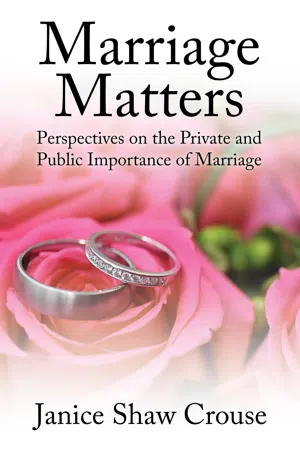
eBook - ePub
Marriage Matters
Perspectives on the Private and Public Importance of Marriage
- 238 pages
- English
- ePUB (mobile friendly)
- Available on iOS & Android
eBook - ePub
About this book
In Marriage Matters, Janice Shaw Crouse argues that marriage is a critical element in a free society and that society's most vulnerable communities, especially minorities and the poor, suffer the most from the nation's retreat from marriage. Crouse writes that marriage advances the public interest and we should create laws and policies that support rather than undermine it. She demonstrates both the public and private importance of marriage, and organizes her argument in a thoughtful and logical manner. Compared to other household arrangements, Crouse observes, marriage is by far the best for raising children and offers financial advantages as well. Writing about bullying, Crouse shows how the trend away from marriage has lead to poor child-rearing and to some of the nation's worst contemporary problems. In household arrangements with an absence of traditional fathers, the government has in some ways overtaken this role by creating social programs such as food stamps, Social Security, and Medicare. Social programs are but a small part of an effective solution. The groundwork for strong marriages and lasting relationships is examined in detail. Crouse then discusses the role of sex in marriages and the harmful influence of casual sex. The second half of the work shows how marriage matters to individuals (specifically to women and children) and depicts same-sex marriage as a threat to the institution. Other public policy issues affecting marriage are also explored.
Trusted by 375,005 students
Access to over 1.5 million titles for a fair monthly price.
Study more efficiently using our study tools.
Information
1
Introduction
Two pure souls fused into one by an impassioned love—friends, counselors—a mutual support and inspiration to each other amid life’s struggles, must know the highest human happiness;—this is marriage, and this is the only cornerstone of an enduring home.
—Elizabeth Cady Stanton (1815–1902)
The July 13, 2009 Time magazine cover story1 surveyed the matrimonial landscape and offered this summary of the ramifications of marital decline and deterioration: hardship, misery, and devastation to women and children, especially among the nation’s underclass. The author, Caitlin Flanagan, asked the question that is the basis for this book: “How much does [marriage] matter?” She answers her own question with a succinct sentence: “More than words can say.” Then, she continues with this assertion: “There is no other single force causing as much measurable hardship and human misery in this country as the collapse of marriage. It hurts children, it reduces mothers’ financial security, and it has landed with particular devastation on those who can bear it least: the nation’s underclass.”
On Valentine’s Day 2011, CNN began airing a “freedom to marry” campaign; this $10 million public education effort is designed to “explain” why “marriage matters.” The advertisements focus on concepts that are deliberately left nebulous—love, commitment, and family—but the unions it celebrates span the whole spectrum of possible couples. The end result, of course, is that when the possible arrangements included within the definition of marriage are expanded to include everything, it ends up meaning nothing. That is the very reason this book became necessary—at the same time that whole segments of society are dismissing marriage as unnecessary, other segments are campaigning to expand the definition of marriage. While determined special interest advocacy groups are trying to redefine marriage in ways that will make it that much less relevant, the media treats the public to a succession of high-profile infidelity scandals by public officials and celebrities.
Serious scholars and researchers face a tough task in trying to repair the damage to marriage, and counselors are left trying to restore the wrecked lives of women and children from the fallout in personal lives and in society as marriage has been undermined and declared unnecessary, irrelevant, and/or impossible. The result is a whirlpool of controversy surrounding the role and significance of “marriage”—so much so that many people are left wondering who to believe in the cascade of opinions aired by a myriad of commentators and pundits. Whether denigrating marriage, trying to redefine it or working to strengthen marriage as an institution of civil society, the issue of marriage is still capable of becoming the cover story or making the headline above the fold.
Social science research has convinced the majority of them that marriage matters; demographic data makes the case that marriage matters. Common sense, accumulated wisdom, and shared experience agree: Marriage has far more impact on adults than most people acknowledge. Researchers indicate that married people have better health, longer and more productive lives, greater general happiness and better mental health than nonmarried individuals. Further, they also agree that marriage performs a critical function for society. Nothing harms children quite the way that not having married parents does. Flanagan summarizes, “On every single significant outcome related to short-term well-being and long-term success, children from intact, two-parent families outperform those from single-parent households.” She adds, “Few things hamper a child as much as not having a father at home.”
Marriage, then, is important because the family is the context within which the next generation establishes lifelong habits, and develops character. The child will learn—to the degree that the child’s family has the desirable characteristics and the child’s family life prepares him or her—to become a well-adjusted, productive adult who will contribute to the community and nation as a law-abiding and involved citizen. In this context, jurist Joseph Story wrote, “Marriage is treated by all civilized societies as a peculiar and favored contract. It is in its origin a contract of natural law.”2
In spite of the overwhelming evidence that marriage matters for individuals as well as society, the overwhelming message for young people today is that marriage can wait; your twenties are for establishing your career, having fun, traveling, finding yourself and sowing your “wild oats,” not for settling down “prematurely” into marriage and establishing a family. As a result, the median age for first marriages in the United States has gone up to around age twenty-six for women and twenty-eight for men—that is the highest age since the Census Bureau began keeping track of such information.
The fact that they are deferring marriage does not mean those young people are not forming relationships and having sex. In fact, according to the National Longitudinal Study of Adolescent Health, more than 93 percent of adults eighteen to twenty-three years old who are in a romantic relationship are having sex; even among those active in conservative churches, it is almost 80 percent. So, the bottom line for today’s young people is that it is okay to “hook up” [have multiple casual sex relationships and numerous recreational sex experiences] or to cohabit [move in together as a couple], but they are “too young for marriage,” “can’t afford to get married,” “can’t afford a wedding,” or should “make sure this is the right person before getting married.”
Even the word “marriage” is loaded today; pressures come to bear on the personal, philosophical, and political dimensions of marriage. People argue about the appropriate role of the government in promoting marriage and whether defending traditional marriage is discriminatory of singles, those who are divorced, and those who struggle with same-sex attractions. Others worry that marriage is too closely aligned with religious and moral views about sexuality and argue that promoting marriage violates the “separation of church and state.” Still others think that marriage is nothing but a legal contract that can be altered to suit the whims of current thinking.
This book endorses the principles laid out by the Witherspoon In-stitute3: Marriage matters in profound ways to a free society, “which depends upon citizens to govern their private lives and rear their children responsibly, so as to limit the scope, size, and power of the state. The nation’s retreat from marriage has been particularly consequential for our society’s most vulnerable communities; minorities and the poor pay a disproportionately heavy price when marriage declines in their communities.”4 Throughout this book, there is evidence that marriage “advances the public interest” and is an institution that “society should endorse and support.” In addition, we advocate support for those “laws and public policies that will reinforce and support” marriage rather than undermine it, and we call upon the nation’s leaders to “support public policies that strengthen marriage as a social institution.”5
Social scientists agree that traditional marriage is a “tough sell” for contemporary youths who are prolonging their adolescent stage far into their twenties. In 1960, two-thirds of twenty somethings were married; in 2008, only 26 percent were.6 The sexual revolution of the 1960s ushered in a new way of thinking about sex that completely separated it from the context of marriage and the family. Magazines like Playboy, Broadway plays like Hair, and college campuses that abandoned policies of in loco parentis created an “anything goes” environment that made marriage seem old-fashioned and portrayed “family values” as prudish and the object of derision. The fact of the matter, however, is that the hoopla in the media about the “joys of casual sex” illustrated by the promiscuous lifestyles of glamorous Hollywood celebrities was foolishly embellished propaganda; even the earliest legitimate research revealed that the media portrayals of sex bore little resemblance to the reality.7 Those early studies showed the same result as later, more sophisticated ones: married sex produces the best orgasms and the most frequent as well as most satisfying sex.
In addition to providing the best relationship for the couple—the husband and wife—there is general agreement among marriage scholars that, compared to all other household arrangements, marriage is by far the very best place to raise children; further, it is the best place for the well-being and health of adults. Indeed, most social scientists agree that marriage also has very important positive social consequences for communities and nations. The traditional married-couple family is the most effective training ground for building citizens who contribute to the common good, especially in the minority communities. Marriage conveys numerous economic, educational, health, and safety benefits that establish a foundation from which communities and nations thrive. Marriage has been called the “social glue” for the way that it binds fathers to their children and unites couples while helping to strengthen the bonds between people and their nation.8
Marriage is virtually a universal societal institution; cultures around the globe consider marriage the link that unites parents with their children and families to their communities. While marriage is a critical institution in civil society, researchers agree that it is endangered and, currently, is in a “fragile” state. Some even call the situation a “crisis” in that there is heated public debate (based on unfounded assertions of antifamily ideologues) as to whether a married couple—mom and dad—family is the most stable and nurturing environment for couples and their children. After forty years of distorted data and misrepresentation about the questions related to family structure, there are, literally, thousands of studies that agree that the best family structure for children’s well-being is the married couple—mom and dad—family. They also agree on the social costs of family disintegration. American taxpayers pay an enormous price for family fragmentation: divorce, unwed childbearing, crime, drug abuse, education dropouts, domestic violence, chronic illness, poverty, foster care, etc. This tremendous body of research, however, does not deter those who have a vested interest in seeing the current negative trends continue and seeing the institutions of marriage and family—as they have traditionally been composed—disintegrate beyond functionality.
Gone are the days of Brady Brunch families and June Cleaver-style households; they have morphed into ABC’s “Modern Family”—a show promoted as “redefining what family means,” and portrayed as “one big straight-gay, multicultural, traditional, happy family.”9 According to Brian Powell, a sociology professor at Indiana University, 60 percent of Americans in 2010 believe, “If you consider yourself to be a family, then you [are] one.”10 Pew Center research finds that Americans are “sharply divided” over the changing definitions surrounding the family and the various ways that has affected society, but they agree that “women raising children without a male partner is bad for society.”11
Without strong marriages, there cannot be strong democracies because democracy depends on an informed, mature citizenry of good character. My friend, Robert W. Patterson, spells out the inextricable link between marriage and the markets in Adam Smith’s The Wealth of Nations and points out that Gary Becker makes the same connection in his Treatise on the Family because the “division of labor maximizes production in the market and in the home.” Preserving and strengthening marriage are essential, not just for the well-being of individual citizens, but also for American exceptionalism. Our future as a free nation rests on our ability to reproduce productive and upright citizens who will contribute to the nation’s strength and stability. The breakdown of marriage and family threaten America’s ability to produce the caliber of citizens who will be capable of sustaining our heritage of self-governance. The present trajectory of our society, however, is not promising. Paul Amato, Distinguished Professor of Sociology and Demography at Pennsylvania State University, wrote that the “…changes in American marriage and family structure since the 1960s have decreased the mean level of child well-being in the population, lowered the well-being of many adults, increased child poverty, and placed a large financial burden on our society.”12
Currently, married couple households are a little less than half of households in the United States.13 This stands in stark comparison to 1950 when 78.2 percent of households were married couples; by 1970 that percentage had dropped 7.6 points to 70.6 percent of all households. From 1970 to 1990, the percentage dropped another 14.6 points to 56.0 percent. Then, from 1990 to 2010, there was another drop of 6.3 percentage points to the current 49.7 percent. Having married-couple families constitute less than half of American households is a situation that undermines the “law of the land” as established by the American Congress. Public Law 104-193—Personal Responsibility and Work Opportunity Reconciliation Act of 1996—clearly states Congressional “findings...
Table of contents
- Cover
- Title Page
- Copyright Page
- Contents
- Acknowledgments
- 1. Introduction
- Part I: The Groundwork for Strong Marriages
- Part II: Marriage: Safe Haven for Sexuality
- Part III: Marriage: The Impact on the Private Sector
- Part IV: Marriage: The Impact on the Public Sector
- Appendix
- Index
Frequently asked questions
Yes, you can cancel anytime from the Subscription tab in your account settings on the Perlego website. Your subscription will stay active until the end of your current billing period. Learn how to cancel your subscription
No, books cannot be downloaded as external files, such as PDFs, for use outside of Perlego. However, you can download books within the Perlego app for offline reading on mobile or tablet. Learn how to download books offline
We are an online textbook subscription service, where you can get access to an entire online library for less than the price of a single book per month. With over 1.5 million books across 990+ topics, we’ve got you covered! Learn about our mission
Look out for the read-aloud symbol on your next book to see if you can listen to it. The read-aloud tool reads text aloud for you, highlighting the text as it is being read. You can pause it, speed it up and slow it down. Learn more about Read Aloud
Yes! You can use the Perlego app on both iOS and Android devices to read anytime, anywhere — even offline. Perfect for commutes or when you’re on the go.
Please note we cannot support devices running on iOS 13 and Android 7 or earlier. Learn more about using the app
Please note we cannot support devices running on iOS 13 and Android 7 or earlier. Learn more about using the app
Yes, you can access Marriage Matters by Janice Crouse in PDF and/or ePUB format, as well as other popular books in Social Sciences & Marriage & Family Sociology. We have over 1.5 million books available in our catalogue for you to explore.