eBook - ePub
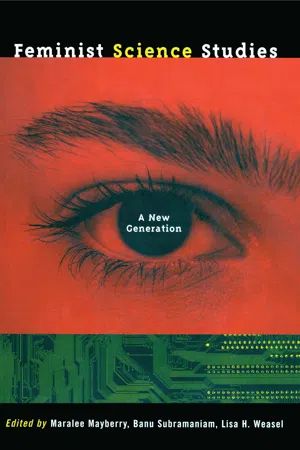
Feminist Science Studies
A New Generation
- 384 pages
- English
- ePUB (mobile friendly)
- Available on iOS & Android
eBook - ePub
Feminist Science Studies
A New Generation
About this book
This essential text contains contributions from a wide range of fields and provides role models for feminist scientists. Including chapters from scientists and feminist scholars, the book presents a wide range of feminist science studies scholarship-from autobiographical narratives and experimental and theoretical projects, to teaching tools and courses and community-based projects.
Trusted by 375,005 students
Access to over 1.5 million titles for a fair monthly price.
Study more efficiently using our study tools.
Information
STORES FROM THE FIELD
Implementing Feminist Science Studies in the Academy
Section III
[Section Introduction]: Feminist Leadership in the Academy
Innovations in Science Education

The sciences have traditionally been seen as a systematic process devoted to obtaining objective and value-free knowledge about the natural world. In contrast, feminists have consistently pointed to the significant role science plays in the validation of cultural constructions of gender. Feminist critics from both inside (Bleier 1984; Fausto-Sterling 1985; Hubbard 1990; Keller 1992) and outside the sciences (Code 1991; Harding 1986; Longino 1990; Schiebinger 1999) have explored how scientific authority has consistently been used to justify and reinforce inequitable gender power structures. There seem to be two fundamental mechanisms by which this takes place: first, a blanket acceptance that scientific knowledge claims are devoid of cultural influences; second, that women are virtually excluded from participating in the production of science itself. Education, both inside and outside the sciences, plays a key role in both of these practices. The chapters in this section disrupt these mechanisms by presenting pedagogical and curricular ideas and innovations that are designed specifically to translate theories from feminist science studies into new and different educational approaches that interrogate the cultural underpinnings of scientific knowledge through an examination of the intersections of natures and cultures.
As secondary and postsecondary science educators with academic appointments in natural science departments (biology and chemistry), we occupy unusual and relatively rare positions since most science educators are housed within colleges of education and have little contact with science faculties. However, we find our unique positions to be particularly effective sites from which to operate as activist feminists and enact a transformative educational agenda. We can use our credentials as “scientists” for entry to otherwise inaccessible science domains, allowing us proximity to those who shape academic science disciplines. Yet, we remain insulated from some of the pressures to conform to the masculine nature of science culture by virtue of our designation as “education lines.” We fall into a relatively new category of interdisciplinary scholars, border-crossers, who negotiate these terrains daily, and find a subversive satisfaction in the idea that neither the educational or scientific community can pin us down. The journey has many challenges and obstacles. However, the very nature of border-crossing provides the freedom to engage in the transformative feminist leadership of science education to which we are profoundly committed.
This section of the anthology provides a myriad of examples of the ways in which the field of feminist science studies has begun a constructive discourse between feminism and education. As border-crossers, Pamela Baker, Bonnie Shul-man, and Elizabeth Tobin tell an intriguing story regarding the trials and tribulations they faced in their effort to carve out such a discourse on their university campus. Their struggles illuminate the challenges inherent in making connections between incongruent places and their successes illustrate what the view from the academic bridges could look like. As subsequent chapters demonstrate, by forging such connections with other academic domains, feminist educators have developed an effective critique of science and feminism, and constructed ways to integrate this critique into education in the sciences and women’s studies.
Toward Feminist Science Education Reform
There is currently a widespread movement devoted to reforming K-16 science education. These efforts center on changing science curricula, teaching, and assessment practices. The various calls for reform have focused on what and how science is taught, and the best strategies for assessing students’ understanding of science concepts and processes. Specifically, the emphasis has changed from placing importance on students’ ability to memorize science content to students’ development of an understanding and appreciation of science as a “way of knowing” and “a process for producing knowledge” (Project Kaleidoscope 1991; NRC 1996a, 1996b; NSF 1996; Rutherford and Ahlgren 1990).
As Maralee Mayberry points out in her chapter, to address this issue science educators have used constructivism as a theory of knowledge to help us understand how students learn and, in particular, how this theory may improve teaching. Social constructivism attends to the influence and impact of the social milieu of knowledge making, curriculum making, and the teaching and learning of science. Although current reform initiatives do not typically deploy the concept of gender, our work as feminist science educators illuminates the insidious ways that science education uses the construction of knowledge as a means of perpetuating the masculinity of science. For example, the credibility of the knower is important when discussing knowledge production. However, philosophers typically have treated those who construct knowledge as “featureless abstractions” and have defined knowledge as an objective and transcending experience (Code 1991). This position poses several dilemmas in discussing the culture of science teaching. If we adhere to the constructivist ideals that students create knowledge and meaning from their social interactions with their peers and teachers and also adhere to feminist perspectives that all view social relations as gendered, classed, and racial, then the knower cannot be a featureless abstraction. When knowledge is viewed as abstract, the importance and value of experience is negated. Such ideas prevent people who value experience from engaging in knowledge production. Mayberry explores these dilemmas in her discussion of the theoretical underpinnings of two pedagogical approaches to reforming science education—collaborative learning and feminist pedagogy. Her analysis illustrates how on the one hand collaborative approaches maintain existing power structures in the sciences, whereas on the other hand feminist pedagogy subverts existing structures of power to create sciences that speak from the lives of women and other marginalized groups.
To work toward a bridge between science and feminist education and enact feminist reforms in science education, it is crucial to document our experiences within the sciences so schooling can be a key part of transforming sciences culture. As science educators, our daily existence makes us acutely aware of the inextricable connection between scientific pedagogy and the masculine nature of the natural sciences. As feminists, our political perspective is the infrastructure for using a transformative educational process to change the culture of science. As researchers and activists we are compelled to show the way and document this journey. It is heartening to see how closely our work parallels that of the other authors in this section of this anthology. All of us describe feminist efforts to enact transformative strategies for education at the college level and all of these efforts build a feminist analytical perspective into the goals for education.
Transforming College Science Teaching
In our case, our unique positions allow us to teach both science content and pedagogy courses to students from a variety of academic programs. Additionally, we work with graduate students and K-12 teachers. Like the authors in this section, our formal and informal teaching is interwoven in our political stance and commitment to improve the gender and racial/ethnic climate of science. WTiile the courses described in this section have been implemented in primarily liberal arts institutions where class sizes are small, allowing for greater interaction between instructor and students, our experience suggests that the recent call for reforms to improve science pedagogy can be implemented in large classrooms in large public universities as well. Professors in these settings have incorporated hands-on activities, small-group discussions, e-mail chat rooms, and problem-based learning into their teaching to enhance students’ learning (Jones, Anderson, and Dhanwada 1999).
The “typical” formal curriculum for a science major is approximately fifty credit hours of college-level science and mathematics courses. Students learn mostly through coursework taught by professors who often cover material at a fast pace and make little or no attempt to relate the material to the everyday world. In the other usual setting for learning science—teaching laboratories—experiments are often cookbook and bear little relationship or relevance to the lectures or the actual scientific process. By the end of their science experiences, students often have not posed a hypothesis, designed scientific experiments, or completed original research. Their science coursework provides very little exposure to anything other than a rigid, cold, fact-dominated memorization process (Seymour 1992). In our science courses, the goal is to challenge and transform this “typical” experience and to practice something akin to what Karen Barad terms “agential literacy.” Barad challenges the current bandwagon slogan “scientific literacy” by arguing that our pedagogical work needs to move beyond facilitating common understandings of scientific literacy—which focus on a science that is not in intra-action with other practices—to teaching our students “agential literacy” or “learning how to intra-act responsibly within the world.” The courses described by Barad and other authors in this section provide pilot sites for enacting these strategies.
For example, a fundamental premise we work from is that a successful general education course will provide a re-presentation of science. We strive to help our students think critically about the myth of a universal “Western” scientific thinking and the handicaps imposed by its exclusionary image. One effective way to achieve this is by passing out issues of National Geographic magazine and asking students to find examples of someone doing something scientific. Every issue contains multiple examples, and sharing these pictures sets the groundwork for discussions of the ubiquitous nature of scientific activity. The cultural diversity of the features disrupts the notion that science happens only in the West and also serves to frame the lesson that the standardized script of the hypothetico-deduc-tive model presents such a limited notion that it is actually a misrepresentation of science. Students enter our classes expecting professors to be aloof and distant, and care little about them as individuals. By actively questioning and initiating discussions, the flow of the discourse becomes at least two-way, if not multidirectional. Writing assignments dramatically enhance student learning by allowing individuals to pursue personal interests in the application of the course material. Balancing the assessment of students’ performance by weighing outside writing assignments on topics of their personal interest at least as heavily as test scores in the determination of their final grade changes students’ class experience and improves their chances for success.
We are also interested in emphasizing the social and personal relevance of learning scientific subject matter. For example, we have found that a human biology course that integrates aspects of life such as reproduction, heredity, cancer, AIDS, and immunity readily captures the attention of the undergraduates. A unit on reproduction is an effective site to interrogate concepts such as sex/gender and male-female, and present the range of sexes and sexualities that abound in humans and animals. The chapters by Sharon Kinsman and Rebecca Herzig provide detailed course descriptions that illustrate how units similar to ours can be designed. During another unit on heredity, it is possible to take an antiracist stance and use sound biological presentations of population genetics and molecular biology to deconstruct the notion that race is a valid biological category. Tracing the origins of human evolution, it is delightful to remind the class that all Americans are of African descent, it is just that some of us—as Beverly Tatum (1997) suggests—have a more recent connection to that continent. The implicit message of social justice is made by raising students’ consciousness of the inextricable nature-nurture connections by teaching sound scientific content.
Similarly, context and social issues can be incorporated into more scientific courses. For example, in chemistry, the production and use of the drug thalidomide provides an excellent explanation and rationale for naming chemical compounds and illustrates the important role of the Food and Drug Administration in drug regulation. In the 1950s and early 1960s, doctors prescribed thalidomide to pregnant women for morning sickness. The drug caused deformities in unborn babies that resulted in children with no arms and/or legs. Although many factors contributed to the continued worldwide use of thalidomide after the link had been made between the drug and the birth defects, one problem was the “naming system” used to identify the compound. The drug was banned as thalidomide in the United States, but was still being prescribed in other countries under different names. European doctors did not realize that the same drug was being repackaged by the drug company under another name. In the United States, the thalidomide case precipitated increased regulation of drug companies with regard to extensive testing of new drugs before giving approval for public use (Selinger 1989). Further classroom discussions on the role of the FDA could involve how these laws affect scientific funding for the development of drugs for patients with HIV. This example also illustrates the masculine hierachy of science, because female nurses identified the problem with thalidomide but were ignored by male doctors for several years.
The chapters by Kay Picart, Lisa Weasel and her colleagues, and Haydee Salmun provide other examples of curriculum reform models that can be applied in the humanities, physical sciences, and enginee...
Table of contents
- Cover
- Half Title
- Title Page
- Copyright Page
- Table of Contents
- Adventures Across Natures and Cultures
- (UN)Disciplined Identities Forging Knowledge Across Borders
- Altered States Transforming Disciplines From Within
- Stories From the Field Implementing Feminist Science Studies in The Academy
- Destination Reintegrating Science, Community, and Activism
- Notes on Contributors
- Acknowledgements
- Index
Frequently asked questions
Yes, you can cancel anytime from the Subscription tab in your account settings on the Perlego website. Your subscription will stay active until the end of your current billing period. Learn how to cancel your subscription
No, books cannot be downloaded as external files, such as PDFs, for use outside of Perlego. However, you can download books within the Perlego app for offline reading on mobile or tablet. Learn how to download books offline
Perlego offers two plans: Essential and Complete
- Essential is ideal for learners and professionals who enjoy exploring a wide range of subjects. Access the Essential Library with 800,000+ trusted titles and best-sellers across business, personal growth, and the humanities. Includes unlimited reading time and Standard Read Aloud voice.
- Complete: Perfect for advanced learners and researchers needing full, unrestricted access. Unlock 1.5M+ books across hundreds of subjects, including academic and specialized titles. The Complete Plan also includes advanced features like Premium Read Aloud and Research Assistant.
We are an online textbook subscription service, where you can get access to an entire online library for less than the price of a single book per month. With over 1.5 million books across 990+ topics, we’ve got you covered! Learn about our mission
Look out for the read-aloud symbol on your next book to see if you can listen to it. The read-aloud tool reads text aloud for you, highlighting the text as it is being read. You can pause it, speed it up and slow it down. Learn more about Read Aloud
Yes! You can use the Perlego app on both iOS and Android devices to read anytime, anywhere — even offline. Perfect for commutes or when you’re on the go.
Please note we cannot support devices running on iOS 13 and Android 7 or earlier. Learn more about using the app
Please note we cannot support devices running on iOS 13 and Android 7 or earlier. Learn more about using the app
Yes, you can access Feminist Science Studies by Maralee Mayberry, Banu Subramaniam, Lisa Weasel, Maralee Mayberry,Banu Subramaniam,Lisa Weasel in PDF and/or ePUB format, as well as other popular books in Social Sciences & Feminist Literary Criticism. We have over 1.5 million books available in our catalogue for you to explore.