This special issue of Mind, Culture, and Activity revisits Rommetveit's ideas in admiration for his quest to understand meaning, language, and mind. It also reflects the inspiration he has provided for those struggling with these issues. Written by those studying Rommetveit and one by Rommetveit himself, all three articles are attempts to spell out, extend, and apply ideas that Rommetveit outlined in his writings at some point early in his career. Rommetveit, however has moved ahead in his struggle to understand the ethical dimensions of communication--including the communication involved in the study of communication--which represents his newest project.
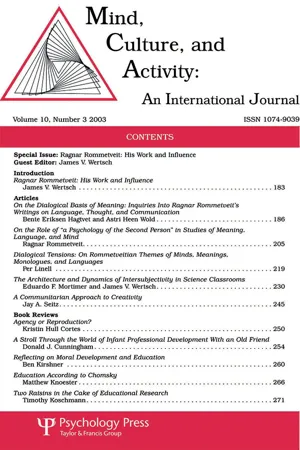
eBook - ePub
Ragnar Rommetveit
His Work and Influence:a Special Issue of mind, Culture, and Activity
- 96 pages
- English
- ePUB (mobile friendly)
- Available on iOS & Android
eBook - ePub
Ragnar Rommetveit
His Work and Influence:a Special Issue of mind, Culture, and Activity
About this book
Trusted by 375,005 students
Access to over 1.5 million titles for a fair monthly price.
Study more efficiently using our study tools.
Information
On the Dialogical Basis of Meaning: Inquiries Into Ragnar Rommetveit's Writings on Language, Thought, and Communication
Bente Eriksen Hagtvet
Institute of Special Needs Education University of Oslo
Astri Heen Wold
Institute of Psychology University of Oslo
Institute of Special Needs Education University of Oslo
Astri Heen Wold
Institute of Psychology University of Oslo
Introduction
Given the complexity of cognitive and language development, and given that most scholars consider humans to be products of biological—individual and sociocultural forces, the tendency to study language and cognition as either primarily a sociocultural or primarily a biological-psychological phenomenon is striking. This tendency to compartmentalize research is not unique to the study of language and cognition. Rather, academic systems tend to organize their activities in dichotomies—for example, natural scientific versus humanistic research paradigms, quantitative versus qualitative research, modem versus postmodern conceptualizations. A position may in rare cases reflect theoretically based convictions, but more typically there "seem to be few bases other than personal preference or disciplinary affiliation for making a selection among the alternatives" (Wertsch, 1995, p. 58). In fact, both ethical and scientific considerations make dichotomies inadequate for dealing with multifaceted, complex reality.
Ragnar Rommetveit represents an alternative to research approaches that enhance the segmentation of insights into language, thought, and communication, rather than their integration. The aim of this article is to explore some crucial dimensions of Rommetveit's thought in order to demonstrate their relevance and importance to scientific disciplines, in particular to the study of language and communication in psychology and education.
Requests for reprints should be sent to BenteE. Hagtvet, Institute of Special Needs Education, University of Oslo, Boks 1140 Blendern, N-0317 Oslo, Norway. E-mail: [email protected]
In his research writings and academic life as an adviser and lecturer, Rommetveit has advocated an open position toward methodological issues as well as toward theoretical paradigms and scientific traditions. For example, he used experimental methodology in studies of reading under conditions of binocular rivalry (Rommetveit & Blakar, 1973) and used humanistically oriented discourse analysis in examining the opening dialogue between Nora and Helmer in Henrik Ibsen's A Doll's House (Rommetveit, 1991a). Thus, experimental and humanistic methods are viewed not as being in opposition but as being complementary tools representing different perspectives on mental activities and human interaction.
To gain deeper insights into a complex and multifaceted world (cf. I Linell, this issue), Rommetveit has consistently argued, for example, that descriptions of reality are dependent on the perspective adopted by the communicators and also that a word's meaning is dependent on its context of use. Yet at the same time he has discarded the postmodern idea that all perspectives are equally acceptable. Influenced by theoretical traditions like Gestalt psychology, European continental phenomenology, and sociocultural theories from the former Soviet Union, Rommetveit's theoretical framework is truly interdisciplinary.
This broad scope of mind and range of perspectives have given numerous students and colleagues—including ourselves—valuable insights into a reality that appears less orderly and simple, but more real, than the one portrayed in more traditional approaches. At the same time we appreciate that the implications of Rommetveit's approach are often difficult to understand in depth. What is the basis of scientific truth if scientific results are dependent on the perspective chosen by the researcher? Are some perspectives more acceptable than others? Where do truth and morality enter the scene when nothing is objective? How may children learn the meaning of words when "literal meaning" does not exist? Does his openness imply a nihilistic position in which everything goes and there are no ways to evaluate scientific results and everyday descriptions as good or bad, right or wrong? Is Rommetveit's world a premodern version of postmodernism—"an orgy in pluralism," as some of his colleagues have argued in friendly conversations with him?
Underneath Rommetveit's pluralistic approach, however, there are clear restrictions, presuppositions, and principles that direct scientific work and set limits for possible interpretations. These restrictions may be harder to detect than are the multitude of potentially "chaotic" perspectives. Also, Rommetveit has himself shown a greater dedication to arguing against what he sees as wrongly perceived objectivism and "literal meanings" in mainstream psychology and linguistics than in making restrictions on openness explicit.
In this article we foreground these restrictions. First, however, we focus on dimensions that open and expand the paradigm by discussing some concepts of crucial importance to Rommetveit's thinking—concepts such as "perspective," "position," and "aspect" and also the related notion of word meaning in terms of "meaning potentials." Second, we elaborate on concepts that impose restrictions on perspectival pluralism by means of the notions of "dialogue," "truth," and "values." We have analyzed these restrictions in a series of discussions with Ragnar Rommetveit while writing this article. In addition, we are drawing on research seminars, lunch conversations, and readings over a span of more than 30 years.
A Pluralistic Approach to the Study of Language and Communication
Perspectivity and Related Terms
The notion that descriptions of reality should be objective and value neutral is deep-rooted in commonsense views as well as in much Western-oriented scientific thinking. Over a lifetime, Rommetveit has been an ardent critic of such a simplified view. To him, every description is provided from a particular perspective or position, highlighting some aspects of objects or states of affairs while overlooking others (Rommetveit, 1968, 1992). Thus, perfect objectivity and value neutrality are Utopian notions, he argued—often with reference to sociocultural theories of mind (e.g., Bakhtin, 1984; Voloshinov, 1986; Vygotsky, 1978, 1986; Wertsch, 1988).
Perspectival relativity has been underscored by scholars from several theoretical traditions such as postmodern paradigms (Gergen, 1992; Kvale, 1992a, 1992b). However, few researchers have highlighted the idea that descriptions of reality vary with perspectives as radically, persistently, and vigorously as Rommetveit. To him, perspectival relativity is an axiomatic feature of a dialogical approach to language and mind.
To show how the same state of affairs may be "brought into language"1 in different ways depending on the perspectives of the interlocutors, Rommetveit has on several occasions (e.g., Rommetveit, 1990) made use of an example from ordinary life, an example in which a "Mr. Smith" is mowing his lawn on a Sunday morning. Is Mr. Smith then working, exercising, or relaxing? That depends on the perspective adopted. We return to this example later. At this point, we use Mr. Smith only to illustrate how basic the notion of perspectival relativity is in Rommetveit's conception of human cognition, language, and communication. Here is his explication of Mr. Smith mowing his lawn:
1Rommetveit used this formulation (brought into language) frequently (see, e.g., Rommetveit, 1992, p. 22). It was borrowed from Gadamer (1975): "Wahrheit und Methode."
His mowing of the lawn can be made sense of and talked about in a variety of distinctively different ways under different dialogically established background conditions. But this is also the case with any not yet verbalized state of affairs. Perspectival relativity, I shall claim, is an inherent characteristic of human cognition and part and parcel of its situatedness. This implies in metaphorical yet pertinently spatial terms, that the very identity of any given state of affairs is contingent upon the position from which it is viewed, (p. 87)
Along with the notion of perspectivity, the concept of position is a key concept in the cited argument. These concepts are, together with the related concept of aspect, used to explicate nuances of "perspectival relativity" in many of Rommetveit's discussions of the topic.
Perspectivity is related to the identity of objects and actions toward them through the concept of aspect. This relation is discussed by Graumann (1989), among others, who asserted, "To be present in aspects with respect to a given viewpoint is the basic meaning of perspective" (p. 96). Perspectives are therefore of central importance to how we experience the world. The notion of perspectivity is, moreover, inherently connected to a notion of "several possibilities." It implies that different perspectives exist, and that we have to choose between them even when we are not consciously aware of the options ourselves. Rommetveit (1992) saw these possibilities in connection with motivational realms of human life: "Options with respect to perspectives on states of affairs entering human discourse reflect the range of possible human interests, commitments and concerns with respect to those states of affairs" (p. 23). Thus, perspectivity cannot be considered a purely cognitive concept. It also involves motivation because what one sees is related to one's personal projects and goals.
Rommetveit's use of perspectivity and related terms has its root in the tradition of phenomenology, in which a core issue is the individual's encounter with her or his world as a subjective individual experience. However, in phenomenological discussions of subjective experience, no second person or social group is explicitly included and communication of experiences to others is not a central theme.
In Rommetveit's thinking, on the other hand, language and communication are the focus, and the social dimension is always present. Rommetveit has clearly been inspired by what Graumann (1989) labeled "the interactionist approach" (p. 98), with George Herbert Mead (1934) as one of the leading scholars. Within this tradition the reciprocity of perspectives is a central notion and the expression "taking the perspective of the other" a recurrent term. Inspiration from Mead is clearly reflected in Rommetveit's writings as early as the 1950s.
Thus. the notion of perspectivity and related concepts in Rommetveit's paradigm of thought have dual roots in phenomenology and in theories of social constructivism—in an individual and a social tradition. This is consistent with a position more generally held by Rommetveit, of integrating individual and social variables in theory building as well as hypothesis testing, for which reason his paradigm has been described as a "social cognitive theory of language and communication" (Rommetveit, 1992). However, neither the phenomenologists nor Mead have focused primarily on language and communication. It is among Rommetveit's credits to bring perspectivity and related terms into the field of language and communication.
How descriptions of reality vary with the perspective one adopts is illustrated in an experiment by Olson (1970), an experiment that Rommetveit developed further (Rommetveit & Rommetveit, 1980). In a set of tasks children were asked to label geometric figures. On each occasion a child was to label one block in a context in which the number and characteristics of other blocks (the referential domain) varied.
Not unexpectedly, the labels the children used were heavily influenced by the context of the block. If the target object was a white, round block, and the context of objects a single black, round block (○/•), it was most typically identified as "the white one." If, however, the block in the context was white and square, the referent would more typically be labeled "the round one" (○/□). In cases in which four blocks made up the context of objects, two white ones (one round and one square) and two black ones (one round and one square), speakers typically identified the correct block by expressions such as "the white and round one" (○/○□•■·).
Thus, speakers—even fairly young children—spontaneously take into consideration the other objects from which the listener has to discriminate the object in focus. In other words, they vary their verbal labeling of the target object, depending on the perspective they adopt. Olson (1970) argued that in events in which the alternatives are not perceptually present "the speaker must make an estimate of the contextual alternatives both in the light of the preceding utterances in the dialogue and on the basis of the experience ... [the speaker] has of the listener" (p. 266). This is in principle the same in more complex events and states of affairs, as in the example with Mr. Smith, in which the actors are Mr. Smith, a fireman who likes to go fishing; Mrs. Smith, his wife; Betty, a friend of Mrs. Smith; and Mr. Jones, who likes to go fishing with Mr. Smith (Rommetveit, 1980, 1990, 1992). The scene is an early Saturday morning in a suburban area. Mr. Smith has already started to mow their lawn, while Mrs. Smith is sitting in the kitchen with her morning coffee. Then the telephone rings. It is Betty, who asks, "That lazy husband of yours, is he still in bed?" To this, Mrs. Smith answers, "No. Mr. Smith is working this morning. He is mowing the lawn." Some minutes later the telephone rings a second time. It is Mr. Jones, who simply asks, "Is your husband working this morning?" Mrs. Smith takes it for granted that Mr. Jones, as usual, wants to find out if Mr. Smith is free to go fishing with him that day. She answers, "No. Mr. Smith is not working this morning. He is mowing the lawn."
What is striking in this case is that Mrs. Smith brings the same state of affairs—that is, his mowing of their lawn—into language in two ways, which in some respects are opposites. She informs Betty that her husband is "working" and Mr. Jones that he is "not working." In both cases her words function effectively in the communication and would be judged as both "correct" and "true" descriptions of the state of affairs. Examples such as these demonstrate that the outer world may be brought into language from different perspectives and that reference is clearly not a matter of a one-to-one relationship between language and the world. Rather, the perspective chosen, or intuitively adopted, is influenced by the communicative partners' aim of establishing mutual understanding or intersubjectivity.
Our tentative conclusion so far is that according to Rommetveit we cannot adopt "an absolute neutral point, a 'divine position' from which the world can be viewed" (Fløistad, 1968, p. 75; our translation). This seems to be the case whether we approach the world as scientists or as laypersons. Our cognition grasps aspects and is influenced by our perspectives, aims, and concerns: "Human cognition is inherently dual, in the sense that its product is informative about the observer as well as about the observed" (Rommetveit, 1992, p. 21).
This conclusion is provocative. If an individual may work and not work at the same time, depending on the perspective she or he adopts, how may we then conceptualize "word meaning"? How may children come to learn the "meaning" of words, and how may two interlocutors attain intersubjectivity? Furthermore, what happens to questions about the truth of different descriptions when this duality is acknowledged?
The Openness of Word Meaning
It follows from Rommetveit's discussion on perspectival relativity that word meanings are influenced by the perspective adopted by the speaker. Word meanings are "open," until they are used in a communicative act. They entail only a set of "meaning potentials." This concept...
Table of contents
- Cover
- Introduction
- Ragnar Rommetveit: His Work and Influence
- Articles
- On the Dialogical Basis of Meaning: Inquiries Into Ragnar Rommetveit's Writings on Language, Thought, and Communication
- On the Role of "a Psychology of the Second Person" in Studies of Meaning, Language, and Mind
- Dialogical Tensions: On Rommetveitian Themes of Minds, Meanings, Monologues, and Languages
- The Architecture and Dynamics of Intersubjectivity in Science Classrooms
- A Communitarian Approach to Creativity
- Book Reviews
- Agency or Reproduction?
- A Stroll Through the World of Infant Professional Development With an Old Friend
- Reflecting on Moral Development and Education
- Education According to Chomsky
- Two Raisins in the Cake of Educational Research
Frequently asked questions
Yes, you can cancel anytime from the Subscription tab in your account settings on the Perlego website. Your subscription will stay active until the end of your current billing period. Learn how to cancel your subscription
No, books cannot be downloaded as external files, such as PDFs, for use outside of Perlego. However, you can download books within the Perlego app for offline reading on mobile or tablet. Learn how to download books offline
Perlego offers two plans: Essential and Complete
- Essential is ideal for learners and professionals who enjoy exploring a wide range of subjects. Access the Essential Library with 800,000+ trusted titles and best-sellers across business, personal growth, and the humanities. Includes unlimited reading time and Standard Read Aloud voice.
- Complete: Perfect for advanced learners and researchers needing full, unrestricted access. Unlock 1.5M+ books across hundreds of subjects, including academic and specialized titles. The Complete Plan also includes advanced features like Premium Read Aloud and Research Assistant.
We are an online textbook subscription service, where you can get access to an entire online library for less than the price of a single book per month. With over 1.5 million books across 990+ topics, we’ve got you covered! Learn about our mission
Look out for the read-aloud symbol on your next book to see if you can listen to it. The read-aloud tool reads text aloud for you, highlighting the text as it is being read. You can pause it, speed it up and slow it down. Learn more about Read Aloud
Yes! You can use the Perlego app on both iOS and Android devices to read anytime, anywhere — even offline. Perfect for commutes or when you’re on the go.
Please note we cannot support devices running on iOS 13 and Android 7 or earlier. Learn more about using the app
Please note we cannot support devices running on iOS 13 and Android 7 or earlier. Learn more about using the app
Yes, you can access Ragnar Rommetveit by James V. Wertsch in PDF and/or ePUB format, as well as other popular books in Psychology & Cognitive Psychology & Cognition. We have over 1.5 million books available in our catalogue for you to explore.