eBook - ePub
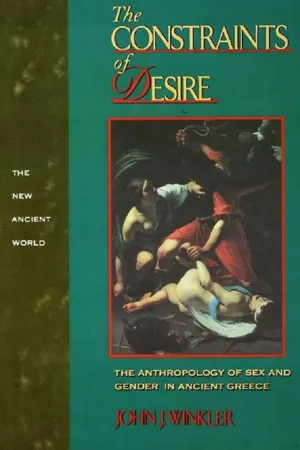
The Constraints of Desire
The Anthropology of Sex and Gender in Ancient Greece
- 282 pages
- English
- ePUB (mobile friendly)
- Available on iOS & Android
eBook - ePub
About this book
For centuries, classical scholars have intensely debated the "position of women" in classical Athens. Did women have a vast but informal power, or were they little better than slaves? Using methods developed from feminist anthropology, Winkler steps back from this narrowly framed question and puts it in the larger context of how sex and gender in ancient Greece were culturally constructed. His innovative approach uncovers the very real possibilities for female autonomy that existed in Greek society.
Part One:
Andres
1
Unnatural Acts: Erotic Protocols in Artemidoros’ Dream Analysis
For “Nature,” Read “Culture.”
If sex were simply a natural fact, we could never write its history. We would have then to abandon what has become one of our favorite modern projects—describing the sex/gender systems of the varied societies we know, their development and periodization and dialectical interaction.1 But sex is not, except in a trivial and uninteresting sense, a natural fact. Anthropologists, historians, and other students of culture (rather than of nature) are sharply aware that almost any imaginable configuration of pleasure can be institutionalized as conventional and perceived by its participants as natural. * Indeed what “natural” means in many such contexts is precisely “conventional and proper.” The word “unnatural” in contexts of human behavior quite regularly means “seriously unconventional” and is used like a Thin Ice sign to mark off territory where it is dangerous to venture. Such warnings may be couched in absolute terms, but all such claims have been eroded by time: like the geological changes over millennia in the earth's surface the moral land-masses and “natural” boundaries can be shown to have under gone radical shifts.
There certainly was a time when the contrast of nature and convention, of phusis and nomos, as applied to sexual activity and to everything else, was not exploited, a time before that particular contrast was developed as a linguistic or ideological turn. In our records the contrast of nature vs. culture seems to be a product of the sophistic enterprise of the fifth century B.C.E.2 Before that time there were no doubt other ways of condoning and condemning sexual behavior,* but the use of “nature” appears not to have been among them. It is important to underline that the contrast of phusis and nomos, of nature and culture (if you will), is itself a cultural item, a format of thought once newly discovered, which thereafter spread and eventually was enlisted as a weapon in a historically specific cultural struggle (now called the Enlightenment). Over time it has become an automatic cliché, a deeply imbedded habit of the sort that is almost (as we say) a second nature, such that we can hardly imagine not thinking in those terms.3 This is to say that although it seems natural to us to discuss sex in terms of nature and “unnature,” the “naturalness” of these categories is itself a sort of cultural illusion. Like sexuality, “nature” (as applied to sex) has a history.
History of Ideas/History of Practices
But how should we write such a history? It certainly will not do (though it is often done) to latch onto isolated bits of moralizing texts, snip them from the page and pin them to a drawing board so that they form a “systematic” narrative—Plato to Philo to Paul to Plotinos.4 Above all it is a methodological mistake to invest such clippings with a cultural authority derived only from projections into their future.
Consider the example of cultural attitudes to paederasty, and the implications of one famous text that seems to inaugurate a condemnation of the practice. Plato's spokesman in the Laws (835D–842A) toys with the idea of inventing a social order that would conform to “nature” as Greek society supposed it was before Oidipous’ father Laios invented paederasty. To do so would require a massive restructuring of common belief and practice, placing paederasty on a par with incest so that everyone acquired a horror of it.† Plato's legislator confesses his idea to be a pipe-dream. Yet even though that dream, or rather nightmare, came true—and did so in the very terms employed in the Laws, with paederasty coming to be stigmatized as “unnatural”—what should stand out about Plato's text is the despair there felt about the impossibility, almost the inconceivability, of the project. It was clearly a thought-experiment on the same order as censoring traditional poetry in the Republic, one that went utterly against the grain of the values, practices, and debates of Plato's society. These speculations of Plato are unrepresentative—not the opening move in a new game of moralizing sex— and hence only obliquely useful for writing the history of a society's sexual mores and practices.
But our critique must go further. Aside from the issue of treating philosophical or theoretical texts as if they possessed prophetic weight, we err in a more general way when we reconstruct cultural history simply or primarily in terms of ideas, no matter whose, rather than in terms of the competing variety of social practices. Philosophers and moralists offer primary material for the history of ideas, only inadvertently for the history of practices. This is particularly true in the case of classical Greece. We know what kinds of person possessed cultural authority in a typical assembly of Athenian citizens in Plato's day because we know who is constantly appealed to by those delivering political speeches and courtroom arguments: Homer, Hesiod, Tyrtaios, Solon, Sophokles, and Euripides have such authority, along with various culture-heroes from history.5 Sokrates, Plato, Aristotle and the like count for nothing—in this context. Athens was a society in which philosophers were often ignored and when noticed were easily represented not as authority figures but as cranks and buffoons.6 If we focus our attention not on that eccentric côterie but on the citizen body (in its own way an elite in the population of Athens), we get quite a different picture, one in which the debates of philosophers have no discernible impact *
After demoting philosophers from the privileged position sometimes assigned to them in reconstructing a picture of ancient society, we must go on and apply a similar critique to other texts. It cannot be said too strongly or too frequently that the selection of book-texts now available to us does not represent Greek society as a whole. The social and editorial conventions within which most public speaking and published writing took place tended to give voice to a select group of adult male citizens and to mute the others— female, adolescent, demotic (working persons with a minimum of leisure), metic (non-citizen). Further, as we shall see in Chapter Two, the public proprieties could also misrepresent the interests and feelings of even the adult male citizens who sponsored them. Those conventions of male prominence and competition between households are well known and roughly correspond to proprieties still broadly observable in the family of cultures around the Mediterranean basin. But inasmuch as our current intellectual interest is not to pay allegiance to the values or pretensions of that hegemonic group (and thus indirectly to support its equivalent in our own society), we must not allow these conventions to represent “everyone.”
More than that, we are not simply trying to “map” a culture and find its system or complex of competing systems. As Bourdieu has shown for the conflicting genealogies, calendars, and other sorting systems of the Algerian Kabyle, the very act of drawing a map, insofar as it implies an established and unarguable regularity and system, falsifies important uncertainties, smoothes out the wrinkles, and regularizes all matters that are still to be negotiated between actors in the social conglomerate (Bourdieu 1977: 2, 37, 105). Rather we would like to make some statements about that social conglomerate which manage both to characterize the fundamental conventions or protocols and to show the limits of their application to real lives. The first part of this goal is the subject of the present chapter, in which Artemidoros’ Dream Analysis is used to reveal the basic principles of meaning employed by Greek-speaking men around the Mediterranean basin in ancient times to interpret sexual acts. The second part, the estimation of how strongly or lightly those principles weighed on individual lives, is the subject of the next chapter. This approach or interest, which may be designated anthropological, is one way of reading ancient texts and it does not, of course, preclude other uses of the same texts. One may still decide to study the history of ideas: what one should not do is misrepresent those ideas as having a weight, a power, a dominance which they did not possess.7
What Was “Unnatural”?
If it is indeed the case that the nature/culture contrast, as it applies to sex, was not exploited before the sophistic movement of the fifth century B. C. E., it is also the case that, when it was exploited, it did not possess the same valence that it does today. The terms “natural” and “unnatural,” in other words, did not function (as they have since the Enlightenment) as equivalents of “normal” and “abnormal,” “healthy” and “diseased,” “ordinary” and “monstrous.” A glance at some of the contexts in which the contrast between nature and culture was applied to sex clearly reveals that the content assigned to “natural” behavior in the ancient world is surprisingly different from that assigned to it today, and further that its mode and range of application (that is, who comes under its restrictions) are far from universal. Thus, in Thoukydides’ description of open class warfare in Korkyra (Corfu), the wives support their husbands’ struggle by throwing tiles from the roof onto the heads of the oligarchs: their endurance of the din of battle is “unnatural,” para phusin (3.74). In this case “unnatural” is a term of praise, as the wives transcend their socialized reticence and engage in open violence in support of their families’ interests. What we can call Greek women's “socialized reticence,” Thoukydides terms their “nature,” meaning a conventional or expected limitation which they can heroically rise above. He does not mean that the Korkyran democratic women are perverts, acting in violation of the universal laws discovered by science or theology.
If we juxtapose the passage from the Laws, quoted earlier, which seems an anticipation of later condemnations of unnatural sex, to some passages from other texts (less favored by historians of ideas), a new picture starts to emerge. Seneca, for example, inveighing against luxury in Epistle 122.7–8, declares the following items to be contra naturam: hot baths, potted plants, and banquets after sunset (requiring wakefulness at night and sleep in the daytime, both unnatural acts). When he goes on to treat sex between men in the same passage, he makes it clear that what he condemns is either men dressing in clothing appropriate to women or men making themselves look youthful—both of which suggest to Seneca the wish to serve as the sexual object of other men * “Contrary to nature” means to Seneca not “outside the order of the kosmos” but “unwilling to conform to the simplicity of unadorned life” and, in the case of sex, “going AWOL from one's assigned place in the social hierarchy.” This Stoic view, though articulated as universal, is obviously directed at a very small and wealthy elite—those who can afford the sort of luxuries Seneca wants “all mankind” to do without.
The world view that frames Seneca's diatribe against luxury is nicely drawn by the Greek orator Dio Chrysostom in his idealized depiction of Euboian hillbillies (Oration 7), two families who live directly from their own farming and hunting, pay no taxes, buy no goods, and are unfamiliar with the normal amenities of urban life. It would be better if barber shops and house paint were forbidden altogether, Dio argues (117–8), so that people would not have their minds turned from a simple life in accordance with nature (103). Dio contrasts this simple life in the mountain wilds with city life, where brothels flourish, adultery is tolerated, the wealthy seduce one another in private, and men tired of their easy conquests of women corrupt boys contrary to nature (134–6, 149). The content given to this use of “nature” has more to do with the general thematic of expenditure and loss, of thrifty and prudent behavior in a scarcity society, than it does with modern conceptions of universal law based on the paradigms of natural science. Dio wants to argue in favor of simplicity and against lavishness: the life of the poor can, believe it or not, be “dignified and natural” (81). Farmers, hunters, and shepherds are induced by their poverty to lead lives that are “better and more useful and more natural” (mallon kata phusin) than those of the urban wealthy.
Dio's “nature” has also laid down moral rules about sex: the non-reproductive is unnatural (134–36, 149). But again if we look closely at the argument it appears that “unnatural” refers not so much to behavior which contravenes the necessary order of the world but to behavior which is self-indulgent, luxurious, and exceedingly appealing. His principal target is urban prostitution, since it provides a luxury market of boys and women for sale, and encourages the sexual desire of male consumers to wax wanton, reaching out to ever more exquisite and refined forms of satisfaction. When human appetite is restricted to basic needs, as it is for the simple mountaineers, life is stable—and this is Dio's image of human good. But when markets are introduced, stimulating but never satisfying desire, the consumer becomes restless, acquisitive, never at peace with himself. Using a slippery slope argument, Dio describes how “the man who is never satiated ...
Table of contents
- Cover Page
- Half Title page
- Title Page
- Copyright Page
- Contents
- Preface
- Abbreviations
- Introduction
- Part One Andres
- 1 Unnatural Acts: Erotic Protocols in Artemidoros' Dream Analysis
- 2 Laying Down the Law: The Oversight of Men's Sexual Behavior in Classical Athens
- 3 The Constraints of Desire: Erotic Magical Spells
- Interlude: Reading Against the Grain
- 4 The Education of Chloe: Hidden Injuries of Sex
- Part Two Gunaikes
- 5 Penelope's Cunning and Homer's
- 6 Double Consciousness in Sappho's Lyrics
- 7 The Laughter of the Oppressed: Demeter and the Gardens of Adonis
- Appendix One Artemidoros of Daldis: Dream Analysis Book One, chapters 78–80
- Appendix Two Phusis and Natura Meaning “Genitals”
- Notes
- Bibliography
- Index of Passages Discussed
- General Index
Trusted by 375,005 students
Access to over 1.5 million titles for a fair monthly price.
Study more efficiently using our study tools.
Frequently asked questions
Yes, you can cancel anytime from the Subscription tab in your account settings on the Perlego website. Your subscription will stay active until the end of your current billing period. Learn how to cancel your subscription
No, books cannot be downloaded as external files, such as PDFs, for use outside of Perlego. However, you can download books within the Perlego app for offline reading on mobile or tablet. Learn how to download books offline
Perlego offers two plans: Essential and Complete
- Essential is ideal for learners and professionals who enjoy exploring a wide range of subjects. Access the Essential Library with 800,000+ trusted titles and best-sellers across business, personal growth, and the humanities. Includes unlimited reading time and Standard Read Aloud voice.
- Complete: Perfect for advanced learners and researchers needing full, unrestricted access. Unlock 1.5M+ books across hundreds of subjects, including academic and specialized titles. The Complete Plan also includes advanced features like Premium Read Aloud and Research Assistant.
We are an online textbook subscription service, where you can get access to an entire online library for less than the price of a single book per month. With over 1.5 million books across 990+ topics, we’ve got you covered! Learn about our mission
Look out for the read-aloud symbol on your next book to see if you can listen to it. The read-aloud tool reads text aloud for you, highlighting the text as it is being read. You can pause it, speed it up and slow it down. Learn more about Read Aloud
Yes! You can use the Perlego app on both iOS and Android devices to read anytime, anywhere — even offline. Perfect for commutes or when you’re on the go.
Please note we cannot support devices running on iOS 13 and Android 7 or earlier. Learn more about using the app
Please note we cannot support devices running on iOS 13 and Android 7 or earlier. Learn more about using the app
Yes, you can access The Constraints of Desire by John J. Winkler in PDF and/or ePUB format, as well as other popular books in History & Ancient History. We have over 1.5 million books available in our catalogue for you to explore.