eBook - ePub
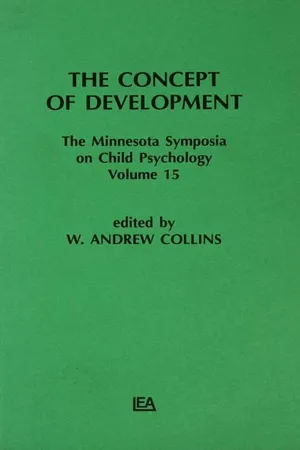
The Concept of Development
The Minnesota Symposia on Child Psychology, Volume 15
- 238 pages
- English
- ePUB (mobile friendly)
- Available on iOS & Android
eBook - ePub
About this book
Published in 1982, the Concept of Development is a valuable contribution to the feild of Developmental Psychology.
Trusted by 375,005 students
Access to over 1.5 million titles for a fair monthly price.
Study more efficiently using our study tools.
Information
1 Structures, Stages, and Sequences in Cognitive Development
Stanford University
My aim in this chapter is to speculate about certain aspects of childhood cognitive development. The chapter is intended to be an essay or “think piece” rather than a literature review, and thus the coverage and referencing are selective rather than systematic and exhaustive. The aspects of cognitive growth that are discussed mostly fall into the “formal” rather than “functional” category. As Flavell and Wohlwill (1969) have stated:
The formal aspect has to do with the “morphology” of the process: the sorts of cognitive entities that make up the successive outputs of development and how these entities are causally, temporally, and otherwise interrelated…. The other aspect… has to do with function and mechanism: the activities or processes of the organism, somehow specified in relation to environmental inputs, by which it in fact makes the cognitive progress that has been formally characterized [pp. 67–68].
Discussion centers on three formal aspects—structures, stages, and sequences—with the discussion of sequences raising questions about functional aspects. An important objective throughout is to make best guesses about how much and what kind of structure or organization there is in human cognitive growth. To what extent and in what ways can it be characterized as orderly, predictable, coherent, regular, consistent, or otherwise nonrandom? To see the range of possibilities, imagine a dimension with minimum developmental order at one end and maximum developmental order at the other. At the minimum-order end, no cognitive-developmental acquisition bears any kind of interesting relation to any other. Acquisitions cannot be meaningfully compared to one another as to similarity of underlying process, structure, or maturity level; they do not influence one another's emergence; they do not consistently appear either synchronously or sequentially, one in relation to another. At this end of the dimension, cognitive development is a chaotic hodgepodge of isolated and unconnected learnings and maturings.
Let us suppose that the other end of the dimension is occupied by some extreme and caricaturish variation of the Piagetian view of cognitive development. Such a development consists of a fixed and universal sequence of stages and substages, each defined by a highly general cognitive structure of the Piagetian structure d'ensemble type. Predictability, consistency, and coherence abound. If a child is in a stage or substage at all, he is in it completely, in the sense that all his cognitive activities are tightly governed by that stage's cognitive structure. Thus, at any point in his childhood, the nature and developmental level of his thinking are constant and consistent across all tasks and situations. His mentality undergoes profound qualitative changes in its orderly progression toward its universal adult destination, but it is “homogeneous” (Fischer, 1980) rather than “heterogeneous” at each step in this progression.
Although it is certain that real-life cognitive development differs from both of these extreme portraits, it is by no means clear exactly how much and what sorts of organization can justifiably be attributed to it. We should also like to be able to make guesses as to why cognitive development might have whatever amount and kind of structure we decide it does have. For example, if we were to conclude that human cognitive growth is really not very stage-like after all, we would also like to be able to say why that state of affairs might be just what one would expect, given this fact or that consideration. Focusing exclusively on structures, stages, and sequences cannot give us a complete picture here, because it ignores regularities on the functional side. However, it is a good place to begin—or, in the present case, to begin again (Flavell, 1970, 1971, 1972, 1977; Flavell & Wohlwill, 1969). It is also a good time to begin again, because there now exists a substantial theoretical literature on these and related topics, some of it still in press or in preparation. Writings that I have found particularly useful in thinking about these issues include Brainerd (e.g., 1978a, 1978b, plus commentaries by others on 1978b), Case (1978, in preparation), Damon (1977, in press), C. F. Feldman & Toulmin (1976), D. H. Feldman (1980), Fischer (1980), Gardner (1973), Keats, Collis, & Halford (1978), Klahr & Wallace (1976), Rest (1979), Selman (in press), Siegler (1979, in press), Smedslund (1977), Toulmin (in preparation), Turiel (in press), and Wohlwill (1973).
Before proceeding further, it should be pointed out that psychologists are quite capable of discovering new and important things about childhood cognitive growth without deciding exactly what they believe about structures, stages, sequences, etc.—without pondering “the nature of the big picture of cognitive development” (Fischer, 1980, p. 520). Most of us go about our daily research activities without worrying much about this “big picture.” Still, it is probably good for all of us to get out of the trenches occasionally to try to see what the whole landscape looks like. It might even improve our research.
Structures, Structuralists, and Structuralism
Let me begin by trying to define “cognitive structure.” Flavell, 1971, has stated:
the really central and essential meaning of “cognitive structure” ought to be a set of cognitive items that are somehow interrelated to constitute an organized whole or totality; to apply the term “structure” correctly, it appears that there must be, at minimum, an ensemble of two or more elements together with one or more relationships interlinking these elements. There also appear to be at least two additional secondary properties. One is that such organizations of cognitive items are relatively stable, enduring affairs, rather than merely temporary arrangements. The other, closely related, is that a structure is to be regarded as the common, underlying basis of a variety of superficially distinct, possibly even unrelated-looking behavioral acts; to use Werner's (1937) terminology, structures are akin to the “processes” which give rise to a variety of cognitive “achievements” [pp. 443–444].
With respect to this second property, we could say that cognitive structures are intellectual “forms” that are somewhat abstract in the sense that they can apply to a range of contents. Rough synonyms might include “system,” “organization,” “network,” and “program” (in artificial intelligence).
The terms structuralist and structuralism are often used in an effort to distinguish among different developmental psychologists' conceptions of what cognitive development is like—of how much and what kind of “organization” it possesses, in the sense described previously. It might therefore be useful to try to convey the meaning of these concepts also. Structuralism and structuralist are applied to the work of a group of (mostly) European scholars in such fields as linguistics, anthropology, literary and art criticism, psychology, psychoanalysis, and philosophy (DeGeorge & DeGeorge, 1972). Marx, Freud, and de Saussure appear to have been the major precursors of the structuralist movement. Contemporary structuralists best known to psychologists would probably be Chomsky, Jakobson, Lévi-Strauss, and Piaget (Piaget, 1970). Although structuralists differ from and disagree with one another, Gardner (1973) has well described what seem to be the core similarities:
The structuralists are distinguished first and foremost by their ardent, powerfully held conviction that there is structure underlying all human behavior and mental functioning, and by their belief that this structure can be discovered through orderly analysis, that it has cohesiveness and meaning, and that structures have generality (otherwise there would be as many structures as behaviors, and little point in spelling them out) [p. 10].The most salient feature of structuralism … is the belief that diverse sets of phenomena can be related to one another, once relevant factors and their relationships have been ferreted out [p. 40].Each of these scholars [Lévi-Strauss, Piaget, and Chomsky] focuses particularly on Man, seeing him as a constructive organism, with generative capacities, who nonetheless is preordained to follow certain paths in his intellectual development and achievement because of the structure of his own brain and the regulating forces in the human environment [pp. 241–242].
It is probably true that reference to “structuralism” and to “structuralist” theoretical approaches that posit the existence of cognitive “structures” in the developing child was once a clear and useful way to distinguish some students of child behavior and development from others. “Structuralist” mainly meant the followers of Piaget, Chomsky, and Kohlberg—and appropriately so. Those not called structuralists mostly subscribed to some variety of behaviorism or S-R theory and were thus loathe to endow the inside of the head with anything complex enough to require the designation “cognitive structure.”
However, I believe that there has been a precipitous decline in the usefulness of these terms as the “cognitivization” of psychology has become more and more complete. Piaget, Newell and Simon, Chomsky, and others have now convinced just about everyone that adult and child minds alike are inhabited by exceedingly rich structures of knowledge and cognitive processes. Consider adult cognition about the nonsocial and social worlds, and how it is currently conceptualized by theorists in the areas of psycholinguistics, cognitive psychology, artificial intelligence, judgment and decision processes, and social cognition or person perception. One sees a variety of models postulating such patently “structural” cognitive structures as sentence and story grammars, schemata, frames, scripts, prototypes, implicit or naive theories, production systems, systematic judgmental and inferential biases, executive processes, organized strategies, knowledge structures, expertise, and semantic networks (Brown, in press; Glass, Holyoak, & Santa, 1979, Nisbett & Ross, 1980). Virtually everyone nowadays agrees with Piaget that we assimilate input to our existing knowledge structures rather than merely copy it—that our learning, comprehension, and other cognitive activities are heavily constructive or “top down” in nature.
The same is true of the contemporary field of cognitive development. Almost everyone takes it for granted that there is considerable structure and organization in the infant's and child's knowledge and cognitive processes. How many cognitive developmentalists can you think of who do not believe that the child's mental contents and processes are complexly organized?
I think there is a very simple reason why we cannot reasonably deny die appellation structuralist to today's cognitive psychologists and cognitive developmentalists. It is that anything capable of generating the enormously complex and variegated behavior patterns these scientist routinely observe could not help but have a very complicated structure itself. There is simply no alternative possibility that I can imagine. Read once again the preceding passages from Flavell (1971) and Gardner (1973) and ask what contemporary theories and theorists they do not describe. Doesn't every student of human cognition have an “ardent, powerfully held conviction that there is structure underlying all human behavior and mental functioning, etc.” (Gardner, 1973, p. 10)? This is not to say, of course, that developmentalists agree on what sorts of cognitive structures to attribute to the child—for example, how abstract, general, and context-free they should be—or even on their role and importance in describing or explaining cognitive development (Brainerd, 1978b, plus commentary by others; Feldman & Toulmin, 1976). However, there is general agreement today that cognition is heavily and complexly structured.
I think, therefore, that we should give up using “structuralism” and “structuralist” to describe “them” versus “us” type differences of opinion about the nature and development of cognition. In my opinion, they have become empty slogans or buzz words that vaguely and imprecisely connote some measure of acceptance of some part or variate of the Piagetian vision of cognitive growth. They actually interfere with communication because they give one only the illusion of understanding exactly what claims about the formal aspects of development are being made. If someone told me 15 years ago that he/she subscribed to a structural or structuralist view of cognitive development, I would assume he was either a Piagetian or a Wernerian. If someone told me the same thing today, I would: (1) have only a rough idea what he meant; and (2) suspect that he might also have only a very rough idea what he meant. (Expressions like “structural transformations” and “developmental reorganizations” affect me the same way, although others may find them meaningful.) It is, of course, extremely difficult to communicate clearly to either yourself or others when trying to formulate in a precise, specific way exactly what you believe and don't believe about the morphology of cognitive growth. I think, however, that a moratorium on the use of structuralist in an era of almost universal structuralism of one variety or another would be a help.
STAGES
Consider once again the order-disorder dimension described at the beginning of this chapter. Most developmental psychologists would obviously be happier if real-life cognitive development turned out to be very orderly in this particular sense; that is, cognitive development would clearly be a much more interesting and substantial object of scientific inquiry if it had a lot of internal structure for us to describe and explain. It would go a long way toward being that kind of scientific object if it were highly stage-like in nature.
As Wohlwill (1973, Chapter 9) has shown, “stage” can mean a number of different things in developmental psychology. In this chapter, I am going to focus only on what Wohlwill called the “horizontal structure” aspects of the stage concept. This means the degree to which the child's thinking at any stage X is all of the same cognitive-developmental level; that is, all “stage X-like” in nature and quality. This focus intentionally neglects other important issues concerning stages, in particular the possible formal and functional relationships between stage X and those immediately proceeding and following it; I return to some of these issues in the section on Sequences, however. For present purposes, then, we say that human cognitive growth is “stage-like” to the extent that the child's mind is at any given point in its development “all of a piece”—constant, consistent, uniform, and homogeneous in its character, quality, and level of cognitive maturity across all tasks, situations, and cognitive domains.1
What might incline developmental psychologists to believe that cognitive development is highly stage-like? The most obvious answer would refer to the enormous influence of Piaget's theory and research: We think it is highly stagelike because Piagetians the world over have amassed a great deal of evidence purporting to show that it is. This is probably not the only source of our inclination, however. Another source has already been mentioned; that is, our understandable wish that the object of our scientific study possess significant regularities, with stage-like properties being one class of such regularities.
Another source may be certain basic tendencies of the human mind, which developmentalists and other scientists naturally share with everyone else (Nisbett & Ross, 1980; Schneider, Hastorf, & Ellsworth, 1979). We all try to make the world cognitively manageable by simplifying it as we assimilate and categorize it. We gloss over differences, inconsistencies, irregularities, and other real but...
Table of contents
- Cover
- Full Title
- Copyright
- Contents
- Foreword
- Preface
- 1. Structures, Stages, and Sequences in Cognitive Development
- 2. Comparative and Psychobiological Perspectives on Development
- 3. The Concept of Affordances in Development: The Renascence of Functionalism
- 4. Development and the Dialectic: The Need for a Systems Approach
- 5. Epidemiological-Longitudinal Approaches to the Study of Development
- 6. Commentary
- List of Contributors
- Author Index
- Subject Index
Frequently asked questions
Yes, you can cancel anytime from the Subscription tab in your account settings on the Perlego website. Your subscription will stay active until the end of your current billing period. Learn how to cancel your subscription
No, books cannot be downloaded as external files, such as PDFs, for use outside of Perlego. However, you can download books within the Perlego app for offline reading on mobile or tablet. Learn how to download books offline
Perlego offers two plans: Essential and Complete
- Essential is ideal for learners and professionals who enjoy exploring a wide range of subjects. Access the Essential Library with 800,000+ trusted titles and best-sellers across business, personal growth, and the humanities. Includes unlimited reading time and Standard Read Aloud voice.
- Complete: Perfect for advanced learners and researchers needing full, unrestricted access. Unlock 1.5M+ books across hundreds of subjects, including academic and specialized titles. The Complete Plan also includes advanced features like Premium Read Aloud and Research Assistant.
We are an online textbook subscription service, where you can get access to an entire online library for less than the price of a single book per month. With over 1.5 million books across 990+ topics, we’ve got you covered! Learn about our mission
Look out for the read-aloud symbol on your next book to see if you can listen to it. The read-aloud tool reads text aloud for you, highlighting the text as it is being read. You can pause it, speed it up and slow it down. Learn more about Read Aloud
Yes! You can use the Perlego app on both iOS and Android devices to read anytime, anywhere — even offline. Perfect for commutes or when you’re on the go.
Please note we cannot support devices running on iOS 13 and Android 7 or earlier. Learn more about using the app
Please note we cannot support devices running on iOS 13 and Android 7 or earlier. Learn more about using the app
Yes, you can access The Concept of Development by W. A. Collins in PDF and/or ePUB format, as well as other popular books in Psychology & Developmental Psychology. We have over 1.5 million books available in our catalogue for you to explore.