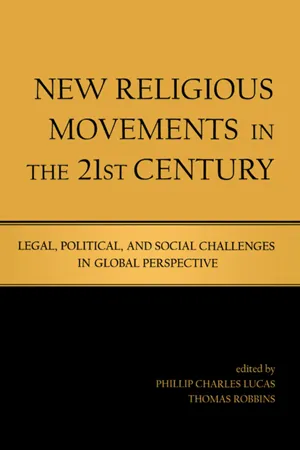
New Religious Movements in the 21st Century is the first volume to examine the urgent and important issues facing new religions in their political, legal and religious contexts in global perspective. With essays from prominent NRM scholars and usefully organized into four regional areas covering Western Europe, Asia, Africa, and Australia, Russia and Eastern Europe, and North and South America, as well as a concluding section on the major themes of globalization and terrorist violence, this book provides invaluable insight into the challenges facing religion in the twenty-first century. An introduction by Tom Robbins provides an overview of the major issues and themes discussed in the book.
eBook - ePub
New Religious Movements in the Twenty-First Century
Legal, Political, and Social Challenges in Global Perspective
- 376 pages
- English
- ePUB (mobile friendly)
- Available on iOS & Android
eBook - ePub
New Religious Movements in the Twenty-First Century
Legal, Political, and Social Challenges in Global Perspective
About this book
Trusted by 375,005 students
Access to over 1.5 million titles for a fair monthly price.
Study more efficiently using our study tools.
Information
Topic
Theology & ReligionSubtopic
ReligionPART 1
Western Europe
CHAPTER 1
General Overview of the
“Cult Scene” in Great Britain
Since 1559, the Church of England has been “by law established.” There is also an established (Presbyterian) Church in Scotland; the Church of Ireland was disestablished in 1869; and the Church in Wales was disestablished in 1920. The sovereign of Britain is called “Defender of the Faith” and must promise on his or her accession to uphold the Church of England. Although Catholics and non-conformist Protestants have existed within a general tradition of dissent throughout the centuries, it was not until the second half of the nineteenth century that full civil and political rights were extended to all religions—in 1871 Parliament passed the Universities Test Act that opened Oxford and Cambridge to members of all religions, and in 1890 all government posts became open to members of the Jewish faith. Around the turn of the century, a number of alternative religions (widely defined), such as Theosophy, Spiritualism, Deism, Auguste Comte’s Positivist Church of Humanity, and the Salvation Army, began to make their presence known. During the first half of the twentieth century, other new religions, most notably those of Eastern origin such as SUBUD, Vedanta, and the followers of Krishnamurti, gained popularity among a small but significant group of middle-class intellectuals.
In the late 1960s, protests against the Vietnam War and bourgeois imperialism in general broke out among the student population. This merged into the hippie period with “flower power” and the embracing of all manner of new kinds of religiosity and spirituality. Internationally operating movements came to Britain from the East and the West. The Church of Scientology had been one of the earliest of the current wave of new movements to appear on the scene, but it was soon followed by Krishna devotees chanting and dancing in the streets and the increased visibility of other new religions such as the Unification Church, the Rajneesh movement, the Children of God (later The Family), and the Divine Light Mission (later Elan Vital). Erhard Seminars Training (est) and other examples of the human potential movement joined indigenous new religions, such as the Emin, Exegesis, the Aetherius Society, the School of Economic Science, and the Findhorn community in the north of Scotland, and a number of small congregations within mainstream churches were labelled “cults” as they exhibited some of the more enthusiastic characteristics of new religions and their leaders. The Nine o’clock Service, a Church of England congregation in Sheffield, was one of the more extreme examples.1
Another source of new (to Britain) religions was immigration, with several hundreds of black and Asian religions (such as Cherubim and Seraphim from Nigeria, and the followers of Swaminarayan from India) springing up around those areas (mainly large city conurbations) where the immigrant populations settled. On the whole, little attention is given to the black Afro-Caribbean churches, which have increased in number, largely due to immigration. However, widespread consternation accompanied the discovery of the torso of a young boy of African origin who was found in the Thames in September 2001. The investigation into what is widely assumed to have been a ritual killing still continues, with the enquiry extending to African villages where police are trying to discover the boy’s origins through DNA sampling.
Despite the fact that the vast majority of the two million or so Muslims in Britain are well integrated into the country and perfectly law-abiding citizens, the apparently growing (but unknown) number of young, well educated Christians converting to Islam has been giving rise to apprehension in some quarters. An incipient Islamophobia was fanned by the fatwa placed by Ayatollah Khomeini on Salman Rushdie after the publication of his book, The Satanic Verses, and by the bombing of the World Trade Center and the Pentagon in the United States on September 11, 2001. This has been exacerbated by the existence of a few militant new movements, such as Hizb ut-Tahrir, Al Muhajiroun, and the Nation of Islam. Two additional incidents, both involving converts to Islam, raised the level of public fear. First, there was the so-called shoe-bomber, Richard Reid, who has been jailed for life in the United States for attempting to blow up a trans-Atlantic flight with 197 people on board. Second, an imam at a south London mosque, Sheikh Abdullah el-Faisal, who was reportedly a former supporter of Osama bin Laden, has been jailed for soliciting murder and inciting hatred against non-Muslims.
Like some other countries, Britain had its “Satanic scare,” but it did not last very long, largely due to a thorough investigation being carried out with a grant from the government which revealed that almost all the incidents in which so-called ritual abuse had been conducted on children were, in fact, either “ordinary abuse” or complete fabrications.2 In 1975, the first of the contemporary anticult organizations appeared on the scene.3 Known as FAIR, the initials originally stood for Family Action Information and Rescue, but this was changed in 1994 to Family Action Information and Resource when it was decided that the erstwhile practice of forcible deprogramming carried out by some of its members was no longer acceptable. FAIR, which was founded by Paul Rose, MP, consisted mainly, but by no means only, of distressed parents who were later joined by some disillusioned ex-members. Two Christian countercult movements also appeared (the Deo Gloria Trust and the Reachout Trust). Later, other anticult groups, such as the Cult Information Centre (run by a man who had spent a few days with a group in Canada that had successfully cured him of smoking), Catalyst, and some groups specifically designed to warn the public of the dangers of particular movements, also joined the scene.4
Although there have been some excellent reports by journalists who have written books about British alternative religions (such as William Shaw’s Spying in Guru Land5 and Jon Ronson’s Them: Adventures with Extremists6), as elsewhere around the world, the British media have tended to relate the more sensational stories about “the cults.” Some of these have resulted in court cases, such as the libel case that the Unification Church lost against the Daily Mail when the tabloid accused it of brainwashing and breaking up families.7 The jury, as a result of its deliberations, not only declared the Daily Mail to be vindicated in its accusations, but also requested that the Attorney General remove the church’s charitable status. However, after a lengthy investigation, it was decided that there were no legal grounds for doing this. Another case was a successful libel suit against the Daily Telegraph for quoting an anticultist’s remarks that a barrister and his wife constituted a cult. In the longest trial ever to take place in the Family Court, a grandmother lost her plea to have custody of her daughter’s child while her daughter was a member of The Family. This was, however, only after the daughter and The Family had been required by Lord Justice Ward to renounce some of the teachings of their leader, David Berg.8
So far as the law is concerned, both Conservative and Labour governments have made it clear that, although they do not like many of the new religions, they have no intention of introducing any special laws to deal with them. So long as the NRMs act within the common and criminal law, they are as free as anyone else to believe and do what they wish.9 This does not mean that there has been no discrimination against the movements, however. In 1968, restrictions were imposed on foreigners entering the U.K. to study or work for Scientology. Following the Foster Report, these restrictions were lifted in 1980. In 1986, Louis Farrakhan was denied entry to visit his followers in the Nation of Islam, and successive Home Secretaries have upheld the ban in the courts. In 1995, Mr. Justice Sedley ruled that the then Home Secretary, Michael Howard, had used unlawful means to prevent Sun Myung Moon from entering the country “by reason of procedural unfairness,” but in May 2003 a letter was sent to Moon stating that the current Home Secretary, David Blunkett, had personally directed that he “should be excluded from the United Kingdom on grounds that your [Moon’s] presence here would not be conducive to the public good for reasons of public order.” At the time of this writing, the church is in the process of appealing this decision.
There have also been a few cases where members of new or minority religions have been discriminated against in the courts.10 In one instance, a teacher was dismissed because of her unconventional (Unification) beliefs (even though it was agreed that she had not attempted to pass these on to her pupils); in another instance, a case involving the use of Bhaktivedanta Manor was taken through the British Courts system before ISKCON devotees were finally allowed to use the manor for religious festivities.11 Moving to the universities, a few new religions (such as the International Churches of Christ and Hizb ut-Tahrir) have been banned by Students’ Unions from some campuses; but, generally speaking, religious groups are free to speak wherever they wish, so long as they do not cause a disturbance.
Towards the end of the 1980s, amid cries from anticultists and others that “something needed to be done,” the Home Office and mainstream churches decided to support the founding of an independent charity which would supply enquirers with information about NRMs that was as objective and up to date as possible. INFORM (Information Network Focus on Religious Movements), which is based at the London School of Economics and employs staff trained in the methods of the social sciences, now deals with over one thousand inquiries each year, produces literature about the movements, and provides twice-yearly seminars and talks for various organizations. It is the only “cult-watching group” that has received official support from the British churches, the government, and the police.12
Although in the 1970s discrimination on the grounds of race or sex was outlawed, Northern Ireland has been the only part of the United Kingdom in which discrimination on grounds of religion was not permitted. On October 1, 2000, however, a new Human Rights Bill, incorporating the European Convention on Human Rights into U.K. law, was made legally binding. Although there has been a considerable amount of speculation as to what difference this will make, it is still too early to judge its effects.
While the government does not discriminate among religions—apart from the special status accorded the Established Church—the Charity Commissioners do so, and whether or not they decide to grant charitable status to a group will have considerable financial consequences so far as tax exemption is concerned. Generally speaking, there are four grounds on which a group may claim charitable status: 1. the relief of the poor, handicapped and the aged; 2. the advancement of education; 3. the advancement of religion; 4. other charitable purposes which help and benefit the community.13 Charity law is not clear on exactly what these criteria entail, and recent efforts to clarify the position have not been entirely satisfactory for any of the people concerned. The Church of Scientology has not succeeded in persuading the Commissioners that it is a religion. The Pagan Federation has objected to the fact that one of its caring facilities has not been accepted—although, unlike Rastafarians, Scientology, and the Nation of Islam, it is allowed to have a chaplain visiting its members who are in prison. In fact, there is considerable ambiguity about Paganism in Britain. On the one hand, Pagans are depicted as spiritually aware and ecologically concerned citizens with high standards of morality;14 on the other hand, they are vilified as evil witches involved in black magic and Satanic rituals. The Pagan Federation’s first national youth manager was suspended from his job as a drama teacher in a state secondary school when it was discovered that he was a “witch”—although he had never used his position to promote his beliefs and was subsequently reinstated.15 There was, furthermore, a considerable furor when the then incoming Archbishop of Canterbury, Rowan Williams, “became a druid”—or, more accurately, was inducted into the Gorsedd of Bards, by donning white robes and partaking in an ancient ceremony honoring Welsh-speaking poets, musicians, and other artists.16
Although it is probable that most people, if asked, would “know” that “cults are a bad thing,” it is also true that most people in Britain do not give the matter much thought. There may be a few demonstrators outside the Albert Hall when Mataji or Maharaj Ji are giving a talk to their respective actual and potential followers, but such events will, on the whole, pass unnoticed. There are, of course, individual members of Parliament and of the traditional churches who share the view of the anticult movement that NRMs should be subject to special restrictions and control. But although they clearly do not agree with the beliefs of other religions, the Established Church, the Free Church Council, and the Roman Catholic Church have exhibited a generally tolerant attitude towards them. Successive archbishops of Canterbury have strongly supported the approach taken by the government and INFORM, rather than that of the anticultists. That is, that it is necessary to provide accurate and balanced knowledge of the movements to public and official bodies, but that the movements and their members should not be treated in law any differently from the rest of the population.
It should be recognized that over the past quarter of a century several changes have taken place within the better known new religions themselves, making them more likely to wish to be accepted as “normal” rather than insisting upon the ways in which they differ from the rest of society.17 This and other factors, such as more easily accessible knowledge of the movements’ beliefs and practices, have defused...
Table of contents
- Cover
- Half Title
- Full Title
- Copyright
- Contents
- Acknowledgments
- Introduction: Alternative Religions, the State, and the Globe
- PART 1. Western Europe
- PART 2. Eastern Europe and Eurasia
- PART 3. Africa, Asia, and Australia
- PART 4. North and South America
- PART 5. Theoretical Considerations
- Index
Frequently asked questions
Yes, you can cancel anytime from the Subscription tab in your account settings on the Perlego website. Your subscription will stay active until the end of your current billing period. Learn how to cancel your subscription
No, books cannot be downloaded as external files, such as PDFs, for use outside of Perlego. However, you can download books within the Perlego app for offline reading on mobile or tablet. Learn how to download books offline
Perlego offers two plans: Essential and Complete
- Essential is ideal for learners and professionals who enjoy exploring a wide range of subjects. Access the Essential Library with 800,000+ trusted titles and best-sellers across business, personal growth, and the humanities. Includes unlimited reading time and Standard Read Aloud voice.
- Complete: Perfect for advanced learners and researchers needing full, unrestricted access. Unlock 1.5M+ books across hundreds of subjects, including academic and specialized titles. The Complete Plan also includes advanced features like Premium Read Aloud and Research Assistant.
We are an online textbook subscription service, where you can get access to an entire online library for less than the price of a single book per month. With over 1.5 million books across 990+ topics, we’ve got you covered! Learn about our mission
Look out for the read-aloud symbol on your next book to see if you can listen to it. The read-aloud tool reads text aloud for you, highlighting the text as it is being read. You can pause it, speed it up and slow it down. Learn more about Read Aloud
Yes! You can use the Perlego app on both iOS and Android devices to read anytime, anywhere — even offline. Perfect for commutes or when you’re on the go.
Please note we cannot support devices running on iOS 13 and Android 7 or earlier. Learn more about using the app
Please note we cannot support devices running on iOS 13 and Android 7 or earlier. Learn more about using the app
Yes, you can access New Religious Movements in the Twenty-First Century by Phillip Charles Lucas, Thomas Robbins, Phillip Charles Lucas,Thomas Robbins in PDF and/or ePUB format, as well as other popular books in Theology & Religion & Religion. We have over 1.5 million books available in our catalogue for you to explore.