- 368 pages
- English
- ePUB (mobile friendly)
- Available on iOS & Android
eBook - ePub
About this book
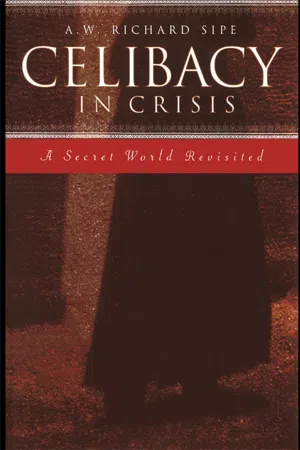
In the midst of the worst crisis the Catholic Church has seen in almost 500 years, this book challenges Catholic authorities to renew, rethink, or reform the long-standing institution of celibacy.
Trusted by 375,005 students
Access to over 1.5 million titles for a fair monthly price.
Study more efficiently using our study tools.
Information
PART I
BACKGROUND AND CONTEXT
1
WHY STUDY CELIBACY?
His great subject was the relation of corruptible action to absolute principle; of worldly means to transcendent ends; of historical commitment to personal desire.
—Irving Howe
When a man kneels before the Pope, in the process of becoming a cardinal, he takes this vow in Latin:
I, [name], cardinal of the Holy Roman Church, promise and swear to remain, from this moment and for as long as I live, faithful to Christ and to his gospel, constantly obedient to the Holy Apostolic Roman Church, to the Blessed Peter in the person of the Supreme Pontiff John Paul II and of his successors canonically elected; to preserve always in word and deed communion with the Catholic Church; never to reveal to anyone whatever has been confided in me to keep secret and the revelation of which could cause damage or dishonor to the Holy Church; to carry out with great diligence and fidelity to tasks to which I am called in my service to the Church, according to the norms of law. So help me Almighty God.(emphasis added)
(Vatican Ritual; English translation by Baltimore Sun, Dec.1994)
I was a monk for 18 years—a priest for 11 of them. When I began my initial studies for that career at age 13,1 had no idea that I was entering into a secret world.
More surprising than that—shocking to me, in fact, as I look back at the age of 70—is the fact that it took more than half a lifetime to realize the depth and breadth of that secret world, and the tremendous implications it has for millions of lives.
I, along with many others, could not distinguish between secrecy and confidentiality. Confessional “secrecy” seemed to be the noblest treasury of the church where sinful thoughts and acts could be stored for safekeeping.
Many have not yet solved the confusion between confidentiality and secrecy. Secrecy must be distinguished from confidentiality.“Confidentiality is a private personal and privileged communication that must be protected at great sacrifice (not only out of professional duty) because it is in the service of (and necessary for) personal transformation and growth. It may also be necessary to protect due process. Secrecy is a stance that reserves access to knowledge in the service of power, control, or manipulation.” Secrecy is rationalized as the only way to avoid scandal.
Sex—and more precisely, celibacy—is at the core of the secret world.
One canon lawyer points out how essential celibacy is to the power system of the church:
Celibacy holds the central role in the Roman rite regarding governance, ecclesiastical office, and authority. A person must be a celibate for the bishop to appoint or install him in a role of essential governance, an ecclesiastical office, or a position exercising principle authority. Negatively, once a man is released from the obligation of celibacy (laicized), canonically he is incapacitated to hold any office, function, or delegated authority. The bottom line is: celibacy is essential—key—for a man to hold a position of power and authority in the Western Rite of the Roman Catholic Church, validly and licitly (Patrick Wall, personal communication, 2002).
The value of this study lies in the questions that it addresses:
- What is celibacy?
- How is it really practiced by those who profess it?
- What is the process of celibacy?
- What is the structure of celibate achievement?
These questions are dangerous. Even examining them seriously threatens the stability of the secret system. They have a potential to disrupt—to cause chaos in any system dependent on secrecy for its image and power. The final two questions, however, address the inherent power in lived celibacy, and one avenue to strength and integrity.
In short, this is a search for a structural and dynamic model of an ancient practice that crosses cultural and religious boundaries. Although this study is limited to Catholic priests in the United States, the questions are meaningful to the understanding of celibate practice universally, including the Buddhist and Hindu traditions.
Any efforts to address questions about celibacy were greatly reinforced on January 6, 2002. Four Catholic journalists working for The Boston Globe—Walter Robinson, Matt Carroll, Sacha Pfeiffer, and Michael Rezendes—shattered the locks barring the doors to the secret world of the Roman Catholic priesthood that concealed the sexual abuse of minors by priests. The battering ram they used was not merely the report of individual sexual abusers, but documents that clearly demonstrated the operation of a system of support, concealment, denial, and deception that fostered abuse and intimidated victims (Betrayal, 2002).
Later Stephen Kurkjian and other writers joined the effort that resulted in seismic consequences with national and international consequences for the Catholic Church and beyond. Within six months the pope summoned all the American cardinals to Rome, and the United States bishops held a meeting devoted solely to addressing the problem of clergy sexual abuse. They set a policy of “zero tolerance” and began to reveal the names of known abusers to civil authorities. Lay people began demanding—to an unprecedented degree—accountability and transparency. Some bishops resigned when their past sexual activity was exposed.
The Vatican resisted the move toward American independence and civil justice. It countered with a set of guidelines that placed secret procedures, clerical control of investigations, and Vatican defense of the rights of clergy above any other considerations.
The initial focus of investigation and revelation had been Boston and the sexual abuse of minors. But the inevitable consequence of a peek into the secret world of Catholic clergy was uncontrollable. The tangle of questions about sex and celibacy had been raised.“What really, does celibacy mean?”
The dictionary definition of a celibate is simply an unmarried or single person. Religious celibacy implies complete sexual abstinence. Those assumptions, although incomplete, will be sufficient to sustain the reader for initial consideration. A more precise definition will amplify and challenge incomplete notions.
In spite of the fact that celibacy has not been a constant tradition even in the Roman Catholic Church, there is a common psychic presumption of a “virginal” clergy that is reinforced even in the Jewish rabbinate. More than one psychologically sophisticated rabbi has told me that they are aware of this phenomenon among members of their congregations. This is especially evident in the celebration of any sacred service or in the recitation of sacred texts. Clerical acts and words need to be separated in the minds of the faithful from the sexuality of the minister, much as children must separate their parents from any sexual “contamination.”
Questions about celibacy are not commonly asked, nor do they very often stir great interest. Some justification may help the reader understand why anyone would pursue such questions systematically for 40 years, and why the subject of celibacy should merit a reader’s time and interest.
SEX/CELIBACY: BREAKING THE TABOO
My initial research spanned the quarter-century—1960 to 1985— that marked the “sexual revolution.” We have all learned a great deal about and from sexual nature, expression, and sexual indulgence in those 25 years. However, there is also much to be learned about sexuality from sexual restraint and abstinence.C.S.Lewis noted that you learn more about an army by resisting it than by surrendering to it.
What better examples of sexual control are there than those who publicly profess a life full of meaning but devoid of sex—Roman Catholic priests? Yet information that would seem so easily accessible from every priest by the simple question—What is your celibate/sexual adjustment?—is shrouded in secrecy, denial, and mystery.
“Before the 1960s, celibates were presumed to have no sexuality. Any priest who showed signs of sexuality was considered at least strange,” said a priest participant in a dialogue on the sexual matur ing of celibates (Tetlow, 1985). Asking a priest about his celibacy is like asking a banker about his honesty—if one questions closely guarded and highly defended assumptions, insult, confusion, rage, and even chaos can result.
Carl Eifert, a lay spokesman for the National Conference of Catholic Bishops, asserted in an interview that statements by U.S.bishops on the issue of celibacy are “based on the assumption that priests are consistent in their adherence to their vows” (Niebuhr, 1989).
A priest spokesman for the same agency was typically defensive about the claim that “a substantial proportion of professed celibates do have a sexual life.” He said, “Priests are humans and have feelings; but the great, great majority of priests that I know are faithful to their vows. I know hundreds and hundreds of priests—it’s certainly not true.” (Niebuhr, 1989).
That is not a passing assumption propagated by the church. In February 2000, Sr. Mary Ann Walsh, the current spokesperson for the United States Bishops Conference asserted on ABC TV that she believed that “Ninety-nine and 44/lOOs percent of priests keep their celibacy.” When the interviewer asked her if she really believed that she reassured him and the national audience that she did.
My study looks for facts beyond all the assumptions—both positive and negative—about celibacy. There are equally unfair contrary suppositions surrounding celibacy, and not only among secular nonbelievers. One middle-aged priest, a poetic cynic, said, “Celibacy is like the unicorn—a perfect and absolutely noble animal…. I have read eloquent descriptions of it and have seen it glorified in art. I have wanted desperately to believe in its existence, but alas, I have never been able to find it on the hoof.”
Priests who know “hundreds and hundreds of priests” often do not “know” the celibate/sexual adjustment of their closest friends because they do not want to. Attitudes of denial rule. Sexual adjustment is mostly secret, but an “open” secret, since a priest knows the truth, on some level, about himself and some others. A priest’s celibate/sexual life becomes public through a scandal in which a pregnancy, a lawsuit, or an allegation comes to public attention.
Priests share the secret of their celibate achievement or compromise in the confessional. However, many priest informants revealed that they do not consistently confess what might be, at least technically, termed a transgression of the promise of celibacy, for example, masturbation.
Whereas confession can be accomplished in the dark and anonymously, spiritual direction and psychotherapy are two arenas where a priest can reveal his intimate lifestyle and deal openly, and yet in a privileged manner, with issues of sexuality. During the period of our study, priests increasingly talked more openly to friends or in small groups about their sexual struggles.
This shifting socio-sexual attitude made my study of celibacy possible. Psychiatry was the first legitimate and effective incursion into the secret celibate world in centuries. Men attempting to practice celibacy increasingly turned to the psychological sciences for help and understanding. Bishops and superiors did too. Individual revelations and collections of data penetrated the veil of secrecy. It was useful to those who wanted to understand sexuality better, and those who wished to live celibacy effectively. This shift provided the first window into the secret world of the celibate.
The sexual abuse crisis has kindled unprecedented public awareness of the sexuality of some priests and has cast a spotlight on the system of celibacy. The nature of the criminal and civil cases against priests and bishops has added a dimension of public scrutiny and measurability.
The ideal of celibacy has been gloriously extolled throughout history, just as it has been ingloriously ridiculed. However, it has never been examined in a way open to scientific research. This study helps open the door to more research.
There is no unseemliness in attempting to examine the secrets of celibate practice and achievement. In fact, Pope John Paul II, in speaking to journalists said, “The Church endeavors and will always endeavor more to be a house of glass, where all can see what happens and how it fulfills a mission” (Baltimore Sun, Jan. 28, 1984). He was speaking in a general sense, and not specifically about celibacy, but how could he exclude an element so vitally entwined with the priesthood? Personal celibacy is a public stance. Religious leaders and their own personal standards contribute significantly to the understanding of sexuality and sexual morality among their flocks. Certainly, the public witness and teaching of the clergy cannot be separated from their personal attitudes towards sexuality and the observance of their vow.
THE BROADER CONTEXT
Henry C.Lea wrote a classic 19th-century study of sacerdotal celibacy. He hoped that his study would be of interest to the general reader.”…not only on account of the influence which ecclesiastical celibacy has exerted, directly and indirectly, on the progress of civilization, but also from the occasional glimpse into the interior life of past ages afforded in reviewing the effect upon society of the policy of the church as respects the relations of the sexes” (Lea, 1884).
However, where Lea focused on the interior life of past ages, I focus on the current picture, but hold the same hope that he did. I invoke the broader context of celibacy and historical connections wherever I think they help the reader understand the aspects of celibate practice being discussed or wherever they might be of interest. Unlike Lea, I do believe that celibacy has one origin in the apostolic community, but I am well aware that it was not then nor in the first Christian millennium a universal requirement for the priesthood.
Celibacy should be viewed in its historical context to understand its relationship to ministry, and to delineate clearly what is a charism (spiritual grace) versus the discipline (church law). What is essential, what optional? Furthermore the current situation can be judged more accurately—even in the midst of its chaos—and guided to a sound resolution. Because sexual abuse of minors by priests is not the only element fomenting the celibate crisis.
In 1960, there were 53, 796 Catholic priests in the United States and about 8,000 men in the final 4 years of their preparation for ordination. In 1985, 57, 317 priests were recorded as active, with 4, 063 men studying (Hoge, 1987, p. 229). If one looks at the priest population in 1934 (30,000), one cannot help but be struck by the steady progress in numbers between 1935 and 1965 (65,000) in glaring contrast to the plateau and decrease in total numbers between 1965 and 2002 (45,000). The leveling of the total priest population is another factor that made this study possible. The concomitant decrease in candidates for the priesthood, from 9,000 to 3,000, is at least in part due to a decline in the understanding and appeal of celibacy (Hoge, 1987, 2002).
THE STUDY: WHAT IT IS AND WHAT IT IS NOT
There is currently a hot debate in clerical circles about a married clergy versus a celibate priesthood. I do not defend either position. The facts and analysis that follow can be used to support either view. They challenge partisans of both camps to a deeper understanding and clarification of their arguments (cf. Luhmann, 2002; Jaki, 1997; McGovern, 1998).
My work is based upon interviews with and reports from people who have firsthand knowledge of the celibate/sexual adjustment of priests. First of all, I consider priests who were in some form of psychotherapy either during inpat...
Table of contents
- COVER PAGE
- TITLE PAGE
- COPYRIGHT PAGE
- FOREWORD
- ACKNOWLEDGMENTS
- PART I: BACKGROUND AND CONTEXT
- PART II: PRACTICE VERSUS PROFESSION
- PART III: THE HEART OF THE CRISIS
- PART IV: PROCESS AND ATTAINMENT
- EPILOGUE DlMENSIONS OF THE CRISIS
Frequently asked questions
Yes, you can cancel anytime from the Subscription tab in your account settings on the Perlego website. Your subscription will stay active until the end of your current billing period. Learn how to cancel your subscription
No, books cannot be downloaded as external files, such as PDFs, for use outside of Perlego. However, you can download books within the Perlego app for offline reading on mobile or tablet. Learn how to download books offline
Perlego offers two plans: Essential and Complete
- Essential is ideal for learners and professionals who enjoy exploring a wide range of subjects. Access the Essential Library with 800,000+ trusted titles and best-sellers across business, personal growth, and the humanities. Includes unlimited reading time and Standard Read Aloud voice.
- Complete: Perfect for advanced learners and researchers needing full, unrestricted access. Unlock 1.5M+ books across hundreds of subjects, including academic and specialized titles. The Complete Plan also includes advanced features like Premium Read Aloud and Research Assistant.
We are an online textbook subscription service, where you can get access to an entire online library for less than the price of a single book per month. With over 1.5 million books across 990+ topics, we’ve got you covered! Learn about our mission
Look out for the read-aloud symbol on your next book to see if you can listen to it. The read-aloud tool reads text aloud for you, highlighting the text as it is being read. You can pause it, speed it up and slow it down. Learn more about Read Aloud
Yes! You can use the Perlego app on both iOS and Android devices to read anytime, anywhere — even offline. Perfect for commutes or when you’re on the go.
Please note we cannot support devices running on iOS 13 and Android 7 or earlier. Learn more about using the app
Please note we cannot support devices running on iOS 13 and Android 7 or earlier. Learn more about using the app
Yes, you can access Celibacy in Crisis by A.W. Richard Sipe in PDF and/or ePUB format, as well as other popular books in Psychology & Mental Health in Psychology. We have over 1.5 million books available in our catalogue for you to explore.