- 114 pages
- English
- ePUB (mobile friendly)
- Available on iOS & Android
eBook - ePub
About this book
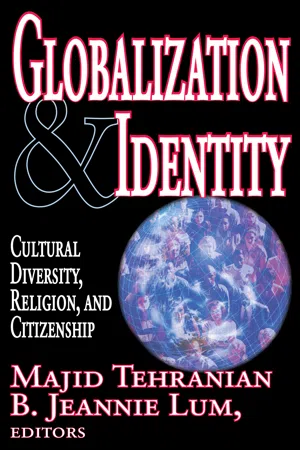
In the first decade of the twenty-first century, globalization and identity have emerged as the most critical challenges to world peace. This volume of Peace & Policy addresses the overarching question, "What are the effects of globalization in the areas of culture, ethnic diversity, religion, and citizenship, and how does terrorism help groups attain a sense of global identity?"Part I, "Citizenship in a Globalizing World," reexamines globalization in light of the traditions from which human civilizations have evolved. Linda Groff focuses on Samuel R. Huntington's thesis that the Cold War would be followed by a clash of civilizations. Joseph A. Camilleri traces the history of the concept of citizenship and its transformation through the ages to modern times. Kamran Mofid argues that the marketplace is not just an economic sphere but one where economic and business interests must embrace the spiritual assets of the community. Majid Tehranian raises the problem of identity and advocates the assumption of global identity, responsibility, and citizenship. Part II, "Convergence in Global Cultures," explores the complex issues of diversity in religions. Christopher Leeds, Vladimir Korobov, and Bharapt Gupt show how the reconceptualization of the world both geographically and regionally can recreate new sensibilities needed to overcome differences. Part III, "Divergence in Global Conflicts," discusses the multiple dimensions of the globalizing effects of economic expansion and political strife experienced by different cultures at local and regional levels. Audrey Kitigawa and Ade Ogunrinade use Nigeria as an example of political manipulation of religious and ethnic groups to divert attention from the real problems of social and economic marginalization. Fred Riggs looks at how the Web has become a medium in the globalization of religious movements.The authors maintain that continuing efforts for dialogue across cultural and religious boundaries in today's
Information
I. Civilization in the Global Age
The Dialogue or Clash of Civilizations
Linda Groff
Linda Groff is a professor of political science & future studies at California State University, Dominquez Hills, and Director, Global Option Consulting.
Dialogue versus Clash of Civilizations
Globalization, with its many meanings, has generated a great deal of controversy and debate about its impact on different groups of people. Theses like Huntington’s (1993, 1996) “clash of civilizations” predict the replacement of the Cold War conflict with conflicts between civilizations in the twenty-first century, but there are other more positive ways in which civilizations may interact in the global environment. In this chapter, the effects of globalization, as well as localization, are examined through the framework of civilizations. Increasing interactions among diverse peoples help create an increasingly interdependent world, which requires reframing of how different civilizations relate to each other (i.e., via dialogue instead of clash).In reconceptualizing this debate, attention to a whole systems worldview that honors both the unity and the diversity of the world’s peoples, cultures, and civilizations would be of great value.
Definitions of Terms
In recent years, there has been an increasing interest in civilizations, or groupings of cultures with similar underlying values and lifestyles, and their past and future evolution. Inter-ethnic conflict within countries has increased since the end of the Cold War, and terrorist conflicts have emerged, involving state, transnational, and non-state actors. Since September 11, 2001, terrorism has dominated world politics, despite the fact that terrorism has been around much longer. Huntington (1993, 1996) focuses much attention on the evolution of conflict, maintaining that the major conflicts in future global politics will be driven by culture, rather than by economy or ideology, and clashes between different civilizations will dominate. A more desirable outcome would be a dialogue of civilizations, but for such a dialogue to occur, a host of positive tools, such as those provided by the fields of intercultural communication and inter-religious dialogue, as well as conflict resolution and negotiation skills, and a commitment to various forms of peace building and nonviolence, will be necessary.
There have been various attempts to define and classify civilizations into different types (Chandler, 1992; Huntington, 1993, 1996; Toynbee and Caplan 1972), and classical macrohistory studies of civilizations have been done in the past (Galtung and Inayatullah 1997). Huntington (1993) characterizes civilization as the largest cultural grouping with which people identify short of humanity as a whole. Civilization can include whole groupings of cultures with similar underlying values and lifestyles. Examples include European, East Asian, South Asian, Arab/Islamic, Slavic, African, and Latin civilizations.
Culture is what gives meaning to life; it is learned, shared, patterned behavior as reflected in technology, tools, social organizations, values, and ideas.
Civilizations began with the rise of ancient empires, following preliterate, precivilizational societies; and will be followed by a post-civilizational world in the twenty first century, now that all civilizations are interacting with each other and realizing that their culture or civilization is only one version of “reality”; not the only one (Chandler 1992). Macrohistory examines history’s evolution by focusing on broad changes in civilization over broad periods.
Views of Civilizations
Events of September 11, 2001, and other terrorist events, underscore Huntington’s warning of a “clash of civilizations” replacing the old Cold War conflict, in this case Muslim versus Western civilizations. Huntington’s views have been controversial and have generated a true global debate on the issue. But there is a range of different views on the future of civilizations, and how globalization will affect that future.
One common anthropological view mourns the damage to, and destruction of, non-Western cultures by Western cultures. There is a fear that global cultural homogenization based on the predominance of Western values and lifestyles is threatening the survival of other civilizations and cultures worldwide (Maybury-Lewis, 1992). Sometimes related to this view is the notion that non-Western values and cultures are superior to those of the West. An opposite view sees Western culture as the wave of the future (Cahill, 1995, 1998; Van Doren 1991). Another view posits that civilizations need not rise and fall; they can survive if they have enough energy to meet new challenges as these arise (Toynbee 1972).
A view of Western civilization becoming overly materialistic (sensate) in the 1930s led to a prediction then of a future swing in the pendulum towards spiritual (ideational) values or spiritual and material (idealistic) values (Sorokin, 1985). There is a parallel concern today with the increasing materialization of non-Western civilizations, and the hope that they will not totally lose their spiritual roots as they undergo rapid development and modernization. Yet another view sees an emerging global future which honors and dynamically balances Western and non-Western values, cultures, and worldviews within a larger, global, whole systems context (Smoker and Groff, 1996). This draws upon traditional Taoist worldviews on the dynamic unity of opposites. And Fons Trompenaars (1998) sees the possibility of a true “reconciliation” in the future between formerly opposing, underlying cultural values—such as Eastern and Western, Japanese and “American” values.
P.R. Sarkar (1987, 1999) characterizes civilization by a cyclical power rotation between four groups in the following order: warriors, intellectuals, entrepreneurs, and workers, with each coming to power because of certain strengths they possess, and later losing power because of particular weaknesses that emerge in their exercise of power. Sarkar’s model is based on the Indian caste system, and it is therefore fascinating that the Internet (a Western invention) has evolved through the first three stages of Sarkar’s model, with the fourth stage predictably emerging next. Another view of traditional civilizations as representing different learned maps or versions of reality (not the territory or ultimate reality), finds these versions to be available as mindsets to be donned when appropriate, for in an interdependent world there can be no fixed worldviews containing all truth (Chandler, 1992).
Stage views of civilizations are also represented in the literature, such as those that see advances in technology driving civilizations through universal stages – agricultural, industrial, and information age stages (Toffler, 1980). Tehranian (2002) sees hunting and gathering, agricultural, commercial/trading, industrial, and informatics ages as examples.
Other “futures” of civilizations see movement towards spiritual values increasingly replacing material values, leading to the eventual creation of the “Noosphere”— a sphere around the earth that would link all the minds of humanity together (Teilhard de Chardin, 1965). These views presaged the emergence of the Internet as the infrastructure for an emerging global brain or mind of humanity. Barbara Marx Hubbard (1993) sees the future going beyond traditional cultures, civilizations, and religions to create something totally new, that is, a great evolutionary leap leading to the emergence of a “universal human” connected to universal spiritual values, going out to explore the universe. Finally, a view common in science fiction sees an evolution to space-age civilizations beyond earth, with the possibility of encounters with extraterrestrial life, and an even greater diversity of civilizations, races, and species. Who can forget Star Trek, and its claims to “go where no man/person has gone before,” and to honor the “prime directive” and its notion of non-intervention in the evolution of other species’ civilizations? Star Trek created a culture of dealing with great diversity from a positive, constructive perspective, and it undoubtedly contributed to the enduring popularity of the series (Friedman, 1999).
What is essential is that a “dialogue of civilizations”—including a dialogue of religions as an important component of civilizations—increasingly replace Huntington’s “clash of civilizations.” A number of organizations are involved in facilitating the dialogue of religions, including the Council for a Parliament of the World’s Religions and the United Religions Initiative, among many others. A number of significant books have also documented the importance of this dialogue of civilizations and religions (Beversluis, 2000; Mische and Merkling, 2001; Tehranian and Chappell, 2002; Tehranian, forthcoming). These books document what world news often does not, namely that peoples of diverse cultures, civilizations, and religions from around the world are all reaching out to each other in important ways, and are using dialogue to create better understanding and respect. These efforts represent important alternatives to Huntington’s “clash of civilizations,” and the future of the world depends on these alternatives being realized.
Further Reflections
Culture has superficial aspects (dress, greetings, food, etc.) that can change more quickly, and deeper levels, where change occurs much more slowly. The United States has been known as a “melting pot” of cultures, but now the “salad bowl” image of unity amidst great diversity is seen as a more appropriate metaphor. Likewise, the fear of Western cultural imperialism creating a homogenized global culture (one scenario for the future) may be occurring on a superficial level, but perhaps not as much at deeper levels where culture changes much more slowly. This suggests that, while aspects of a global culture are being created on one level, on deeper levels people will continue to value their own diverse cultures in their everyday lives. As people move more quickly into the future, they may also return more to their own roots to hold on to what is really important and meaningful to them from their respective cultures. In these various ways, people will both stay connected to their past as well as ensure their movement into the future.
In an interdependent world, it is vitally important that everyone realizes that cultures are all different, socially learned maps of reality, but they are not ultimate reality, nor are cultures fixed or static or immune from outside influence. Cultures and civilizations can conquer other cultures and on the surface predominate, but sometimes the values and behaviors of the conquered culture survive in various mutated ways, or even eventually co-opt the conquering culture. Possible examples might eventually include Native Americans in the dominant U.S. culture; indigenous peoples in Australia or New Zealand; and Tibetans in China. When the conquered culture or civilization has values needed by, but lacking in, the dominant culture, this can happen. Since more material cultures often conquer less material, but often more spiritual cultures, it is these very spiritual values (of holism and interdependence with all of life) that the dominant culture lacks, but needs to rebalance itself, especially when its technology becomes so advanced and potentially destructive. This is the stage at which humans are on earth today. Unfortunately, much cultural damage can be done before this rebalancing occurs, however. Without a reframing of worldviews to acknowledge diversity and interdependence among the world’s peoples, dangers of conflicts and wars among civilizations, cultures, and religions remain very real (Galtung, 1990; Huntington, 1993).
All cultures and civilizations must adapt to global interdependence today and reframe how they relate to other cultures and civilizations. Fundamentalist views— holding that one’s own civilization, culture, nation, or religion is the only valid one— become increasingly dysfunctional in an interdependent world that requires respect among cultures and an ability to work together. Black and white thinking—whether of Bin Laden’s Islamic fundamentalism and attack, or of the Bush administration’s decision to invade Iraq without an international consensus—has greatly increased the polarization of the world. It has fueled support for Huntington’s thesis of a “clash of civilizations.” Such policies are out of touch with what is needed for an interdependent world.
An alternative hypothesis for the future is that as people from different cultures increasingly interact with each other, communities and individuals can each form unique syntheses of all the different cultural influences that have impacted their lives. In short, people’s “identity” will increasingly cross boundaries between different cultures and civilizations. Much intercultural creativity can be unleashed from such interactions within societies and within individuals, who must seek ways within themselves to make sense of and reconcile these diverse cultural influences in their lives. While this process is not always easy, it is a process that all humanity is going through today in varying degrees.
The best framework is to view all cultures and civilizations as having something important to contribute to the world, based on those strengths that each has developed from their own unique histories, experiences and environmental requirements, with no culture or civilization having all the answers. In the future (as in the past), people can enrich their own lives by being open to learning from other cultures, while continuing to value what is important from their own cultural roots. One can thus look at each culture or civilization as bringing different gifts to the table of humanity today. This framework can only work, however, if people can be open to learning from, and respecting, cultural diversity.
Two hypothetical, archetypal, opposite cultural worldviews are possible, with most cultures falling somewhere in between these extremes, though often more towards one pole than the other: (1) a homogenized, whole systems worldview (especially characteristic of non-Western civilizations); and (2) a segmented worldview—where everything is separate from each other (especially characteristic of nineteenth-century Western worldviews). A homogenized, whole systems worldview sees everything as part of an interconnected, larger whole, including collective identity, humanity being a part of nature, spirit immanent in everything, and energy connecting everything, as acu-puncture sees the human body. A segmented worldview sees reality divided into separate parts, including individual identity, being separate from nature, God as separate and “on high,” and reality divided into separate parts in the Western scientific method.
The seeking of common ground between the world’s diverse cultures and civilizations illustrates the possibility of a third, alternative, complex whole systems worldview emerging today—of unity amidst great diversity. For example, people may be seeking ways to have individual and group identities, as well as global, national, and local identities; to honor both spiritual and material values; to be open to both Eastern and Western cultures, as well as indigenous cultures; and to honor both tradition and development or modernization. We are increasingly living in a both/and world, not an either/or world. This emerging worldview can perhaps be characterized by one or more of the following elements: seeing “reality” as a dynamic “dance of life” between opposites (Taoist view); as a “reconciliation” between opposites (Trompenaars and Hampton-Turner 1998b); or at least being able to u...
Table of contents
- Cover Page
- Half title
- title
- copy
- Peacenotes
- Introduction
- I 1 Civilization in the Global Age
- The Dialogue or Clash of Civilizations
- Citizenship in a Globalizing World
- Globalization for the Common Good
- Rethinking Civilization: Communication and Terror in the Global Village
- II Convergence in Global Cultures
- Process Theology and Ecology in the Age of Globalization
- Models of Global Culture
- Religious Plurality in Education
- III Divergence in Global Conflicts
- Globalization as the Fuel of Religious and Ethnic Conflicts
- Turmoil in Babel
- Globalization and Religion on the Web
- News & Views
- Call for Proposals To
- Forthcoming International Conference
- Peace Poetry
- “Requiem for the Buddhas of Bamiyan”
- Is World War III Upon Us, Or Is This Really Just a Game?
- In Memoriam
- Andre Gunder Frank 24 February 1929 to 23 April 2005
- Sir Joseph Rotblat (1908-2005)
- Booknotes
- Global Peace and Policy
Trusted by 375,005 students
Access to over 1.5 million titles for a fair monthly price.
Study more efficiently using our study tools.
Frequently asked questions
Yes, you can cancel anytime from the Subscription tab in your account settings on the Perlego website. Your subscription will stay active until the end of your current billing period. Learn how to cancel your subscription
No, books cannot be downloaded as external files, such as PDFs, for use outside of Perlego. However, you can download books within the Perlego app for offline reading on mobile or tablet. Learn how to download books offline
Perlego offers two plans: Essential and Complete
- Essential is ideal for learners and professionals who enjoy exploring a wide range of subjects. Access the Essential Library with 800,000+ trusted titles and best-sellers across business, personal growth, and the humanities. Includes unlimited reading time and Standard Read Aloud voice.
- Complete: Perfect for advanced learners and researchers needing full, unrestricted access. Unlock 1.5M+ books across hundreds of subjects, including academic and specialized titles. The Complete Plan also includes advanced features like Premium Read Aloud and Research Assistant.
We are an online textbook subscription service, where you can get access to an entire online library for less than the price of a single book per month. With over 1.5 million books across 990+ topics, we’ve got you covered! Learn about our mission
Look out for the read-aloud symbol on your next book to see if you can listen to it. The read-aloud tool reads text aloud for you, highlighting the text as it is being read. You can pause it, speed it up and slow it down. Learn more about Read Aloud
Yes! You can use the Perlego app on both iOS and Android devices to read anytime, anywhere — even offline. Perfect for commutes or when you’re on the go.
Please note we cannot support devices running on iOS 13 and Android 7 or earlier. Learn more about using the app
Please note we cannot support devices running on iOS 13 and Android 7 or earlier. Learn more about using the app
Yes, you can access Globalization and Identity by B. Lum in PDF and/or ePUB format, as well as other popular books in Politics & International Relations & Civics & Citizenship. We have over 1.5 million books available in our catalogue for you to explore.