- 448 pages
- English
- ePUB (mobile friendly)
- Available on iOS & Android
eBook - ePub
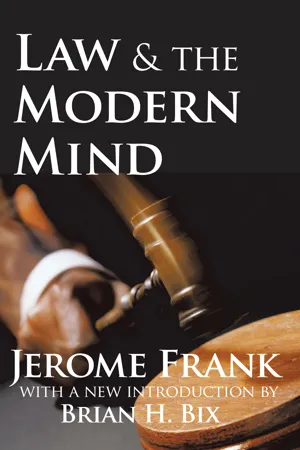
Law and the Modern Mind
About this book
Law and the Modern Mind first appeared in 1930 when, in the words of Judge Charles E. Clark, it "fell like a bomb on the legal world." In the generations since, its influence has grown-today it is accepted as a classic of general jurisprudence.The work is a bold and persuasive attack on the delusion that the law is a bastion of predictable and logical action. Jerome Frank's controversial thesis is that the decisions made by judge and jury are determined to an enormous extent by powerful, concealed, and highly idiosyncratic psychological prejudices that these decision-makers bring to the courtroom.
Trusted by 375,005 students
Access to over 1.5 million titles for a fair monthly price.
Study more efficiently using our study tools.
Part One
THE BASIC LEGAL MYTH, AND SOME OF ITS CONSEQUENCES
CHAPTER I
THE BASIC MYTH
The lay attitude towards lawyers is a compound of contradictions, a mingling of respect and derision. Although lawyers occupy leading positions in government and industry, although the public looks to them for guidance in meeting its most vital problems, yet concurrently it sneers at them as tricksters and quibblers.
Respect for the bar is not difficult to explain. Justice, the protection of life, the sanctity of property, the direction of social control—these fundamentals are the business of the law and of its ministers, the lawyers. Inevitably the importance of such functions invests the legal profession with dignity.
But coupled with a deference towards their function there is cynical disdain of the lawyers themselves. “Good jurist, bad Christian,” preached Martin Luther in the sixteenth century. Frederick the Great and Herbert Hoover, Rabelais and H. G. Wells have echoed that sentiment. In varying forms it is repeated daily. The layman, despite the fact that he constantly calls upon lawyers for advice on innumerous questions, public and domestic, regards lawyers as equivocators, artists in double-dealing, masters of chicane.
The stage comedian can always earn a laugh with the pun on lawyers and liars. Still popular are Gay’s couplets,
“I know you lawyers can, with ease,
Twist words and meanings as you please;
That language, by your skill made pliant,
Will bend to favor every client.”
Not all the criticism is as gentle: “Going tew law,” said Josh Billings, “is like skinning a new milch cow for the hide and giving the meat tew the lawyers.” Butler in “Hudibras” was of like mind:
“He that with injury is grieved
And goes to law to be relieved,
Is sillier than a Scottish chouse
Who, when a thief has robbed his house,
Applies himself to cunning men
To help him to his goods again.”
Arnold Bennett denounces the “lawyers as the most vicious opponents of social progress today.” Ambassador Page wrote, “I sometimes wish that there were not a lawyer in the world.”
Diatribes against lawyers contain such words and phrases as “duplicity,” “equivocation,” “evasions,” “a vast system of deception,” “juggling,” “sleight of hand,” “craft and circumvention,” “the art of puzzling and confounding,” “darken by elucidation,” “the pettifoging, hypocritical, brigandage rampant under forms of law.” Kipling expresses the feeling of many in his fling at the “tribe who describe with a gibe the perversions of Justice.”
What is the source of these doubts of the lawyer’s honesty and sincerity?
A false tradition “invented by twelfth-century priests and monks,” replies Dean Roscoe Pound.[1], 1 “For the most part clerical jealousy of the rising profession of non-clerical lawyers was the determining element. . . . Naturally, the clergy did not relinquish the practice of law without a protest.” What those priests began, says Pound, Luther developed, and since Luther’s day the other learned professions have taken over, “Unless one perceives that a struggle of professions for leadership is involved,” one cannot understand the distrust of the legal profession. The lawyer is today, as he was in the twelfth century, in a marked position of advantage. This irks the other learned men. “Their minds are fertile soil for the time-worn tradition.”
An ingenious explanation, but patently superficial.2 Surely twentieth-century mistrust of lawyers is based on something more than a twelfth-century monkish invention embodied in a tradition kept alive principally because the physicians, the engineers, and the journalists have been jealous of the lawyers’ prestige. Modern dispraise of the Bar is not to be explained as merely an outcropping of angry rivalry; obviously it is not comfined to members of competing professions. That lawyers are scheming hair-splitters is a popular commonplace.
What lies back of this popular criticism? It appears to be founded on a belief that the lawyers complicate the law, and complicate it wantonly and unnecessarily, that, if the legal profession did not interpose its craftiness and guile, the law could be clear, exact and certain. The layman thinks that it would be possible so to revise the law books that they would become something like logarithm tables, that the lawyers could, if only they would, contrive some kind of legal slide-rule for finding exact legal answers. Public opinion agrees with Napoleon who was sure that “it would be possible to reduce laws to simple geometrical demonstrations, so that whoever could read and tie two ideas together would be capable of pronouncing on them.”[2]
But the law as we have it is uncertain, indefinite, subject to incalculable changes. This condition the public ascribes to the men of law; the average person considers either that lawyers are grossly negligent or that they are guilty of malpractice, venally obscuring simple legal truths in order to foment needless litigation, engaging in a guild conspiracy of distortion and obfuscation in the interest of larger fees.[3]
Now it must be conceded that, if the law can be made certain and invariable, the lawyers are grievously at fault. For the layman is justified in his opinion that the coefficient of legal uncertainty is unquestionably large, that to predict the decisions of the courts on many a point is impossible. Any competent lawyer, during any rainy Sunday afternoon, could prepare a list of hundreds of comparatively simple legal questions to which any other equally competent lawyer would scarcely venture to give unequivocal answers.
Yet the layman errs in his belief that this lack of precision and finality is to be ascribed to the lawyers. The truth of the matter is that the popular notion of the possibilities of legal exactness is based upon a misconception. The law always has been, is now, and will ever continue to be, largely vague and variable. And how could this well be otherwise? The law deals with human relations in their most complicated aspects. The whole confused, shifting helter-skelter of life parades before it—more confused than ever, in our kaleidoscopic age.
Even in a relatively static society, men have never been able to construct a comprehensive, eternized set of rules anticipating all possible legal disputes and settling them in advance. Even in such a social order no one can foresee all the future permutations and combinations of events; situations are bound to occur which were never contemplated when the original rules were made. How much less is such a frozen legal system possible in modern times. New instruments of production, new modes of travel and of dwelling, new credit and ownership devices, new concentrations of capital, new social customs, habits, aims and ideals—all these factors of innovation make vain the hope that definitive legal rules can be drafted that will forever after solve all legal problems. When human relationships are transforming daily, legal relationships cannot be expressed in enduring form. The constant development of unprecedented problems requires a legal system capable of fluidity and pliancy.3 Our society would be strait-jacketed were not the courts, with the able assistance of the lawyers, constantly overhauling the law and adapting it to the realities of ever-changing social, industrial and political conditions; although changes cannot be made lightly, yet law must be more or less impermanent, experimental and therefore not nicely calculable. Much of the uncertainty of law is not an unfortunate accident: it is of immense social value.4
In fields other than the law there is today a willingness to accept probabilities and to forego the hope of finding the absolutely certain.5 Even in physics and chemistry, where a high degree of quantitative exactness is possible, modem leaders of thought are recognizing that finality and ultimate precision are not to be attained.[4] The physicists, indeed, have just announced the Principle of Uncertainty or Indeterminacy. If there can be nothing like complete definiteness in the natural sciences, it is surely absurd to expect to realize even approximate certainty and predictability in law, dealing as it does with the vagaries of complicated human adjustments.
Since legal tentativeness is inevitable and often socially desirable, it should not be considered an avoidable evil. But the public learns little or nothing of this desirability of legal tentativeness from the learned gentlemen of the law. Why this concealment? Have the lawyers a sinister purpose in concealing the inherent uncertainty of law? Why, it may fairly be asked, do they keep alive the popular belief that legal rules can be made predictable? If lawyers are not responsible for legal indefiniteness, are they not guilty, at any rate, of duping the public as to the essential character of law? Are they not a profession of clever hypocrites?
There is no denying that the bar appears to employ elaborate pretenses to foster the misguided notions of the populace. Lawyers do not merely sustain the vulgar notion that law is capable of being made entirely stable and unvarying; they seem bent on creating the impression that, on the whole, it is already established and certain. When a client indignantly exclaims, “A pretty state of affairs when I can’t learn exactly what my rights are!” how does the lawyer usually respond? With assurances that the situation is exceptional, that generally speaking the law is clear enough, but that in this particular instance, for some reason or other the applicable rules cannot be definitely ascertained. Often the facts are the scape-goat: “If,” says the lawyer, “the facts of your case were established and undisputed, the law could be categorically stated.” When this explanation won’t wash, because the pertinent facts do not happen to be in doubt, the client is told that the rules affecting his problem have become but temporarily unsettled: “Congress has just passed a badly worded statute,” or “The judges who have recently tampered with the law of the subject are exceptionally stupid, or thoughtless, or weak, or radical, or what not.” Implicit in these rejoinders is the view that, for the most part, legal rights and obligations are clear and indubitable, and that such small portion of the law as is not already certain can easily be made so.
Of course, such assurances are unwarranted. Each week the courts decide hundreds of cases which purport to turn not on disputed “questions of fact” but solely on “points of law.”[5] If the law is unambiguous and predictable, what excuses can be made by the lawyers who lose these cases? They should know in advance of the decisions that the rules of law are adverse to their contentions. Why, then, are these suits brought or defended? In some few instances, doubtless, because of ignorance or cupidity or an effort to procure delay, or because a stubbornly litigious client insists. But in many cases, honest and intelligent counsel on both sides of such controversies can conscientiously advise their respective clients to engage in the contest; they can do so because, prior to the decision, the law is sufficiently in doubt to justify such advice.
It would seem, then, that the legal practitioners must be aware of the unsettled condition of the law. Yet observe the arguments of counsel in addressing the courts, or the very opinions of the courts themselves: they are worded as if correct decisions were arrived at by logical deduction from a precise and pre-existing body of legal rules. Seldom do judges disclose any contingent elements in their reasoning, any doubts or lack of whole-hearted conviction. The judicial vocabulary contains few phrases expressive of uncertainty. As Sir Henry Maine put it—
When a group of facts comes before a court for adjudication, “the whole course of the discussion between the judge and the advocate assumes that no question is, or can be, raised which will call for the application of any principles but old ones, or of any distinctions but such as have long since been allowed. It is taken absolutely for granted that there is somewhere a rule of known law which will cover the facts of the dispute now litigated, and that, if such a rule be not discovered, it is only that the necessary patience, knowledge or acumen, is not forthcoming to detect it. The uninformed listener would conclude that court and counsel unhesitatingly accept a doctrine that somewhere, in nubibus, or in gremio magistratum, there existed a complete, coherent, symmetrical body of . . . law, of an amplitude sufficient to furnish principles which would apply to any conceivable combination of circumstances.”
Why these pretenses, why this professional hypocrisy? The answer is an arresting one: There is no hypocrisy. The lawyers’ pretenses are not consciously deceptive. The lawyers, themselves, like the laymen, fail to recognize fully the essentially plastic and mutable character of law.6 Although it is the chiefest function of lawyers to make the legal rules viable and pliable, a large part of the profession believes, and therefore encourages the laity to believe, that those rules either are or can be made essentially immutable. And so you will find lawyers saying that “The judicial process in ascertaining or applying the law is essentially similar to the process by which we acquire our knowledge of geometry. . . . In the great majority of cases the solution of them [legal problems] is as certain and exact as an answer to a problem in mathematics.”[6]
Now the true art of the lawyer is the art of legal modification, an art highly useful to the layman. For the layman’s interests, although he does not realize it, would be poorly served by an immobile system of law. Especially is this so in the twentieth century. The emphasis of our era is on change. The present trend in law is, accordingly, away from static security—the preservation of old established rights—and towards dynamic security—the protection of men engaged in new enterprises.[7] Which means that the layman’s ordinary practical needs would be seriously thwarted by an inelastic legal arrangement. A body of un-deviating legal principles he would find unbearably procrustean. Yet paradoxically he and his lawyers, when they express their notions of a desirable legal system, usually state that they want the law to be everlastingly settled.
Here we arrive at a curious problem: Why do men crave an undesirable and indeed unrealizable permanence and fixity in law? Why in a modem world does the ancient dream persist of a comprehensive and unchanging body of law? Why do the generality of lawyers insist that law should and can be clearly knowable and precisely predictable although, by doing so, they justify a popular belief in an absurd standard of legal exactness? Why do lawyers, indeed, themselves recognize such an absurd standard, which makes their admirable and socially valuable achievement—keeping the law supple and flexible—seem bungling and harmful?7 Why do men of our time repeat the complaint made by Francis Bacon several hundred years since, that “our laws, as they now stand, are subject to great incertainties” and adhere to his conviction that such “incertainties” are pernicious and altogether avoidable?
Why this unceasing quest of what is unobtainable and would often be undesirable?
One keen thinker, Wurzel,[8] has directed his attention to this question. He, too, questions why there exists a longing for complete certainty in law and why a pretense that it can be attained. He finds the answer in what he terms a “social want” for a body of law which shall appear to be, what it can never be, an exhaustive list of commands, issued by the State, sufficient to settle every conceivable controversy which may arise. He maintains that the psychology of our administration of justice imperatively requires that this “social want” be satisfied by false appearances.
This is scarcely a sufficient answer.8 It provokes the further questions, What is back of this “social want”? Why must law seem to be, what it is not, a virtually complete set of commands? Why do lawyers who seem to be keen-minded, hard-headed realists, use numerous devices, however unwittingly, to deceive themselves and the public? Why this desire to be fooled? What...
Table of contents
- Cover Page
- Half title
- Title Page
- Copyright Page
- Dedication
- Contents
- Introduction to the Transaction Edition
- Preface
- Preface to Sixth Printing
- PART ONE THE BASIC LEGAL MYTH, AND SOME OF ITS CONSEQUENCES
- PART TWO THE BASIC MYTH, AND CERTAIN BRILLIANT LEGAL THINKERS
- PART THREE CONCLUSION
- APPENDIXS
- Index
Frequently asked questions
Yes, you can cancel anytime from the Subscription tab in your account settings on the Perlego website. Your subscription will stay active until the end of your current billing period. Learn how to cancel your subscription
No, books cannot be downloaded as external files, such as PDFs, for use outside of Perlego. However, you can download books within the Perlego app for offline reading on mobile or tablet. Learn how to download books offline
Perlego offers two plans: Essential and Complete
- Essential is ideal for learners and professionals who enjoy exploring a wide range of subjects. Access the Essential Library with 800,000+ trusted titles and best-sellers across business, personal growth, and the humanities. Includes unlimited reading time and Standard Read Aloud voice.
- Complete: Perfect for advanced learners and researchers needing full, unrestricted access. Unlock 1.5M+ books across hundreds of subjects, including academic and specialized titles. The Complete Plan also includes advanced features like Premium Read Aloud and Research Assistant.
We are an online textbook subscription service, where you can get access to an entire online library for less than the price of a single book per month. With over 1.5 million books across 990+ topics, we’ve got you covered! Learn about our mission
Look out for the read-aloud symbol on your next book to see if you can listen to it. The read-aloud tool reads text aloud for you, highlighting the text as it is being read. You can pause it, speed it up and slow it down. Learn more about Read Aloud
Yes! You can use the Perlego app on both iOS and Android devices to read anytime, anywhere — even offline. Perfect for commutes or when you’re on the go.
Please note we cannot support devices running on iOS 13 and Android 7 or earlier. Learn more about using the app
Please note we cannot support devices running on iOS 13 and Android 7 or earlier. Learn more about using the app
Yes, you can access Law and the Modern Mind by Jerome Frank,Brian H. Bix in PDF and/or ePUB format, as well as other popular books in Law & Jurisprudence. We have over 1.5 million books available in our catalogue for you to explore.