Key Cases has been specifically written for students studying law. It is an essential revision tool to be used alone or with the partner Key Facts book in order to ensure a thorough knowledge of core cases for any given law topic.
Understanding essential and leading cases fully is a vital part of the study of law - the format, style and explanations of Key Cases will ensure you have this understanding.
The series is written and edited by an expert team of authors whose experience means they know exactly what is required in a revision aid. They include lecturers and barristers, who have brought their expertise and knowledge to the series to make it user-friendly and accessible.
Key features include: essential and leading cases explained; user-friendly layout and style; cases broken down into key components by use of clear symbol system; pocket-sized and easily portable; highly-regarded authors and editors.
- 208 pages
- English
- ePUB (mobile friendly)
- Available on iOS & Android
eBook - ePub
Key Cases: Evidence
About this book
Trusted by 375,005 students
Access to over 1.5 million titles for a fair monthly price.
Study more efficiently using our study tools.
Chapter 1
Introductory Matters
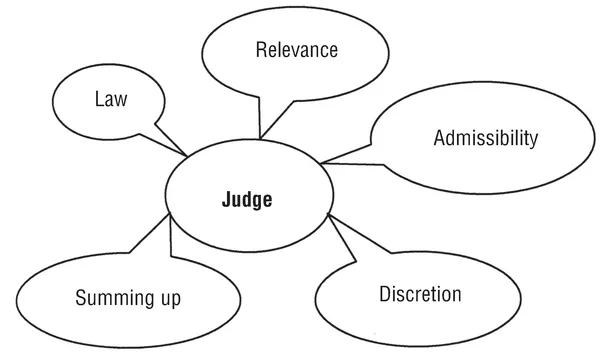
Responsibilities of Judge and Jury
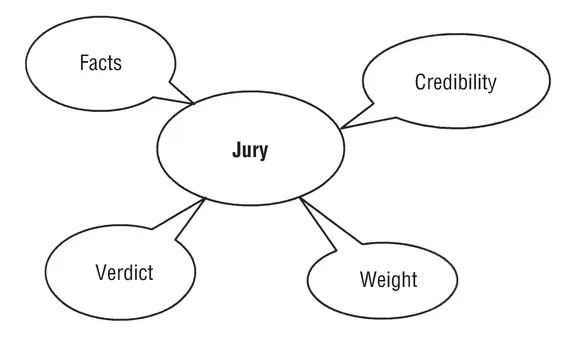
1.1 The functions of judge and jury
1.1.1 Fact and law
CA R v Mainwaring (1982) 74 Cr App R 99

Two directors of a property company allegedly misappropriated money entrusted to purchase property by using it to promote ap op singer.

CA held that it was for the judge to determine whether an obligation arose under s5(3) Theft Act 1968 to retain and deal with property in a particular way, because that is a matter of law. Having determined that such an obligation existed, it was for the jury to determine on the facts whether Ds had acted dishonestly.
1.1.2 Admissibility
CCA Rv Francis (1959) 43 Cr App R 174

The trial judge refused to rule on the admissibility of a confession until all the evidence in the case had been heard. The conviction was quashed by the Court of Appeal.

Questions of admissibility are determined in trials on indictment by the judge. Where the admissibility of a confession is challenged, the judge must conduct a voir dire in the absence of the jury to determine that issue, since admissibility is a matter of law, not fact.
1.1.3 'No case' submission
CA Rv Galbraith [1981] 1 WLR 1039

G was charged with affray. The evidence of two witnesses suggested that G had taken part, but this was denied in his statement. The trial judge rejected a ‘no case’ submission.

A judge should stop a case following a submission of no case to answer only where there is either no evidence or the evidence is so tenuous that a properly directed jury could not safely convict upon it. Where a case turns on the credibility of witnesses, the matter should be left to the jury.
1.1.4 Summing up: functions of judge
CA Rv Curtin [1996] Crim LR 831

Rose LJ:
‘It is a judge’s duty, in summing up to a jury, to give directions about the relevant law, to refer to the salient pieces of evidence, to identify and focus attention upon the issues, and in each of those respects to do so as succinctly as the case permits. It follows that as part of this duty the judge must identify the defence.’
CA Rv Jackson [1992] Crim LR 214

There were conflicts of evidence at J’s trial and the judge directed the jury that they should decide where the truth lay. In the course of summing up, the judge made his own views plain and failed to direct the jury to give priority to their own views over his. The appeal was allowed.

Had the trial judge used the model direction of the Judicial Studies Board, cited with approval by the Court of Appeal, the appeal would have been avoided:
‘It is my job to tell you what the law is and how to apply it to the issues of fact that you have to decide and to remind you of the important evidence on these issues. As to the law, you must accept what I tell you. As to the facts, you alone are the judges. It is for you to decide what evidence you accept and what evidence you reject or of which you are unsure. If I appear to have a view of the evidence or of the facts with which you do not agree, reject my view. If I mention or emphasise evidence that you regard as unimportant, disregard that evidence. If I do not mention what you regard as important, follow your own view and take that evidence into account’.
1.2 Classifications and definitions
1.2.1 Facts in issue
DC Chappell v DPP (1988) 89 Cr App R 82

D was charged under s 5 Public Order Act 1986 wi...
Table of contents
- Cover
- Title
- Copyright
- Contents
- TABLE OF CASES
- PREFACE
- Chapter 1 INTRODUCTORY MATTERS
- Chapter 2 THE BURDEN AND STANDARD OF PROOF
- Chapter 3 COMPETENCE AND COMPELLABILITY
- Chapter 4 THE PROCESS OF TRIAL
- Chapter 5 SUSPECT EVIDENCE
- Chapter 6 DRAWING ADVERSE INFERENCES AGAINST THE DEFENDANT
- Chapter 7 CHARACTER AND CONVICTIONS
- Chapter 8 HEARSAY: THE RULE, EXCEPTIONS UNDER THE CIVIL EVIDENCE ACT 1995 AND AT COMMON LAW
- Chapter 9 HEARSAY UNDER THE CRIMINAL JUSTICE ACT 2003
- Chapter 10 CONFESSIONS
- Chapter 11 EVIDENCE OBTAINED BY ILLEGAL OR UNFAIR MEANS
- Chapter 12 OPINION EVIDENCE
- Chapter 13 PRIVILEGE AND PUBLIC POLICY
- Index
Frequently asked questions
Yes, you can cancel anytime from the Subscription tab in your account settings on the Perlego website. Your subscription will stay active until the end of your current billing period. Learn how to cancel your subscription
No, books cannot be downloaded as external files, such as PDFs, for use outside of Perlego. However, you can download books within the Perlego app for offline reading on mobile or tablet. Learn how to download books offline
We are an online textbook subscription service, where you can get access to an entire online library for less than the price of a single book per month. With over 1.5 million books across 990+ topics, we’ve got you covered! Learn about our mission
Look out for the read-aloud symbol on your next book to see if you can listen to it. The read-aloud tool reads text aloud for you, highlighting the text as it is being read. You can pause it, speed it up and slow it down. Learn more about Read Aloud
Yes! You can use the Perlego app on both iOS and Android devices to read anytime, anywhere — even offline. Perfect for commutes or when you’re on the go.
Please note we cannot support devices running on iOS 13 and Android 7 or earlier. Learn more about using the app
Please note we cannot support devices running on iOS 13 and Android 7 or earlier. Learn more about using the app
Yes, you can access Key Cases: Evidence by Beverley Hopkins,Emma Washbourne in PDF and/or ePUB format, as well as other popular books in Law & Law Theory & Practice. We have over 1.5 million books available in our catalogue for you to explore.