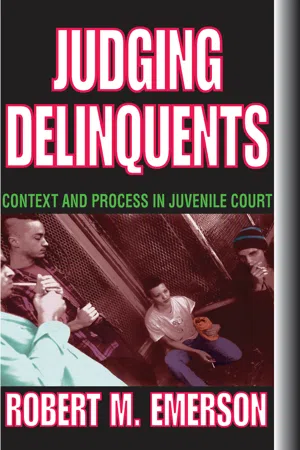
- 308 pages
- English
- ePUB (mobile friendly)
- Available on iOS & Android
eBook - ePub
About this book
Juvenile court has elicited the interest and criticism of lawyers, social workers, and criminologists, but less attention from sociologists. This book adds to growing sociological literature on the operations of legal institutions. It describes some critical aspects of the functioning of the juvenile court, an institution charged with judging and treating delinquents. To this end, it analyzes the nature of the court operation, the handling of delinquents, and the court's functions in relation to the wider social and legal system.
Trusted by 375,005 students
Access to over 1.5 million titles for a fair monthly price.
Study more efficiently using our study tools.
I
The Dilemmas of Treatment
These initial chapters describe the nature and consequences of the juvenile court's efforts to implement "treatment" as an organizational goal. Chapter 1 presents the general setting and internal organization of the court, emphasizing the balance between treatment and legal concerns with restriction and control within this organization. Chapters 2 and 3 explore the nature of court relations with the political, enforcement, and welfare institutions that make up its organizational environment, relations that tend to contradict and deflect court pursuit of treatment. These chapters serve both to introduce the institutional setting of the juvenile court and to describe the social forces that set the terms on which the court judges and responds to delinquents.
I
The Setting and Structure of the Juvenile Court
Juvenile court personnel are committed to several different and conflicting orientations toward delinquency and its control, orientations summarized in the "social-agency" and "legal" images of the juvenile court (Dunham, 1958). The legal image highlights the juvenile court's restraining, controlling, and punishing functions, functions that demand some guarantee of due process safeguards. The social-agency image orients activities toward providing "help" and "treatment" to delinquent and other disad-vantaged youths. In this light, "the purposes of the juvenile court are to understand the child, to diagnose his difficulty, to treat his condition, and to fit him back into the community" (Dunham, 1958, p. 513). This chapter outlines the juvenile court's commitment to these dual orientations as background for the analysis of court efforts to implement its treatment goals. and the consequences of these efforts in the following chapters.
The Contemporary Setting
The juvenile court under study is located in the central district of a metropolitan complex of over two million people in the northern United States. The central city itself has a population of almost 700,000, of which about 215,000 fall within the jurisdiction of the juvenile court.1
The juvenile court's jurisdiction covers the business and financial districts, several large state and federal government complexes, and all of the central shopping area. There are also several hospital and medical complexes, a number of colleges and associated student apartments and dormitories, and two wealthy residential areas. It also encompasses those sections of the city that provide its nightlife—bars, theaters, nightclubs, and shows, its most disreputable slum area, and its "vice" center, where derelicts, addicts, prostitutes, and the transient poor wander among rooming houses and bars. Finally, the court's jurisdiction includes a number of clear-cut ethnic settlements: a large and established Italian district, a small Chinese community, and a large part of the Negro ghetto interspersed with small pockets of Jewish, Irish, and Italian families.
Census material on the jurisdictional area indicates the relative importance of slum and ghetto. Of the total population of 215,000, 73 per cent are white and 27 per cent are nonwhite, mostly Negro. It should also be noted that about 84 per cent of the total nonwhite population of the city (and over 90 per cent of this is Negro) falls within the court's jurisdiction. Finally, the population within the court's jurisdiction consistently falls below the citywide average in both education and family income, again indicating the predominantly lower class character of the area.
Fifty-nine thousand or 28 per cent of the population within the court's jurisdiction is under 18. This provides a large part of the clientele of the court, which has jurisdiction over offenders up to the age of 17. But since the court hears all cases arising from offenses committed within its area, without regard to the offender's place of residence, it also handles a considerable number of children both from other parts of the city and from the suburbs. These cases usually involve shoplifting in the major downtown department stores, but they may also arise from incidents in the "red-light district" of the bars, movie theaters, and penny arcades, and in a newer "beatnik" area of coffee houses and discothèques.
Several comments must be made about the general character of the political and institutional life of the city. First, there is an extreme consciousness of ethnicity, despite the fact that all significant foreign immigration ceased more than fifty years ago. This is largely a legacy of the city's patterns of immigration, whereby the established native American groups retained control of the important public institutions long after they had been outnumbered by foreign immigrant populations. This has resulted in a history of ethnic hostility, resentment, and conflict, often coinciding with the religious split between the Catholic Irish and Italian immigrants and the Protestantism of the native American population.
Politics is one of the prime arenas of expression of this ethnic consciousness. The newer immigrants tend to be represented in the Democratic party, which is predominantly lower class and Catholic, and dominated within the city by the Irish. The Republican party, in contrast, is heavily middle class and Protestant, with its main support in suburban and rural regions outside the area of the central city. Within the city the political system is presently dominated by the Irish (with the support of other immigrant groups) and the lower and lower-middle classes.
While the Democratic machine is no longer as powerful as it once was, city politics continue to emphasize personal followings, often along ethnic lines. This places great value on jobs and favors as rewards and resources in the political game. The flavor of local politics is well illustrated by the comments of a former member of the state legislature:
The fact . . . that the whole legislature is run on a personal basis leaves a lot of room for back-scratching and for "put this man on and I'll see that this man gets in that department," or "I know so-and-so up in this department that's looking for a job and maybe we can work him into another job but at the same time, if I do that for you or for your cousin up there, why don't you do something for my friend down here?" I think there's a good deal of that.2
In general, ethnic rivalry and personalism rather than bureaucratic professionalism typify local politics and local governmental institutions.
Court Powers and Procedure
The court under study operates under statutes embodying the ideological thrust of the juvenile court movement. Its purpose is distinguished from that of the criminal court:
as far as practicable, they [children 7 to 17] shall be treated, not as criminals, but as children in need of aid, encouragement and guidance. Proceedings against children . . . shall not be deemed criminal proceedings.3
The court is exhorted to treat children brought before it with the same kind of "care, custody and discipline'' that they would receive from good parents. Ordinary criminal procedure is modified to implement this purpose. Finally, the court protects the youthful delinquent from criminal stigmatization with private hearings and with rules insuring confidentiality of court records.
The geographic jurisdiction of the juvenile court extends over the central sections of the city. The court hears all complaints arising from violations of criminal law and local ordinances within this area when committed by children between 7 and 17. These complaints for delinquency arise not only from violations of laws that apply to adults, but also from offenses against laws applicable only to children. A child can be judged delinquent as an "incorrigible child," for example, for "refusing to obey the just and reasonable commands of his parents."
All cases begin with a complaint brought against a child.4 Most complaints are brought by the police, although they may be initiated and signed by an injured or threatened party, including the victim of a particular offense, or, in the case of a complaint for "incorrigibility," the parents. Complaints may also be brought by school officials (for school offenders) and truant officers (for truant cases only) .5
Once the complaint has been approved by the clerk, it is turned over to a probation officer who interviews parent and child very briefly in order to complete the court's standard face sheet. Information entered on the face sheet includes basic demographic material about the child and his family (age, race, religion, plus items on parental education, employment, and income) and information about the child's prior court record, school and church contacts, jobs, health, home behavior, hours, associations, and interests. Some inquiry may also be made into the circumstances of the offense, although probation officers often rely solely on police accounts.
The child is taken into the courtroom for arraignment following completion of the face sheet. Here the probation officer outlines the complaint against the child. The judge then informs parent and child of the right to counsel and to the appointment of a public defender if necessary. If a lawyer is desired, the case is continued for hearing at a later date, generally at the convenience of the police officer. If no lawyer is desired and there is no other request for a continuance, the full hearing on the complaint follows.
State law provides the juvenile court with wide discretion to establish procedures for hearing and adjudicating delinquency complaints. Formally, the hearing is not to inquire into or determine the child's guilt or innocence but to establish his status as either delinquent or not delinquent. In practice, the juvenile court extends this protection by prohibiting pleas of delinquent by any child unless represented by counsel. A lawyer, however, may "admit to a finding," i.e., agree to accept a finding of "delinquent" on the facts alleged in the complaint. In this case the judge makes the equivalent of a "guilty" finding and turns to the question of disposition.
Although the juvenile court partially relaxes the usual rules of evidence, hearings afford many procedural safeguards. The complainant, generally a police officer, acts as a prosecutor, presenting his case with the help of available witnesses. Defense counsel may cross-examine all witnesses, and where there is no counsel, either judge or prosecutor asks the child and his parents if they have any questions regarding the testimony. After the prosecution has finished, the defense may present its case. A lawyer may call witnesses, but often the only one is the child himself. If without counsel, the child will be asked whether there is anything he would like to say about the incident. At any time, the judge may cross-examine or question witnesses; it is court policy, however, not to question children who refuse to testify about the alleged offense.
After all the evidence and statements have been heard, an adjudication of either "delinquent" or "not delinquent" is in order. But just as in adult criminal courts where convictions are nearly always obtained, very few juveniles find their contact with the juvenile court terminated at this point with a judgment of "not delinquent": during 1966 only 7 per cent of all complaints led to findings of "not delinquent". (In a small number of additional cases, "dismissed without finding" represents an equivalent verdict. See Appendix.) In a very basic sense, then, once a complaint has been brought against a youth, the court almost routinely assumes jurisdiction over him.
One factor that distorts the rate of dismissal of complaints deserves further consideration here, since in effect it involves a court practice of holding adjudication in abeyance. Certain cases may be "continued without a finding" for indefinite periods. No adjudication of delinquency is made, but this is kept as an open possibility while a probation officer informally supervises the youth for several months. If the child behaves during this period, the complaint will be dismissed and his record kept unblemished. (Thus, "continued without a finding" represents a contingent finding of "not delinquent" and is the most lenient court response for dealing with delinquent children.)
The decision to handle an accused youth as a "juvenile offender" may also lead to the dismissal of the delinquency complaint at this time. State law provides that where the child is over 14, "and the court is of the opinion that his welfare, and the interests of the public, require that he should be tried for said offense or violation," the court may dismiss the delinquency complaint and criminal proceedings may be initiated. In practice, the juvenile court invokes this "juvenile offender" option very infrequently, as judges are reluctant to use it unless all "treatment" attempts have failed, or, as one judge noted, "unless it's an extremely vicious crime." One of the primary expressions of traditional enforcement and punitive goals in the juvenile court, this option frequently is sought by the police in "serious" cases.
Once a finding of delinquency has been made, the court must decide on disposition.6 In this it relies heavily on the probation officer's report, which is derived from his initial interview and outlines briefly the delinquent's background, general behavior, family situation, and school record. Where a case appears sufficiently clear-cut, this information will be adequate, and the probation officer makes a recommendation for disposing of the case, almost always probation. If there is a lawyer in the case, he will also be permitted to make an argument on disposition, and this may agree or disagree with what the probation officer has recommended. However, when confronted by some problem or difficulty, the probation officer will request that disposition be postponed until he has had an opportunity to make a more thorough investigation of the case. This may require contacting other agencies involved in the case, visiting the home and parents, calling upon relatives, and/or making a variety of arrangements upon which a desired disposition will be contingent, such as gaining the youth's admittance into a special program or a boarding school.
Referral to the court clinic or to the Children's Mental Hospital for psychiatric diagnosis and recommendation is frequently used to evaluate difficult cases that have been "continued for disposition" in this way. Generally the judge initiates this course of action and will give great weight to the psychiatric report.
Probation and commitment constitute the two main disposition alternatives. There are two general forms of probation. First, there is straight probation where a probation officer supervises the child on a fairly regular basis. A more intensive form of probation involves attending the Boys' Training Program, a privately financed afternoon recreation-education program run by the court. Probation officers connected with this program supervise these cases. Second, the court can place a child on probation under a suspended sentence: a formal commitment to the Youth Correction Authority is suspended, with probation supervision ordered in the interim. Because appeal can be taken only when the suspended sentence is initially imposed, the delinquent can later be committed to the Youth Correction Authority at the discretion of the court. A suspended sentence is generally revoked if the delinquent commits another offense, but may follow when the probation officer brings the child to court for some lesser violation of probation.
Commitment is the most drastic disposition open to the court. The court has statutory power to commit children found delinquent to the Youth Correction Authority, which then reviews the case and assigns it to the most appropriate institution. Actually this decision is routine, because while there is only one institution for girls, boys are usually assigned to institutions strictly on the basis of age. The Youth Correction Authority has the right to refuse to commit a child, although it rarely does so. The YCA's most important power is over the delinquent's date of release, as the court sentence to the Authority is an indeterminate one. Commitment thus takes the case out of the court's hands.
The juvenile court may also commit truants or school offenders to the County Training School. This school is run on a semimili-tary basis, but puts more emphasis on academic school work than do the state reform schools.
Finally, the juvenile court may terminate contact with a child in'a number of ways. Commitment obviously has this effect, for even when released from the Youth Correction Authority, the delinquent is supervised by a parole officer from that agency and not by the court. In addition, when a child turns 17, the court loses jurisdiction over any new cases, although probation may extend beyond this age limit. Probation, either ''straight" or under a suspended sentence, is generally terminated at the end of the designated period upon a favorable report from the probation officer. The probation officer, however, may also make an unfavorable report and request an extension of the probationary period. In cases that have been continued without a finding, the complaint is simply dismissed at the end of the continuance period, again subject to a favorable probation report. Finally, under certain circumstances the court will dismiss entirely past or current findings of delinquency against a youth. This is routinely done to give a youth a "clean record" in order to qualify him for enlistment in the armed forces.7
Internal Organization of the Juvenile Court
Within the juvenile court one can identify three positions with distinctive ...
Table of contents
- Cover Page
- Title Page
- Copyright Page
- Dedication
- Contents
- Part I The Dilemmas of Treatment
- 1 The Setting and Structure of the Juvenile Court
- 2 Relations with Political and Enforcement Agencies
- 3 Relations with Treatment Resources
- Part II Case Management and Moral Character
- 4 The Framework of Court Categorization: Trouble and Moral Character
- 5 The Dynamics of Categorization: Establishing Moral Character
- 6 The Dynamics of Categorization: Defensive Strategies
- 7 Courtroom Ceremony and Interaction
- Part III The Dilemmas of Authority
- 8 Character and Probationary Control
- 9 Character and the Court Practice of Psychiatry
- 10 Conclusion
- Appendix
- Bibliography
- Index
Frequently asked questions
Yes, you can cancel anytime from the Subscription tab in your account settings on the Perlego website. Your subscription will stay active until the end of your current billing period. Learn how to cancel your subscription
No, books cannot be downloaded as external files, such as PDFs, for use outside of Perlego. However, you can download books within the Perlego app for offline reading on mobile or tablet. Learn how to download books offline
Perlego offers two plans: Essential and Complete
- Essential is ideal for learners and professionals who enjoy exploring a wide range of subjects. Access the Essential Library with 800,000+ trusted titles and best-sellers across business, personal growth, and the humanities. Includes unlimited reading time and Standard Read Aloud voice.
- Complete: Perfect for advanced learners and researchers needing full, unrestricted access. Unlock 1.5M+ books across hundreds of subjects, including academic and specialized titles. The Complete Plan also includes advanced features like Premium Read Aloud and Research Assistant.
We are an online textbook subscription service, where you can get access to an entire online library for less than the price of a single book per month. With over 1.5 million books across 990+ topics, we’ve got you covered! Learn about our mission
Look out for the read-aloud symbol on your next book to see if you can listen to it. The read-aloud tool reads text aloud for you, highlighting the text as it is being read. You can pause it, speed it up and slow it down. Learn more about Read Aloud
Yes! You can use the Perlego app on both iOS and Android devices to read anytime, anywhere — even offline. Perfect for commutes or when you’re on the go.
Please note we cannot support devices running on iOS 13 and Android 7 or earlier. Learn more about using the app
Please note we cannot support devices running on iOS 13 and Android 7 or earlier. Learn more about using the app
Yes, you can access Judging Delinquents by Robert M. Emerson in PDF and/or ePUB format, as well as other popular books in Law & Criminal Law. We have over 1.5 million books available in our catalogue for you to explore.