- 240 pages
- English
- ePUB (mobile friendly)
- Available on iOS & Android
eBook - ePub
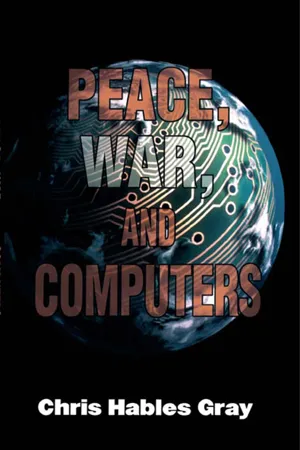
Peace, War and Computers
About this book
Computers are at the heart of war as we know it and this visionary overview of cyber war in the twenty-first century studies how electronics have changed the way we fight. Using informatics and chaos theory, this is a disarming, yet enthralling read.
Information
PART
I
the situation
1
the new normal isn't
ON TERROR
Virtue without limits becomes terror.—Jean Bethke Elshtain (quoted in Der Derian 2001, p. 202)War is cruelty, and you cannot refine it.—William Tescumseh Sherman, 1864Terrorism discourse must be disenchanted.—Joseba Zulaika and William Douglass (1997, p. 239)
War has become indistinguishable from terror. To have real peace, Terror-War must be ended. This has to be the last war. But the causes of this synthesis of terror and war are complicated, and moving beyond its grip on human politics will certainly be difficult. Our situation is shaped by two key 21st-century realities: information (and its technologies) and globalization. Our future will be determined by power: what it is, who uses it, and for what—terror or peace? We cannot have both. So this book begins with terror, as so much of our political thinking must these days. We have to understand the TerrorWar system if we are to have any chance of surviving it.
Terror is fear, great fear—all the dictionaries say so. From the Barnhart Dictionary of Etymology (1988, pp. 1127–1128) we learn that in 1375 terroure, meaning “great fear,” was the old French, and earlier the Latin terror meant “great fear, dread.” The words come from the Sanskrit trasat, “he trembles.” The Oxford English Dictionary makes it clear that many of the earlier uses were to describe the terror of damnation or of death by nature. But war was a part of nature, as “terrror breathing warre” by Drayton, circa 1598 makes clear (OED, p. 3268).
In 1795 “terrorism” came to mean “government by intimidation,” thanks to the French Revolution with its busy guillotine. Since then the word has been used more often to describe violence by those opposed to states rather than the violence states perpetuate (OED, p. 3268). The very act of labeling terrorists has become one of intimidation, aimed at provoking fear and disillusionment, while it opens the terrorists themselves to be met with sudden violence and the fear of it—counterterror.
Two anthropologists, Joseba Zulaika and William Douglass, have done the best job of explaining how deadly the term terrorism can be. They studied and lived with the Basques and so heard much about terrorism, met many so-called terrorists from all sides, and even felt terror on occasion. They were deeply troubled by the “referential invalidity” and “rhetorical circularity” of the uses of terrorism; the term seemed useless and dangerous. “It is the reality-making power of the discourse itself that most concerns—its capacity to blend the media's sensational stories, old mythical stereotypes, and a burning sense of moral wrath,” (1997, p. ix) which leads inevitably to counterterrorism—terrorism that is to counter earlier labeled terrorism—because it is “seemingly the only prudent course of action” (p. ix).
In Terror and Taboo they pointed out that terrorism was “becoming a functional reality of American politics.” It had “been ‘naturalized’ into a constant risk that is omnipresent.” Their conclusion is chilling: “Now that it has become a prime raison d'éetre, its perpetuation seems guaranteed” (1997, p. 238).
Today, terror is a political perpetual-motion machine, a form of violent discourse that isn't supposed to be won. As Grenville Byford points out,
Wars have typically been fought against proper nouns (Germany, say) for the good reason that proper nouns can surrender and promise not to do it again. Wars against common nouns (poverty, crime, drugs) have been less successful. Such opponents never give up. The war on terrorism, unfortunately, falls into the second category. (2002, p. 34)
Helpful as this is, it still begs the question, “What is terrorism?” This has been a matter of great debate for quite some time. In the United States alone there are dozens of “official” definitions from the Central Intelligence Agency (CIA), Department of Defense (DoD), Federal Bureau of Investigation (FBI), State Department, and many smaller units. One college textbook unselfconsciously entitled The Terrorism Reader and apparently aimed at undergraduates begins with nine different definitions from various institutions and individuals. The definitions are mutually contradictory and deeply unsatisfying. Almost all of them could apply to any war (Whittaker 2001, p. 3). This word terrorism is constantly, perhaps always, being misused. As Zulaika and Douglass wryly observe, we are indeed “dealing as much with who has the power to label as much as level their adversaries” (1997, p. 81, original emphasis).
Implicitly agreeing with this logic, a Los Angeles Times article headline cynically proclaims, “Political manuals more useful than dictionary in defining ‘terrorism’“ (2002). The article ends with three different definitions, by the FBI, the Israeli government, and the U.S. State Department. The FBI definition (unlawful use of force) and the Israeli definition (“killing and making attempts… on citizens”) so clearly apply to many of their own actions one almost suspects governmental irony. The State Department, on the other hand, avoids this problem by simply restricting terrorism to “subnational groups or clandestine agents.”
But we know the word originally meant something quite different, if not actually opposite: governments terrorizing their citizens. So it has been with a long history of red terrors, fascist Black Hands, vigilante committees and outright governmental repression in the form of counterterror, bombings, beatings, street fighting, assassinations, and most of all war. It has been an unequal struggle, physically and even rhetorically.
Back in 1982 Edward Herman made a distinction between “retail” and “wholesale” terror. As he rightly pointed out, most terror was (and is) perpetuated by nation-states. Herman characterized the greatest body counts as wholesale terror, as opposed to the retail terror of nonstate actors. There are two problems with this distinction. First, many of us would condemn all terror, from the beating of one child to the bombing of a city, so morally we may not see a difference between wholesale and retail terror. Second, the increasing technological complexity of our society has made it possible for a handful of nonstate terrorists to kill thousands, granting them the same degree of killing power as nation-states. The gap is closing between these different types of terrorism, thanks to information technology and the technosciences it fosters. A network such as Al Qaeda could not threaten the United States without the sophisticated technologies it appropriates for communication, targeting, and destruction. Even though it is a network, not a state, Al Qaeda can kill thousands with major international effects, thanks to the existence of global communications, commercial airliners, and skyscrapers.
Still, Herman's main point remains; the system of terror includes nation-states, and states still have the resources to do the most damage. The West is particularly hypocritical about terrorism in this regard, justifying the massive destruction caused by various U.S. bombings and Israeli raids as collateral damage, although the numerous civilian deaths are absolutely predictable, while condemning every nonstate action, although many kill far fewer innocents. Besides, governments such as the United States often use proxy terrorists.
So what is terror? The answer is at once simple and terrible: Terror is war. All war is terrorism. Startling as this first seems, in retrospect it was inevitable. War has always been about terror, often mainly about terror. Joseba Zulaika and William A. Douglass could not have been more prescient when they said:
The concept of “war” itself is no longer the same when deprived of the goal of military victory: the traditional meaning of war is being replaced by terrorism (defined as “surrogate war”) and deterrence (defined as “mutual balance of terror”). (1997, p. 82, original emphasis)
War has always evoked terror; now war has become terror. War was seldom noble, but the slaughter usually followed certain rules and was confined to combatants. Sometimes prisoners were even taken and the wounded mended. Sometimes when cities were sacked only a few women were raped and none even sold into slavery. But as weapons were developed that could kill at great and indiscriminate distances, all war became terror. The terror of the front lines was moved to the shelled cities (Atlanta, Paris) and then the bombed ones (Shanghai, Guernica, Barcelona).
In World Wars I and II all sides worked hard at developing “strategic” (“terror”) bombing. Although the Italians (in Libya before the war) and the Germans (zeppelin raids on London in WWI, rockets in WWII) were pioneers in indiscriminate aerial attacks on civilians, the Allies perfected them. In his brilliant history of U.S. strategic bombing, The Rise of American Air Power: The Creation of Armageddon, Michael Sherry argues that the political fanaticism of the Axis powers was matched by the technological fanaticism of the Allies. For the Germans, Italians, and Japanese, nationalistic or racist politics justified the exterminations (of Gypsies, Jews, Slavs, Chinese, Koreans) and war on civilians. For the Allies, the existence of the technologies of strategic bombing and nuclear weapons justified the extermination of cities. Sherry explains that it was the product
of two distinct but related phenomena: one—the will to destroy—ancient and recurrent, the other—the technical means of destruction—modern. Their convergence resulted in the evil of American bombing. But it was a sin of a peculiarly modern kind because it seemed so inadvertent, seemed to involve so little choice. Illusions about modern technology had made aerial holocaust seem unthinkable before it occurred and simply imperative once it began. It was the product of a slow accretion of large fears, thoughtless assumptions, and at best discrete decisions. (1987, p. 137)
It led to atomic bombs and then hydrogen weapons, primary symptoms (but certainly not the cause) of postmodern war. These incredible weapons and other new technologies produced the structure of the first Cold War: a balance of terror. The current crisis, this second Cold War, is caused by the collapse of that balance. The United States is hegemonic now, and the “enemies” are ideas and networks more than nations or civilizations.
But terror didn't just determine nuclear strategy in the first Cold War, it was integral to low-intensity conflict, and the details should prove instructive because the central conflicts of the second Cold War are squarely within the low-intensity definitions, as the occupation of Iraq revealed. Because nuclear weapons are too horrible to use, all postmodern wars have to be managed. This is called crisis management, but often it looks more like the harshest of coercions: torture.
Daniel Ellsberg recalls that it was his wife who, after reading the Pentagon Papers, pointed out “in horror” that the U.S. Vietnam War strategy was described by its architects in “the language of torturers.” He gives numerous examples (“‘water-drip’ technique,” “fast/full squeeze,” “the ‘hot-cold’ treatment,” “ratchet,” “one more turn of the screw”) by such luminaries as William P. Bundy, Robert S. McNamara, John T. McNaughton, and Richard Helms (1972, pp. 304–305).
The other side certainly thought the same, and they had a fine pedigree for the idea that terror was justified. Trotsky wrote an essay called “On Terror” when he was commander of the Red Army. In it, he noted approvingly (and mistakenly) that even when you terrorize and kill the innocent your enemy's will grows weaker. Communist theory and practice certainly followed Trotsky's reasoning. But approving terror isn't limited to Communists. Since 9/11 the legal use of “hard” torture has actually become a matter of serious debate in the United States, and so-called soft torture or torture “lite” (sleep deprivation, constant extreme noise, isolation) is policy.
The language of torturers is the language of nonstate terrorists as well, the language of pure coercive violence as Al Qaeda and other suicide bombers have made clear. The conflict doesn't have to be between states for it to be horrible. The long, drawn-out blockade and bombing of Iraq after the first Gulf War seem remarkably similar to many Vietnam War operations, even to the extent that they were both ineffectual and murderous to women, children and the elderly, hundreds of thousands of whom died. The blockade was followed by the invasion, which has now turned into a low-intensity conflict. This last step wasn't part of the U.S. strategy. It actually puts a bit of a crimp in the plan for “the U.S. to rule the world” (Armstrong 2002, p. 76).
A series of official reports by the former Secretary of Defense Dick Cheney (1992, 1993), the latest secretary, Donald Rumsfeld (2002), and key staff members Paul Wolfowitz and Colin Powell lay out the current grand strategy for the United States to be the “biggest bully on the block,” in Powell's phrase (Armstrong, p. 78). The strategy involves developing tactical nuclear weapons as bunker busters, new computerized systems (including autonomous kill platforms), new doctrines such as preemptive war, and dominance of space under the pretense of ballistic missile defense. U.S. planners envision having the ability to threaten and kill everywhere. It is a policy of terror using nuclear, conventional, and special forces.
Colin Gray (no relation) has put it quite clearly in the theoretical journal of the U.S. military, Parameters: “For example, special forces can be unleashed to operate as ‘terrorists in uniform.’ Unconventional warfare of all kinds, including terrorism (and guerrilla operations, is a politically neutral technique” (2002, p. 6). He goes on to complain that “The U.S. armed forces have handfuls (no more) of people amongst their substantial special operations forces who truly can think 'outside the box” and who can reason and, if need be, behave like ‘terrorists in uniform’“ (p. 11).
Is it a coincidence that Saddam's Iraq was the Republic of Terror par excellence? Fear ruled. “Since 1991, the tyrant has remained in power not because he is loved (never the case in Iraq), nor because he exerts genuine authority … but out of fear of what lies in store in the future” explains Kanan Mariya in Republic of Fear (1998, p. xxxi). This is how the United States rules in Iraq and, in all likelihood, how the U.S. successor there will be chosen. In the strange real-...
Table of contents
- Cover
- Half Title
- Title Page
- Copyright Page
- Dedication
- Table of Contents
- Acknowledgments
- Introduction
- Part I: The Situation
- Part II: Responses
- Notes
- Bibliography
- Index
Trusted by 375,005 students
Access to over 1.5 million titles for a fair monthly price.
Study more efficiently using our study tools.
Frequently asked questions
Yes, you can cancel anytime from the Subscription tab in your account settings on the Perlego website. Your subscription will stay active until the end of your current billing period. Learn how to cancel your subscription
No, books cannot be downloaded as external files, such as PDFs, for use outside of Perlego. However, you can download books within the Perlego app for offline reading on mobile or tablet. Learn how to download books offline
Perlego offers two plans: Essential and Complete
- Essential is ideal for learners and professionals who enjoy exploring a wide range of subjects. Access the Essential Library with 800,000+ trusted titles and best-sellers across business, personal growth, and the humanities. Includes unlimited reading time and Standard Read Aloud voice.
- Complete: Perfect for advanced learners and researchers needing full, unrestricted access. Unlock 1.5M+ books across hundreds of subjects, including academic and specialized titles. The Complete Plan also includes advanced features like Premium Read Aloud and Research Assistant.
We are an online textbook subscription service, where you can get access to an entire online library for less than the price of a single book per month. With over 1.5 million books across 990+ topics, we’ve got you covered! Learn about our mission
Look out for the read-aloud symbol on your next book to see if you can listen to it. The read-aloud tool reads text aloud for you, highlighting the text as it is being read. You can pause it, speed it up and slow it down. Learn more about Read Aloud
Yes! You can use the Perlego app on both iOS and Android devices to read anytime, anywhere — even offline. Perfect for commutes or when you’re on the go.
Please note we cannot support devices running on iOS 13 and Android 7 or earlier. Learn more about using the app
Please note we cannot support devices running on iOS 13 and Android 7 or earlier. Learn more about using the app
Yes, you can access Peace, War and Computers by Chris Hables Gray in PDF and/or ePUB format, as well as other popular books in Politics & International Relations & Popular Culture in Art. We have over 1.5 million books available in our catalogue for you to explore.