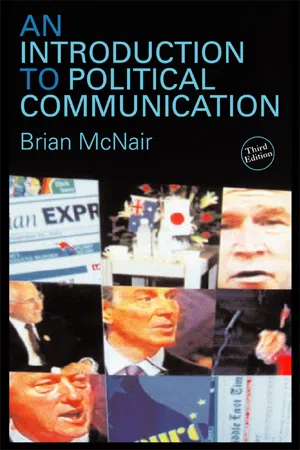
An Introduction to Political Communication explores the relationship between politics, the media and democracy in the UK, the USA and other contemporary societies. Brian McNair examines how politicians, trade unions, pressure groups, non-governmental organizations and terrorist organizations make use of the media. Separate chapters look at political media and their effects, the work of political advertising, marketing and public relations and the communication practices of organizations at all levels, from grassroots campaigning through to governments and international bodies.
Recent developments covered in the new edition include:
* the re-election of New Labour in 2001
* the changes in government information and communication policy introduced by the Blair administration since 1997
* the 2000 election of George W. Bush in the United States
* the NATO interventions in Kosovo and the former Yugoslavia
* the implications for international political communication of September 11
* the emergence of Al-Quaida and the war on terror.
- 272 pages
- English
- ePUB (mobile friendly)
- Available on iOS & Android
eBook - ePub
An Introduction to Political Communication
About this book
Trusted by 375,005 students
Access to over 1.5 million titles for a fair monthly price.
Study more efficiently using our study tools.
Information
Part I
POLITICS IN THE AGE OF MEDIATION
1
POLITICS IN THE AGE OF MEDIATION
This chapter:
- Introduces the concept of political communication
- Identifies the range of political actors involved in communication.
Any book about political communication should begin by acknowledging that the term has proved to be notoriously difficult to define with any precision, simply because both components of the phrase are themselves open to a variety of definitions, more or less broad. Denton and Woodward, for example, provide one definition of political communication as
pure discussion about the allocation of public resources (revenues), official authority (who is given the power to make legal, legislative and executive decision), and official sanctions (what the state rewards or punishes).
(1990, p. 14)
This definition includes verbal and written political rhetoric, but not symbolic communication acts which, as we shall see in this book, are of growing significance for an understanding of the political process as a whole.
The American writer Doris Graber advances a more all-encompassing definition of what she terms ‘political language’, suggesting that it comprises not only rhetoric but paralinguistic signs such as body language, and political acts such as boycotts and protests (1981).
Elsewhere in the work cited above, Denton and Woodward characterise political communication in terms of the intentions of its senders to influence the political environment. As they put it:
the crucial factor that makes communication ‘political’ is not the source of a message [or, we might add, referring back to their earlier emphasis on ‘public discussion’, its form], but its content and purpose.
(Ibid., p. 11)
This book will follow Denton and Woodward by stressing the intentionality of political communication, which I will define here simply as purposeful communication about politics. This incorporates:
- All forms of communication undertaken by politicians and other political actors for the purpose of achieving specific objectives.
- Communication addressed to these actors by non-politicians such as voters and newspaper columnists.
- Communication about these actors and their activities, as contained in news reports, editorials, and other forms of media discussion of politics.
In short, all political discourse is included in our definition. By political communication, therefore, I, like Graber, have in mind not only verbal or written statements, but also visual means of signification such as dress, make-up, hairstyle, and logo design, i.e. all those elements of communication which might be said to constitute a political ‘image’ or identity.
Absent from the book (if not from our definition) is any substantial discussion of the subject of interpersonal political communication. It need hardly be stressed that the political discussions of people in public bars or at dinner parties, the behind-closed- doors negotiations of governments, and the information gleaned by journalists from face-to-face meetings with high-level sources, are highly significant for the political process. By their nature, however, they are hidden from the analyst, requiring methodologically difficult and costly empirical research to uncover their secrets. Conducting and reporting such research is beyond the scope of this volume. Throughout, however, we should bear in mind the potential gap between the public and the private in political rhetoric.
The book also lacks, in the sections dealing with governmental communication, substantial discussion of local (i.e. city and district, regional and town) politics. As Bob Franklin and others have described, local government is a sphere of political activity in which communication is of growing importance (Franklin and Murphy, 1991; Franklin, 1994).
THE SCOPE OF THE BOOK
The study of political communication directs our attention to the relationship between three elements in the process by which political action is conceived and realised.
Political organisations
First, there are the political actors, narrowly defined: those individuals who aspire, through organisational and institutional means, to influence the decision-making process (see Figure 1.1). They may seek to do this by attaining institutional political power, in government or constituent assemblies, through which preferred policies can be implemented. If in opposition their objectives will be to obstruct existing power-holders, and have them replaced by alternatives.
Political parties
This category of political actor includes, most obviously, the established political parties: aggregates of more or less like-minded individuals, who come together within an agreed organisational and ideological structure to pursue common goals. These goals will reflect the party’s underlying value system, or ideology, such as the British Conservative Party’s adherence to ‘individual freedom’ and the supremacy of the market; or their Labour opponents’ preference for ‘capitalism with a human face’ and the principles of social justice and equality. In the US the Democrats have historically been associated with relative liberalism in social policy, and an interventionist approach to the economy, while the Republicans aspire to reduce state involvement in all aspects of socio-economic life.
Despite the ideological differences which may exist between political parties in modern democracies they share a commitment to constitutional means of advancing their objectives, attempting to convince a population as a whole of their correctness, and putting their policies to the test of periodic elections. Once mandated (or rejected, as the case may be) they agree to abide by the constitutional rules of the political system in which they operate, respecting the limitations it puts on their power to implement or oppose policy, until such time as another electoral opportunity comes along.

Figure 1.1 Elements of political communication.
For parties, clearly, the smooth functioning of the process described above is dependent primarily on their ability to communicate with those who will vote for and legitimise them. When, until relatively recently, voting rights in capitalist countries were restricted to small elites of propertied, educated men, it was enough for parties to use various forms of interpersonal communication, such as public meetings and rallies, aided by newspaper coverage, to reach their constituencies. But in an age of universal suffrage and a mass electorate parties must use mass media. Chapters 6 and 7 examine the many communication strategies and tactics which have been developed by political parties in recognition of this fact. These include techniques which originated in the world of corporate and business affairs, such as marketing – the science of ‘influencing mass behaviour in competitive situations’ (Mauser, 1983, p. 5). Political marketing is analogous to commercial marketing in so far as political organisations, like those in the commercial sector, must target audiences from whom (electoral) support is sought, using channels of mass communication, in a competitive environment where the citizen/consumer has a wide choice between more than one ‘brand’ of product. While there are obvious differences in the nature of the political and commercial marketplaces, and political parties measure success not in terms of profit but in voting share and effective power, political marketing employs many of the principles applied by the manufacturers of goods and services as they strive for commercial success.
Political advertising, the subject of Chapter 6, is also founded on principles originally worked out by the business sector to exploit the presumed persuasive potential of mass media. This form of political communication uses mass media to ‘differentiate’ political products (i.e. parties and candidates) and give them meaning for the ‘consumer’, just as the soap manufacturer seeks to distinguish a functionally similar brand of washing powder from another in a crowded marketplace.
A third commercially influenced category of political communication activity is that of public relations – media and information management tactics designed to ensure that a party receives maximum favourable publicity, and the minimum of negative.
Activities covered by the rubric of ‘public relations’ include proactive devices such as party conferences which, as we shall see, are in contemporary politics designed principally to attract positive media coverage of an organisation; news conferences, which permit parties to (attempt to) set political agendas, particularly during election campaigns; and the employment of image managers to design a party’s (and its public leaders’) ‘look’.
Activities covered by the rubric of ‘public relations’ include proactive devices such as party conferences which, as we shall see, are in contemporary politics designed principally to attract positive media coverage of an organisation; news conferences, which permit parties to (attempt to) set political agendas, particularly during election campaigns; and the employment of image managers to design a party’s (and its public leaders’) ‘look’.
Reactive political public relations techniques, in which parties strive for damage-limitation, include the lobbying of journalists and the ‘spinning’ of potentially damaging stories; the suppressing of potentially damaging information, such as was attempted by the
Conservative government of John Major on numerous occasions in the early 1990s (the Iraq arms scandal, the Pergau dam affair, etc.); and disinformation tactics such as ‘leaking’.
The design and execution of these forms of political communication is the province of that new professional class referred to in the Preface – nowadays known variously as media or political consultants, image-managers, ‘spin-doctors’, and ‘gurus’ – which has emerged in the course of the twentieth century and is now routinely employed by political parties.
Public organisations
If parties are at the constitutional heart of the democratic political process they are not, of course, the only political actors. Surrounding the established institutions of politics are a host of non-party organisations with political objectives. Some, like the British trade unions, have clear organisational links with one or more of the parties (the trade unions, indeed, gave birth to the Labour Party as the organised political expression of workers’ interests).
Others, such as consumers’ associations and lobby groups, will be more peripheral, dealing as they do with relatively narrow constituencies and issues. Others will, by virtue of the tactics which they adopt, be excluded from constitutional politics altogether, and may have the status of criminal organisations.
We may divide these non-party actors into three categories. First, trade unions, consumer groups, professional associations and others may be defined as public organisations. They are united not by ideology but by some common feature of their members’ situation which makes it advantageous to combine, such as work problems (trade unions), or the weakness of the individual citizen in the face of large corporations (consumer groups).
In such organisations individuals come together not just to help each other in the resolution of practical problems associated with their common situation, but to campaign for change or to raise the public profile of a particular problem, often through enlisting the help of elected politicians. These organisations have, to a greater or lesser degree, institutional status and public legitimacy, as reflected in their access to policy-makers and media, receipt of charitable donations, and official funding. Chapter 8 will examine the techniques used by such organisations to influence the political process, such as ‘lobbying’, advertising and the organisation of public demonstrations.
Pressure groups
Chapter 8 will also consider the political communication practices of a second category of non-party actor: the pressure group. Pressure groups (or single-issue groups, as they are also known) may be distinguished from the public organisations listed above in that they are typically less institutionalised and more overtly ‘political’ in their objectives, being concerned with such issues as the conservation of the natural environment, and the prevention of cruelty to animals being reared for human food consumption or for use in the testing of drugs and cosmetics. They tend to campaign around single issues, such as the anti-nuclear movement in the early 1980s, and the British anti-poll tax campaign of the late 1980s and early 1990s (Deacon and Golding, 1994). They are unlike the established parties, however, in drawing their support and membership from a more diverse social base. While the Labour and Conservative parties in Britain (and the Democratic and Republican parties in the US) are traditionally associated with ‘labour’ and ‘business’ respectively (given that these associations are much looser now than was once the case) an organisation such as the Campaign for Nuclear Disarmament, and its equivalent in other countries, at the height of its influence drew support and active membership from the entire spectrum of social classes in Britain. The environmental movement likewise, has found support across classes, age groups, and religious and ideological affiliations.
The environmental movement, it should be noted, is an example of a pressure group which sought to break into the mainstream of the political process by establishing ‘Green’ parties throughout Europe. As a political party the Greens have not succeeded in establishing themselves in the British Parliament, although they have many elected representatives in Germany and other European countries. Even in Britain, however, the environmental movement has had a major impact on the political agenda, winning seats in the European and Scottish parliaments and requiring both Conservative and Labour governments to develop at least the appearance of pro-environmental policies.1
Pressure group politics, like that of parties and public organisations, is about communication, using the variety of advertising and public relations techniques now available. Some groups, like Friends of the Earth, have proved themselves to be skilled exponents of these techniques. But because of their non-institutional, more or less marginal character, they are frequently deprived of the financial and status resources which accrue to more established political actors, and must therefore devise less expensive means of communicating their political messages, such as symbolic forms of protest and demonstration designed to attract the attention of journalists. Chapter 8 will explore these techniques and assess their effectiveness in some detail.
Terrorist organisations
The third category of non-party political actor to which we shall refer in Chapter 8 is the terrorist organisation. Although the term ‘terrorist’ is value-laden, and may be rejected by groups whose members may prefer to see themselves as ‘freedom fighters’ in ‘national liberation’ or ‘resistance’ movements, we shall use the term here to refer to groups which use terror tactics – urban bombing, hi-jacking, assassination, and kidnapping, to list the most common – to achieve their political objectives. In this sense, many of the world’s governments, including those of South Africa, Israel, France, and the US, have at one time or another committed acts of (state) terrorism.
More commonly associated with terrorism, however, are such organisations as the Irish Republican Army in Northern Ireland (until the 1998 peace agreement ended ‘the war’, at any rate), Hamas and Hezbollah in the Middle East, ETA in the Spanish Basque country, and the al-Quaida network which destroyed the World Trade Centre in September 2001. All share a readiness to work for their goals outside of the constitutional process, which they regard as illegitimate, and to use violence as a means of ‘persuasion’. Unlike state-sponsored terrorists, who seek to avoid identification and publicity, these organisations actively court media attention, striving to make their ‘target publics’ aware of their existence and their objectives, often by illegal or violent means.
As Chapter 8 argues, therefore, even acts of random violence directed against civilians may be viewed as a form of political communication, intended to send a message to a particular constituency, and...
Table of contents
- COVER PAGE
- TITLE PAGE
- COPYRIGHT PAGE
- ILLUSTRATIONS
- PREFACE AND ACKNOWLEDGEMENTS
- PREFACE TO THE THIRD EDITION
- PART I POLITICS IN THE AGE OF MEDIATION
- PART II COMMUNICATING POLITICS
- NOTES
- BIBLIOGRAPHY
Frequently asked questions
Yes, you can cancel anytime from the Subscription tab in your account settings on the Perlego website. Your subscription will stay active until the end of your current billing period. Learn how to cancel your subscription
No, books cannot be downloaded as external files, such as PDFs, for use outside of Perlego. However, you can download books within the Perlego app for offline reading on mobile or tablet. Learn how to download books offline
Perlego offers two plans: Essential and Complete
- Essential is ideal for learners and professionals who enjoy exploring a wide range of subjects. Access the Essential Library with 800,000+ trusted titles and best-sellers across business, personal growth, and the humanities. Includes unlimited reading time and Standard Read Aloud voice.
- Complete: Perfect for advanced learners and researchers needing full, unrestricted access. Unlock 1.5M+ books across hundreds of subjects, including academic and specialized titles. The Complete Plan also includes advanced features like Premium Read Aloud and Research Assistant.
We are an online textbook subscription service, where you can get access to an entire online library for less than the price of a single book per month. With over 1.5 million books across 990+ topics, we’ve got you covered! Learn about our mission
Look out for the read-aloud symbol on your next book to see if you can listen to it. The read-aloud tool reads text aloud for you, highlighting the text as it is being read. You can pause it, speed it up and slow it down. Learn more about Read Aloud
Yes! You can use the Perlego app on both iOS and Android devices to read anytime, anywhere — even offline. Perfect for commutes or when you’re on the go.
Please note we cannot support devices running on iOS 13 and Android 7 or earlier. Learn more about using the app
Please note we cannot support devices running on iOS 13 and Android 7 or earlier. Learn more about using the app
Yes, you can access An Introduction to Political Communication by Brian McNair in PDF and/or ePUB format, as well as other popular books in Social Sciences & International Relations. We have over 1.5 million books available in our catalogue for you to explore.