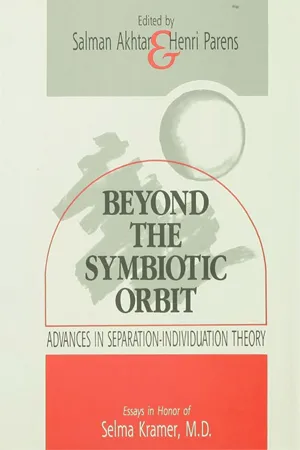
Beyond the Symbiotic Orbit
eBook - ePub

Beyond the Symbiotic Orbit

Advances in Separation-Individuation Theory: Essays in Honor of Selma Kramer, MD

  1. 472 pages
  2. English
  3. ePUB (mobile friendly)
  4. Available on iOS & Android
eBook - ePub

Beyond the Symbiotic Orbit

Advances in Separation-Individuation Theory: Essays in Honor of Selma Kramer, MD

About this book

In this tribute to Selma Kramer, eminent child analyst and colleague and close friend of the late Margaret Mahler, senior analysts explore the continuing relevance of Mahler's separation-individuation theory to developmental and clinical issues. Editors Salman Akhtar and Henri Parens have grouped the original contributions to Beyond the Symbiotic Orbit into sections that reevaluate Mahler's theory.

Section I is a timely reassessment of Mahler's working model from the standpoint of contemporary clinical and research findings. It includes comparisons of Mahler with Winnicott and Kohut, and commentaries on the status of separation-individuation theory in relation to psychosexual theory, early ego development, and observational infancy research. Section II addresses the contribution of separation-individuation theory to our understanding of pathogenesis. Neurosis, severe character pathology, psychosomatic phenomena, eating disorders, and sexual perversions are among the topics of specific chapters. The final section explores the role of separation-individuation theory in the treatment of analysands of different ages and with different kinds of psychopathology; it also considers separation-individuation theory with respect to specific aspects of the treatment process, including reconstruction, transference, and termination.

A fresh reappraisal of a major perspective on early development, Beyond the Symbiotic Orbit is a fitting testimonial to Selma Kramer, who has played so important a role in elaborating Mahler's theory. Following from Kramer's own example, the contributors show how separation-individuation theory, in its ability to accomodate ongoing clinical and research findings, is subject to continuing growth and refinement. They not only advance our understanding of Mahler's working model, but pursue the implications of this model in new directions, underscoring the many areas of exploration that separation-individuation theory opens to us.

Frequently asked questions

Yes, you can cancel anytime from the Subscription tab in your account settings on the Perlego website. Your subscription will stay active until the end of your current billing period. Learn how to cancel your subscription.
At the moment all of our mobile-responsive ePub books are available to download via the app. Most of our PDFs are also available to download and we're working on making the final remaining ones downloadable now. Learn more here.
Perlego offers two plans: Essential and Complete
  • Essential is ideal for learners and professionals who enjoy exploring a wide range of subjects. Access the Essential Library with 800,000+ trusted titles and best-sellers across business, personal growth, and the humanities. Includes unlimited reading time and Standard Read Aloud voice.
  • Complete: Perfect for advanced learners and researchers needing full, unrestricted access. Unlock 1.4M+ books across hundreds of subjects, including academic and specialized titles. The Complete Plan also includes advanced features like Premium Read Aloud and Research Assistant.
Both plans are available with monthly, semester, or annual billing cycles.
We are an online textbook subscription service, where you can get access to an entire online library for less than the price of a single book per month. With over 1 million books across 1000+ topics, we’ve got you covered! Learn more here.
Look out for the read-aloud symbol on your next book to see if you can listen to it. The read-aloud tool reads text aloud for you, highlighting the text as it is being read. You can pause it, speed it up and slow it down. Learn more here.
Yes! You can use the Perlego app on both iOS or Android devices to read anytime, anywhere — even offline. Perfect for commutes or when you’re on the go.
Please note we cannot support devices running on iOS 13 and Android 7 or earlier. Learn more about using the app.
Yes, you can access Beyond the Symbiotic Orbit by Salman Akhtar, Henri Parens, Salman Akhtar,Henri Parens in PDF and/or ePUB format, as well as other popular books in Psychology & Interpersonal Relations in Psychology. We have over one million books available in our catalogue for you to explore.

Subject Index

A

Absence, 394
Abstract symbolization, 253
Academic developmental psychology, relationship to psychoanalysis, 121122, See also Contemporary infant research
Active ego directed action, 313
Activity, infant, 138
Adaptation, Mahler’s study on, 45, 130
Adaptive child-mother interaction, 10, 15
Addictive disorders, 296
Adherence, fetishlike, 47
Adolescence, 5, 17, 189190, 205
Blos’s conceptualization of, 195200
closing phase of, 200
development of character and, 202206
developmental crisis of, 194
early literature on, 190191
eating disorders in, 287
later conceptualizations of, 191195
oedipal conflicts in, 217218
phases of, Blos’s view, 196
termination of, 198
terminology related to, 200202
Adolescence proper, 196
Adolescent, quality of, 192
Adolescent crisis, final, 202
Adolescent individuation, 202
Adult
borderline pathology, 263
neurotic illness, infantile neurosis and, 228
object relationships, 9
Adult analysis, reconstructive data from, 162163
Adult Attachment Interview, 127, 130
Adulthood, stages of, 7
Affect, 124
change in, 140
cognitive aspect of, 108, 110
combination of, 110
contemporary concept of, 112113
derived, 109
development of, 79, 110112
Emde’s view, 131
felt aspect of, 109
Freud’s concept, 108
frightening, 255
integration of, 110
maturation of, 109110
memory organization and, 111112
modulated stage, 113
organization of, disorder of, 96
as organizer of experience, 139140
primary object, 234
primitive, 109
regulation, 79
role in early psychological development, 230
subjective aspect of, 109
transformation of, 110
unconscious, 108
Affect attunement, 129
Affect expressions, 140
Affect-laden issues, discussion of, familial avoidance of, 296
Affect state
low-level, 111, 113
peak, 111, 113, 114
Affect system, during somatopsychological differentiation stage of ego development, 9394
Affective (emotional) object constancy, establishment of, Mahler’s view, 41
Affective development, 110–...

Table of contents

  1. Cover Page
  2. Half Title page
  3. Title Page
  4. Copyright Page
  5. Contents
  6. Contributors
  7. Acknowledgments
  8. Introduction
  9. The Prelude, or Growth of an Analyst's Mind
  10. Publications by Selma Kramer, M.D.
  11. Separation-Individuation Theory: Contrast, Comparison, and Update
  12. Separation-Individuation Theory and Psychosexual Theory
  13. Mahler and Winnicott Some Parallels in Their Lives and Work
  14. Mahler, Kohut, and Classical Analysts Theoretical and Clinical Considerations
  15. The Stages of Ego Development Implications for Childhood and Adult Psychopathology
  16. Some Comments on Early Development
  17. Contemporary Infant Research and the Separation-Individuation Theory of Margaret S. Mahler
  18. Psychopathology as Understood in the Light of Separation-Individuation Theory
  19. Contributions of Separation-Individuation Theory to the Understanding of Psychopathology During the Prelatency Years
  20. Transformations in Normal and Pathological Latency
  21. Separation-Individuation and Adolescence with Special Reference to Character Formation
  22. Adolescence, Sex, and Neurosogenesis A Clinical Perspective
  23. Neuroses and Separation-Individuation Theory
  24. Psychosomatic Phenomena
  25. Three Fantasies Related to Unresolved Separation-Individuation A Less Recognized Aspect of Severe Character Pathology
  26. Dyadic Psychopathology and Infantile Eating Disorder Psychoanalytic Study and Inferences
  27. Form and Function in Sexual Perversion A Contribution to the Problem of “Choice” of Perversion
  28. Treatment Implications
  29. Treatment of Psychological Disorders of Early Childhood A Tripartite Therapeutic Model
  30. Construction and Reconstruction, Semantics and Dynamics
  31. On the Treatment of Preoedipal Pathology
  32. Treatment Implications of Separation-Individuation Theory in the Analysis of Young Adults
  33. Termination and Separation-Individuation
  34. Author Index
  35. Subject Index