- 262 pages
- English
- ePUB (mobile friendly)
- Available on iOS & Android
eBook - ePub
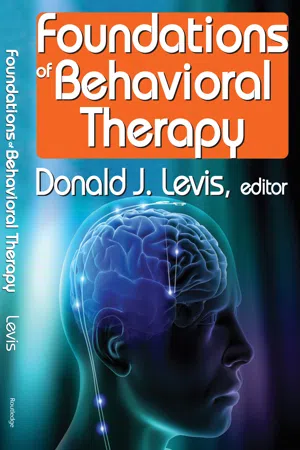
Foundations of Behavioral Therapy
About this book
The term "behavior therapy" is applied to many techniques and strategies, some theoretically based and some not, unified by a common goal: the application of learning principles to the treatment of psychopathology. Although treatment paradigms have changed, with the increased use of drug therapy, this classic volume provides important information about traditional treatments involving therapist and patient. In this volume, comprehensive reviews of the main positions in behavior therapy show how orientations differ from each other and provide a forum for the critical evaluation of each.The editor has assigned to each contributor a review of the behavioral therapy position in which he is distinguished and a commentary on one of the other positions. Levis provides an introduction to the history, principles, and theory underlying the field, asking if behavior therapy is the "fourth therapeutic revolution" (after Pinel, Freud, and Community Mental Health). Bradley Bucher and O. Ivar Lovaas are concerned with the application of operant conditioning techniques to child populations. Leonard Krasner reviews the token economy approaches, illustrating how these techniques apply to the adult hospitalized population and to society.Followed by this, Cyril Franks reviews the Pavlovian conditioning approach, while Peter Lang surveys Wolpei?1/2s systematic desensitization. Implosive therapy is viewed by Thomas Stampfl as an attempt to bridge the conditioning and psychoanalytic models; and Julian Rotter, a pioneer in the field, reviews his social learning theory approach. Judson Brown provides an analytic overview to the collection. A comprehensive look at the orientations and treatment techniques that comprise the field of behavior therapy, this book is important reading for clinical psychologists, psychiatrists, social workers, and related mental health specialists.
Information
1
Behavioral Therapy: The Fourth Therapeutic Revolution?
DONALD J. LEVIS
The increasing number of individuals requesting mental health aid, coupled with the heterogeneity of problems brought to psychotherapy, have spurred many writers to stress the need for new and varied theories and techniques of treatment. Yet, a careful review of the literature will indicate that the field of psychotherapy is not without its share of creative ideas and diversified treatment techniques. Over fifty different theories and techniques of treatment can be found. Many of these techniques reportedly are designed to cover a wide variety of psychopathological problems. Some are intended for short-term treatment, and most claim considerable therapeutic effectiveness.
Nor are these positions lacking companions to articulately present their views. The psychoanalytic, Adlerian, Rogerian, existential, and humanistic movements have made an impact upon the field. And there are other choices, such as assertion-structured psychotherapy, authoritarian therapy, bibliotherapy, cybernetic therapy, didatic group therapy, directive psychotherapy, family therapy, Gestalt therapy, multiple therapy, psychobiological therapy, psychodrama, rational therapy, reeducative therapy, round-table therapy, sector therapy, vegetotherapy, will therapy, and writing therapy, to mention just a few.
The Credibility Gap
With such a vast potpourri of theories and therapeutic strategies available in the treatment arsenal of the therapist, an urgent cry for new approaches would appear unwarranted. Nevertheless, disenchantment with the status quo exists. The concern apparently centers around the unsupported claims of therapeutic efficacy that not only accompany the introduction of each technique but are perpetuated in the literature as accepted fact.
Even a cursory review of the psychotherapy literature attests to the validity of such criticisms. Not only is controlled research almost completely lacking on many techniques, but what research is performed usually falls short of incorporating even a minimum degree of methodological sophistication. This conclusion has been tendentiously and at times cogently presented (Eysenck, 1960, 1966). Unfortunately, the obvious possibility that psychotherapy may not be an effective therapeutic tool has only scratched the defense system of a field that apparently has generated a fetish for psychotherapy.
Professional Organizations. The activities and concerns of the field’s professional organizations appear to reflect the above-suggested resistance. Legal, ethical, and other nonresearch issues continue to dominate the agenda of these organizations. Serious attempts to correct general misconceptions about the field’s effectiveness or to elicit the aid of the scientific and clinical community to engage in a massive evaluation program are noticeably lacking. The problem of communication between researcher and nonresearcher has become so serious that experimentally oriented clinical psychologists have found it necessary to form a separate group within the clinical division of their national organization (Division 12, Section III). One member of this organization, Leonard Ullmann (1968), stated in his terminal address as chairman:
More generally, I am worried by the increased pressure for professionalization in Division 12 and by applied psychologists. Application without scientific foundation is witchcraft. The politics I have seen alarm me: just as I think we must fight the medical model in the theory and treatment of people called abnormal, so I think we must fight the medical model in the formulation and treatment of people called psychologists.
Clinical Training Programs. Clinical training programs have also continued to perpetuate the division by teaching the standard techniques and skills as if they were gospel truths. Studies like those conducted by Rioch and her colleagues (1963) and by Albrondo, Dean, and Starkweather (1964) are frequently overlooked. These heretical experiments provide evidence that housewives and other neophyte psychotherapists can function as effectively as more extensively trained therapists. Still other authors, like Eysenck (1952), argue that in many cases no treatment is just as effective as being seen by a trained psychotherapist.
Not only is the concept of the professional clinician being challenged, but a growing number of writers (Ackerknecht, 1959; Rosenthal, 1963; Strupp, 1963; Tourney, 1967) are entertaining the notion that therapeutic achievements, if attainable, may be independent of any theoretical model, valid etiological knowledge, or specific treatment technique. It is possible that favorable results in therapy may be largely dependent on therapist and/or patient expectations, patient-therapists interactions, social learning, or the skill, experience, and emotional attributes of the therapists.
Without appropriate control conditions and without systematic research on these problems, few conclusions about a particular technique can be made. Yet, according to Levy’s (1962) data, the median publication output of Ph.D. clinical psychologists sampled was 1.6 with 10 per cent of the group accounting for 45 per cent of the total output. The emphasis of training programs is obviously on producing practitioners, not scientists. Those few programs which do train clinical researchers produce products which are frequently undertrained or who tend to shy away from the more methodologically difficult research areas of psychotherapy.
Those who do attempt to undertake the task of evaluating the effects of psychotherapy are confronted by scores of mental health hospital directors and “humanitarian” psychotherapists who add to the problem by actively making research difficult. The latter frequently assume the a priori premise that existing therapeutic techniques obviously work, and that any introduction of a control nontreated group or unconventional treatment procedure is not only not in the best interest of the patient, but borders on the immoral and unethical. This prevailing attitude is reminiscent of the defenders of bloodletting techniques which dominated the medical profession up to the latter part of the nineteenth century.
The Current Trend. Some conciliation can be obtained, however, from the observation that the strong emotional allegiance characteristic of the early analytic therapies is dwindling. Although “schools” of psychotherapy provide a theoretical framework from which to predict and interpret, they also frequently generate dogmatism, ignorance, selective attention, and derogation of conflicting positions.
The emphasis in recent years has been placed upon short-term treatment procedures with attempts to achieve a rapid rehabilitation of the patient to an acceptable level of functioning. Whether for economical or practical considerations, this trend is in opposition to the objectives of the long-term classical analytic therapies which have dominated most of the verbal therapy world for the first half of this century. Training programs that reflect this change are becoming more eclectic and diversified in their orientation. Students are allowed greater freedom in selecting techniques that reflect their interests. Even the continual increase in available techniques can be viewed as a desire for change.
Despite the increasing signs of change, the need for evaluating psychotherapy has still not been squarely faced. The issue is being sidetracked somewhat by what appears to be a remobilization of the field’s energies. The shift is now being made away from individual treatment to involvement in the mammoth program and corporate effort known as community psychiatry or psychology, with its emphasis upon the family, social, and cultural milieu. This latest trend has been hailed (Hobbs, 1964) as the “third psychiatric revolution” (first Pinel, second Freud), or perhaps more appropriately, the “latest therapeutic bandwagon” (Dunham, 1965). Garfield Tourney (1967, p. 794) after reviewing the area concludes:
As we know, literally millions of dollars are being expended on these programs, with great claims for potential success being raised throughout the nation. The fundamental question remains as to the adequacy of our knowledge to develop such programs in an effective way. Through our fetish for therapy and a political belief that we can legislate away the problems of man, are we only about to enter a second “cult of curability” rather than a “third psychiatric revolution”? Are we to founder in the mire of social application and propaganda before the establishment of a hard basis of fact?
It is very depressing and in many ways alarming that such an important area as the mental health field should take so few precautions. How much more cautious and careful in drawing conclusions is the infrahuman researcher whose work has little immediate bearing on human lives.
The Case for a Learning Approach
In recent years, the field of psychotherapy has witnessed a substantial increase in the popularity of yet another new orientation which has frequently been referred to as the behavior, learning, or conditioning approach. This approach, which perhaps represents the development of the “fourth therapeutic revolution,” actually encompasses a variety of different theoretical approaches and techniques, although each is based upon the learning literature.
Will this new approach or revolution only add more noise to an already uninterpretable system? Many writers, other than behavior therapists, believe not and have supported its objectives. Greenspoon (1965), for example, sees considerable advantage in the new orientation’s emphasis on behavior and its measurement, on its pinpointing of environmental variables, on its attempt to develop precise definitions and specifiable operations, and on its stress of experimental control. Although Ford and Urban (1967) conclude that some of the treatment techniques are not new, they see originality in the emphasis the learning approach places on the systematic and detailed analysis of the presenting problem, the concrete specification of the objectives to be obtained, the selection of procedures in terms of the nature of the problem, the orderly and systematic operation incorporated to implement the desired objectives, and the attempt to obtain an objective verification of the extent to which goals have been achieved.
Nevertheless, critics of the movement, such as Breger and McGaugh (1965), have suggested that this approach, like the other existing clinical orientations, is becoming encapsulated in a dogmatic school. They point to such factors as a lack of adequate validation and the existing deficiencies in establishing a direct relationship between theory and treatment technique. Although Rachman and Eysenck (1966) in their reply to Breger and McGaugh attempt to counter these criticisms (also see Breger and McGaugh’s rebuttal, 1966), these warnings should not go unheeded.
Despite the fact that considerable attention has been given to the movement’s treatment success, the importance of the learning approach for this writer is independent of the reported rate of 90 per cent effectiveness. Such claims can be found for other techniques as far back as 1890. This so-called effectiveness may well be correlated more with the commitment and enthusiasm of the followers than with the efficacy of the technique per se. Considerably more research on a variety of homogeneous patient populations with long-term follow-ups is needed before any concrete conclusions can be reached. What is exciting, however, is the potential fruitfulness of the philosophy, orientation, and strategy behind this movement, and the possible impact it will have upon the rest of the mental health field. Four of these potential assets particularly stand out and are described below.
Emphasis on a Learning Model. Few investigators would object to the statement that learning plays an important role in the development of both normal and psychopathological behavior. Even the analytically trained Franz Alexander (1965) concluded, after many years of study, that the therapeutic process is best understood in learning terms. The controversy, however, is whether it is feasible to apply existing learning or conditioning laws to complex human behavior. Since the available evidence is insufficient, any strong pro or con statements to the above proposition would be premature. As Kimble (1961, p. 436) appropriately concluded:
It may, some day, be known whether the laws of conditioning do or do not explain (say) psychopathological behavior. But that day is still far in the future. For the time being all that is possible is to attempt the explanation of complex phenomena in simpler terms. It is to be expected that the resulting explanations will be incomplete and imperfect. Complex behavior, if it is explainable at all in these terms, certainly involves the simultaneous operation of many principles of conditioning. Unfortunately, these principles are not exactly known, and we know even less about the way in which they combine and function together.
Despite some of the incompleteness of the learning model, data do exist to suggest that some principles developed under laboratory conditions are operating, at least partially, in more complex, less well-defined situations. In Farber’s words (1964, p. 37): “I believe a number of behavior theories have proved useful in providing a basis for predicting behavioral phenomena of interest even to those who consider such approaches too simplistic to account for the complexities of personality. Miller’s studies of fear and conflict, Skinner’s studies of operant conditioning, and the extension of both to the area of psychotherapy are cases in point.” It follows then, as Eysenck (1960, p. 5) reasoned:
If the laws which have be...
Table of contents
- Cover Page
- Title Page
- Copyright Page
- Contents
- Preface
- Contributors
- Chapter 1 Behavioral Therapy: The Fourth Therapeutic Revolution?
- Chapter 2 Operant Procedures in Behavior Modification with Children
- Chapter 3 Token Economy as an Illustration of Operant Conditioning Procedures with the Aged, with Youth, and with Society
- Chapter 4 Pavlovian Conditioning Approaches
- Chapter 5 Stimulus Control, Response Control, and the Desensitization of Fear
- Chapter 6 Implosive Therapy: An Emphasis on Covert Stimulation
- Chapter 7 Some Implications of a Social Learning Theory for the Practice of Psychotherapy
- Chapter 8 Responses of a Nonclinician to Stimuli Provided by Behavioral Therapists
- Name index
- Subject index
Trusted by 375,005 students
Access to over 1.5 million titles for a fair monthly price.
Study more efficiently using our study tools.
Frequently asked questions
Yes, you can cancel anytime from the Subscription tab in your account settings on the Perlego website. Your subscription will stay active until the end of your current billing period. Learn how to cancel your subscription
No, books cannot be downloaded as external files, such as PDFs, for use outside of Perlego. However, you can download books within the Perlego app for offline reading on mobile or tablet. Learn how to download books offline
Perlego offers two plans: Essential and Complete
- Essential is ideal for learners and professionals who enjoy exploring a wide range of subjects. Access the Essential Library with 800,000+ trusted titles and best-sellers across business, personal growth, and the humanities. Includes unlimited reading time and Standard Read Aloud voice.
- Complete: Perfect for advanced learners and researchers needing full, unrestricted access. Unlock 1.5M+ books across hundreds of subjects, including academic and specialized titles. The Complete Plan also includes advanced features like Premium Read Aloud and Research Assistant.
We are an online textbook subscription service, where you can get access to an entire online library for less than the price of a single book per month. With over 1.5 million books across 990+ topics, we’ve got you covered! Learn about our mission
Look out for the read-aloud symbol on your next book to see if you can listen to it. The read-aloud tool reads text aloud for you, highlighting the text as it is being read. You can pause it, speed it up and slow it down. Learn more about Read Aloud
Yes! You can use the Perlego app on both iOS and Android devices to read anytime, anywhere — even offline. Perfect for commutes or when you’re on the go.
Please note we cannot support devices running on iOS 13 and Android 7 or earlier. Learn more about using the app
Please note we cannot support devices running on iOS 13 and Android 7 or earlier. Learn more about using the app
Yes, you can access Foundations of Behavioral Therapy by Donald Levis in PDF and/or ePUB format, as well as other popular books in Psychology & History & Theory in Psychology. We have over 1.5 million books available in our catalogue for you to explore.