- 310 pages
- English
- ePUB (mobile friendly)
- Available on iOS & Android
eBook - ePub
About this book
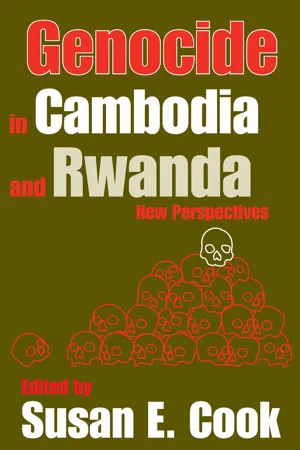
This volume deals with aspects of genocide in Rwanda and Cambodia that have been largely unexplored to date, including the impact of regional politics and the role played by social institutions in perpetrating genocide. Although the "story" of the Cambodian genocide of 1975-1979 and that of the Rwandan genocide of 1994 have been written about in detail, most have focused on how the genocides took place, what the ideas and motives were that led extremist factions to attempt to kill whole sections of their country's population, and who their victims were. This volume builds on our understanding of genocide in Cambodia and Rwanda by bringing new issues, sources, and approaches into focus. The chapters in this book are grouped so that a single theme is explored in both the Cambodian and Rwandan contexts; their ordering is designed to facilitate comparative analysis. The first three chapters emphasize the importance of political discourse in the genocidal process. Chapters 4 and 5 examine social institutions and explore their role in the genocidal process. Chapters 6 and 7 describe the military trajectories of the genocidal regimes in Cambodia and Rwanda after their overthrow, showing that genocide and genocidal intents as a political program do not cease the moment the massacres subside. The final chapters deal with private and public efforts to memorialize the genocides in the months and years following the killing. Drawing on ten years of genocide studies at Yale, this excellent anthology assembles high-quality new research from a variety of continents, disciplines, and languages. It will be an important addition to ongoing research on genocide.
Trusted by 375,005 students
Access to over 1.5 million titles for a fair monthly price.
Study more efficiently using our study tools.
Information
Thailand ’s Response to the Cambodian Genocide
Introduction
In January 1999, Cambodian Prime Minister Hen Sen proposed that the Khmer Rouge’s foreign backers be brought to justice. His proposal was an act of retaliation against the international community who condemned his warm welcome of two defected Khmer Rouge leaders, Khieu Samphan and Nuon Chea. His remark prompted the Thai leaders to distance the country from its past involvement with the murderous regime. The then Prime Minister Chuan Leekpai asserted that Thailand was not involved and had even objected and disagreed with the genocide. He reiterated that a trial was a matter for Cambodia alone. But the Cambodian problem was rarely regarded by its neighbors as an internal affair. The rise of the communist regime in Cambodia, together with those in Laos and Vietnam in 1975, was perceived as a threat for Thailand. But ironically, soon after its fall, the Khmer Rouge became Thailand’s military ally in fighting against the Vietnamese and the new Cambodian regime. Later on, a new dimension was added to the relationship between Thailand and the Khmer Rouge. Though a policy of turning Indochina from a battlefield into a market place of the Chatichai Choonhavan government was initially aimed at breaking a decade-long impasse of the Cambodian conflict, the Thais nevertheless enjoyed having the Khmer Rouge as their business partner. This chapter examines the development of Thailand’s policy towards the genocidal regime between 1975 and the mid 1990s. And as the friendly relationship with the regime was widely supported by the Thais, this chapter also sheds light on the perspectives of various Thai political groups on the crimes committed by the Khmer Rouge.
The Khmer Rouge as a Threat
Khmer Rouge rule began as Thailand was going through a transitional period. The civilian governments after the 14 October 1973 revolution had to cope with expansive communist power. The intense struggle between the left and the right subsequently led to a massacre of students and the military coup of 6 October 1976. Between 1973 and 1976, there were rapid shifts of Thailand’s foreign policy toward its neighbors from anti-communism to co-existence and then back to anti-communism again.
Since Field Marshal Sarit Thanarat took power in 1958, Thailand had served as a launching ground for the United States to conduct covert operations against the communist movements in Laos, Vietnam and Cambodia. The U.S. failure in the Vietnam War as well as Washington’s shift of focus to the Middle East, Europe, and Latin America forced Washington to abandon its full involvement in Southeast Asia. Meanwhile, the Thai military was facing serious political storms from both domestic and regional political changes. After the October 14 uprising, the new civilian governments were forced to adopt two interrelated policies: the withdrawal of U.S. forces from Thailand and the establishment of normal relations with the communist countries.1 The withdrawal of the U.S. bases in Thailand became one of the top campaign issues for the leading student organization, the National Student Center of Thailand (NSCT), after 1973.2 Soon after the royally appointed Prime Minister Sanya Dhammasakti (October 1973 -February 1975) had taken office, his government announced that the U.S. was no longer allowed to use the air bases in Thailand to support its war in Indochina. The successive governments of M.R. Seni Pramoj (February - March 1975 and April - October 1976), and his younger brother M.R. Kukrit Promoj (March 1975 - April 1976) also adopted the same policy. The Sanya administration also tried to establish relations with Vietnam. Later, Kukrit announced the establishment of diplomatic relations with China, visiting Beijing on July 1, 1975.
In fact, the governments of Seni and Kukrit, which comprised conservative and right wing politicians, were initially reluctant to force the U.S. troops from Thailand, particularly at the time of the rapid expansion of both domestic and regional communism. They believed Thailand would be the next domino to fall if the Khmer Rouge-Sihanouk group came to power in Cambodia. At the beginning of his tenure of office in February 1975, Seni primarily stressed the necessity of maintaining U.S. troops in Thailand, reasoning that it was Thailand who had invited the U.S. troops and that Thailand should, therefore, give them time for withdrawal.3 As the situation in Phnom Penh entered the terminal period, the Thai Army Commander General Kris Sivara expressed strong opposition to the calls for immediate withdrawal of the U.S. troops.4
The short-lived Seni government, which failed to obtain parliamentary approval, was succeeded by that of his brother Kukrit in mid-March 1975. Though the Kukrit administration saw a necessity to revise the country’s foreign policy toward its communist neighbors, it was apparently reluctant to implement this option, and that resulted in its contradictory policy toward the Khmer Rouge.
In March 1975, as the anti-U.S. campaign was continuing and calls for revising Thailand’s policy toward its neighbors were getting louder, the Thai public learned that the U.S. was freely using the U-Tapao airbase in southeastern Thailand to airlift arms and ammunition to the falling Lon Nol government. The U.S. also employed trucks from the Thai state enterprise, Express Transport Organization (ETO), to transport arms across the border at Aranyaprathet to the Lon Nol forces in Battambang. After this U.S. operation was exposed to the public, Kukrit immediately told the press that he had ordered the suspension of the use of the base for shipping arms to Cambodia and that America had no right to do this. However, one week later the Thai media revealed that the operation across the Aranyaprathet-Poipet was still underway. Kukrit claimed that he had no knowledge of the arms shipment.5 Obviously, the arms shipments went on with cooperation from the Thai military as the customs official told the press that the ETO trucks to Cambodia had the supreme military command office’s immunity, and they were not subjected to any searches. Besides, the customs office did not receive an order either from the military or the government to stop the arms transport.6
Another move to save the Lon Nol regime came from Kukrit’s Foreign Minister Major General Chatichai Choonhavan. On the eve of the Khmer Rouge’s seizure of Phnom Penh, Chatichai announced that the Thai government was willing to offer Thailand as a site for peace negotiations between the Lon Nol government and the Khmer Rouge.7 Despite a warning from Prince Norodom Sihanouk, nominal president of the National United Front of Cambodia (NUFC), that Thailand should stop playing the U.S. henchman and interfering in Cambodian affairs, Chatichai did not want to give up this effort. He announced that he had already arranged a meeting between Lon Nol’s Prime Minister Long Boret and a Khmer Rouge representative in Bangkok. Chatichai’s claim was soon dismissed by both Boret and the Khmer Rouge leader Khieu Samphan. Sihanouk lashed out at the Thai foreign minister’s initiative as “a figment of the too-fertile imagination of the Thai authorities.”8
It is intriguing that Kukrit pretended that he had no knowledge of what his cabinet members were doing. Some scholars have suggested that a contradictory policy toward Cambodia was the result of the political right wing and military groups while the civilian governments tended to favor a rapprochement policy and the withdrawal of U.S. troops.9 Apart from his background as a royalist and a long-term anti-communist leader, some evidence suggests that Kukrit himself shared the idea of the leaders of military factions in his government. While Kukrit always stressed that his government did not want to interfere in the internal affairs of neighboring countries, he urged Washington on the eve of the Khmer Rouge victory that South Vietnam and Cambodia would not be able to survive if they did not receive enough aid. If these two states fell, the political situation in the region would change, including Thailand’s foreign policy.10 His conservative daily newspaper, Siam Rath, was one of a few presses in 1975 opposing the calls for immediate withdrawal of U.S. troops from Thailand. The paper argued that the deteriorating situation in Cambodia had made conditions along the Thai-Cambodian border more dangerous.11
When it became clear that there would be no U.S. military intervention in Indochina, the Thai leaders realized that they had to try to live with communist neighbors. The Kukrit government soon moved toward rapprochement by offering the Khmer Rouge regime recognition on 18 April.12
However, it was necessary for Thailand to maintain the rebel armed forces along the borders to destabilize the communist regimes. Some may argue that the Thai civilian governments had limited power over security and border issues. But secret support for guerilla forces had never created real conflict between the civilian faction in the governments and the armed forces, in contrast to other domestic issues. Whether the civilian governments had chosen to turn a blind eye, or secretly approved such clandestine operations, does not make much difference. This two-faced diplomacy toward neighboring countries has been ...
Table of contents
- Cover Page
- Title Page
- Copyright Page
- Table of Contents
- Preface
- Introduction
- Peasant Ideology and Genocide in Rwanda Under Habyarimana
- The Khmer Rouge and the Vietnamese Communists: A History of Their Relations as old in the Soviet Archives
- Thailand’s Response to the Cambodian Genocide
- The Endurance of the Cambodian Family Under the Khmer Rouge Regime: An Oral History
- Ibitero: Means and Motive in the Rwandan Genocide
- Second Life, Second Death: The Khmer Rouge After 1978
- Rwanda’s Hutu Extremist Insurgency: An Eyewitness Perspective
- Memory and Sovereignty in Post-1979 Cambodia: Choeung Ek and Local Genocide Memorials
- The Politics of Preservation in Rwanda
Frequently asked questions
Yes, you can cancel anytime from the Subscription tab in your account settings on the Perlego website. Your subscription will stay active until the end of your current billing period. Learn how to cancel your subscription
No, books cannot be downloaded as external files, such as PDFs, for use outside of Perlego. However, you can download books within the Perlego app for offline reading on mobile or tablet. Learn how to download books offline
Perlego offers two plans: Essential and Complete
- Essential is ideal for learners and professionals who enjoy exploring a wide range of subjects. Access the Essential Library with 800,000+ trusted titles and best-sellers across business, personal growth, and the humanities. Includes unlimited reading time and Standard Read Aloud voice.
- Complete: Perfect for advanced learners and researchers needing full, unrestricted access. Unlock 1.5M+ books across hundreds of subjects, including academic and specialized titles. The Complete Plan also includes advanced features like Premium Read Aloud and Research Assistant.
We are an online textbook subscription service, where you can get access to an entire online library for less than the price of a single book per month. With over 1.5 million books across 990+ topics, we’ve got you covered! Learn about our mission
Look out for the read-aloud symbol on your next book to see if you can listen to it. The read-aloud tool reads text aloud for you, highlighting the text as it is being read. You can pause it, speed it up and slow it down. Learn more about Read Aloud
Yes! You can use the Perlego app on both iOS and Android devices to read anytime, anywhere — even offline. Perfect for commutes or when you’re on the go.
Please note we cannot support devices running on iOS 13 and Android 7 or earlier. Learn more about using the app
Please note we cannot support devices running on iOS 13 and Android 7 or earlier. Learn more about using the app
Yes, you can access Genocide in Cambodia and Rwanda by Susan E. Cook in PDF and/or ePUB format, as well as other popular books in Politics & International Relations & Genocide & War Crimes. We have over 1.5 million books available in our catalogue for you to explore.