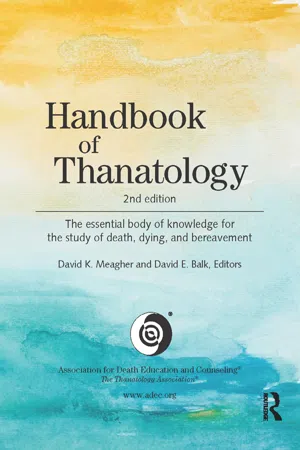
If ever there was an area requiring that the research-practice gap be bridged, surely it occurs where thanatologists engage with people dealing with human mortality and loss. The field of thanatology—the study of death and dying—is a complex, multidisciplinary area that encompases the range of human experiences, emotions, expectations, and realities. The Handbook of Thanatology is the most authoritative volume in the field, providing a single source of up-to-date scholarship, research, and practice implications. The handbook is the recommended resource for preparation for the prestigious certificate in thanatology (CT) and fellow in thanatology (FT) credentials, which are administered and granted by ADEC.
eBook - ePub
Handbook of Thanatology
The Essential Body of Knowledge for the Study of Death, Dying, and Bereavement
- 558 pages
- English
- ePUB (mobile friendly)
- Available on iOS & Android
eBook - ePub
Handbook of Thanatology
The Essential Body of Knowledge for the Study of Death, Dying, and Bereavement
About this book
Trusted by 375,005 students
Access to over 1.5 million titles for a fair monthly price.
Study more efficiently using our study tools.
Information
Dying
Introduction to Part 1, Chapters 1 – 6
DOI: 10.4324/9780203767306-1
Chapters 1 through 6 focus on dying. The Body of Knowledge defined this major category of thanatology knowledge in this way: the physical, psychosocial, and spiritual experience of facing death, living with terminal illness, the dying process, and caring for the terminally ill.
The six chapters of Part 1 focus on dying in terms of these indicators: culture and socialization, religion and spirituality, historical and contemporary perspectives, life span issues, the family and larger systems, and ethical and legal issues. Five chapters were revised from the chapters that appeared in the first edition, and in the case of chapter 6, the contributor wrote a wholly new chapter.
Chapter 1 Culture, Socialization, and Dying
DOI: 10.4324/9780203767306-2
This chapter examines some cultural and social aspects related to persons who are dying or closely approaching death, as well as the care they are offered. The challenge we face is that there are myriad cultural and social variables that may affect dying in any historical and social situation because historical circumstances differ across time and in different communities. Accordingly, societal death systems change in their responses to specific challenges. More importantly, because dying is not the whole of anyone’s life, it is critical to keep in mind that dying persons are living human beings. Dying is a special situation in living; it cannot properly or fully be understood without taking account of the entirety of a person’s life, both individually and within the social systems in which that person is living.
Cultural Factors That Affect Dying
Every human being is born into and raised within a context in which cultural, social, religious, and ethnic factors influence his or her life. As such, these variables, which we subsume here under the broad heading of “cultural factors,” affect each individual’s views of and interactions with dying and death. This cultural influence is true whether the individual accepts or rejects the acculturation that he or she receives, since even in rejection those cultural factors provide a benchmark against which the individual defines and conducts his or her life.
One way to understand the various factors addressed in this section is to think of culture as “a unified set of values, ideas, beliefs, and standards of behavior shared by a group of people; it is the way a person accepts, orders, interprets, and understands experiences throughout the life course” (Thomas, 2001, p. 40). Clearly, in the United States and in most other countries, there are many, often quite diverse, cultural groups. Coming to know something about those cultural groups helps to improve appreciation of ourselves, other people, and our society as a whole.
For example, if we think for a moment about what we know concerning religious differences in beliefs, attitudes, and practices, we can easily recognize differences between various Christian denominations, between orthodox and reform Jews, and between Sunni and Shia Islamic groups. At the same time, it is all too easy to develop stereotypes around religious and cultural differences. For example, we may perceive members of one religious or cultural group as highly expressive and demonstrative in ways they face loss, while others may be viewed as much more reserved and even stoic. This observation may be true as a generalization about the group, but is it also true of every member of that group? In other words, are we settling for superficial stereotypes in what we think about cultural groups and their diverse members?
So our task is to be equally sensitive both to differences between cultural groups and to diversity within those groups. For this reason, it is notoriously difficult to speak in a general way about how cultural factors influence human beings and what results they produce. What is needed is an effort to enter into specific cultural groups and see how they address issues related to dying, an effort something like the one undertaken by the editors of a five-volume series about Death and Bereavement Around the World (Morgan, Laungani, & Palmer, 2002–2009). Our project in this chapter will inevitably be on a much more limited scale.
In this chapter, we focus on selected examples of ways in which cultural factors bear on experiences of dying. Among many possible examples, these include:
- Communication within family or cultural groups and between those groups and outsiders
- Decision making within some family and cultural groups
- Issues about who should be primarily responsible for care of a dying person
- Distrust by members of cultural groups with regard to the larger social system, its health care institutions, and some health care providers
Concerning communication, Thomas (2001, p. 42) has written that, “Communication about end-of-life issues is the key to understanding and making rational decisions.” Accordingly, there have been numerous reports that maintaining control over communication is an important issue for many Asian Americans and some members of other cultural groups (e.g., Doka & Tucci, 2009; Tanner, 1995; Tong & Spicer, 1994). For example, members of such communities may be quite restrained in communicating to health care providers what they are experiencing when they are in distress and dying. Also, some family members may place a high priority on not telling dying persons that they are dying. Health care providers who do not share such values or who lack cultural sensitivity may become frustrated when they are caring for a dying person from such a cultural group.
Closely related to attitudes associated with communication are those related to decision making. Because patriarchal and hierarchical structures are prevalent in some cultural groups, in such groups it is often the oldest male or at least an older member of the family who is expected to make decisions about the care of dying family members (Blackhall, Murphy, Frank, Michel, & Azen, 1995; Braun, Pietsch, & Blanchette, 2000). To outsiders, this practice may appear to deny or at least infringe upon the autonomy of the ill person.
Another significant issue in which cultural factors play an important role has to do with who should care for a dying person. In contemporary American society, the provision of such care is often primarily assigned to outsiders—to staff and volunteers in hospitals, long-term care facilities, and hospice programs. Studies of certain Hispanic cultural groups (e.g., Cox & Monk, 1993; Delgado & Tennstedt, 1997; Gelfand, Balcazar, Parzuchowski, & Lenox, 2001), however, have noted that this role is primarily and insistently held within the family and there most often assigned to female members.
Distrust has many causes and is often quite deep-seated. For example, among African Americans some have traced it back to the general implications of slavery and particularly to the Tuskegee study conducted by the United States Public Health Service. Begun in 1932, the study initially offered the only known treatments at the time to poor African-American sharecroppers in Alabama with syphilis. Tragically, participants were eventually allowed to go untreated until they died in order to study the natural progress of the disease. This research design occurred even after penicillin became available in the mid-1940s and was shown to be effective in treating syphilis. The study was not halted until it was exposed in the press in 1972 (Jones, 1992; Washington, 2006). More recent reports have addressed ongoing racial injustice in health care (e.g., Freeman & Payne, 2000; Geiger, 2002). As a result, many African Americans believe the health care they receive is less adequate than that offered to Caucasian Americans (Tschann, Kaufmann, & Micco, 2003; Waters, 2001).
These issues affecting dying persons and care of the dying are intertwined with ways in which individuals and members of groups in our society view the importance of family, the role of religion, and the importance of being present at a death. They also influence other matters, such as whether or not persons are willing to making advance plans for end-of-life treatment, to consider opportunities for organ donation, or to take part in physician-assisted suicide.
Death Anxiety and Concerns That Affect Dying
Much attention in recent years has been given to the concept of death anxiety and its measurement (e.g., Neimeyer, 1994; Neimeyer, Wittkowski, & Moser, 2004). For example, many reports suggest that women report higher death anxiety than men in our society, while older adults appear to report less death anxiety than some younger persons. It has also been argued that death anxiety is a complex concept, one that varies with both demographic and personality factors, as well as with life accomplishments and past or future regrets (Tomer & Eliason, 1996).
Further, death-related attitudes may reflect very different concerns and responses such as those focused on:
- My own dying: Will it involve a long, difficult, painful, or undignified dying process, especially in an alien institution under the care of strangers who might not respect my personal needs or wishes—if so, I might wish that my dying would occur without any form of distress or prior knowledge, and in my sleep, or perhaps I might take deliberate action to prepare an advance directive or to seek out opportunities for physician-assisted suicide (sometimes called “death with dignity” or “aid in dying;” Corr, 2012), thereby hoping to avoid unacceptable ways of experiencing my dying; by contrast, concerns about my own dying might lead me to wish to avoid a sudden, unanticipated death, allowing time to address “unfinished business,” bid farewell to loved ones (Byock, 2004), and “get ready to meet my Maker.”
- My own death: Will it release me from hardships and suffering, or will it involve losing the life and everything it involves that has been and still is so important to me?
- What will happen to me after my death: Am I anxious about the unknown and fearful of judgment or punishment after death, or am I anticipating a heavenly reward, a passage to a better life, or a reunion. with someone who had died earlier?
- The bereavement of someone I love: Am I mainly concerned about the burdens that my illness and dying are placing upon those whom I love and/or am I worried about what will happen to them after I am gone?
Dying in Our Social System: Once Upon a Time
In times past in the United States of America and in many other developed countries around the world, what Glaser and Strauss (1968) identified as dying trajectories were relatively brief and largely predictable experiences. Mainly caused by communicable diseases, dying typically involved clear and recognizable symptoms such as fever, diarrhea, nausea, vomiting, or muscle ache. Family members, friends, and those professionals who might have been available would have been able to recognize that individuals displaying these symptoms were seriously ill. On the basis of past experiences with similar patterns of disease, it could often be predicted whether or not an individual afflicted in these ways would recover or would die and possibly also when the outcome would be known.
Care given to such individuals would largely have been supportive in nature, offered in the hope that the body would heal itself and concerned not to interfere in that process. This care would likely have focused on providing a place to rest, shelter from the elements, a cool cloth to wipe a feverish brow, and nourishing food (“chicken soup”). Various forms of spiritual intercession would often have accompanied it. Many fortunate individuals would have been cared for at home and by family members. Hospitals likely would not have been available. Even when they were, they often took the form of charitable institutions (almshouses) with large, crowded wards that were typically dark, stuffy, unpleasant, and even life threatening since they threw together many different types of people with very different disabilities and often contagious conditions.
As Western culture became more urbanized, hospitals began to change. During the latter half of the 19th century, a biomedical model emerged that viewed disease as involving specific entities and predictable causes. Therapy became intended to “fix” malfunctioning parts of the human body. Specialization in carrying out therapeutic tasks became the norm. A division of labor came to characterize both health care providers and health care institutions. In particular, hospitals—now often called “medical centers” or “health centers”—came to focus on acute care in which scientific medicine sought to cure disease. A paradoxical result of this new focus on hospital-based, acute care is that within the very institutions in which nearly half of all Americans now die death often began to be perceived as involving a kind of failure.
Following passage of the Social Security Act of 1935, which added federal funding to the personal resources of individuals and their relatives, health insurance, and retirement packages, long-term care facilities began to be developed. These long-term care facilities (often called “nursing homes”) filled the need for chronic care as families had often become small, nuclear groupings in which individuals frequently lived at a distance from their kin instead of extended clusters living nearby in the same community. Chronic care b...
Table of contents
- Cover Page
- Title Page
- Copyright Page
- Table of Contents
- Introduction to the First Edition
- Introduction to the Second Edition
- Certifications in Thanatology: How the Handbook of Thanatology Can Assist
- Body of Knowledge (BOK) Matrix
- List of Contributors
- Part 1 Dying: Introduction to Part 1
- Part 2 End-of-Life Decision Making Introduction to Part 2
- Part 3 Loss, Grief, and Mourning Introduction to Part 3
- Part 4 Assessment and Intervention: Introduction to Part 4
- Part 5 Traumatic Death: Introduction to Part 5
- Part 6 Death Education: Introduction to Part 6
- Part 7 Three Overarching Indicators Within Fundamental Knowledge of Thanatology Introduction to Part 7
- ADEC Code of Ethics
- References
- Index of Key Terms
Frequently asked questions
Yes, you can cancel anytime from the Subscription tab in your account settings on the Perlego website. Your subscription will stay active until the end of your current billing period. Learn how to cancel your subscription
No, books cannot be downloaded as external files, such as PDFs, for use outside of Perlego. However, you can download books within the Perlego app for offline reading on mobile or tablet. Learn how to download books offline
Perlego offers two plans: Essential and Complete
- Essential is ideal for learners and professionals who enjoy exploring a wide range of subjects. Access the Essential Library with 800,000+ trusted titles and best-sellers across business, personal growth, and the humanities. Includes unlimited reading time and Standard Read Aloud voice.
- Complete: Perfect for advanced learners and researchers needing full, unrestricted access. Unlock 1.5M+ books across hundreds of subjects, including academic and specialized titles. The Complete Plan also includes advanced features like Premium Read Aloud and Research Assistant.
We are an online textbook subscription service, where you can get access to an entire online library for less than the price of a single book per month. With over 1.5 million books across 990+ topics, we’ve got you covered! Learn about our mission
Look out for the read-aloud symbol on your next book to see if you can listen to it. The read-aloud tool reads text aloud for you, highlighting the text as it is being read. You can pause it, speed it up and slow it down. Learn more about Read Aloud
Yes! You can use the Perlego app on both iOS and Android devices to read anytime, anywhere — even offline. Perfect for commutes or when you’re on the go.
Please note we cannot support devices running on iOS 13 and Android 7 or earlier. Learn more about using the app
Please note we cannot support devices running on iOS 13 and Android 7 or earlier. Learn more about using the app
Yes, you can access Handbook of Thanatology by David K. Meagher, David E. Balk, David K. Meagher,David E. Balk in PDF and/or ePUB format, as well as other popular books in Psychology & Education in Psychology. We have over 1.5 million books available in our catalogue for you to explore.