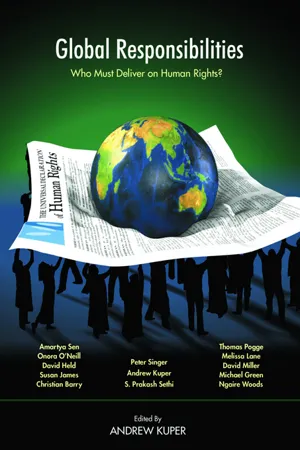
In Global Responsibilities, some of the world's leading theorists of ethics, politics, international relations, and economics-including Nobel Prize winner Amartya Sen and philosopher Peter Singer-ask and answer the question: Who must deliver on human rights?
- 312 pages
- English
- ePUB (mobile friendly)
- Available on iOS & Android
eBook - ePub
About this book
Trusted by 375,005 students
Access to over 1.5 million titles for a fair monthly price.
Study more efficiently using our study tools.
Information
PART
I
The Nature of Responsibility
CHAPTER
1
Human Rights and Human
Responsibilities1
THOMAS W. POGGE
The Problem
Various international declarations and treaties offer formulations of human rights that are, for the most part, clear enough to support reasonably precise estimates of the extent to which human rights are unfulfilled worldwide. Piecing together this global human rights record from the available data, we find that most of the current underfulfillment of human rights is more or less directly connected to poverty. The connection is direct in the case of basic social and economic human rights, such as the right to a standard of living adequate for the health and well-being of oneself and one's family, including food, clothing, housing, and medical care.2 The connection is more indirect in the case of civil and political human rights associated with democratic government and the rule of law. Desperately poor people, often stunted, illiterate, and heavily preoccupied with the struggle to survive, can do little by way of either resisting or rewarding their rulers, who are therefore likely to rule them oppressively while catering to the interests of other (often foreign) agents more capable of reciprocation.
We have a great wealth of data about how widespread and severe global poverty is today: Out of a total of 6.2 billion human beings (2002), some 799 million are malnourished, more than 880 million lack access to basic health services, 1 billion are without adequate shelter, 1.1 billion without access to safe drinking water, 2 billion without electricity, and 2.4 billion without access to basic sanitation. In addition, 876 million adults are illiterate,3 and over 200 million children between 5 and 14 do wage work outside their household, often under harsh or cruel conditions.4 Some 50,000 human deaths per day, fully a third of all human deaths, are due to poverty-related causes and therefore avoidable insofar as poverty itself is avoidable.5
That a large segment of humankind is living in extreme poverty is nothing new. What is comparatively new, however, is that another large segment is living in considerable affluence. “The income gap between the fifth of the world's people living in the richest countries and the fifth in the poorest was 74 to 1 in 1997, up from 60 to 1 in 1990 and 30 to 1 in 1960.” Earlier estimates are 11 to 1 for 1913, 7 to 1 for 1870, and 3 to 1 for 1820.6 With this tremendous upsurge in global inequality comes a dramatic increase in human capabilities to eliminate severe poverty. It would not cost us much to eradicate the deprivations I have highlighted in the preceding paragraph—perhaps around one percent of the disposable incomes of the most affluent tenth of humankind. And this cost would decline over time, as adults who do not have to bear the horrendous mental and physical effects of childhood malnutrition, childhood diseases, child labor, and lack of basic education would be much better able to fend for themselves and to provide for their families. Our opportunity to abolish severe poverty worldwide starkly confronts us then with the question whether we have any responsibilities correlative to the internationally recognized, but massively underfulfilled, human rights of the global poor.
The world's governments faced up to this question at the World Food Summit in Rome, organized by the UN Food and Agriculture Organization (FAO) in November 1996. The principal achievement of this summit was a pledge by the 186 participating governments to reduce the number of undernourished people worldwide by about one-half, to 400 million, by the year 2015. The opening sentences of this Rome Declaration on World Food Security read as follows: “1. We, the Heads of State and Government, or our representatives, gathered at the World Food Summit at the invitation of the Food and Agriculture Organization of the United Nations, reaffirm the right of everyone to have access to safe and nutritious food, consistent with the right to adequate food and the fundamental right of everyone to be free from hunger. 2. We pledge our political will and our common and national commitment to achieving food security for all and to an on-going effort to eradicate hunger in all countries, with an immediate view to reducing the number of undernourished people to half their present level no later than 2015. 3. We consider it intolerable that more than 800 million people throughout the world, and particularly in developing countries, do not have enough food to meet their basic nutritional needs. This situation is unacceptable.”7 The represented governments could not, however, agree on concrete steps toward achieving such progress and did not sign or officially commit to the final document articulating the Summit goals.
Events since 1996 likewise indicate no special eagerness for implementation. The United States has issued an “Interpretive Statement” to clarify its understanding of the Rome pledge: “the attainment of any ‘right to adequate food’ or ‘fundamental right to be free from hunger’ is a goal or aspiration to be realized progressively that does not give rise to any international obligations.”8 Challenging the FAO's claim that achieving the Summit goals would require all developed countries combined to increase their annual official development assistance (ODA) in agriculture by $6 billion,9 the United States published a competing calculation according to which an increase of US$2.6 billion per annum—that is, only $3.30 rather than $7.60 annually for each malnourished person—should be sufficient.10 The affluent states’ foreign aid budgets continued their downtrend.11 And the widely publicized millennial restatement of the pledge weakened its ambition quite dramatically.12
It appears then that the developed countries do not accept any responsibility with regard to severe poverty abroad, either in principle or in practice. Yet, they also seem reluctant to publicize and defend this position, and even suggest the opposite in their rhetorical employment of words such as “intolerable” and “unacceptable.” This should heighten interest in the question before us: What are our responsibilities in regard to the massive and avoidable underfulfillment of human rights abroad?
A New Universal Declaration?
Great expectations are raised, then, when a prominent group of former heads of state, calling itself the InterAction Council, proposes a Universal Declaration of Human Responsibilities for worldwide discussion and for adoption by the General Assembly of the United Nations with the express aim to “complement” the 1948 Universal Declaration of Human Rights on the occasion of its 50th birthday.13 In its preamble, the Draft Declaration has the United Nations announce that: “We, the peoples of the world thus renew and reinforce commitments already proclaimed in the Universal Declaration of Human Rights.” The new declaration is nevertheless necessary, as the accompanying report points out, for clarifying that human rights correlate with human duties: “Because rights and duties are inextricably linked, the idea of a human right only makes sense if we acknowledge the duty of all people to respect it.”
Looking at the Draft Declaration in search for a clarification of the responsibilities for the realization of human rights, one cannot but be severely disappointed. Although one purpose of this Declaration is expressed by the compelling idea that rights are meaningless without the specification of corresponding duties, the Draft Declaration is, if anything, less specific about responsibilities than the human-rights documents it seeks to complement. Consider the various articles that spell out our responsibilities with regard to poverty.
Article 7 begins in a promising way: “Every person is infinitely precious and must be protected unconditionally.” So who must effect this unconditional protection, how, and against what threats? What are our responsibilities? Article 7 continues: “The animals and the natural environment also demand protection. All people have a responsibility to protect the air, water and soil of the earth for the sake of present inhabitants and future generations.” So the only responsibility assigned to us, it seems, is to protect air, water and soil: Animals merely “demand” protection; and humans “must be” protected, though apparently by no one in particular.
Article 9 does somewhat better: “All people, given the necessary tools, have a responsibility to make serious efforts to overcome poverty, malnutrition, ignorance, and inequality.” But again, the main issues raised by this statement remain unaddressed: Is the directive to overcome poverty, malnutrition, etc., addressed to the poor themselves or to others as well? If the latter, which others: compatriots, all human beings? What counts as making a “serious effort”? And what is the import of the qualification “given the necessary tools”? The other sentence of Article 9 offers little help: “[All people] should promote sustainable development all over the world in order to assure dignity, freedom, security and justice for all people.” Nothing is said about what “sustainable development” means or about what counts as promoting it.
Article 10 adds that “Everyone should lend support to the needy, the disadvantaged, the disabled and to the victims of discrimination.” Nothing is said about the amount of support, nor about its targeting to ensure that the most urgent needs are actually met.
Article 11, finally, proclaims that “economic and political power must … be handled … in the service of economic justice and of the social order.” The Draft Declaration provides no guidance with respect to the highly controversial notion of economic justice. Moreover, since the social order is often itself a major contributor to oppression and economic injustice (however one may wish to understand this notion), the Draft assigns potentially counterproductive and conflicting duties to people wielding economic and political power.
While the Draft Declaration expresses awareness of disadvantage and poverty, it fails then to clarify what responsibilities arise therefrom. Perhaps this should not be surprising in a declaration proposed by former heads of state for adoption by present political leaders. For these politicians, any more specific statement of responsibilities might raise awkward questions about how their own decisions have affected global poverty. The former leaders proposing the Draft Declaration can at least adduce the pressures of the Cold War as an excuse. It is unclear what could possibly excuse the increasing tolerance for starvation in the 1990s, when half of the so-called peace dividends would have sufficed to eradicate most of the world hunger problem.14
The excessive generality and vagueness of these middle articles is typical of the Draft Declaration as a whole, and especially evident also in the opening articles, which have the pomposity and emptiness one might expect in a teenager's first writing attempts. The first four articles are billed as “Fundamental Principles for Humanity.” Of these, the third one best exemplifies the problem when it declares that nobody stands above good and evil and that everybody has a responsibility to promote good and to avoid evil “in all things.” But the others are not much more meaningful either. The first principle of humanity says that every person has a responsibility to treat all people in a humane way. What does this mean? There are six billion other people out there, and with the vast majority of these I never interact except very indirectly. In these cases, am I discharging my responsibility to treat them in a humane way? What if some of them are starving or being tortured for their religious or political views and I do nothing for them—am I treating them humanely? Does it matter here whether they are compatriots or foreigners, or whether I have any general or particular knowledge of their plight? Or consider the people around me: Am I discharging my responsibility if I treat them in a humane way at some times and fail to do so at other times? And, most important, how is the distinction between humane and inhumane treatment to be drawn? As if to make up for the vagueness of the prescription, the drafters then add that it applies to every person “regardless of gender, ethnic origin, social status, political opinion, language, age, nationality, or religion.” This addition would have a point if it referred to the objects of the proclaimed responsibility: to those who are to be treated humanely. It could naturally be taken to mean, then, that one's responsibilities are equally strong with regard to all others: The treatment I owe to compatriots, I also owe to foreigners; the treatment I owe to men, I also owe to women; and so forth. The addition is in fact attached, however, to the subjects of the proclaimed responsibility: to those who are to accord humane treatment. Here the long verbal addition adds no content at all: The statement that every person has a responsibility to treat all people humanely already entails that this responsibility is asserted for male and female persons, rich and poor persons, old and young persons, and so on.
One might think that more clarity can be derived from the Draft Declaration's endorsement of the Golden Rule in Article 4: What you do not wish to be done to yourself, do not do to others. This, of course, is the negative version of the Golden Rule. Its positive version—do unto others as you would have them do unto you—is not endorsed, although it is much closer to the “spirit of solidarity” invoked in Article 4. Endorsement of the positive version would have made it difficult to deny that persons have a responsibility to help others in distress, even across large distances, when they can do so at comparatively small cost to themselves. Endorsement of the negative version makes this far easier to deny: By ignoring the distress of others, I am not doing anything to them and hence a fortiori not doing anything I would not wish to be done to myself. What could the point of the selective endorsement of the negative version possibly be, if not to buttress this denial?
To make matters worse, the Golden Rule, in its negative version, often tends to shield and entrench immorality and injustice in situations where exposing them would be painful to their practitioners and beneficiaries. If I had violated some law or some significant ethical rule or principle, or had benefited from another's such violation, I would not wish this fact to become widely known. Does it follow therefrom that I should never expose such violations? Or, to take Kant's related example: Should a judge follow the Golden Rule when it enjoins her not to inflict on a defendant any punis...
Table of contents
- Cover Page
- Half Title Page
- Title Page
- Copyright Page
- Contents
- Acknowledgments
- Introduction: The Responsibilities Approach to Human Rights
- Part I The Nature of Responsibility
- 1 Human Rights and Human Responsibilities
- 2 Agents of Justice
- 3 Open and Closed Impartiality
- Part II Allocating Responsibilities
- 4 Realizing Rights as Enforceable Claims
- 5 Distributing Responsibilities
- 6 Institutional Responsibility for Moral Problems
- 7 Applying the Contribution Principle
- Part III Individual Responsibility for Poverty Relief
- 8 Global Poverty Relief: More Than Charity
- 9 Poverty, Facts, and Political Philosophies: A Debate with Andrew Kuper
- Part IV Accountability of Actors in the Global Economy
- 10 Globalization, Corporate Practice, and Cosmopolitan Social Standards
- 11 Corporate Codes of Conduct and the Success of Globalization
- 12 The Moral Dimension of Corporate Accountability
- 13 Held to Account: Governance in the World Economy
- Contributors
- Appendix
- Index
Frequently asked questions
Yes, you can cancel anytime from the Subscription tab in your account settings on the Perlego website. Your subscription will stay active until the end of your current billing period. Learn how to cancel your subscription
No, books cannot be downloaded as external files, such as PDFs, for use outside of Perlego. However, you can download books within the Perlego app for offline reading on mobile or tablet. Learn how to download books offline
Perlego offers two plans: Essential and Complete
- Essential is ideal for learners and professionals who enjoy exploring a wide range of subjects. Access the Essential Library with 800,000+ trusted titles and best-sellers across business, personal growth, and the humanities. Includes unlimited reading time and Standard Read Aloud voice.
- Complete: Perfect for advanced learners and researchers needing full, unrestricted access. Unlock 1.5M+ books across hundreds of subjects, including academic and specialized titles. The Complete Plan also includes advanced features like Premium Read Aloud and Research Assistant.
We are an online textbook subscription service, where you can get access to an entire online library for less than the price of a single book per month. With over 1.5 million books across 990+ topics, we’ve got you covered! Learn about our mission
Look out for the read-aloud symbol on your next book to see if you can listen to it. The read-aloud tool reads text aloud for you, highlighting the text as it is being read. You can pause it, speed it up and slow it down. Learn more about Read Aloud
Yes! You can use the Perlego app on both iOS and Android devices to read anytime, anywhere — even offline. Perfect for commutes or when you’re on the go.
Please note we cannot support devices running on iOS 13 and Android 7 or earlier. Learn more about using the app
Please note we cannot support devices running on iOS 13 and Android 7 or earlier. Learn more about using the app
Yes, you can access Global Responsibilities by Andrew Kuper in PDF and/or ePUB format, as well as other popular books in Politics & International Relations & Political Economy. We have over 1.5 million books available in our catalogue for you to explore.