- 145 pages
- English
- ePUB (mobile friendly)
- Available on iOS & Android
eBook - ePub
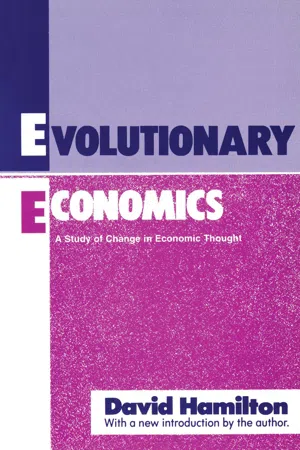
About this book
In reviewing this book in The Economic Journal, S.G. Checkland said that it should be read as a vigorous attempt to relate economics to general thinking and as a challenge to those who are practitioners or elaborators of narrowly prescribed techniques.
Trusted by 375,005 students
Access to over 1.5 million titles for a fair monthly price.
Study more efficiently using our study tools.
1
Institutionalism and Classicism
By the second decade of this century, the work of Veblen had made some impact on economic theorists and there had developed a group of prominent economists such as Hoxie, Mitchell, and Hamilton who were proclaiming a “new economics.” This new economics was held to be different from the traditional doctrine in several significant ways, and it was expected that a revolutionary change in economic theory was in prospect. Exactly what kind of change was implied is not easily determined, for the differences between the two schools have become obscured in the controversy over the fact of difference. There have been those who have held that there is no difference whatever. This was the position taken by Paul T. Homan at the Round Table on Institutional Economics at the 1932 meeting of the American Economic Association. At the same meeting, R. T. Ely maintained that as far as he could determine, the institutionalists were not attempting to do anything that the young economists had not been trying at the time of the formation of the American Economic Association in the eighties. In fact, Ely held that ever since that time economists had been doing essentially what the institutionalists were claiming to have done.1 These statements would indicate that there is no essential difference between the two schools, and this opinion is frequently found among recognized orthodox economists, who also cite various works of classical political economists as evidence to this effect.
A similar attitude is sometimes expressed with regard to institutional economics and the historical school of the nineteenth century. Since institutionalists are concerned with the evolution of behavior patterns from earlier forms, they do delve into the economic past of mankind. The historical school emphasized the necessity of gathering a large body of historical data from which general patterns could be discerned and generalizations drawn. Critics of the historical school have said that it failed to comprehend the interrelatedness of the empirical and the deductive approach. Since institutionalists are following the same procedure, they are chargeable with committing the same error. This is the position taken by Lewis Haney.2
Related to the notion that institutionalism emphasizes historicism is the claim that institutional economics emphasizes inductive technique while classical economics emphasizes deductive technique. Even some professed institutional economists lend credence to this belief. John Gambs, in a chapter on methodology in his little volume Beyond Supply and Demand, states that this distinction is “superficial” but nevertheless “has a rough elementary usefulness.”3 In line with this opinion, it is held that institutional economists advocate the gathering of “facts” about the present-day world; they are supposedly concerned with the photographic representation of the facts of the economic system as a going concern. Such interpreters point to empirical studies of labor, the business cycle, and the corporation as examples of institutional economics. This opinion is clearly expressed by A. G. Hart in the preface to his textbook on money.4
Some hold that institutional economics is concerned with the whole pattern of human activity, attempting to place the economic aspects of that behavior in relation to the larger whole of which economics is only a part. Adherents of this point of view claim that man’s economic activity cannot be artificially separated from his other affairs; all of life is interrelated and separation into categories is an artificial device of the scholar which is apt to give a false impression of the life process. Economic affairs do not exist in a vacuum and economic activity is affected by all the rest of human activity. The institutionalist, it is held, differs from the classicist by recognition of this interrelatedness. Allan Gruchy, in a perceptive work, holds that this difference in approach and viewpoint is the distinguishing mark of institutionalism. Classicists abstracted economic activity from the life process, giving a distorted picture of economic behavior, while institutional economists differ from the classicists “in their tendency to emphasize the importance of studying the economic system as a whole rather than as a collection of many unrelated parts.”5 He likens institutionalism to the “holistic” philosophy of Jan Smuts.
Still others have held that institutional economists emphasize the study of institutions. This idea is related to the last mentioned difference in that those who hold this view assume that the study of institutions is a broadening of economic inquiry from the narrow view of the classicist. It is assumed that the classicist ignored the fact that man is a creature whose behavior is molded by institutions. The classicist concerned himself with a free-wheeling man operating in accordance with free-will. The institutionalist studies institutions and focuses his attention on the effect of institutions on economic behavior.
John Gambs holds that the chief difference is the emphasis the institutionalist places on coercion. The classical economist, assuming that the economic universe was a harmonious one free from restraint and coercion, emphasized freedom of enterprise and individual self-help without interference. Gambs contends that the institutionalist views the economic universe as a coercive one in which coercion is brought to bear on those least able to protect themselves.6
From this cursory review it is obvious that there is no agreement on whether there is a difference, and neither is there agreement, if there is a difference, on just where that difference lies. To those such as Homan, who hold that there is no difference, it can be argued that classicists as well as institutionalists have made clear “aspects of problems, methods, and generalized knowledge” that differ significantly in institutionalism and classicism. Further, even a superficial examination of the work of some institutionalists, especially that of Veblen, would reveal a marked difference. Yet there seems to be no agreement among these men except that there is a difference.
Some of the differences that have been discussed, however, could better be called differences of emphasis rather than of substance. Classical economists have concerned themselves with the origin and development of the present economic system and many economists adhering to classical theory have engaged in gathering historical data. In fact, the largest proportion of work in economic history has been done by those of the classical faith, and at no time has the classicist denied the relevance of historical data. Adam Smith devoted a relatively large part of the Wealth of Nations to the historical background of capitalism.
The claim that classicism has been theoretical or deductive while institutionalism has been empirical or inductive is also invalid except with reference to degree. Not one of the classical economists has denied the value of the inductive method, and while it is true that classicism has built elaborate theoretical systems on a thin set of questionable assumptions, it should not be concluded from this that the classical economists dismiss induction as a method or that they make no use of induction. For that matter, the founders of classical political economy were of the opinion that the assumptions upon which they built their system were revealed to all by common sense, and did not require the drudgery of scholarly empirical verification. On the other hand, it is equally incorrect to hold that institutional economists make no use of deduction. There are, of course, so-called institutionalists who, despairing of the classical theory, have renounced theory per se and have engaged in multiplying facts for fact’s sake. Certainly no one, however, would claim that the work of Veblen was not theoretical. The titles of his first two major works began with the word “Theory,” as Veblen pointed out to H. J. Davenport when the latter accused him of neglecting theory.7 If economic theory is defined as synonymous with the theoretical speculations of the classical economists, then there is of course no institutionalist theory, but this definition could be held seriously only by one very narrowly trained in classical theory. It would seem, then, that both classical and institutional economists adhere to deduction and induction.
The classical economist does not give much attention to the economic framework of his economic society because in all classical economics the institutional framework is taken for granted. As will be shown, the founders of classical political economy took the social organization of their time for granted as the product of a stable human nature characterized by common-sense reason. As the institutional economist has taken into consideration institutional patterns of behavior, it is assumed that he differs from classical political economy on this ground. But that is not quite the case, as there have been those whose study of the institutional structure is perfectly compatible with classical political economy. This is true of the work of Max Weber, who has been classified as an institutionalist by some, but who would better be classified as a student of economic sociology whose work is in no way incompatible with classical economics.8 That the institutional economist has something more in mind than merely the influence of the institutional framework on a classically conceived human behavior is clear from the work of Veblen alone. Veblen not only delved into the institutional structure; he rejected classical political economy in toto and developed a “new economic theory.” This rejection is clear in several of his early essays on methodology.9 The idea that the institutionalist is one who studies institutions has also been rejected by present-day institutionalists. John Gambs has stated that institutional economics “is not institutional.”10 Unfortunately, the word institutionalism connotes the study of institutions and has come to designate this school of thought. C. E. Ayres, at the end of a long note in his Theory of Economic Progress, calls attention to the confusion engendered by this usage.
As a designation of a way of thinking in economics the term “institutionalism” is singularly unfortunate, since it points only at that from which an escape is being sought. Properly speaking, it is the classical tradition that is “institutionalism,” since it is a way of thinking which expresses a certain set of institutions.11
To sum up, in view of the general confusion over the differences between these two schools of thought, it might well be asked if there is any marked difference. If there is no difference, then it would be better that all discussion cease, and the energy put into more constructive pursuits. On the other hand, if there is a marked difference, then the key to the difference remains to be found.
There is one possible way out of the confusion: an appeal to the institutionalists themselves. If there is some consensus among institutionalists on one point of difference between their work and that of traditional economics, therein may lie the key. In spite of apparently total confusion, there is one important point of difference that all institutional economists have stressed, even those who have favored some other difference as the major one: they all have criticized the classical political economists for failing to deal satisfactorily with change.
In one of his earliest essays Veblen claimed that the received economics was not an evolutionary one, and stated that, “from what has been said it appears that an evolutionary economics must be the theory of a process of cultural growth as determined by economic interest, a theory stated in terms of the process itself.”12 Veblen held that the traditional economists based their economic theory on a hedonistic psychology and accepted the natural-order preconceptions of the eighteenth century. The result was to develop a taxonomic science that was not in conformance with the trend of modern science to go beyond taxonomy to an explanation of the phenomena in terms of cumulative change and process. Economics in the hands of the classicists failed of the mark and their work was termed “pre-Darwinian.”
Walton Hamilton called attention to the same dereliction on the part of classicists. Hamilton in an early paper claimed that the classical economists had “regarded social arrangements which had existed for the briefest moment in human history as of the immutable cosmos itself.” Nevertheless, man was beginning to view all phenomena as subject to change.13 In a paper on institutional economics at the 1918 annual meeting of the American Economic Association, Hamilton held that the difference between institutionalism and classicism was “no pointless struggle in method to be carried on by breaking syllogisms over concepts and by engaging in polemics over niceties in statement.” The disagreement “involves the very nature of the problems which the theorist should set himself; its real issue is over what economic theory is all about.”14 Hamilton held that an adequate economic theory should deal with cumulative change and that the traditional economics failed to meet the test of a valid...
Table of contents
- Cover Page
- Evolutionary Economics
- copy
- Contents
- INTRODUCTION TO THE TRANSACTION EDITION
- FOREWORD BY ALLAN G. GRUCHY
- ACKNOWLEDGEMENTS
- INTRODUCTION: INSTITUTIONALISM TODAY
- 1 INSTITUTIONALISM AND CLASSICISM
- II NEWTONIANISM AND DARWINISM IN ECONOMIC THEORY
- III CHANGE AND HUMAN NATURE
- IV CHANGE AND SOCIAL ORGANIZATION
- V CHANGE AND PROGRESS
- VI ECONOMIC DYNAMICS
- BIBLIOGRAPHY
- INDEX
Frequently asked questions
Yes, you can cancel anytime from the Subscription tab in your account settings on the Perlego website. Your subscription will stay active until the end of your current billing period. Learn how to cancel your subscription
No, books cannot be downloaded as external files, such as PDFs, for use outside of Perlego. However, you can download books within the Perlego app for offline reading on mobile or tablet. Learn how to download books offline
Perlego offers two plans: Essential and Complete
- Essential is ideal for learners and professionals who enjoy exploring a wide range of subjects. Access the Essential Library with 800,000+ trusted titles and best-sellers across business, personal growth, and the humanities. Includes unlimited reading time and Standard Read Aloud voice.
- Complete: Perfect for advanced learners and researchers needing full, unrestricted access. Unlock 1.5M+ books across hundreds of subjects, including academic and specialized titles. The Complete Plan also includes advanced features like Premium Read Aloud and Research Assistant.
We are an online textbook subscription service, where you can get access to an entire online library for less than the price of a single book per month. With over 1.5 million books across 990+ topics, we’ve got you covered! Learn about our mission
Look out for the read-aloud symbol on your next book to see if you can listen to it. The read-aloud tool reads text aloud for you, highlighting the text as it is being read. You can pause it, speed it up and slow it down. Learn more about Read Aloud
Yes! You can use the Perlego app on both iOS and Android devices to read anytime, anywhere — even offline. Perfect for commutes or when you’re on the go.
Please note we cannot support devices running on iOS 13 and Android 7 or earlier. Learn more about using the app
Please note we cannot support devices running on iOS 13 and Android 7 or earlier. Learn more about using the app
Yes, you can access Evolutionary Economics by David Hamilton in PDF and/or ePUB format, as well as other popular books in Economics & Economic Theory. We have over 1.5 million books available in our catalogue for you to explore.