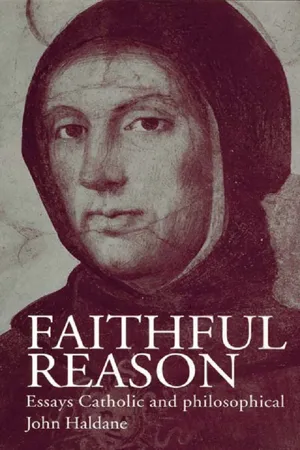
In Faithful Reason, the noted Catholic philosopher John Haldane explores various aspects of intellectual and practical life from a perspective inspired by Catholic thought and informed by his distinctive philosophical approach: 'Analytical Thomism'. Haldane's discussions of ethics, politics, education, art, social philosophy and other themes explain why Catholic thought is still relevant in today's world, and show how the legacy of Thomas Aquinas can benefit modern philosophy in its efforts to answer fundamental questions about humanity and its place within nature. Drawing on a Catholic philosophical tradition that is committed to concepts of the world's intrinsic intelligibility and the objectivity of truth, Faithful Reason's bold and insightful perspectives provide rich matter for debate, and food for further thought.
- 304 pages
- English
- ePUB (mobile friendly)
- Available on iOS & Android
eBook - ePub
About this book
Information
Part I
Catholicism and philosophy
Chapter 1
Thomism and the future of Catholic philosophy1
Introduction
When one takes account of the scale and range of Aquinas's achievements it becomes clear why he deserves to be described as the greatest of the medieval philosopher–theologians, for he was the first thinker of the high medieval period to work out in detail the new synthesis between Catholicism and philosophy. It is sometimes supposed that this just meant ‘Christianizing’ Aristotle. Even were that the limit of his achievement it would have been considerable, but in fact he went further. For while he opposed unquestioning appeals to authority, he believed in the idea of cumulative philosophical and religious wisdom and sought to integrate Neoplatonist, Augustinian and Anselmian ideas, as well as Aristotelian ones, with scripture, patristic teaching and evolving Catholic doctrine.
St Thomas inspired a tradition that bears his name; and just as he was a great thinker, so too is Thomism a great movement. It is rare, and not just among pre-modern systems of thought, in having lasted from the period of its birth to the present day. Platonism and Aristotelianism are more ancient, but neither has enjoyed the same degree of cultural continuity. Marxism has had enormous influence, but it is now all but abandoned, and while there may be positive reassessments of aspects of Marx's thought it is difficult to believe that it will ever again be widely adopted as ideology. Existentialism appears even more ephemeral, like a short-lived literary fashion. Notwithstanding its faltering emergence, and periods of decline or of marginalization, Thomism has been a feature of Catholic thought during seven centuries.
Here I will offer a short history of the movement and consider its present state and possible future development. While I hope that this history will be of some general interest, I am more concerned that readers draw lessons from it. As will emerge, those who have associated themselves with the thought of Aquinas have tended to move in one or other of two directions: towards the goal of faithful interpretation of the original system, or towards that of effective application to contemporary issues. Set at right angles to these movements is another pattern of variation: the rise and fall of Thomistic thought. One lesson, I suggest, is that Thomism has declined when it has ignored, or turned its back on, leading rival philosophies; and a second is that its revivals have generally been the result of engagement with other traditions. A third lesson is that the task of synthesis is promising but difficult. Thomism began as a synthesis of philosophy and theology and versions of it have ended in the tangled wreckage of unworkable combinations. A fourth lesson, following upon these others, is that in there is pressing need for a systematic re-articulation of neo-Thomist thought.
Aquinas and the first Thomism
Aquinas was born (in 1224) into a religious culture whose dominant intellectual tradition was a form of Christian Neoplatonism. The main source of this was St Augustine mediated via later Latin thinkers such as St Anselm. Early in his life, however, and under the direction of Albert the Great, Aquinas developed an intense interest in the more naturalistic philosophy of Aristotle. Works of ‘the philosopher’ were then being translated into Latin for the first time, having been rediscovered through contact with the Arab world where they had been preserved.
To Albert and Aquinas, Aristotle offered a more promising resource for the articulation of Christian doctrine than did the Augustinianism current in the cathedral schools and universities. Yet this new synthesis met with considerable opposition, for it seemed to be at odds with orthodoxy. In fact, St Thomas found himself in dispute with two groups. To one side were the Augustinians represented by the secular teachers and the Franciscans; and to the other were radical Aristotelian naturalists who held doctrines that are indeed difficult to reconcile with Christian orthodoxy. Aquinas sought to tread a middle path directing writings against each group in turn: On the Eternity of the World against Bonaventure and other Augustinian Franciscans, and On the Unity of the Intellect against Siger of Brabant and other Latin Averroists.
Although Aquinas's Christian Aristotelianism was later to be judged the ‘most perfect’ reconciliation of philosophy and faith, its immediate fate was to be attacked and subjected to ecclesiastical denunciation. In 1270 Bishop Tempier of Paris condemned several propositions associated with Aristotelianism, and in 1277, three years after St Thomas's death, he issued a further denunciation in which Thomistic claims were specified, though Aquinas was not named. In the same year Robert Kilwardby, Archbishop of Canterbury and a fellow Dominican, issued a similar condemnation and the following month the Pope endorsed Tempier's decree. Two years later a Franciscan, William de la Mare, produced a work ‘correcting’ the error of Aquinas's ways.
The Dominican response was to defend their master against these attacks. The general chapter appointed a committee to investigate the English Dominican disloyalty, and in the meantime they set about promoting the cause of Thomas as a thinker and as a saint. In 1282 William of Macclesfield responded to de la Mare countering his charges, and around the same time John of Paris produced a similar response. By 1286 the Parisian Dominicans commanded the study of Aquinas and this instruction was repeated elsewhere: in Saragossa (1309), in London (1314) and in Bologna (1315). Defence gave way to counter-attack and on 18 July 1323, within fifty years of his death, Aquinas was declared a saint by Pope John XXII. Two years later Bishop Bourret of Paris revoked Tempier's condemnation.
Ecclesiastical approval removed one obstacle to acceptance of Thomistic thought and his ideas began to spread and gain influence. Apart from their merit, an important factor in this development was the increasing number of colleges and universities. Each approved place of study would have houses belonging to the main teaching orders, and by this means the Dominicans ensured that their master's voice could be heard throughout Europe.
Early in the fifteenth century Aquinas found a powerful follower in the person of John Capreolus (1380–1444). In the late scholastic period the ideas of St Thomas had to compete with those of two other medieval figures, namely Duns Scotus and William of Ockham. Capreolus challenged various views of Scotus to such good effect that he earned the title ‘foremost Thomist’. More common than dialectical defences, however, were informed commentaries on Aquinas's works, in particular the Summa Theologiae. These commentaries were important in transmitting Thomist doctrines, yet in themselves they did little to combat the rising tide of Ockhamist nominalism.
The second Thomism
The next century was the most troubled in the history of post-medieval Christendom. The Reformation divided Europe into Catholic and Protestant states. It would be wrong to suppose that Aquinas was only read by Catholics, for in England the Anglican Richard Hooker (1553–1600), and in Holland the Calvinist Hugo Grotius (1583–1645), were both influenced by studying his work. However, it was within Catholic regions that the next phase of Thomism developed. In particular, Spain and Italy gave rise to new theologically and metaphysically oriented presentations of Thomas's thought. In Protestant Europe reformers drove their axe to the roots of Catholic belief, and in response the Church of Rome set about renewing its intellectual resources. Thus was born the ‘Counter-Reformation’.
The Council of Trent (1545–63) aimed to systematize Catholic doctrine producing a definitive Catechism in 1566 in which the thought of Aquinas had a major influence. Contrary to an oft-repeated tale, however, the Summa Theologiae was not placed on the altar alongside the Bible during meetings of the Council. Trent also encouraged the study of philosophy and theology in all Catholic colleges, seminaries and universities. This created a need for appropriate textbooks, which was met with a new style of manual setting out Thomistic thought. A further response to the reformers was the development of new religious orders. In founding the Society of Jesus, St Ignatius explicitly encouraged the study of Aquinas and Aristotle, and expressed the hope that interpretations of their ideas adapted to the needs of the time would be forthcoming.
In this he was drawing upon the earlier pre-Tridentine tradition of Thomistic teaching and commentary in which the major figures were Dominicans. In the first decade of the century Peter Crockaert (died 1514), a Belgian working in Paris, had substituted the Summa Theologiae for what had previously been the standard text for theological instruction, the Sentences of Peter Lombard. Likewise in Italy, Thomas de Vio Cajetan (1469–1534) was lecturing on the Summa and producing a major commentary later to be published alongside the works of Aquinas. In Spain Francisco de Vitoria (1485–1546) also made the Summa the basis of theological education, and he was followed in this by his disciple Domingo de Soto (1494–1560).
Early Jesuit Thomists included students of de Soto. But the full Jesuit appro-priation of Thomas came later with Luis de Molina (1535–1600) and, most famously, Francisco Suarez (1548–1617). Starting from the need to produce theology adequate to meet that of the reformers, Suarez was led to the conclusion that it was not appropriate just to invoke the philosophy of Aristotle; instead fundamental issues needed to be addressed afresh. The result was a mix of Thomistic and non-Thomistic metaphysics. In fact, Suarez anticipates much of the thinking about essence, existence and identity of late twentieth-century analytical metaphysicians.
The Dominicans meanwhile had stayed closer to the detail of Aquinas's philosophy, in part out of loyalty to a brother who had long been misrepresented and maligned. Their need to evangelize and to educate also led them to produce a line of philosophical and theological textbooks, the most famous of which (still in use into the twentieth century) were those of John of St Thomas (John Poinsot, 1589–1644).
In 1568 Aquinas was named a ‘Doctor of the Church’, only the ninth person to be so honoured, and this led to the familiar title of ‘Angelic Doctor’. By the end of that century there were two main schools of Thomism. The first had its strongest base in Italy, was associated with Dominican textual interpretation, and remained close to the historical doctrines of St Thomas. The second was rooted in Spain, centred around the Jesuit appropriation of Aquinas, and gave rise to treatises on particular philosophical themes.
Inevitably there was competition between these traditions; but the most heated conflict was doctrinal, not interpretative. It ran from around 1590 to 1610 and continued intermittently thereafter. The subject was grace, free will and divine foreknowledge. On the one side the Jesuit Molina argued that God's total omniscience is compatible with human liberty, because God knows what each person would freely do in every possible circumstance of choice, and distributes grace accordingly. In opposition the Dominicans, of whom the most prominent was Dominic Banez (1528–1604), contended that God knows who will be saved and who will be damned because he has distributed fully effective grace to some but not all. The Jesuits accused the Dominicans of Calvinist predestinarian-ism, while the Dominicans charged the Jesuits with Pelagianism.
This ‘heresy-calling’ led the popes to try and tame the debate, though without much success. Meanwhile the energies of Thomists had been largely distracted from the important task of developing the general system so as to take account of the rise of modern science and the new philosophies of rationalism and empiricism. The trial of Galileo (1564–1642) and the replies of Descartes (1596–1660) to his critics show the Thomists to have fallen behind their times. Indeed it was their ill-preparedness to engage modern thought rather than weaknesses within Thomism itself that led to the marginalization of the tradition in the seventeenth and eighteenth centuries.
The fate of Thomism in the latter period also reflected the general situation of the Catholic Church. The century featured many social disruptions and much ecclesiastical infighting. In 1772 the Jesuits were suppressed on the order of the Pope, and in the next decade Catholicism itself was battered by the French Revolution and by the rise of secularism. The new political thinking was anti-theocratic, anti-clerical, broadly democratic, and at best deistic, though often atheist. It is hardly surprising, therefore, that a system of thought born of medieval Catholicism did not flourish in these circumstances. The Dominicans went on producing new editions of St Thomas's writings but it is doubtful whether many other than Dominicans read them. Even in Rome ecclesiastics had lost interest in Thomism.
Neo-Thomism
As in the past, however, a process of revitalization led to a renaissance. Following the French Revolution, Catholic thought in France, Belgium and Italy divided between two movements: one that emphasized the centrality of faith and sought to deal with the threat from rationalism by side-stepping it; and a philosophical approach which maintained, along lines first suggested by Christian Neoplatonists, that the intellect directly intuits God in all its acts of knowledge. These two approaches came to be known as ‘traditionalism’ and ‘ontologism’; their main proponents being Lamennais (1782–1854) and de Maistre (1752–1821), and Gioberti (1801–52) and Rosmini (1797–1855), respectively.
Elsewhere in Italy and in Spain, the Dominicans maintained loyalty to St Thomas. The Italian Tommaso Zigliara (1833–93) found favour with Bishop Pecci of Perugia (later to become Leo XIII), and in 1873 he was appointed Regent of Studies in the Dominican College in Rome where he was joined by Alberto Lepidi (1838–1922). Both men were critical of the traditionalists and the ontologists; and through their writings, teachings and administration did much ...
Table of contents
- Cover
- Half Title
- Full Title
- Copyright
- Contents
- Preface
- Acknowledgements
- Introduction: analytical Thomism and faithful reason
- PART I Catholicism and philosophy
- PART II Faith and reason
- PART III Ethics and politics
- PART IV Education and spirituality
- PART V Beauty and contemplation
- Index
Trusted by 375,005 students
Access to over 1.5 million titles for a fair monthly price.
Study more efficiently using our study tools.
Frequently asked questions
Yes, you can cancel anytime from the Subscription tab in your account settings on the Perlego website. Your subscription will stay active until the end of your current billing period. Learn how to cancel your subscription
No, books cannot be downloaded as external files, such as PDFs, for use outside of Perlego. However, you can download books within the Perlego app for offline reading on mobile or tablet. Learn how to download books offline
Perlego offers two plans: Essential and Complete
- Essential is ideal for learners and professionals who enjoy exploring a wide range of subjects. Access the Essential Library with 800,000+ trusted titles and best-sellers across business, personal growth, and the humanities. Includes unlimited reading time and Standard Read Aloud voice.
- Complete: Perfect for advanced learners and researchers needing full, unrestricted access. Unlock 1.5M+ books across hundreds of subjects, including academic and specialized titles. The Complete Plan also includes advanced features like Premium Read Aloud and Research Assistant.
We are an online textbook subscription service, where you can get access to an entire online library for less than the price of a single book per month. With over 1.5 million books across 990+ topics, we’ve got you covered! Learn about our mission
Look out for the read-aloud symbol on your next book to see if you can listen to it. The read-aloud tool reads text aloud for you, highlighting the text as it is being read. You can pause it, speed it up and slow it down. Learn more about Read Aloud
Yes! You can use the Perlego app on both iOS and Android devices to read anytime, anywhere — even offline. Perfect for commutes or when you’re on the go.
Please note we cannot support devices running on iOS 13 and Android 7 or earlier. Learn more about using the app
Please note we cannot support devices running on iOS 13 and Android 7 or earlier. Learn more about using the app
Yes, you can access Faithful Reason by John Haldane in PDF and/or ePUB format, as well as other popular books in Philosophy & Education Theory & Practice. We have over 1.5 million books available in our catalogue for you to explore.