- 95 pages
- English
- ePUB (mobile friendly)
- Available on iOS & Android
eBook - ePub
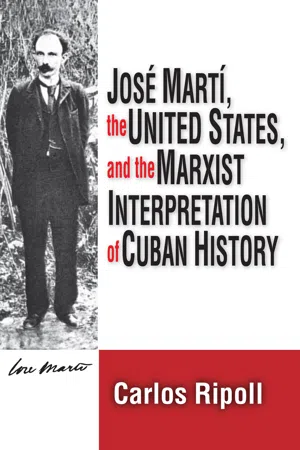
Jose Marti, the United States, and the Marxist Interpretation of Cuban
About this book
This brief volume is an eloquent statement on the meaning of José Martí's thought as well as on how his thought has been harnessed to the needs of ideology in present-day Cuba. Hence, José Martí, the United States, and the Marxist Interpretation of Cuban History should quite properly be viewed as a contribution to the sociology of knowledge, and the political processing of the literature.Professor Ripoll's volume gives special attention to Martí's writings on the United States: without sparing the colonialist and annexationist currents of the times, Martí in his writing demonstrated a full and balanced sense of pluralist currents in the United States.The author sees Martí, in his desire for redemption, as a truer socialist and revolutionary than those who seek to cloak themselves in his words. Because Martí believed freedom to be indispensable for the advancement of society, efforts to hitch Martí to a single ideological post are considered futile.
Trusted by 375,005 students
Access to over 1.5 million titles for a fair monthly price.
Study more efficiently using our study tools.
1 An Introduction to José Martí
Josí Martí was an acute observer of the United States, where he lived for some fifteen years, and is considered one of the great writers of the Hispanic world. His importance for the American reader, however, stems even more from the universality and timeliness of his thought.
Martí devoted his life to ending colonial rule in Cuba and to preventing the island from falling under the control of the United States or a regime inimical to the democratic principles he held. With those goals, and with the conviction that the freedom of the Caribbean was crucial to Latin American security and to the balance of power in the world, he devoted his talent to the forging of a nation. Hence the breadth of his work: he was a revolutionary, a statesman, a guide, and a mentor. And because his vast learning enabled him to move comfortably in the most diverse fields, his teaching is rich indeed.
Martí was born in Havana in 1853. At seventeen he was exiled to Spain for his opposition to colonial rule. There he published a pamphlet exposing the horrors of political imprisonment in Cuba, which he himself had experienced. Upon graduating from the University of Saragossa, he established himself in Mexico City, where he began his literary career. His objection to a regime installed by a military coup led him to depart for Guatemala, but government abuses soon forced him to abandon that country as well. After returning to Cuba under a general amnesty in 1878, he joined in conspiracies against the Spanish authorities that once again led to his exile. Banished to Spain, he quickly left for the United States, and then, after a year in New York, for Venezuela, where he hoped to settle, only to have still another dictatorship force him to depart. Martí lived in New York again from 1881 through 1895, when he left to join the war for Cuban independence that he had painstakingly organized. There he died in one of its first skirmishes.
During the years he spent in the United States, Martí analyzed American society with clarity and insight as a correspondent for the most influential newspapers of Argentina, Venezuela, and Mexico. “In order to know a country,” he wrote, “one must study all its aspects and expressions, its elements, its tendencies, its apostles, its poets, and its bandits.” This he did, and because of his uncompromising honesty, his chronicles contain both criticism and praise that have sometimes been put to improper use. It was the period when the American experiment in self-government and free enterprise was crystallizing, now strengthening, now undermining moral values. Martí roundly censured materialism, prejudice, expansionist arrogance, and political corruption, and enthusiastically applauded love of liberty, tolerance, egalitarianism, and the practice of democracy. Thus, in October 1885, contrasting the opulence and poverty in New York, he warned his readers: “It is necessary to study the way this nation sins, the way it errs, the way it founders, so as not to founder as it does. . . . One must not merely take the statistics at face value but hold them up to examination and, without being dazzled, see the meaning they contain. This is a great nation, and the only one where men can be men, but as a result of conceit over its prosperity and of its inability to satisfy its appetites, it is falling into moral pygmyism, into a poisoning of reason, into a reprehensible adoration of all success.”
Martí’s thought has ethical foundations: as a political theorist and artist he can be understood only in terms of his faith in morality. Every inquiry into the nature of man and his role on earth led Martí to identify good with truth. For him there was no force behind what he considered right unless it had the strength of truth. He believed that “every human being has within him an ideal man, just as every piece of marble contains in a rough state a statue as beautiful as the one that Praxiteles the Greek made of the god Apollo.” To attain the salvation of man the only thing needed, he felt, was to free man from apathy and egotism.
Although given to pure speculation, Martí had an overriding desire to affect reality, and so constantly strove to reduce abstract thought to concrete formulae of conduct. His ability to do so was singular. Martí himself explained the exercise thus: “What proud work could be done by sending forth to face life together three beings who think differently about it: one, like the Brahman and the Morabite, given to the impossible worship of absolute truth, the second to exuberant self-interest, and the third with a Brahman’s spirit restrained by prudent reason and going through life as I do, sadly and sure that no reward will come, daily drawing fresh water from an ever recalcitrant stone.”
How to achieve a functional accommodation of truth, self-interest, and reason was the central question posed by Martí. Although he did not systematize his knowledge and, therefore, left no treatise on political philosophy, his works are replete with ideas on the purpose of the state and its relations to society. He thought it possible to reconcile individual with collective needs and disapproved of all governmental forms that proposed subjecting either, since freedom was for him the only viable climate for human existence: “A nation is made of the rights and opinions of all its children,” he wrote, “and not the rights and opinions of a single class.” He knew that the differences and inequalities among men could not be ignored, but that neither could they be left to the whims of history or the manipulation of a single group. Rather, he recommended correcting the imbalances through “social charity and social concern,” the objectives of which were, he declared, “to reform nature herself, for man can do that much; to give long arms to those whose arms are short; to even the chances for men who have few gifts; to compensate for lack of genius with education.”
Martí’s own example lent validity to his doctrines, and the strength of his style enhanced their effectiveness as political and philosophical instruments. His literary work is an invaluble achievement of expression and is conditioned throughout by moral objectives; the artist and the apostle became inseparable in his work. “In literature one should not be Narcissus but a missionary,” he proclaimed. For Martí aesthetics was but an aspect of ethics: “Man is noble and inclined to what is best. After knowing beauty and the morality that comes from it, he can never after live without morality and beauty.” In his art and as a critic of art he resolutely voiced faith in human perfectibility, a faith in total agreement with his insistence on coupling act with thought.
Insofar as Martí made freedom and justice cornerstones and could never accept curtailment of the natural expansiveness of the human spirit, insofar as he believed, on the contrary, that man’s redemption would come through love and unfettered reason, his doctrine has become subversive in Cuba. However, those who hold power there cannot erase Martí from the minds of his people. They distort and falsify his image, twisting his words or taking them out of context. One of Martí’s most familiar apothegms is: “I want the first law of our republic to be the reverence of Cubans for the total dignity of man.” The Cuban socialist Constitution maliciously incorporates that sentence, but both the Constitution and the system that issued it disregard the remainder of the thought: “Either the republic is built on the character of each one of its children, on their habit of working with their hands and thinking for themselves, on the full exercise of their abilities and respect for the right of others fully to exercise theirs, as if it were a matter of family honor, in short, on a passion for the dignity of man, or the republic is not worth a single tear from one of our women, a single drop of blood from one of our brave men.”
Martí’s teachings controvert the political system that has been implanted in Cuba—the restraint on individual freedom, the intolerance, the materialism, the foreign dependence—just as his writings condemn all despotic regimes and all abridgments of human rights, including the lack of spirituality, mammonism, and arrogance of capitalist society. For this reason, it is of great urgency to disseminate his thought with its full force: his own words speak more eloquently against the Cuban apostasy than all the accusations others might make.
2 José Martí and the American Founding Fathers
Strident partisanship has in recent years brought to the fore those writings in which Martí portrayed the defects and errors of the United States he knew. His harsh indictments of the sectors of this nation debased by arrogance and the abuse of power are quoted often and with unwholesome satisfaction. In this oblique campaign to chastise the guilty, the accusers would obscure that Martí’s anger was aroused rather by the guilt itself For Martí, wrong was universally to be censured and deplored, and his words were ultimately intended to instill and encourage the principles and practice of human decency. What Martí abhorred in this country is quintessential today in some adversaries of this country: nothing here he criticized more severely than the assault on liberty and justice.
Martí admired this nation which, “with imperturbable generosity opened its arms ... to the unfortunate and industrious of the earth,” but he did not love it; his love went out to the South, to the peoples who compose what he piously called Mother America. He saw the hopeful looks cast North by the inexperienced republics in search of guidance, and he feared, correctly, that imitation would lead them astray and that awe would lay open their frontiers to the greed of the very country at which they marveled. And so he used no reserve in uncovering to them “the truth about the United States” and in insisting: “It is necessary to study the way this nation sins, the way it errs, the way it founders, so as not to founder as it does.”
Exiled because of his activities in favor of Cuban independence, Martí arrived in New York for the first time at the beginning of 1875, at the age of twenty-two. Seven years earlier, Spanish officials had sentenced him to hard labor and then banished him from Cuba. Then in Spain he studied at and graduated from the University of Saragossa, whereupon he fled to Mexico, stopping briefly in New York. In Mexico he worked as a journalist until, chagrined at the excesses of those in power, he left for Guatemala, where he began a career as a teacher, only to abandon this country too, shortly after, for similar reasons. It was his second expulsion from Cuba that again brought Martí to the United States, in 1880. Here he lived until 1895, carrying on the struggle to which he had dedicated his life and which led him to his death on May 19 of that year, at the outset of the independence war he had organized. His first employment in New York was as a journalist, and in some of the earliest articles he wrote for The Hour, a magazine devoted to the arts and letters, he left his impressions as a newcomer who had only recently ended years of instability and wanderings: “I am, at last, in a country where everyone looks like his own master. One can breathe freely, freedom being here the foundation, the shield, the essence of life.”
Like no other Hispanic writer of his time, during his fifteen years in this country, Martí came to know and understand the ways and complex problems of U.S. society: the difficulties and the promise created by immigration; the racial prejudice; the burgeoning labor movement; the corruption in politics. For the newspapers of Central and South America he wrote magnificent chronicles on these and other topics as well as portraits of great Americans: Emerson, Whitman, Longfellow; Courtlandt Palmer, the “millionaire socialist”; Henry Garnet, the Black orator “who hated hate”; Peter Cooper, “the friend of man”; Wendell Phillips, “the ardent knight of human dignity.” Martí described the important events he witnessed and everything that in some way could contribute to an accurate and vivid image of the United States, a country that inspired in him both admiration and anxiety. “We love the land of Lincoln, just as we fear the land of Cutting,” he said, summarizing his attitude. In the “sublime offspring of the lowly” he found the embodiment of nobility; in the “shameless reporter and adventurer” who maligned Mexico and espoused annexation of Cuba to the United States, the embodiment of conceit and malice.
When Martí took pen in hand, it was to enhance his subject, especially when the subject itself was adorned by virtue; and when he wrote in censure, it was with compassion and the sole purpose of bettering the world—never with hate, for few have been so apprehensive as he of that passion he called a poison and a crime. He held at his fingertips every device language and literature offered, and when these were insufficient, he created new and surprising ones, through sheer genius and without the slightest hint of effort or fatigue. And so, through his art were revealed to Spanish America myriad pictures of the United States as a land where the people performed feats worthy of giants but in their hurry seemed a swarm of ants; and through his insight was captured the nation’s spirit in the strength of a hero or the smile of a child. The aged Domingo Faustino Sarmiento, who at the peak of his fame had Martí’s “North American Scenes” read to him so that he could savor their inexhaustible expressive wealth, said: “In Spanish, there is nothing that compares with the swell and roar of Martí’s prose, nor has anything comparable to his metallic resonance come out of France since Victor Hugo.”
While totalitarian regimes are continually making Martí’s works available to their people in their native tongues, falsifying through hushed censorship and abridgement their meaning and intent, only a handful of Martí’s works has been properly translated into English. The integrity of the texts must be restored and their translation encouraged; as Emil Ludwig has said, were they accessible to readers throughout the world, “they alone would suffice to make of Martí a source of leadership and guidance for our times.” For the United States, Martí’s writings have the added significance of providing, through an astute outsider’s eyes, a critique of past errors and still-ingrained flaws, and a reminder of the treasures that must be appreciated and safeguarded.
“The Apostles of Philadelphia”
Martí engraved in his memory every turn that history made, and he applied its lessons to the plight of Cuba. His first printed words about the revolutionary period were written in Mexico during the centennial of the American Declaration of Independence. There, news reached him of the celebrations in New York, where many of his compatriots lived, like him refugees from Spanish tyranny. On July 4, they marched with the Cuban flag, and their gesture was hailed by sympathetic American observers. Martí took note of the occurrence in an article for Revista Universal: “As the symbol of the heroic Antillean island was carried on the long parade, it was greeted not with applause, but with ovations. Does the blood shed valiantly by a people seeking freedom deserve less from a sister nation than cheers of affection and love? What nation, itself the offspring of oppression, is not moved and made proud by the exalted emblem of an energetic and revered people in whose glory are mirrored its own past glories?”
In the United States Martí found the cradle of liberty in the Americas, so he set himself to studying it. He inquired how and why the throne of freedom had been built and secured here, for he wanted to enthrone freedom in his native land. “Freedom is the Mother of the earth,” “the essence of life,” “the definitive religion,” he said, and he sought to understand the progeny, the doctrines, and the rituals that made freedom flourish. But beside it, he found slavery: “In 1620 the Mayflower carried the pilgrims to Plymouth, and in 1620 a Dutch ship carried twenty African slaves to Virginia.” And so he was careful in his analysis to separate the two seeds, to set apart the Declaration of Independence from the federal Constitution. The former was for Martí “the genuine expression of the lofty spirit that moved the heroes and the preachers of liberty, that did battle in Bunker Hill and triumphed in Yorktown.” But in the pacts of 1787 among the states, along with the precepts to ensure liberty, he saw guaranteed the iniquitous institution of bondage.
In his evocations of the revolutionary period, Martí captured the excitement awakened by Thomas Paine’s Common Sense and the animation created in Philadelphia by the arrival of the delegates to the Second Continental Congress, from Pennsylvania, Virginia, the Carolinas, New York, and the rest of the thirteen colonies. He portrayed with equal measures of humanity and immortality the outstanding figures of the moment. Franklin was the “humble man,” the “austere ambassador” to the French court “who entered the king’s palace dressed in the modest garb of democracy, and spoke and triumphed with the language of liberty.” He described Jefferson, “who had sworn eternal hostility to all forms of slavery,” drawing up the draft of the Declaration, his tiny script “that of a soul contracted in its labors to strike in the hearts of men, like a flagstaff in its base, the ideas with which nations should be formed.” He drew attention to the words so carefully chosen to convey those principles: “We hold these truths to be self-evident: that all men are created equal, that they are endowed by their Creator with certain inalienable rights, that among these are life, liberty, and the pursuit of happiness.” Never before had such brilliant thoughts been pronounced upon the foundation of government among men. As Samuel Eliot Morison has rightly said: “These words are more revolutionary than anything written by Robespierre, Marx, or Lenin, more explosive than the atom, a continual challenge to ourselves, as well as an inspiration to the oppressed of all the world.”
Martí studied the Constitution through the two-volume History by George Bancroft, whom he admired as an historian but reproached as the secretary of the navy under whose administration California was taken from Mexico. In an article he wrote for the Buenos Aires newspaper La Nación in 1877, Martí borrowed from Bancroft’s account to render his own of the lively debates at the convention and of the conflicting interests that had to be reconciled for the federation to be formed: the South’s differences with the North, the farmers’ with the industrialists, the big states’ with the small, the slave states’ with the free. And with a few details he characterized the delegates: Hamilton, “the impetuous aristocrat”; Madison, “precise and forthright,” “learned in letters and a scholar of history”; Governor Morris, “a graduate from Kings College” a...
Table of contents
- Cover Page
- Title Page
- Copyright
- Contents
- Acknowledgments
- Preface
- 1. An Introduction to José Martí
- 2. José Martí and the American Founding Fathers
- 3. José Martí and the Marxist Interpretation of Cuban History
- 4. Martí Studies and Control of the Cuban Past
- 5. “Inside the Monster”: Martí and the United States
- 6. José Martí and Socialism
- Name-Title Index
- Subject Index
Frequently asked questions
Yes, you can cancel anytime from the Subscription tab in your account settings on the Perlego website. Your subscription will stay active until the end of your current billing period. Learn how to cancel your subscription
No, books cannot be downloaded as external files, such as PDFs, for use outside of Perlego. However, you can download books within the Perlego app for offline reading on mobile or tablet. Learn how to download books offline
Perlego offers two plans: Essential and Complete
- Essential is ideal for learners and professionals who enjoy exploring a wide range of subjects. Access the Essential Library with 800,000+ trusted titles and best-sellers across business, personal growth, and the humanities. Includes unlimited reading time and Standard Read Aloud voice.
- Complete: Perfect for advanced learners and researchers needing full, unrestricted access. Unlock 1.5M+ books across hundreds of subjects, including academic and specialized titles. The Complete Plan also includes advanced features like Premium Read Aloud and Research Assistant.
We are an online textbook subscription service, where you can get access to an entire online library for less than the price of a single book per month. With over 1.5 million books across 990+ topics, we’ve got you covered! Learn about our mission
Look out for the read-aloud symbol on your next book to see if you can listen to it. The read-aloud tool reads text aloud for you, highlighting the text as it is being read. You can pause it, speed it up and slow it down. Learn more about Read Aloud
Yes! You can use the Perlego app on both iOS and Android devices to read anytime, anywhere — even offline. Perfect for commutes or when you’re on the go.
Please note we cannot support devices running on iOS 13 and Android 7 or earlier. Learn more about using the app
Please note we cannot support devices running on iOS 13 and Android 7 or earlier. Learn more about using the app
Yes, you can access Jose Marti, the United States, and the Marxist Interpretation of Cuban by Carlos Ripoll in PDF and/or ePUB format, as well as other popular books in History & Historiography. We have over 1.5 million books available in our catalogue for you to explore.