- 493 pages
- English
- ePUB (mobile friendly)
- Available on iOS & Android
eBook - ePub
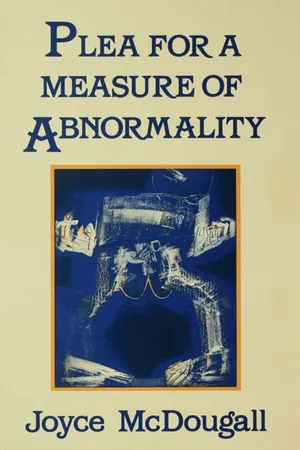
Plea For A Measure Of Abnormality
About this book
First published in 1993. Within this classic volume can be heard the wise and compassionate voice of an analyst in constant motion, carefully and respectfully mapping new territories in the understanding of the human psyche. Dr. McDougall is vigilant in her attention to the ongoing dialogue between the patient's inner drama and her own internal world, not willing to stay planted safely in the realm of existing precepts, favoring instead a position of evolving creativity. At the center of this fascinating book stand Dr. McDougall's patients -those individuals labelled abnormal by some, but who, for the author, represent the most challenging encounters. Exploring such topics as The Sexual Scene and the Anonymous Spectator, Creation and Sexual Deviation, The Psychosoma and the Psychoanalytic Process, and Plea for a Measure of Abnormality, Dr. McDougall celebrates the wide range of human difference. In the author's words: This book contains a trajectory of reflection on the experience I have shared with my analysands over a period of years, for the psychoanalytic adventure, like a love affair, requires two people. At the foundation of her work, then, is the need to call into question again and again not only the psychoanalyst's skill, but her identity. This book reveals both the human and practical imperative behind that commitment.
Trusted by 375,005 students
Access to over 1.5 million titles for a fair monthly price.
Study more efficiently using our study tools.
Information
Chapter IX
The Psychosoma and the Psychoanalytic Process
The difficulties of being human oblige us to create an infinity of psychic structures to bind or in some way cope with the inevitable physical and mental pain we are going to encounter. We have to start doing this shortly after birth and are only able to do it because of a unique phylogenetic heritage: the capacity for symbolic functioning. Most of our psychic pain is occasioned on the path to acquiring individual status and personal identity followed by the acquisition of our sexual identity. Freud was the first to emphasize the essentially traumatic nature of human sexuality, while Klein and her disciples have thrown light on the earlier traumas inherent in the process of separating one's image from that of the primordial Other in order to become a person. We must find answers early on to the conflicting claims of instinctual life and reality demands these processes bring in their wake, and for the rest of our lives much of our psychic energy will be directed toward maintaining the solutions we have found. Some of these solutions make life a creative adventure; others are maintained at the expense of psychic, and eventually somatic, well-being.
Anthropologists such as Levi-Strauss postulate that sexual laws of some kind are inherent in any social structure in that they are the minimal requirement for distinguishing a social group from a herd, such as may be found in brute nature. In psychoanalytic theory, insight into the complexities of social and sexual integration is attained through the concept of the Oedipus complex, of castration anxiety, and of the symbolic structures to which they refer. These relatively sophisticated structures are intricately bound up with language and indeed could not exist without it. Beyond them lies the darker, infraverbal and pregenital area, less weighted semantically (leading Freud to designate this the prehistoric part of the individual's psychic story). In this early phase, psyche and soma might appear to coincide, although the extensive charting of these laboriously mapped areas of the mind (the principal cartographers after Klein being Winnicott and Bion) tend to show that the psyche grows out of the soma almost from birth. To attain the primitive psychosomatic level of existence is rather like trying to recreate the experience of original awareness, as mystics do. Any research into psychosomatic pathology must struggle with the unknowns of this early phase of psychic functioning. The psychic material that enters into the primordial fusion of mother and nursling is composed of smells, sounds, and visual and tactile sensations. These are in themselves despatializing factors, and this no doubt favors the setting in motion of one of the earliest of psychic mechanisms, subsumed under the concept of projective identification. These mechanisms will dominate until such time as language spatializes and limits the psychic structure, thus delimiting the inner and the outer world, while at the same time the infant begins to inhabit his soma. He becomes embodied. Little Oedipus comes to terms relatively late with the problems caused by the difference between the sexes, the narcissistic mortification of the primal scene, and the relinquishment of his erotic and aggressive incestuous wishes. We are concerned here with the much smaller Narcissus who must come to terms with the definitive loss of the magical breastmother and with the ineluctable demand to create psychic objects that will compensate for his loss. His capacity to create the symbolic structures necessary for this achievement will be circumscribed in large part by the limits of his parents’ unconscious fears and desires. The mythical moment in which the fusional identity with the mother is relinquished requires a mother who herself is prepared to accept the loss of the magical union. This loss might be considered as the primordial castration in an individual's life. Many parents, through intense narcissistic identification with their young, tend to spare them the inevitable confrontation with reality beyond the point demanded by their immaturity. The anxieties to which this primal separation give rise are usually qualified by terms such as annihilation and disintegration, and in turn might be conceived of as the prototype of castration anxiety proper. Once again it is a global menace. Frustration, anxiety, and conflict have not yet become symbolically attached to the sexual organs.
The inherent difficulty facing the infant in his task of becoming an individual is of a more global, more “psychosomatic” nature than the problems encountered in coming to terms with sexual realities. Failure to sort oneself out from the “not-me” environment and so to create a sense of personal identity produces more catastrophic results than does a similar failure in the acquisition of sexual identity and the rights that belong with it. Yet such catastrophic failure does not necessarily result in a startling psychosis. It may go unnoticed while its insidious effects continue, silently, like the Freudian death instinct. When this occurs, body and mind have somehow lost their connecting links.
In the earliest attempt to deal with physical pain, frustration, and absence psychically, we have the first “mysterious leap” from body to mind. We know very little about it. Considerably more knowledge has been garnered by psychoanalysis about that still more mysterious leap in the other direction, the leap from mind to body which underlies hysterical conversion and the various inhibitions of bodily functioning. Long before such complicated psychic creations are available, the baby must first have been induced to live by his mother, for herein lies the initial movement that stirs the first glimmerings of psychic life. This much we know: the structuring of the psyche is a creative process destined to give each individual his unique identity. It provides a bulwark against psychic loss in traumatic circumstances and, in the long run, in man's psychic creativity may well lie an essential element of protection against his biological destruction.
This brings me to the first point of this chapter: the importance of man's innate capacity for symbolic activity and psychic creation, in particular, the heterogeneous character of these creations. In the attempt to maintain some form of psychic equilibrium under all circumstances, every human being is capable of creating a neurosis, a psychosis, a pathological character pattern, a sexual perversion, a work of art, a dream, or a psychosomatic malady. In spite of our human tendency to maintain a relatively stable psychic economy and thus guarantee a more or less enduring personality pattern, we are liable to produce any or all of these diverse creations at different periods in our lives. Although the results of our psychic productions do not have the same psychological, nor indeed the same social value, they all have something in common in that they are the product of man's mind and their form is determined by the way his psyche has been structured. They all have inherent meaning in relation to his wish to live and to get along as best he can with what life has dealt out to him. From this point of view it is evident that the psychosomatic creations appear the most mysterious since they are the least appropriate to the over-all desire to live. If their psychological function is conspicuous by its absence, their biological meaning also eludes us. In many respects they are the antithesis of neurotic or psychotic manifestations. Indeed it is frequently when the latter cease to function that psychosomatic (as opposed to psychological) illness declares itself. My reflections on this particular phenomenon have been much enriched by the extensive research into psychosomatic illness carried out by my colleagues in the Paris Psychoanalytical Society. I refer in particular to the works of Marty, Fain, David and de M'Uzan. My personal interest in psychosomatic symptoms and their relation to symbolic processes has come from a different direction, which I hope will become clear.
My second point is that man's irrepressible psychic fertility of whatever order is coexistent with life itself. If we admit that something like psychic death may occur, then it is possible that when psychic creation falters or comes to a halt man may be threatened with biological death. The psychic processes that create and maintain psychic health as well as those responsible for maintaining psychic ill-health are nevertheless on the side of life. When we, for any reason, fail to create some form of mental management to deal with psychic pain, psychosomatic processes may take over.
This brings me to my final point. The psychoanalytic process is itself a creative one in that it re-establishes separated links and also forges new ones. Like our psychological creations, these links too are of a heterogeneous nature: liaisons between past and present, conscious, preconscious, and unconscious, affect and representation, thought and action, primary and secondary processes, body and mind. I would suggest that psychoanalytic processes are the antithesis of psychosomatic processes. Psychosomatic transformations pose special problems in the course of an analysis, and it may be that they demand a different approach from that required to understand the neurotic parts of the personality. I do not wish to suggest that there are special “techniques” for dealing with man's different psychic manifestations, but simply that further insight into the processes at work may alter our way of listening to our patients. Itten, in his remarkable book on color and painting (1961), writes of artists in words that might apply equally to the intuitively creative aspects of the analyst's task: “Doctrines and theories are best for weaker moments. In moments of strength problems are solved intuitively, as if of themselves.” So is it with analytic work. Itten goes on to say, “If you, unknowing, are able to create masterpieces in color, then un-knowledge is your way. But if you are unable to create masterpieces out of your un-knowledge, then you ought to look for knowledge.”
The rest of this chapter will be concerned with background material, theoretical and clinical, to elucidate the above points. My hope is to contribute to our knowledge of the silent messages of the body and to stimulate reflection on our intuitive understanding of the psychosoma, so that we may come to know better what we have done, unknowing.
Psychosomatic man
Research into the meaning and treatment of psychosomatic illness is at the crossroads of various scientific disciplines. Although I shall give a bird's-eye view of the psychosoma and the use of the term psychosomatic, I can describe only that picture which may be obtained through the psychoanalytic microscope. This instrument is a highly specific one, concerned with psychical and symbolic functioning rather than somatic transformations; in addition, the latter are objects of study for which it was not originally conceived. Furthermore, from a research point of view, psychoanalytic case sampling can scarcely be called unselected. In the first place, people suffering from disorders of psychosomatic origin seek a physician rather than an analyst for their somatic ills —unless of course they consider they have psychological problems as well. Sometimes, however, patients who are unaware of suffering from psychological symptoms do turn up in the analyst's consulting room, complaining, for example, of gastric symptoms or cardiopathology, because a psychoanalytic or psychiatric consultation has been suggested by the physician. In these cases opinion among analysts would be sharply divided as to whether such a request should be met with an offer of psychoanalytic help. Some would consider full-scale analysis to be the best available treatment if allied to appropriate medical care. Others would advocate a modified form of analytic psychotherapy. Others again would consider the project to be fraught with danger and would regard the presenting symptoms, if unaccompanied by any neurotic manifestations, as a counterindication for analysis.
The fact of the matter is that the analyst is rarely given the choice. Not only will he find himself constantly confronted with psychosomatic behavior of a general kind in all his analysands, he will also discover that a considerable number of his patients, whether he wishes it or not, suffer from authentic psychosomatic disorders. These may range from allergic skin disorders, bronchial asthma, hyperthermic states, and hypertension to peptic ulcers and ulcerative colitis. This frequency is in no way due to a preponderance of psychosomatic pathology among psychoanalytic patients. Psychosomatic manifestations affect analysts as well, and indeed must be regarded as a common phenomenon in the population at large. If we include in our considerations the psychosomatic aspect of increased sensitivity to infectious diseases and the psychological problems of the accident-prone, we shall be obliged to recognize that most of our patients, as well as our friends and colleagues, suffer at one time or another from psychosomatic manifestations. In my own analytic practice, although no patient has ever come to me specifically for his psychosomatic troubles, I have had, over the years, twelve analysands who at some time in their adult lives had contracted plumonary tuberculosis, in circumstances which left little doubt as to the important part played by psychological factors. I have had many patients with gastric dysfunctions of varying severity, including two with a serious history of peptic ulcers. Bronchial asthma has been the lot of several others, and I have had the usual run of patients suffering chronically or intermittently from urticaria, hay fever, eczema, and the like. The psychological problems raised by the somatic symptoms of these patients have given me much food for thought, particularly when I felt I had uncovered certain features in common among them. The analyst cannot but feel that psychosomatic man is a challenge to his understanding of the psychological determinants of physiological symptoms.
In addition to the ubiquitous nature of psychosomatic disorders, it should be added that they are often resistant to cure, whether approached from the physiological or the psychological direction. Yet, psychosomatic patients suffering from grave symptoms do get better, and frequently as a result of psychoanalytic help when all else has failed. Let us add in passing the common clinical observation that people who have had several years of analysis find their susceptibility to colds, influenza, headaches, stomach aches and such like, dramatically reduced as the analytic work progresses. Why this should be so, and whether it is our treatment that cures them, is another matter!
Psyche and soma in psychoanalytic theory
The uses and abuses of man's body by his mind are so varied and so extensive that it is well to define what we mean by the term “psychosomatic,” and to delineate in particular the distinction between psychosomatic disorders and hysterical or other somatic manifestations. We might recall that Freud designated two types of somatization: conversion hysteria and actual neurosis. In a sense one was the antithesis of the other. Whereas in hysterical conversion we witness the “mysterious leap” from mind to body, in the concept of the actual neuroses there is a leap in the opposite direction, from the somatic to the psychic sphere. In either case an invisible barrier is crossed. The problems raised by this transition have, to this day, lost little of their mystery.
Although “actual neurosis” as a nosographic entity is little used nowadays, it is pertinent to our inquiry to note, as Laplanche and Pontalis (1973) have pointed out, that in Freud's conception the “actual” symptoms (neurasthenia and anxiety neurosis) were principally somatic ones. Being of a physiological order, they were considered by Freud to be devoid of symbolic meaning and therefore not truly within the scope of psychoanalytic treatment. Freud's belief that the actual neuroses are brought about as a reaction to actual everyday tension, and in particular to the blockage of libidinal satisfactions, is closely related to certain modern conceptions of psychosomatic reactions, though today the notion of psychic “pressure” would lay equal emphasis on the blockage of aggressive impulses and on all that might be subsumed under the term of environmental stress. Freud considered that conversion hysteria and actual neurosis both arose from sexual sources, but whereas the latter was related to present-day sexual problems, the former stemmed from the sexual conflicts of early childhood, and the physical symptoms retained their symbolic significance, i.e., they appeared in the place of instinctual satisfaction and were in essence a symbolic solution to an unconscious conflict and not a reaction to frustration. It is evident that the “somatic” symptoms of conversion hysteria are symbolic in that they refer to a fantastic body in the literal sense of the word, a body functioning as a small child might imagine, or a fantasy body such as might be contrived by primary-process thinking.
After the construction of his topographical model, Freud also came to consider hysterical conversion and hysterical identification as ego defenses. In this way were added to the well-known list of hysterical symptoms those that use the body to translate inhibitions of id impulses as a reaction to the repressive forces of ego and superego. Thus inhibitions of bodily functioning such as constipation, impotence, frigidity, psychogenic sterility, anorexia, insomnia, and so on have come to be considered as closely allied to classical conversion symptoms. In every case the symptom tells a story. Once decoded, the story always reveals the hero to be a guilty victim of forbidden wishes who has met setbacks on the pathways of desire. His symptoms might be said to result from the combined effects of his unconscious fantasy life and the structure of his ego defenses. These symptoms, of indubitable psychogenic origin, do not form part of what is denoted by the term psychosomatic. We might say that in hysteria the body lends itself and its functions to the mind to use as the mind wills, whereas in psychosomatic illness the body does its own “thinking.” The drama being expressed is a more archaic one, and its elements have been stored differently. The symptoms are signs, not symbols, and follow somatic and not psychic laws. Unlike the hysterical dramatizations, the thinking of the soma is carried out with, sometimes literally, deadly precision. The recurring character of science fiction, the mechanized robot who takes over, without a shred of emotion or identification with human wishes and conflicts, is a pristine image of the workings of the psychosomatic symptom. The soma is no longer concerned to translate the wishes of the psyche as in neurotic illness. If we attempt to define the area covered in today's terminology by the word psychosomatic we might say that this term is reserved for organic disorders of demonstrable physiological dysfunction. Although they have no apparent symbolic significance, they appear nevertheless to be linked with the patient's personality structure, life circumstances, and history, i.e., they declare themselves in connection with situations of stress arising either from within the individual or from his immediate environment. The psychosomatic sufferer, however, is rarely aware of any such connections and is frequently unaware of being under any particular stress. This definition, though extremely vague, serves to distinguish such disorders from hysterical manifestations in which there is neither physiological lesion nor infection, and also from organic illness in which no links with the personality or to environmental stress are apparent.
At this point we come back to the fact that the mental and the physical are indissolubly linked, yet essentially different. The psychosoma functions as an entity. There is little doubt that every psychological event has its effect on the physiological body just as every somatic event has repercussions on the mind, even if these are not consciously registered. Industrial research has produced convincing statistics to demonstrate that people are more apt to fall ill, need operations, or have accidents when they are feeling depressed or anxious than when they feel fulfilled or optimistic about their lives. Indeed one does not have to be a psychoanalyst to recognize that there is a relationship of contiguity between the psychological and the biological events in any given individual's life. This type of intuitive knowledge is within the scope of the porter's wife or somebody's grandmother. “No wonder he had that car accident after all the trouble they've had with the family,” and “Naturally she came down with the Hong Kong flu straightaway after the ac...
Table of contents
- Front Cover
- Half Title
- Title Page
- Copyright
- Contents
- Preface to the 1990 Edition
- Preface
- I The Sexual Scene and the Anonymous Spectator
- II The Primal Scene and the Perverse Scenario
- III The Homosexual Dilemma: A Study of Female Homosexuality
- IV Masturbation and the Hermaphroditic Ideal
- V Creation and Sexual Deviation
- VI The Anti-Analysand in Analysis
- VII Countertransference and Primitive Communication
- VIII Narcissus in Search of a Reflection
- IX The Psychosoma and the Psychoanalytic Process
- X The Body and Language and the Language of the Body
- XI Psychic Pain and the Psychosoma
- XII Three Heads and Three Bodies
- XIII Plea for a Measure of Abnormality
- References
Frequently asked questions
Yes, you can cancel anytime from the Subscription tab in your account settings on the Perlego website. Your subscription will stay active until the end of your current billing period. Learn how to cancel your subscription
No, books cannot be downloaded as external files, such as PDFs, for use outside of Perlego. However, you can download books within the Perlego app for offline reading on mobile or tablet. Learn how to download books offline
Perlego offers two plans: Essential and Complete
- Essential is ideal for learners and professionals who enjoy exploring a wide range of subjects. Access the Essential Library with 800,000+ trusted titles and best-sellers across business, personal growth, and the humanities. Includes unlimited reading time and Standard Read Aloud voice.
- Complete: Perfect for advanced learners and researchers needing full, unrestricted access. Unlock 1.5M+ books across hundreds of subjects, including academic and specialized titles. The Complete Plan also includes advanced features like Premium Read Aloud and Research Assistant.
We are an online textbook subscription service, where you can get access to an entire online library for less than the price of a single book per month. With over 1.5 million books across 990+ topics, we’ve got you covered! Learn about our mission
Look out for the read-aloud symbol on your next book to see if you can listen to it. The read-aloud tool reads text aloud for you, highlighting the text as it is being read. You can pause it, speed it up and slow it down. Learn more about Read Aloud
Yes! You can use the Perlego app on both iOS and Android devices to read anytime, anywhere — even offline. Perfect for commutes or when you’re on the go.
Please note we cannot support devices running on iOS 13 and Android 7 or earlier. Learn more about using the app
Please note we cannot support devices running on iOS 13 and Android 7 or earlier. Learn more about using the app
Yes, you can access Plea For A Measure Of Abnormality by Joyce Mcdougall in PDF and/or ePUB format, as well as other popular books in Psychology & Mental Health in Psychology. We have over 1.5 million books available in our catalogue for you to explore.