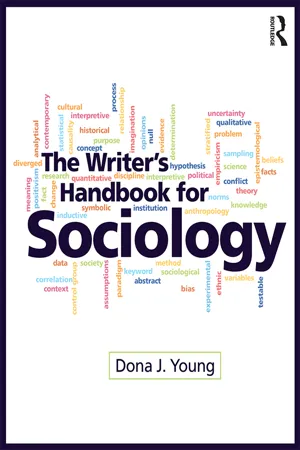
The Writer's Handbook for Sociology gives students the tools that they need to develop evidence-based writing skills and format academic papers in American Psychological Association (APA) and American Sociological Association (ASA) style. This book helps learners develop a reader-friendly writing style incorporating active voice, parallel structure, and conciseness. In addition, grammar and mechanics are presented in a systematic way to facilitate learning, helping students fill learning gaps.
- 458 pages
- English
- ePUB (mobile friendly)
- Available on iOS & Android
eBook - ePub
The Writer’s Handbook for Sociology
About this book
Information
Part 1
Writing in Sociology
Chapter 1
Purpose, Voice, and Viewpoint
Academic writing is challenging, even for those who have developed excellent composition skills. That’s because academic writing is scholarly writing and embraces a unique set of demands and expectations beyond skills developed in other types of writing.
For example, academic writing is evidence-based: writers use research to support their claims, arguments, and outcomes and must meticulously cite their sources. In addition, academic writing applies elements of style such as third-person viewpoint and active voice, which take conscious effort to apply until you develop your academic voice. In sociology, you also have other requirements, such as applying guidelines from citation systems, such as those of the American Psychological Association (APA) and the American Sociological Association (ASA), which are briefly discussed in this chapter and in various chapters throughout the book.1,2
In fact, until you become familiar with writing in sociology, you may feel like a novice writer all over again, even if you have well-honed skills. By developing expertise with purpose, voice, and viewpoint, you are building core skills in evidence-based writing: these skills support you in developing a writing style that meets the expectations of any audience, including your professors, the publishers of scholarly journals, and potential employers.
This chapter reviews the types of writing in sociology and how to adapt your writing for your audience to achieve effective results. From the chapters that follow, you will gain additional understanding and skill in evidence-based writing as well as APA and ASA citation styles. Even if you do not plan to become a professional sociologist, these skills will serve you well in all areas of your studies and throughout your career.
When you have completed this chapter, you will be able to:
- Understand how academic, professional, and reflective writing differ.
- Analyze purpose to determine audience, voice, and viewpoint.
- Adapt your voice for an academic audience.
- Apply APA and ASA guidelines for pronoun viewpoint, voice, and verb tense.
- Understand the difference between a thesis statement and a hypothesis.
- Write a purpose statement, a thesis statement, and an introductory paragraph.
- Discuss the relationship between voice and plagiarism.
As you review this chapter, understand that adapting your writing for your audience is an element of editing, not composing. In Chapter 2, “Process, Strategy, and Style,” you will review the writing process and the importance of separating composing from editing. Thus, as you compose, do not expect yourself to write in a specific style or from a specific viewpoint: apply principles to shape your words when you edit. Let us get started by exploring purpose as it applies to academic, professional, and reflective writing.
Purpose
When you think of writing in sociology, the challenges of writing a paper probably come to mind—writing a paper can feel like a daunting task, even if you are not doing original research or submitting your paper for publication. However, in sociology, other types of writing are also important, and you will be at an advantage if you become proficient in the style of each: academic writing, professional writing, and reflective writing.
Academic Writing
Academic writing is evidence-based writing, and the most formal type of writing. Academic writing involves taking ideas and concepts apart: analyzing data, decisions, positions, and actions, as well as asking questions in a dispassionate, non-adversarial way. As a professional sociologist, you learn to remove bias, such as beliefs and opinions, from your writings. When you write a paper, you base your findings on research, fact, and logic.
Evidence-based academic writing tasks in sociology include the following:
- Research papers
- Arguments and summaries
- Case studies
- Participant-observation studies
- Abstracts and synopses
- Surveys and research design
Academic writing is complex because it involves the following:
- Knowing content or subject matter well enough to summarize in your own words
- Analyzing, synthesizing, and evaluating concepts
- Applying basic writing skills such as grammar, punctuation, word usage, and more
- Applying editing skills to reshape and revise for purpose, clarity, and structure
According to the taxonomy of educational objectives, a learner must understand and be able to apply information before being able to analyze, synthesize, or evaluate it.3 Thus, when you get stuck with your writing, consider if the barriers that you are facing are due to not yet understanding the content well enough to write about it. At those times, read and re-read to deepen your understanding. Then reflect on what you have read and recollect key points, jotting them down in your own words. Critical reading is a precursor to critical writing; so when your writing does not flow well, identify what is holding you back and take the action you need to fill the learning gap.4
This book assists you in filling learning gaps in your composing and editing skills, and gives you structure for writing academic papers. Here’s how to make real progress:
- Practice principles until you can apply the new learnings to your own writing
- Throughout the process, use writing as a learning tool by summarizing key points in your own words
Whenever you feel stuck, do what you need to do so that you can move forward—if you don’t know what that is, discuss your topic with a friend.
Professional Writing
When you write a message to a professor or a colleague, you provide information, pose questions, and offer your views. In contrast to evidence-based writing, professional communication may include opinions and beliefs. In addition, professional writing involves developing relationships built on respect and trust: for professional writing, context is important, and relationships help define context. Though professional writing might sound easy compared to academic writing, knowing audience expectations and applying protocol makes a difference in the results you achieve.
Professional writing tasks include the following:
- E-mail messages
- Proposals
- Letters and memos
Reflective Writing
As you work on projects and conduct research, keep track of your insights and observations as well as sources for your research. Though reflective writing can be personal, anything that you write about your professional activities has important implications beyond your personal use. The following are examples of reflective writing:
- Notes
- Work journals
- Blogs
Each of these types of writing is explored in more depth in this chapter and throughout this book. Next, let us examine voice and how viewpoint relates to each type of writing.
Your Voice and Viewpoint
Voice is a powerful element of all writing. By becoming mindful of voice, you gain the ability to control the tone of your writing: using an effective tone shows respect for your readers, and you receive a better response from them. You see, to reach your audience, you must adapt your voice to meet their expectations.
In fact, your writing already spans a broad spectrum from casual to formal: think of the difference between the way that you write a text message to a friend and the way that you write an e-mail message to a professor. Now think of the kind of language that you use when you write a paper. Do you notice that you already use a different voice for each type of writing?
A starting point for understanding voice is pronouns.
Pronouns
First-Person or "I" Viewpoint
Use the first-person viewpoint when you are speaking from your own understanding and experience. When speaking from your own perspective, using “I” is a natural part of the writing process. (Note that the personal pronoun “I” is always capitalized.)
Second-Person or "You" Viewpoint
Use the second-person viewpoint when you intend to speak directly to your readers (or audience); for example, “You may be asked to chair the committee.”
Third-Person Viewpoint
Use third-person viewpoint to convey information from an “outside” viewpoint or another’s point of view; for example, “The research demonstrates the need for additional funding.”
Since writing in sociology involves reflective, professional, and academic writing, here is how pronouns are used in each type of voice:
Reflective Voice
Write from your reflective voice for journals, notes, and blogs. For reflective writing that is personal, write in whatever style you wish. When you are expressing your feelings and opinions, you naturally speak from the I viewpoint.
Another purpose of reflective writing is to keep track of events and record your thoughts, at times in ...
Table of contents
- Cover
- Half Title
- Title
- Copyright
- Dedication
- Contents
- Part 1 Writing in Sociology
- Part 2 Editing for Clarity
- Part 3 Proofreading for Credibility
- Part 4: Quick Guides
- Keys to Activities
- Glossary of Terms
- Index
Trusted by 375,005 students
Access to over 1.5 million titles for a fair monthly price.
Study more efficiently using our study tools.
Frequently asked questions
Yes, you can cancel anytime from the Subscription tab in your account settings on the Perlego website. Your subscription will stay active until the end of your current billing period. Learn how to cancel your subscription
No, books cannot be downloaded as external files, such as PDFs, for use outside of Perlego. However, you can download books within the Perlego app for offline reading on mobile or tablet. Learn how to download books offline
Perlego offers two plans: Essential and Complete
- Essential is ideal for learners and professionals who enjoy exploring a wide range of subjects. Access the Essential Library with 800,000+ trusted titles and best-sellers across business, personal growth, and the humanities. Includes unlimited reading time and Standard Read Aloud voice.
- Complete: Perfect for advanced learners and researchers needing full, unrestricted access. Unlock 1.5M+ books across hundreds of subjects, including academic and specialized titles. The Complete Plan also includes advanced features like Premium Read Aloud and Research Assistant.
We are an online textbook subscription service, where you can get access to an entire online library for less than the price of a single book per month. With over 1.5 million books across 990+ topics, we’ve got you covered! Learn about our mission
Look out for the read-aloud symbol on your next book to see if you can listen to it. The read-aloud tool reads text aloud for you, highlighting the text as it is being read. You can pause it, speed it up and slow it down. Learn more about Read Aloud
Yes! You can use the Perlego app on both iOS and Android devices to read anytime, anywhere — even offline. Perfect for commutes or when you’re on the go.
Please note we cannot support devices running on iOS 13 and Android 7 or earlier. Learn more about using the app
Please note we cannot support devices running on iOS 13 and Android 7 or earlier. Learn more about using the app
Yes, you can access The Writer’s Handbook for Sociology by Dona Young,Dona J Young in PDF and/or ePUB format, as well as other popular books in Social Sciences & Sociology. We have over 1.5 million books available in our catalogue for you to explore.